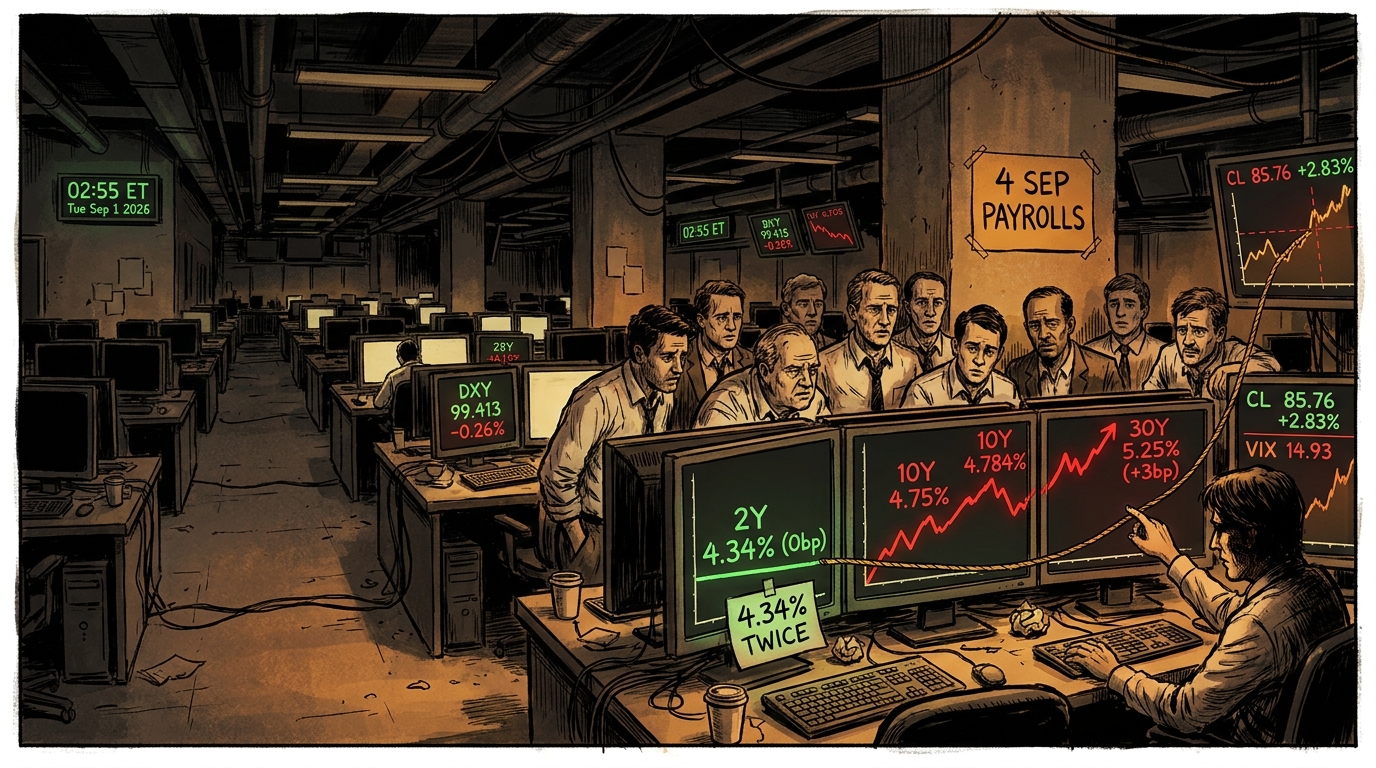
A supply shock moved the 30-year, and left the 2-year exactly where it was
⚓ Weathervane – The wind is still coming from the long end. The policy rate has been frozen at 3.50% to 3.75% since July whilst the term premium does the tightening, and the price of long money is set by deficits, issuance supply and a synchronised global duration bid rather than by the committee. Monday tested that with a genuine energy supply event and the banner came through stronger than it went in. The cruise ship is holding this heading.
 Ahoy there, Trader! ⚓️
It’s Phil…
The central question
If an oil shock is an inflation shock, why did the 2-year not move at all whilst the 30-year did?
The sequence matters. Over the weekend US forces struck 2 Iranian rocket launchers on Larak Island, and Tehran reported strikes on American bases in Jordan. West Texas Intermediate settled Monday at 85.76 dollars, up 2.83%. Brent settled at 90.49, up 2.71%. Visible commodity-vessel traffic through the strait had fallen to 5 ships a day over the weekend.
Now walk the dots. The 30-year constant maturity closed at 5.25%, 3 basis points higher. The 10-year closed at 4.75%, 2 basis points higher, and carried on overnight to 4.784% by half past one Tuesday morning, its highest since early 2025. The 2-year closed at 4.34%, which is precisely where it closed on Friday. The curve steepened from 39 to 41 basis points. The dollar fell 0.26%. Energy was the strongest sector at roughly 2% and utilities the weakest.
The textbook is unambiguous about this. An energy supply shock is an inflation shock. An inflation shock lifts the expected policy path. The expected policy path lives at the front of the curve, so the 2-year should lead and the long end should follow at a discount. That is the ordinary transmission, taught in that order for good reason.
What the tape did was the exact inverse. The long end led, the front end abstained, and the dollar declined to confirm either reading.
So sit with the gap. One explanation is that the market simply does not believe this committee reacts to energy. Another is that it has read this oil shock as a growth tax rather than an inflation impulse, in which case it belongs in term premium and in rate-sensitive equities, which is exactly where it went. The utilities move is the quiet corroboration.
There is a third possibility, and it is the uncomfortable one. Three sessions earlier the same 2-year moved 14 basis points because a Federal Reserve chairman gave a speech that contained no commitment at all. If an instrument reprices for words and not for events, it may have stopped pricing the economy and started pricing the podium. I do not know which of the three it is. Friday’s payrolls print is the next thing capable of telling us.
Phil’s Musing
The bit I keep circling is the asymmetry. Fourteen basis points for rhetoric and nothing for a war is not a market weighing evidence, it is a market that has decided the committee is the only variable worth watching. That holds right up until an event arrives too big to route through a press conference. I am not repositioning on it. I am watching whether payrolls gets a normal reaction.
Happy trading,
Phil
Less Brain, More Gain
…and may your trades be smoother than a cashmere codpiece
P.S. – Phils Footnote I got Monday wrong in yesterday’s read, so let me say so plainly. I had the long end going nowhere, off an intraday quote. The settled Treasury series says it rose 2 basis points at the 10-year and 3 at the 30. That changes the conclusion, not just the number: the long end did follow crude, and it was the front end that sat still.