No. 1 (Manic Monday): Nvidia lost its chief executive, the bond market priced a hike, and stocks did nearly all their work on Monday
 Ahoy there, Trader! ⚓️
It’s Phil…
Markets have a habit of doing their week’s work before anyone has finished reading the news.
This week’s three questions:
- Why did stocks rise 2.51% in a week that priced a Fed hike?
- What did Nvidia losing its chief executive actually cost, and whom?
- Why did oil fall in a week full of Gulf supply scares?
⚓ Weathervane. The wind is coming from the long end: the price of long-term money is set by government borrowing and global demand for bonds, not by the Fed’s committee. This week leaned against that heading without turning it. Short-term rates led, the 2-year Treasury yield up 37bp to 4.88% against 21bp on the 30-year, but only part of the 2-year’s climb traces to a dated Fed speech, and long rates still rose more than half as far. The 20-year still yields more than the 30-year (5.52% against 5.47%).
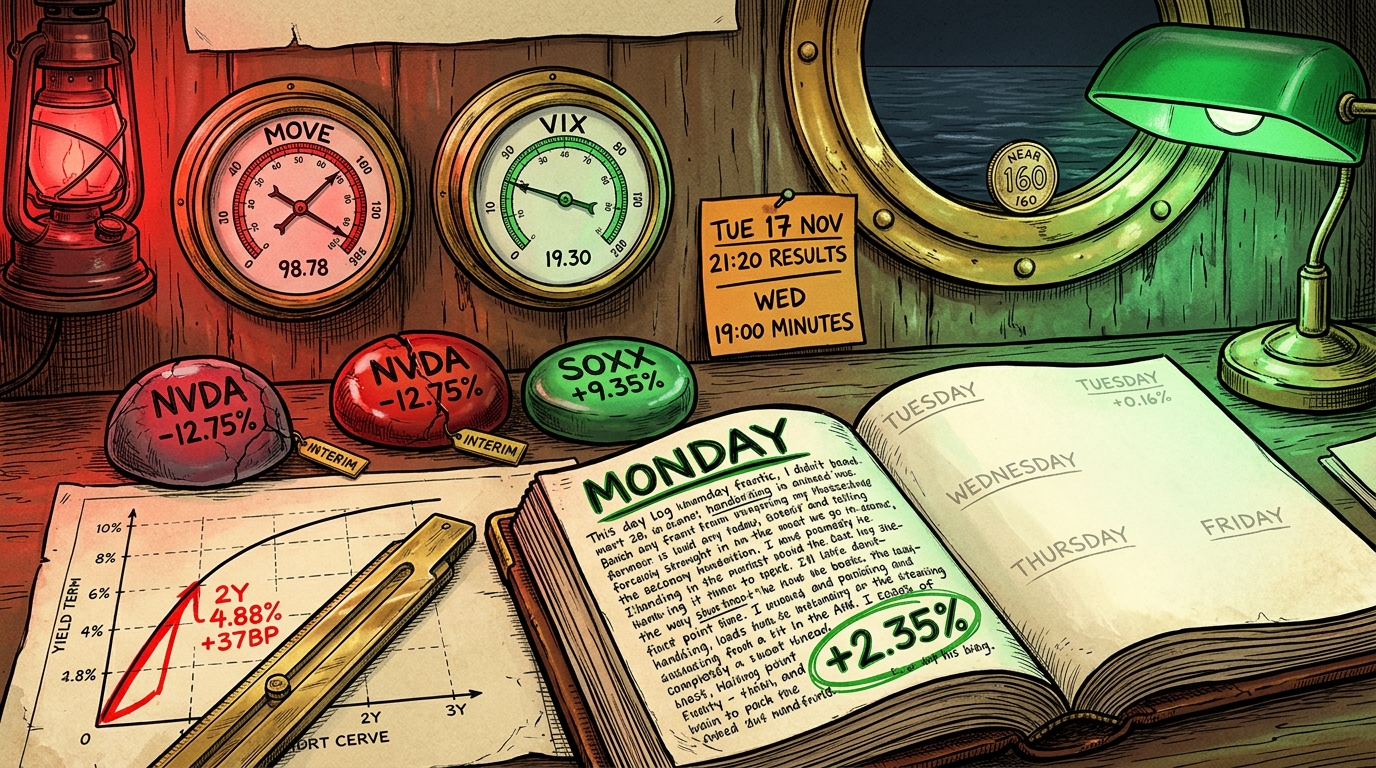
💬 Quote of the week: “In that case, I believe a 50 basis point hike in the policy rate should be considered at the December meeting.” Governor Christopher Waller, Federal Reserve, BoE Watchers Conference, London, 10 Nov
Macro movers
| Story | What moved | Macro impact |
|---|---|---|
| The December hike gets priced: Waller’s 50bp line (Tue 09:00 UTC), October CPI at 0.4% headline and 0.3% core, PPI 0.3% on Friday | 2-year Treasury yield 4.51% to 4.88%, +37bp; 30-year +21bp; bond volatility (MOVE) 92.78 to 98.78, +6.46% | Short rates rose faster than long ones. On a futures relay a December hike became fully priced and a 50bp hike became a live possibility. |
| Nvidia’s chief executive resigns (filing accepted 13:52 UTC Thursday); Colette Kress interim | NVDA 186.64 to 162.85, -12.75%; it opened 13.08% down on Thursday and closed 4.34% down | More than half of the week’s fall came before the resignation, during the China-chips inquiry. Results land Tuesday under an interim chief. |
| AI results split: CoreWeave beats and raises, Nebius guides low, Cisco and Applied Materials beat and fall | AMD +18.93%, Broadcom +18.16%, CoreWeave +14.50%, Nebius -10.51%; SOXX +9.35% against SMH +4.91% | The two chip funds weight the sector differently and split by 4.44 percentage points. |
| Iran: “effectively over” (Mon 20:52 UTC), Houthi claims on Saudi sites, “we’ve got their Strait”; the IEA sees a fourth-quarter surplus | December WTI 90.83 to 88.56, -2.50%; January Brent 98.32 to 95.84, -2.52% | Monday’s 4.38% crude fall settled 82 minutes before the remark, and nothing on record explains it. Energy still led the 11 SPDR sector funds (XLE +5.42%). |
| The dollar climbs; the yen sits near 160 and Tokyo says it will respond appropriately | Dollar index 102.28 to 103.41, +1.11%; USDJPY 159.71; gold spot 4,065.20 to 3,877.19, -4.62% | The dollar and short rates rose together and gold fell; this book holds no series that links them. |
The week in numbers
| Market | Friday close | Week |
|---|---|---|
| S&P 500 | 7,561.67 | 🟢 +2.51% |
| Nasdaq 100 | 27,943.74 | 🟢 +3.53% |
| Russell 2000 | 2,790.49 | 🟢 +1.32% |
| 2-year Treasury yield | 4.88% | 🔴 +37bp |
| 10-year Treasury yield | 5.15% | 🔴 +29bp |
| Dollar index | 103.41 | 🟢 +1.11% |
| December WTI crude | 88.56 | 🔴 -2.50% |
| Gold spot | 3,877.19 | 🔴 -4.62% |
| Bitcoin | 68,224.27 | 🔴 -9.91% |
| VIX | 19.30 | 🟢 -24.73% |
| Nvidia | 162.85 | 🔴 -12.75% |
Should have moved, didn’t
| Story | Expected | What happened |
|---|---|---|
| Three Fed presidents lean towards more tightening on Thursday | Stocks lower on a hawkish day | The 2-year rose 13bp to 4.86%; the S&P 500 fell only 0.35%, and its opening drop was bigger than its whole move. |
| A 37bp rise in the 2-year and a priced December hike | Stock-market fear gauges up | The VIX fell from 25.64 to 19.30 (-24.73%); from Monday’s close it went 19.92 to 19.30 while the 2-year rose 32bp. |
| Iran’s claim that a tanker hit a mine in Hormuz (Wed, about 07:23 UTC) | Higher crude | December WTI settled at 86.53, up 0.57% on the day, and finished the week 2.50% lower. |
The week in review
Rates: the bond market priced the hike
The short end of the curve did the week’s worrying, and it did it in public. On Tuesday at 09:00 UTC Fed Governor Waller said in London: “I believe a 50 basis point hike in the policy rate should be considered at the December meeting”, if core CPI printed 0.3% or more (Reuters’ summary of the condition). At 13:30 UTC it printed 0.3%, with headline inflation at 0.4% against 0.3% expected. The 2-year yield rose 17bp that day in three roughly equal steps: the Waller hour, the CPI hour, and an hour after the open that nothing on record explains. The bond market shut on Wednesday for Veterans Day. On Thursday three Fed presidents leaned towards more tightening and the 2-year added 13bp; Friday’s softer-than-expected producer prices (0.3% against 0.4%) barely dented it.
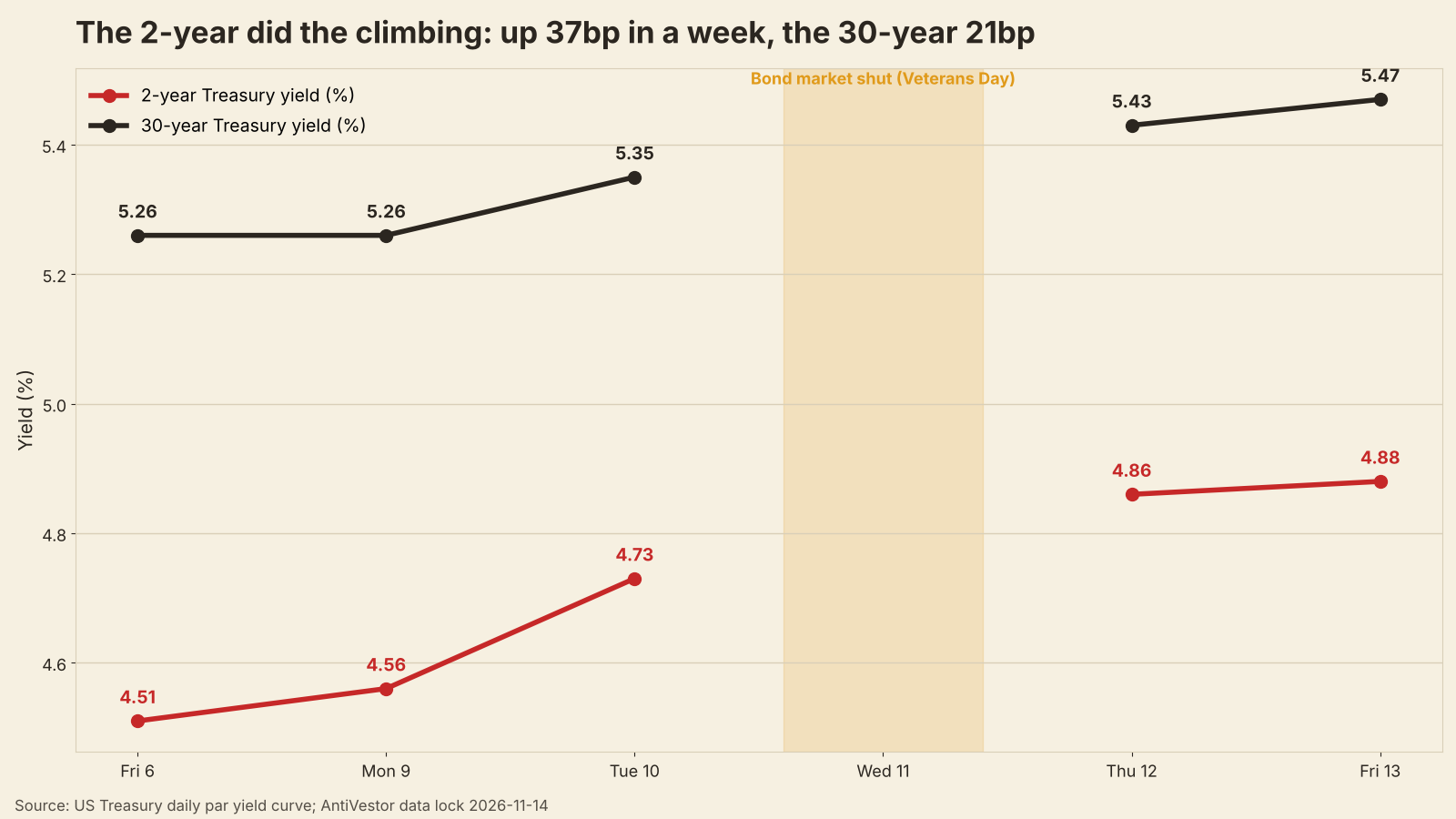
How it works: The 2-year Treasury yield tracks where traders think the Fed’s own rate will be over the next two years, so it moves on Fed speeches and inflation data. Long yields carry more: government borrowing, inflation over decades, global demand for bonds. When short yields rise faster than long ones, the curve flattens, and the market is betting the Fed tightens now rather than that inflation runs for years.
What it means: Fixed-rate mortgages and savings deals price off these yields, so savers may see better offers and borrowers costlier ones within weeks if this holds.
The AI trade: one stock fell, the sector did not
Nvidia had a terrible week and the chip trade had a good one. Nvidia fell 5.47% on Tuesday as The Information reported (15:26 UTC) that its hardware reached Chinese firms through a network linked to Megaspeed’s Alice Huang. On Thursday Jensen Huang resigned at 13:52 UTC, 37 minutes before the open; Reuters reported an alleged relationship with Alice Huang, whom US authorities suspect of spying. Nvidia opened 13.08% down and won back two thirds of the gap to close 4.34% lower. The S&P 500 opened 0.90% lower that day; nothing on record before the open could carry that drop, since one company never explains an index. The FT reported the board had approached Arm’s Rene Haas; the board later said it had not formally engaged any candidate. Around it, AMD rose 18.93% and Broadcom 18.16% on the week. CoreWeave rose 24.71% on Wednesday after raising its outlook, Nebius fell 16.84% on Thursday after guiding low, and Cisco and Applied Materials beat and still fell on Friday.
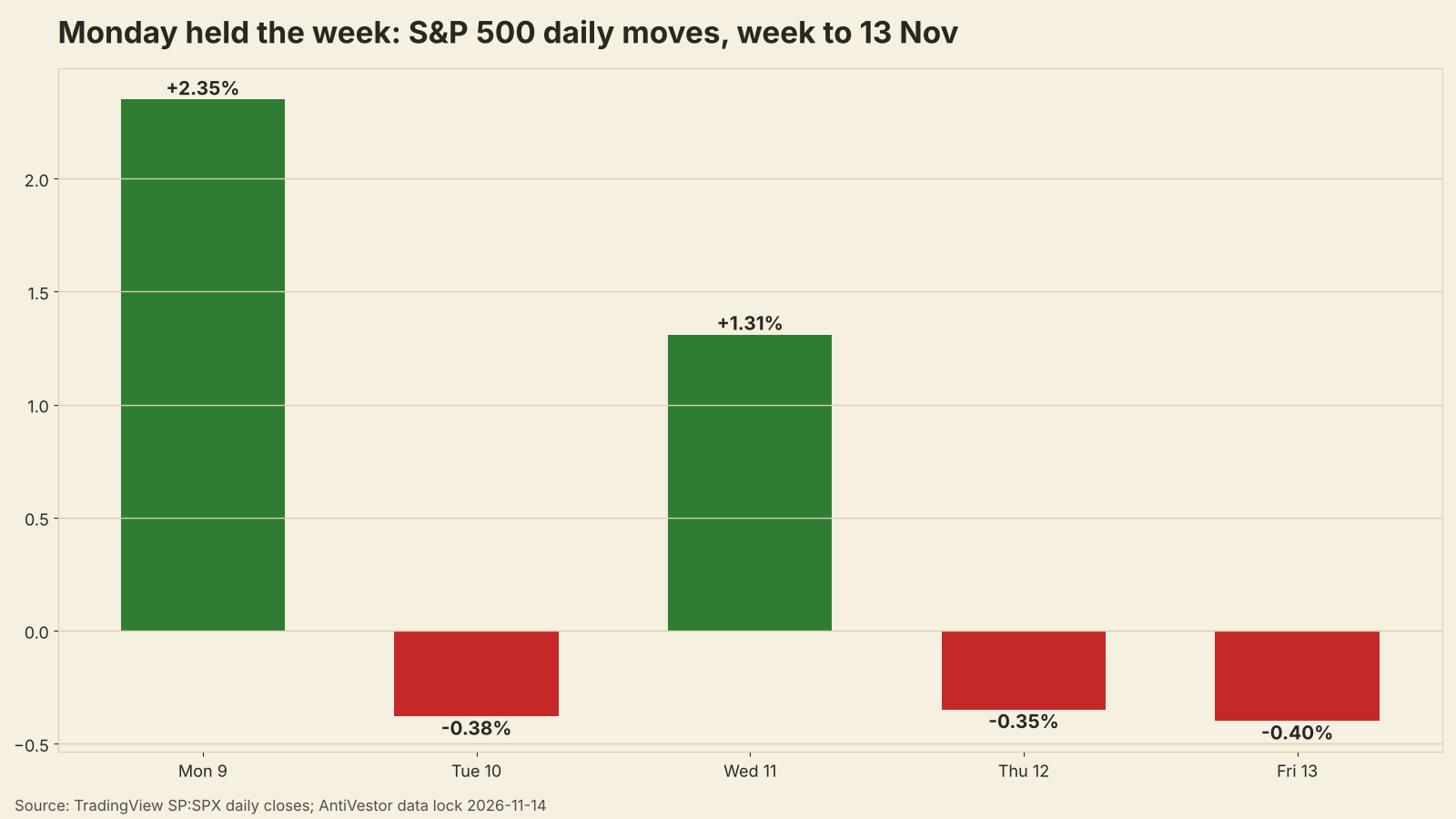
The index tells a stranger story. The S&P 500 rose 2.35% on Monday and a net 0.16% across the other four days, so 93.65% of the week’s gain in points came on Monday, and nothing on record arrived early enough to explain Monday’s rise at the index level.
What it means: An index fund held up, but a pension heavy in one AI giant learned this week what single-company risk looks like.
Oil, the dollar and gold: the war premium leaked out
Crude fell for the week despite three days of Gulf supply scares. December WTI fell 4.38% on Monday and settled 82 minutes before President Trump called the Iran war “effectively over” at 20:52 UTC, so the remark cannot explain it. Iran claimed a tanker hit a mine in Hormuz on Wednesday morning, and crude rose 0.57%. On Thursday the Houthis claimed strikes on Saudi Arabia’s East-West pipeline and Yanbu, and January Brent rose 3.30% to 95.82. On Friday the IEA said the market returns to surplus in the fourth quarter and Brent finished at 95.84, down 2.52% on the week. Meanwhile the dollar rose 1.11% and the yen sat near 160, with Tokyo’s finance minister saying the government will respond appropriately. Gold spot fell 4.62% on the week, including 2.79% on Thursday, a day the VIX rose 6.92%, and this book holds no real-yield series to explain it.
What it means: Cheaper crude should reach petrol prices with a lag. A stronger dollar makes American holidays dearer for British travellers, and gold is not behaving like a haven.
The case against
The doubting Thomas reading is that equities were right and bonds are overreacting. A hike that only takes the Fed’s rate back to where long yields already sit would not change much for company earnings, and the AI spending that matters for the index kept flowing. The VIX falling 24.73% in a week of hike talk could be calm judgment rather than complacency. Retail sales on Tuesday and the Fed’s minutes on Wednesday will show whether the economy is strong enough to need the hike the bond market priced.
What would change the reading: a 2-year yield back below 4.60% before the 8-9 Dec Fed meeting would say the bond market has backed off the hike, and the equity market had it right.
Warts and all
Misses first. None of the calls this book scored from Wednesday to Friday missed. The records for Monday’s and Tuesday’s letters are no longer held, so whatever they scored is unreported, which is a wart in itself.
- The Weathervane did not turn, for a fortieth letter running. It turns only when a dated Fed speech moves the 2-year 10bp or more while the 30-year moves less than half as far, on two days. Tuesday missed by 0.5bp (+17bp against +9bp) and shared the day with the CPI print. Thursday ran +13bp against +8bp. Friday is not yet assessed.
- The thesis line above drops its usual claim that the Fed’s rate was “frozen for most of the year”. That contradicts the 16 Sep hike, and it stays out until Phil rules.
- Gold as a haven is now challenged after Thursday’s fall on a nervous day.
- A special report draft carried two unconfirmed items (a Singapore statement’s date, an 18 Nov House briefing since superseded). Caught before publication.
- The ETF flow source failed again, so no flow figure is printed.
Hits. Wednesday’s letter said Nvidia would lag the chip fund SOXX on 10 Nov; it did, -5.47% against -0.12%. Thursday’s said the same for 11 Nov; it did, +2.87% against +6.01%. Friday’s scored two calls that the 2-year would hold more than half of Tuesday’s 17bp rise (it closed at 4.86%) and one that CoreWeave would close above 54.75 (it closed at 56.60). The running record is 22 hits, 7 misses and 2 splits, up from 17 hits.
Pending, scored Monday. Nvidia below 173.73, Nebius below 154.69, Corteva below 12.14. Friday’s closes were 162.85, 115.88 and 9.43.
Corrections. None after publication in the records held.
Coming next week
All times UTC; “(one route)” means one source only.
- Sun 15 Nov 23:50: Japan third-quarter GDP, first estimate.
- Mon 16 Nov: China October activity data 02:00 (one route); Empire State manufacturing 13:30; Fed Chair Warsh speaks 17:00 (one route).
- Tue 17 Nov: Home Depot before the bell; October retail sales 13:30; industrial production 14:15; Nvidia results about 21:20, call 22:00.
- Wed 18 Nov: UK October CPI 07:00; Lowe’s, Target and TJX before the open; housing starts 13:30; 20-year bond auction 18:00; Fed minutes 19:00; November VIX expiry. APEC leaders meet in Shenzhen 18-19 Nov; a Trump-Xi meeting is expected, time not published.
- Thu 19 Nov: Walmart 12:00; Philadelphia Fed manufacturing 13:30; 10-year TIPS reopening 18:00; Japan October CPI 23:30 (one route).
- Fri 20 Nov: University of Michigan final sentiment 15:00; December WTI (CLZ2026) last trading day; monthly options expiry (one route).
The question for the week: with retail sales, Nvidia’s results and the Fed minutes landing inside 30 hours, does the 2-year’s 37bp finally reach the stock market?
Phil
Less Brain, More Gain
…and may your trades be smoother than a cashmere codpiece