No. 2 (The Showcase That Sank): Nvidia beat and fell -22.92%, Anthropic first traded 34.34% above its offer price, and the 2-year fell 25bp while the Fed talked up hikes
 Ahoy there, Trader! ⚓️
It’s Phil…
Nvidia’s results and Anthropic’s listing were meant to make this AI’s week; it turned into a stress test for everything else.
This week’s three questions:
- Was the AI trade re-priced, or did a wider sell-off simply start there?
- Why did bonds rally and gold fall while the Fed talked up rate rises?
- What, if anything, did the Shenzhen summit change for markets?
⚓ Weathervane. The wind is coming from the long end of the bond market: the price of long-term money is set by deficits, issuance and a global appetite for long bonds rather than by the committee. This week pushed hard against that heading. Short-dated Treasuries did the moving, the 2-year yield falling 25bp to 4.63% against 16bp on the 30-year, while Fed governors argued for higher rates. Treasuries from one year out to thirty rallied as shares fell, so this week the bond market priced fear rather than deficits. The heading holds only on one detail: the 20-year still yields more than the 30-year (5.34% against 5.31%).
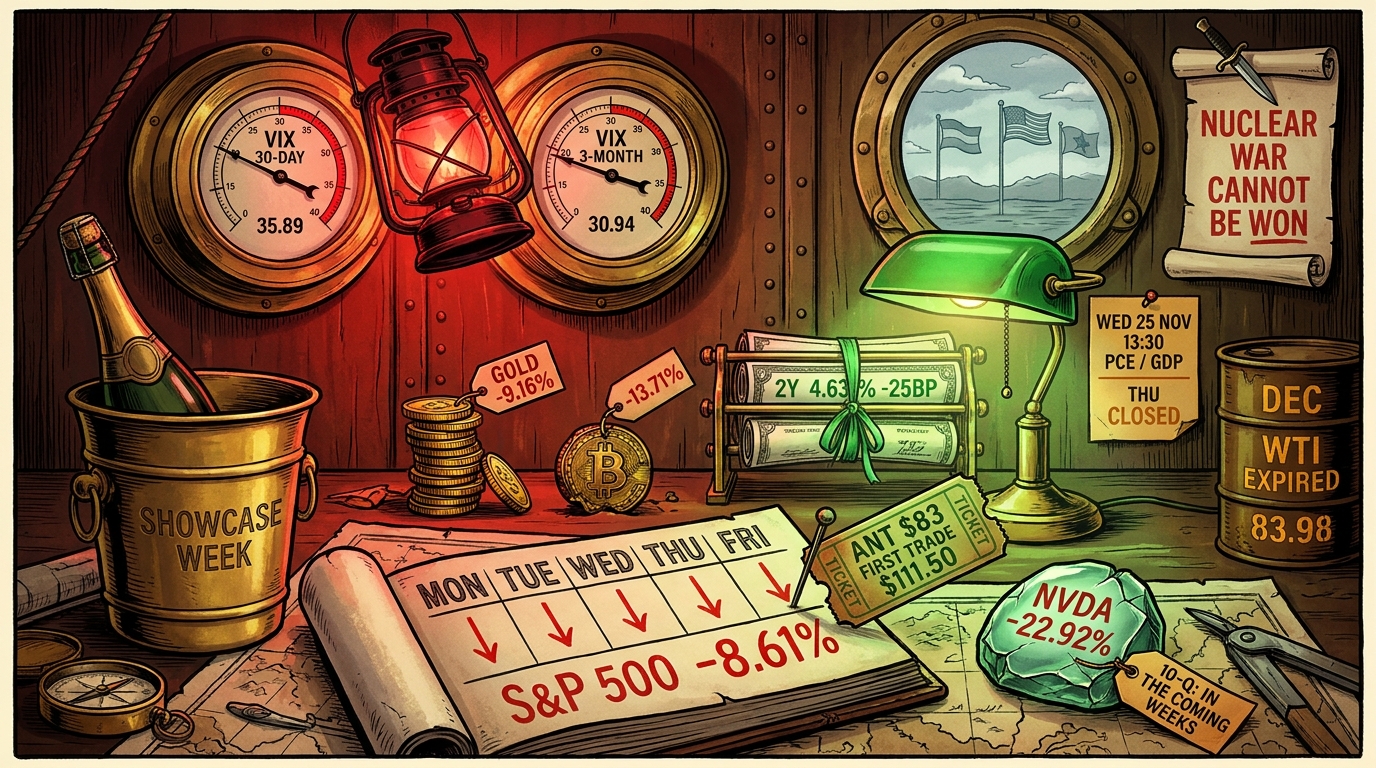
💬 Quote of the week: “an increase of more than 25 basis points could warrant consideration at the next meeting if incoming inflation data were unfavorable” Minutes of the Fed’s 27-28 Oct meeting, released 18 Nov
Macro movers
| Story | What moved | Macro impact |
|---|---|---|
| Nvidia beats, then sinks: results on Tuesday evening, a reported SEC inquiry (Wall Street Journal, Tuesday; Reuters on Friday said staff were looking at accounting), its quarterly filing held back | NVDA 162.85 to 125.53, -22.92%; -14.01% on Friday alone | The company at the centre of the AI trade beat expectations and lost more than a fifth of its value. The open questions are about governance and accounting, not demand. |
| Anthropic lists on Nasdaq | Priced at $83 against a $70-78 range; first trade $111.50 on Thursday; closed $97.17, then $88.91 on Friday, 7.12% above the offer | Investors wanted the listing. They sold the AI shares around it anyway, so the debut was a sign of appetite, not a rescue. |
| Chips and rented computing power fall hardest, with a short-seller report on AMD (Hunterbrook, Thursday) | SOXX -17.36%, SMH -17.81%, AMD -20.54%, CoreWeave -25.64%, Nebius -29.83% | The selling ran down the AI supply chain, from chip designers to the firms that rent out data-centre capacity. |
| The Fed talks up hikes; bonds rally anyway | 2-year 4.88% to 4.63%, -25bp; 10-year -23bp; 30-year -16bp | The minutes floated a move bigger than 25bp and the 2-year ignored them. Treasuries became the place to hide. |
| Friday’s global sell-off | S&P 500 -3.70% on the day and -8.61% on the week; VIX 19.30 to 35.89, +85.96% | A seventh straight daily fall for the S&P 500, with sharp falls across Asia first and no single headline in front of it. |
| Gold, silver and bitcoin fall with shares | Gold spot -9.16%; December silver -16.39%; bitcoin -13.71%; ether -15.9% | The usual refuges did not act as refuges, and real yields fell, which removes the textbook explanation. |
| Shenzhen: Trump meets Xi, and both meet Putin; the US chip-export rule and China’s warning | S&P 500 -2.02% on the summit day; no move we can time to a readout | Words on nuclear weapons and fuel supply, nothing published on chips or tariffs. The January truce deadline still stands. |
The week in numbers
| Market | Friday close | Week |
|---|---|---|
| S&P 500 | 6,910.39 | 🔴 -8.61% |
| Nasdaq 100 | 25,028.98 | 🔴 -10.43% |
| Russell 2000 | 2,581.79 | 🔴 -7.48% |
| 2-year Treasury yield | 4.63% | 🟢 -25bp |
| 10-year Treasury yield | 4.92% | 🟢 -23bp |
| Dollar index (DXY) | 103.84 | 🟢 +0.42% |
| December WTI crude (expired Friday) | 83.98 | 🔴 -5.17% |
| January Brent crude | 92.57 | 🔴 -3.41% |
| Gold spot | 3,520.57 | 🔴 -9.16% |
| Bitcoin | 58,951.51 | 🔴 -13.71% |
| VIX | 35.89 | 🔴 +85.96% |
| SOXX chip fund | 123.38 | 🔴 -17.36% |
Should have moved, didn’t
| Story | Expected | What happened |
|---|---|---|
| The minutes float a hike bigger than 25bp (Wednesday, 19:00 UTC) | A higher 2-year yield | The 2-year closed Wednesday unchanged at 4.80% and finished the week at 4.63%. |
| Iran’s Revolutionary Guards claim tankers hit mines near Hormuz, and the US strikes a missile site on Qeshm | Higher crude | January Brent fell 3.55% on Monday, rose 0.76% on Tuesday and finished the week 3.41% lower. |
| Nvidia reports revenue of $115.8bn, up 103%, and guides to $130bn | A lift for chip shares | The gain after hours was gone by Wednesday’s close (-2.89% to 150.96); SOXX finished the week 17.36% lower. |
| Iran reports an overnight attack on US sites in Kuwait (Wednesday) | Higher crude | January Brent fell 1.28% that day, after US crude stocks rose 3.4m barrels. |
The week in review
The AI week
The AI trade was marked down hard in the week built to celebrate it, and the evidence points to a re-pricing of what investors will pay, not a collapse in demand.
On Monday, the Commerce Department announced a rule requiring licences for advanced chips sent to data centres owned by Chinese-headquartered companies anywhere in the world. The same day, Fed Governor Barr gave a speech in Milan on AI and financial stability: “On-balance-sheet debt of the seven largest AI firms has been growing significantly in 2026”. On Tuesday the Wall Street Journal reported an SEC inquiry. That evening Nvidia reported revenue of $115.8bn, up 103% on a year earlier, and guided to $130bn for the current quarter. The shares rose after hours and gave it all back on Wednesday, closing 2.89% lower at 150.96. Nvidia said it would file its quarterly report “in the coming weeks”. It has been run since last week by an interim chief executive, Colette Kress, after Jensen Huang resigned. On Friday Reuters reported that SEC enforcement staff were examining potential accounting issues (we do not hold the time of the report). The shares fell 14.01% on the day to 125.53. Neither the SEC nor Nvidia has confirmed an investigation, and an inquiry is not a finding.
Anthropic priced 980m shares at $83 on Wednesday evening, above a $70-78 range and upsized from 825m shares, raising $81.34bn before an underwriters’ option on 147m more; no filing confirms its use. It opened on Thursday at $111.50, closed at $97.17 and fell to $88.91 on Friday, still 7.12% above the offer. Also on Thursday, Hunterbrook published a short report alleging AMD firmware turned up in servers built by a Chinese company on the US export blacklist; AMD disputes them; the shares fell 7.72% that day and 20.54% on the week.
The selling ran down the chain. The two big chip funds fell 17.36% (SOXX) and 17.81% (SMH), Oracle 19.27%, Broadcom 12.28%, and the companies that rent out AI computing fell furthest: CoreWeave 25.64%, Nebius 29.83%.
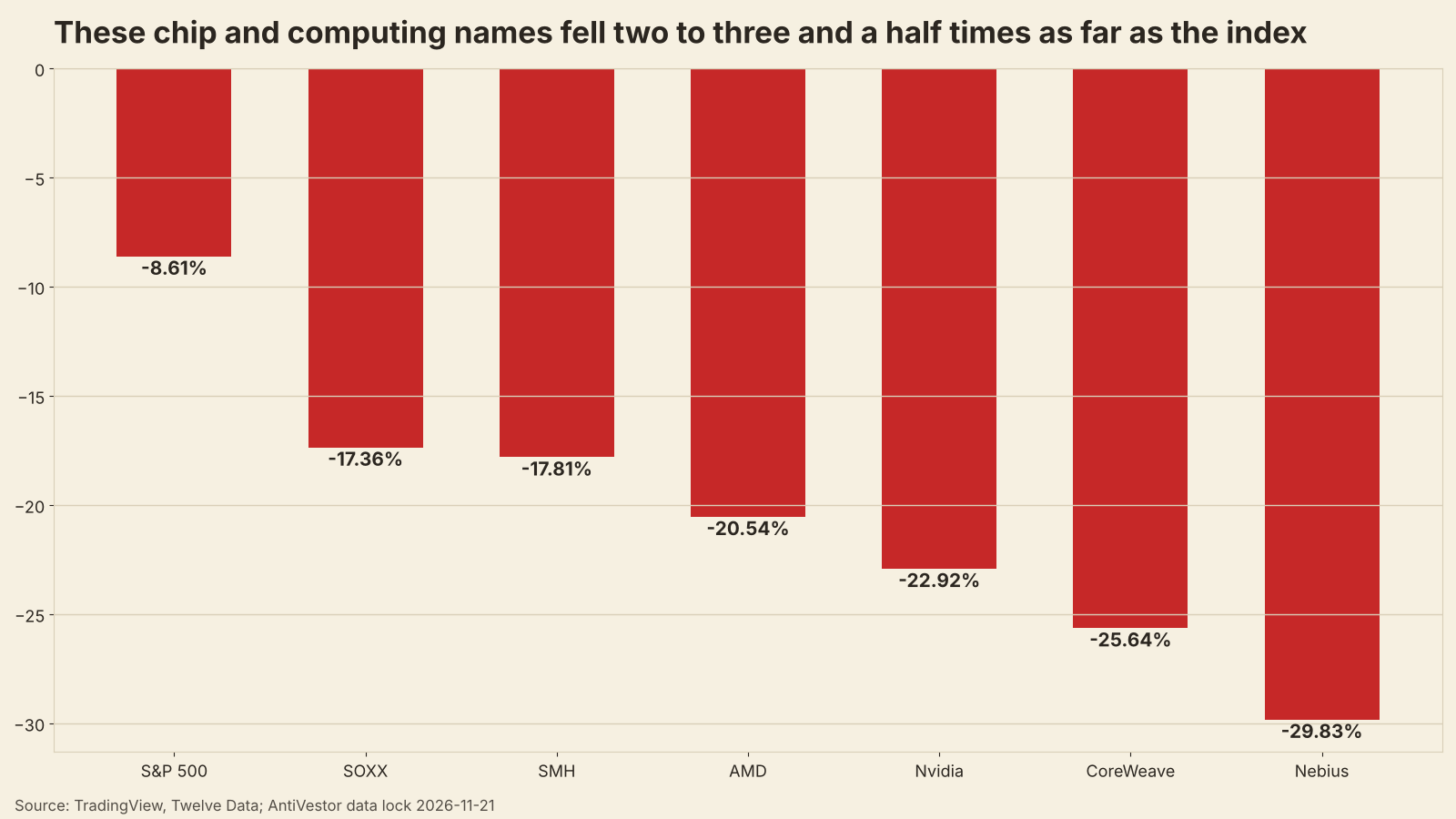
What the evidence supports: demand numbers were strong and a listing raising $81.34bn found buyers, yet prices fell. That is investors paying less for the same growth. We cannot tie the week’s AI selling to one dated headline; the reported SEC inquiry and the AMD report each landed on single stocks. The market’s own explanation, AP’s, was that midterm winners favouring slower data-centre building fed fears of an AI bubble.
What it means: anyone in a fund that tracks the S&P 500 lost more than the average share did, because the biggest companies fell furthest: the SPY fund, which weights companies by size, fell 8.56% against 6.20% for the RSP fund, which holds each one equally.
The heavily bearish week across the board
Almost everything fell together, and most of it fell without a dated reason on record.
The S&P 500 fell every day, its seventh straight loss on Friday, from 7,561.67 to 6,910.39. That is -1.92% on Monday, -1.03% on Tuesday, -0.23% on Wednesday, -2.02% on Thursday and -3.70% on Friday. Measured in points, Thursday and Friday together did 63.45% of the week’s damage. The Nasdaq 100 fell 10.43%, the Dow 8.02% and the Russell 2000 7.48%; AP reported the Nasdaq Composite is now down for 2026. All 11 sector funds fell, from consumer staples (-2.05%) to technology (-12.49%). On the New York Stock Exchange, falling shares outnumbered rising ones on all five days, by as much as five to one on Thursday (a ratio of 0.2) and four to one on Friday.
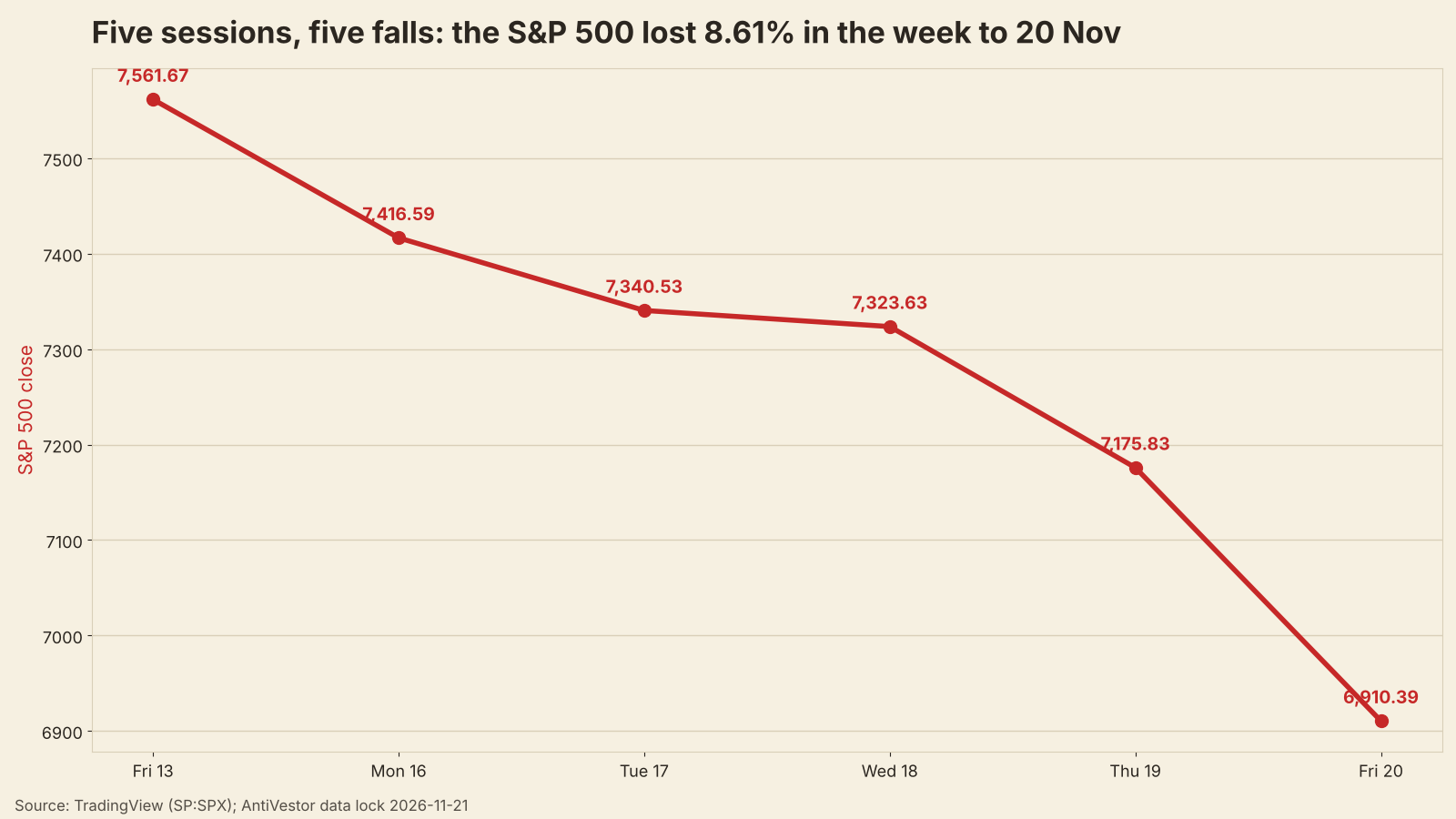
AP calls it a correction, more than 10% below the October peak, a close we do not hold. On Friday the index opened 9.58% of the way to its close and did the other 90.42% during the session, making its low in the last half hour. We searched the Asian sell-off, the Michigan survey, Cook’s speech, Reuters’ Nvidia report and options expiry: nothing on record before the open explains the bulk of it, and nothing timed inside the session does either.
Fear moved into the options market. The VIX rose from 19.30 to 35.89, and closed above the three-month VIX on four straight days.
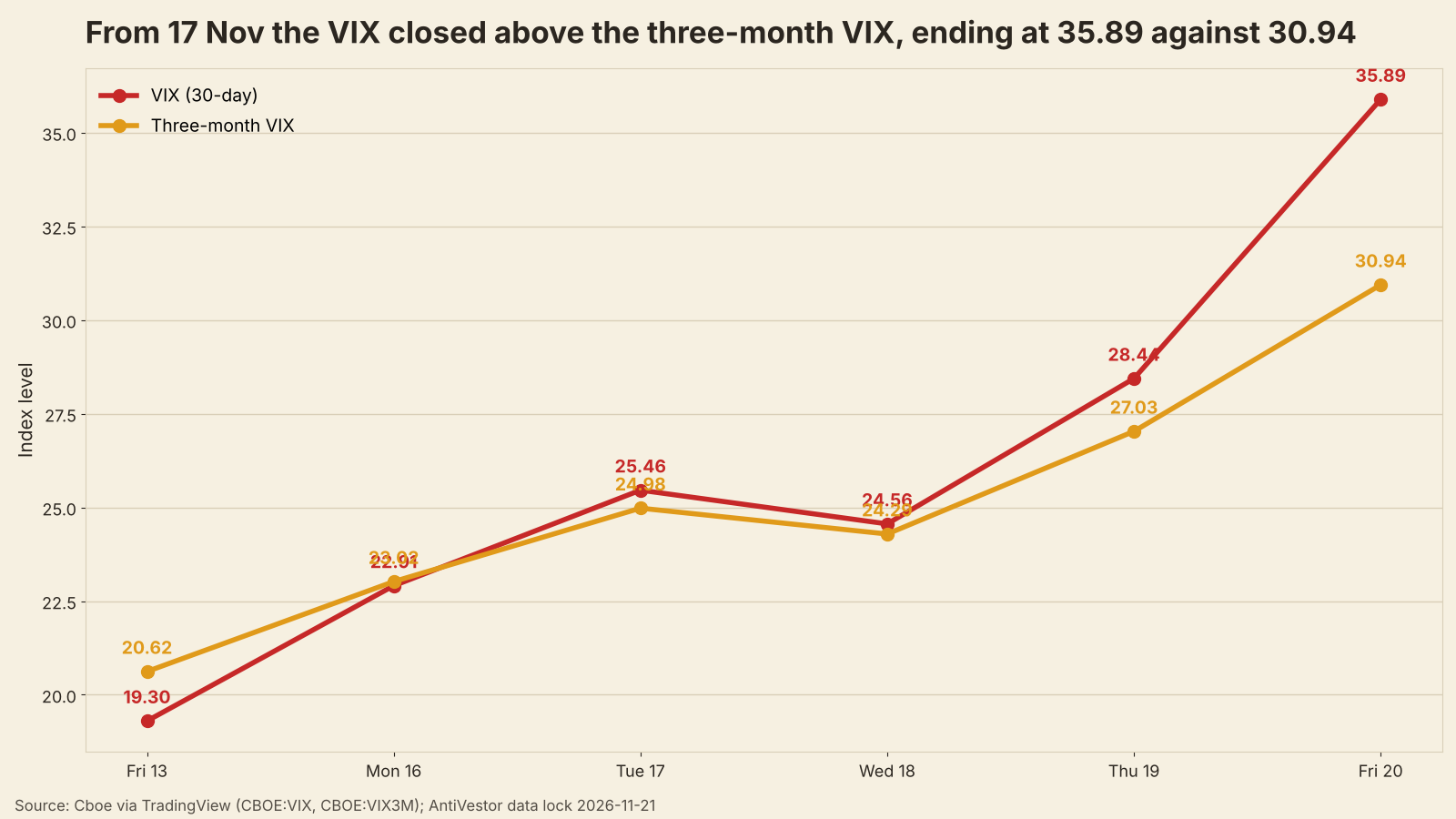
How it works: The VIX measures what investors pay to insure shares over the next 30 days; the three-month VIX does the same over three months. Normally near-term insurance is cheaper, because calm is the usual state. When the 30-day measure rises above the three-month one, investors are paying more for protection this month than for the season ahead. It is the signature of acute stress rather than a slow grind, and on its own it says nothing about how long the stress lasts.
Bond volatility rose early in the week, fell on Wednesday and Thursday, then jumped on Friday (MOVE 106.31, +10.69% on the day). The refuges failed: gold spot fell 9.16%, December copper 9.94% and bitcoin 13.71%, with ether down 15.90% (gold and bitcoin measured on one feed’s closes for both Fridays). Abroad, Europe’s Stoxx 600 closed Friday at 625.65, down more than 5.7% on the week by Reuters’ count. Credit cracked a little: the extra yield on high-yield bonds rose from 3.23 to 3.52 percentage points between Friday 13 and Thursday 19 Nov.
What it means: a diversified saver had few places to hide this week; high-grade bonds and cash were among the few things that held their value.
Rates and the Fed
The Fed spent the week talking up rate rises, and the bond market bought Treasuries anyway.
The 2-year yield went 4.88%, 4.83%, 4.80%, 4.80%, 4.76%, 4.63% across the six closes from Friday 13 to Friday 20. On Wednesday the minutes of the October meeting said “an increase of more than 25 basis points could warrant consideration at the next meeting if incoming inflation data were unfavorable”. The 2-year closed that day where it started. Barr said the same afternoon, conditional on the economy evolving as he expects: “I expect it will be appropriate to raise rates further”. On Thursday Vice Chair Jefferson said: “Currently, the AI buildout is exerting upward pressure on demand and inflation.” On Friday Governor Cook said: “waiting longer to implement rate increases risks getting behind the curve.” Governor Waller reportedly told CNBC on Wednesday he favours a half-point move in December, and New York Fed President Williams told an Axios event on Tuesday that AI investment may argue for more hikes.
The 2-year fell 13bp on Friday alone. Its intraday path on a second price feed, used for timing only, shows about half of the fall before New York opened, during the Asian and European selling; a step lower in the hour the University of Michigan published year-ahead inflation expectations of 3.7%, down from 4.3% in the preliminary reading; and a second leg late in the day with no dated event in front of it.
How it works: The 2-year yield is roughly the market’s average guess for the Fed’s rate over the next two years, plus a little for safety. Shares fall → investors buy Treasuries for safety → bond prices rise and yields fall → the market starts pricing the hikes being reversed sooner. So a 2-year can fall while a hike next month is still expected: the later months, not the next meeting, can do the moving.
Before Friday’s rally, Saxo reported money markets pricing at least two more 25bp hikes by mid-2027; we hold no reading taken after it. The curve steepened: the gap between the 10-year and 2-year widened from 27bp to 29bp, and between the 30-year and 2-year from 59bp to 68bp. Freddie Mac’s 30-year mortgage rate rose to 7.28% from 7.11%. The 20-year auction on Wednesday sold at a yield of 5.46%, with bids for 2.63 times the amount on offer. US surveys softened: the Empire State index printed 7.8 against an expected 18, the Philadelphia Fed 6.3 against 20, and the homebuilders’ index 25. October retail sales rose 0.2%, and weekly jobless claims came in at 203k.
What it means: savers locking in fixed rates now get less than a week ago, and borrowers have not yet seen the benefit, because the mortgage survey predates Friday’s fall.
Geopolitics: Shenzhen, chips and the Gulf
Three leaders met and published a joint declaration, and nothing we hold shows markets trading any of it.
The chip rule came first, on Monday. On Tuesday China’s commerce ministry said it would take countermeasures if Washington insisted on going its own way, as relayed by the Global Times. On Thursday President Trump met President Xi in Shenzhen. China’s readout says the two sides will draw up a plan for a relationship of “strategic stability” and records Trump as saying the US does not support Taiwan independence; we found no White House readout of the two-way meeting. The three-way meeting with President Putin produced a joint declaration, published by the White House and Xinhua, covering UN reform, nuclear weapons and fuel supply. Its plainest line: “The three heads of state reaffirmed that a nuclear war cannot be won and must never be fought.” The countries also plan to raise production of refined petroleum products. The Kremlin’s spokesman said Ukraine was not the focus of the three-way talks; we did not reach the Kremlin’s own text. Trump said Xi agreed the Strait of Hormuz must stay open, a claim that appears in no other readout.
What did not appear anywhere: chips, tariffs, or the trade truce that runs to 10 January, the date Treasury Secretary Bessent gave in September.
What markets did: the S&P 500 fell 2.02% on the summit day, but nothing we hold times any part of that to a readout. Friday’s selling started in Asia, where Taipei, Seoul and Tokyo fell sharply on syndicated reports and Korea’s exchange briefly paused programme selling. European shares fell with them, led by chip-equipment makers.
What it means: the summit produced words on nuclear weapons and fuel, nothing a chip investor can use, and the January deadline is still the date to watch.
Oil and the December WTI expiry
Oil fell on a week of loud Gulf headlines, and December WTI went out quietly.
December WTI’s last trading day was Friday; it settled at 83.98, down 5.17% from 88.56. January WTI took over as the most traded contract on Wednesday (250,599 lots against 88,764) and fell 4.44% to 83.41. January Brent fell 3.41% to 92.57.
The Gulf supplied headlines all week. Iran’s Revolutionary Guards claimed tankers had hit mines near Hormuz, and Brent fell 3.55% on Monday; wires credited the International Energy Agency’s surplus forecast, published on Friday 13, which is the market’s explanation rather than ours. The US struck a missile site on Qeshm Island on Tuesday and Brent rose 0.76%. On Wednesday Iran reported an overnight attack on US sites in Kuwait, and US crude stocks rose 3.4m barrels against expectations of little change; Brent fell 1.28%. On Thursday Iran’s navy said two more tankers had hit mines; January Brent settled 3 cents higher. Friday brought no oil story we could find.
What it means: cheaper crude is the one piece of this week that helps household budgets; pump prices tend to follow crude with a lag.
Beyond AI: shops, health insurers and the world
TJX and Target held up; the expensive and the exposed did not.
TJX rose 3.91% and Target 2.71% on the week after results, Walmart was flat (-0.11%), Home Depot fell 2.77% and Lowe’s 3.03%. Ross fell 7.86% and Williams-Sonoma 17.06%. Palo Alto Networks rose 9.9% on Wednesday before its results and 6.42% on Thursday after revenue grew 39% to $3.44bn, ending the week up 6.54%. Intuit fell 10.65% after hours on Thursday after its results and 20.85% on the week. UnitedHealth fell 16.59% after the government proposed a rule extending Medicare Advantage audit recoveries, and Nike fell 13.35%. Take-Two said Grand Theft Auto VI took $3.79bn in retail sales on its first day.
Abroad, UK inflation rose to 3.6% in October from 3.5%. Japan’s economy shrank at an annualised 0.1% in the third quarter. China’s October retail sales grew 0.4% on a year earlier and fixed-asset investment over the year to October fell 8.1%.
What it means: one week of share prices is not spending data, but TJX and Target had the better week, and China’s own figures show a weak consumer.
The case against
The strongest reading against ours: this was a Fed week, not an AI week. The minutes floated a bigger move, Waller reportedly backed a half point, Barr and Cook argued for more, and a market facing hikes into softening factory surveys (Empire State 7.8, Philadelphia 6.3) sold its most expensive shares first. On that view the 2-year fell because investors expect the Fed to tighten until something breaks, and the AI selling is the symptom rather than the story. It would be settled by short-dated yields: if hikes are the driver, the 2-year should climb back once the panic fades, while shares stay down.
What would change the reading: the 2-year back above 4.88%, last Friday’s close, before the Fed’s 9 Dec decision, with the S&P 500 still below 7,175.83.
Warts and all
Misses first.
- Wednesday’s letter said that if the VIX closing above the three-month VIX was insurance bought for one night, it should unwind by that evening’s minutes. It did not: the VIX closed above the three-month VIX on Wednesday (ratio 1.01) and on every day since, 1.16 by Friday. Marked a miss.
- Gold as a refuge has been challenged again: spot gold fell 9.16% in a week the S&P 500 fell 8.61%.
- The Weathervane’s test for changing course did not advance. It needs a dated Fed communication to move the 2-year 10bp or more while the 30-year moves less than half as far. The minutes moved the 2-year 0bp; Friday’s 13bp fall had no Fed communication in front of it.
- Wednesday’s letter reported Nvidia’s after-hours gain; it did not survive the next session.
- Friday’s letter came close to publishing a wrong figure. A first draft read the S&P 500’s intraday bars an hour early and put more than half of Thursday’s fall before Anthropic’s first trade; the true share was 36.5%. Both checkers caught it before publication.
- Our bitcoin fund-flow source failed for a fourteenth edition; we hold two daily reports from other outlets and no weekly total, so no flow figure is printed.
- Strategy, the bitcoin-holding company, broke its stated vow not to sell earlier this autumn, and the mark stays a miss; its filing this week showed another purchase, which does not undo it.
- The Weathervane above still omits its usual clause that the policy rate was “frozen for most of the year”, because it contradicts the September hike. It stays out until it is rewritten.
Last week’s question asked whether the 2-year’s 37bp rise would reach the stock market. Shares fell 8.61%, but the 2-year fell 25bp too, so we cannot say whether last week’s rise reached them. Last week’s letter set no “what would change the reading” level.
Hits. Last Saturday’s three pending calls (Nvidia below 173.73, Nebius below 154.69, Corteva below 12.14) were scored on Monday; the running record rose from 22 hits to 25 with misses unchanged at 7, but Monday’s scorecard is no longer held, so we cannot show the marks. Palo Alto’s after-hours gain carried into Thursday’s session, a hit. Thursday’s refusal to credit Anthropic’s pricing with the overnight futures rally held up: the rally did not survive the session. Running record: 26 hits, 7 misses, 2 split decisions.
Corrections. None of a figure. One wording flag: Friday’s letters said China reserves the right to retaliate over the chip rule. The wording we can source this week is the commerce ministry’s that it will take countermeasures; the substance stands, the phrase does not.
Coming next week
All times UTC; “(one route)” means one source only. Thanksgiving week: US stock markets shut on Thursday 26 Nov and close early (18:00) on Friday 27 Nov; the bond market shuts Thursday and closes early (19:00) on Friday, per SIFMA.
- Mon 23 Nov: Tokyo closed for a holiday. Euro-area flash PMIs 08:30 and UK 09:30 (one route each). Chicago Fed activity index 13:30 (one route). Anthropic listed options may start trading, pending industry readiness. Flash November PMIs 14:45 (one route). 2-year note auction, $69bn, 18:00. Zoom after the close (one route).
- Tue 24 Nov: Medtronic 11:45 and Analog Devices 12:00 before the open; Dick’s Sporting Goods before the open (one route); Best Buy, time not confirmed (one route). Case-Shiller house prices 14:00 (one route). Conference Board consumer confidence 15:00 (one route). 5-year note auction, $70bn, 18:00. Workday, Dell and HP after the close; Autodesk (one route).
- Wed 25 Nov: the big data morning, all at 13:30: October personal income and spending with the PCE inflation gauge, the second estimate of third-quarter GDP, October durable goods, and weekly jobless claims moved from Thursday (one route). New home sales 15:00. Weekly oil stocks 15:30 (one route). 7-year note auction, $44bn, 16:30. Deere results. The Fed’s Beige Book 19:00.
- Thu 26 Nov: Thanksgiving; US stocks and bonds shut. Bank of Korea rate decision (time not confirmed).
- Fri 27 Nov: shortened US session; Black Friday. Advance goods trade and inventories 13:30. The Fed’s weekly balance sheet, moved for the holiday, 21:30 (one route).
- Not next week: OPEC+ meets Sun 29 Nov (one route); House committees want Jensen Huang on 1-2 Dec and Senate Banking on 3 Dec, with Commerce Secretary Lutnick on 10 Dec; Nvidia’s quarterly filing is due by about 4 Dec on outside arithmetic; the FOMC decides on 8-9 Dec; government funding runs to 11 Dec. No Fed Board speeches are scheduled; regional presidents’ diaries were not checked.
The question for the week: with the Fed’s preferred inflation gauge and GDP landing on Wednesday morning into a half-empty holiday market, does the 2-year keep falling towards pricing no December hike, or does it climb back while shares keep falling?
Happy trading,
Phil
Less Brain, More Gain
…and may your trades be smoother than a cashmere codpiece