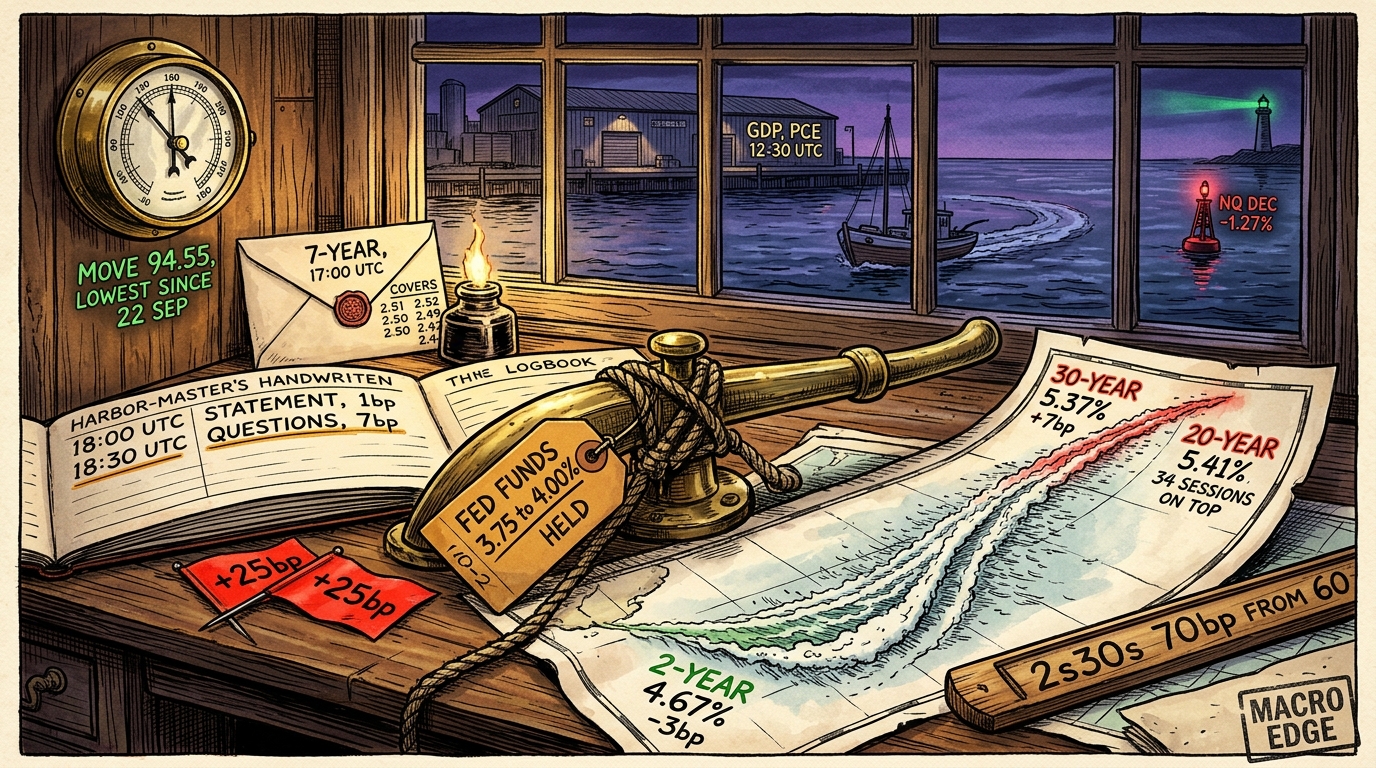
A 10-2 vote with both dissents for a hike, a 2-year down 3 basis points to 4.67%, a 30-year up 7 to 5.37%, and a MOVE index at its lowest close since 22 September
⚓ Weathervane. The wind is coming from the long end. The policy rate has been frozen for most of the year whilst the term premium does the tightening, and the price of long money is set by deficits, issuance supply and a synchronised global duration bid rather than by the committee. Higher-for-longer stopped being a Fed decision and became a bond-market fact. The cruise ship is holding this heading.
 Ahoy there, Trader! ⚓️
It’s Phil…
Why did the 30-year rise 7 basis points on the afternoon the Fed declined to raise anything?
The facts first. At 18:00 UTC the committee held at 3.75 to 4.00%, 10 votes to 2, both dissents for a quarter-point hike. The 2-year closed 4.67%, down 3 basis points; the 10-year 5.05%, up 6; the 20-year 5.41%, up 7, top of the curve for a 34th session; the 30-year 5.37%, up 7. 2s30s 70 from 60. The MOVE index closed 94.55, lowest since 22 September. The S&P 500 rose 0.28% with more New York listings falling than rising, and the count is of every New York listing, not of the index.
The textbook got the day backwards: a hawkish split should lift the front end, which prices the next vote, and leave the back end alone. The tape did the mirror: the front end eased after the questions started and the long end, untouched by any vote, finished 7 higher.
A labelled speculation. On the 2-year’s intraday path the statement bar moved it one basis point and the fifteen minutes after 18:30 UTC moved it seven, which passes the majority test. A press conference can be timed and not weighed, so it stays a sequence. Nothing here is a retrieved cause.
What we can hand over is yesterday’s test. Before the statement, this letter wrote that if the market had read it correctly the MOVE would close below 97.88 and the 2-year within 5 basis points of 4.70%. Both landed. The market had read the statement. The long end’s 7 basis points was not what the test measured, and on the 10-year’s path most of it was in before the statement. The gap is between the front of the curve, which took the hold as read, and the back, which charged more for thirty years.
So the next test. The 7-year prices at 17:00 UTC today against trailing covers of 2.51, 2.52, 2.50, 2.49, 2.50 and 2.42. If the 7 basis points was a higher price for duration, the auction clears below 2.42 and the 30-year holds above 5.30 through Friday’s close. If it was an afternoon’s noise, the auction clears inside the run and the 30-year gives the 7 back by Friday’s close. A cover above the run, or a split, settles nothing and will be said so. The cover is on tomorrow’s page, the level on Monday’s.
Phil’s Musing
I keep a picture of the committee as the hand on the tiller and the long end as the current. On Wednesday the hand did not move and the boat still turned. I do not think the dissents moved it; the 2-year went the other way. I cannot see what drives the current from where I sit.
Happy trading,
Phil
Less Brain, More Gain
…and may your trades be smoother than a cashmere codpiece
P.S. – Phils Footnote I assumed a hawkish dissent would be read as hawkish by the whole curve. The front end disagreed within fifteen minutes of the questions starting and the back end agreed with nobody in the room. I had the textbook the right way up and the curve the wrong way round, and the only thing that stopped me writing the wrong letter was a test I had written down the day before.