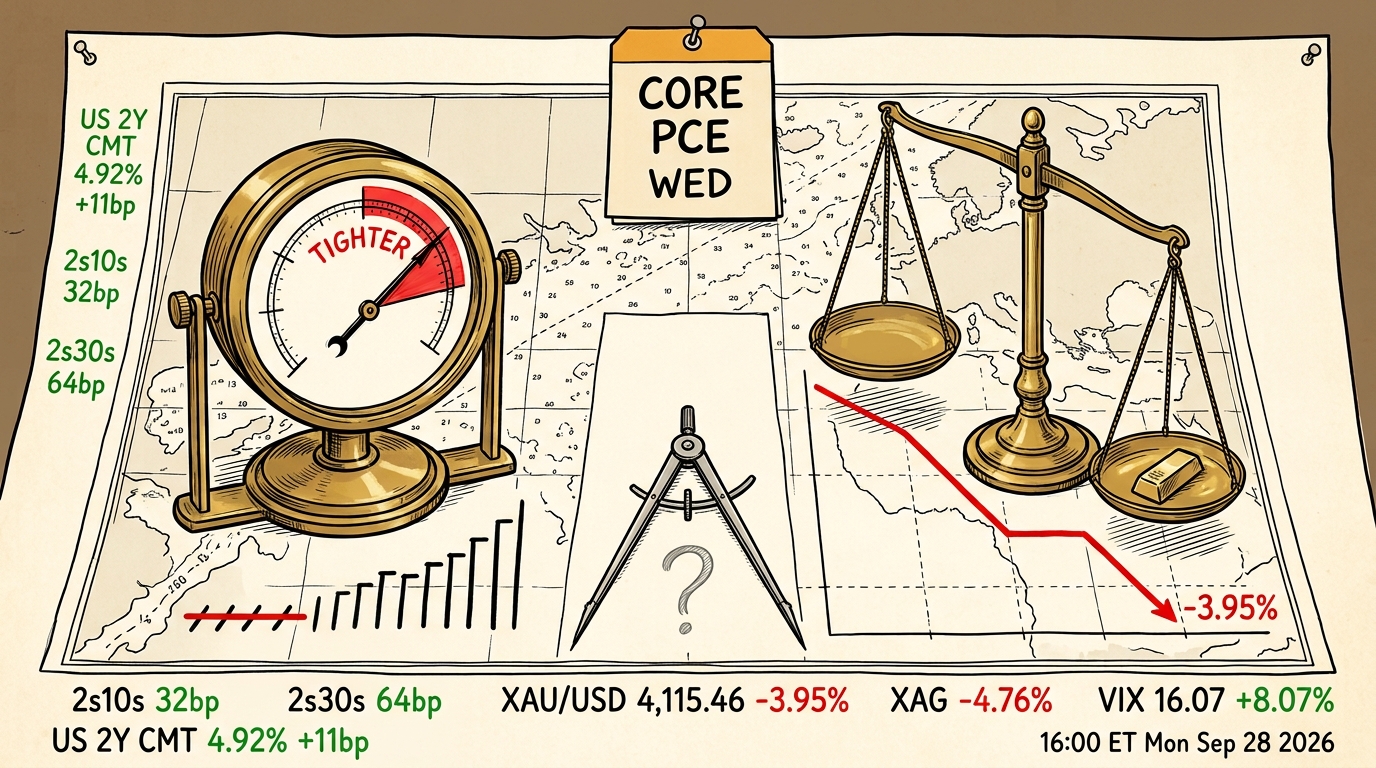
The 2-year rose 11 basis points, gold lost 3.95%, and both cannot be a considered view
⚓ Weathervane. The wind is coming from the long end. The policy rate has been frozen for most of the year whilst the term premium does the tightening, and the price of long money is set by deficits, issuance supply and a synchronised global duration bid rather than by the committee. Higher-for-longer stopped being a Fed decision and became a bond-market fact. The cruise ship is holding this heading.
 Ahoy there, Trader! ⚓️
It’s Phil…
If the market spent Monday pricing a harder fight against inflation, why did the inflation hedge fall 4%?
The common view of Monday is simple and most desks will file it that way. The 2-year rose eleven basis points to 4.92%, the curve flattened four basis points at both 2s10s and 2s30s, volatility rose 8.07%, and the dollar firmed. Hawkish repricing. Risk off. Next.
But sit with what a hawkish repricing actually asserts. It says the market now thinks inflation is more stubborn than it did on Friday, and that the committee must lean harder against it. Gold is the asset people own for precisely that belief. And gold spot fell 3.95% to 4,115.46, December silver 4.76%, December copper 1.96%. The insurance policy was sold hard on the day the risk got marked up.
The textbook expects those to move together, and it has a mechanism for when they do not. Gold competes with a real yield. If nominal rates rise on expected inflation, gold should hold or gain. If they rise because the real rate has risen, gold should fall, because a metal that pays nothing gets dearer against a bond that now pays more. So the two reconcile, and the reconciliation carries a claim: Monday was a real-rate move wearing an inflation costume.
Here we must be honest about what we hold. That reading is tidy and this letter cannot prove it: we have not retrieved the breakeven series that would split the nominal move into its real and inflation-expectation halves. The utilities and property sectors both fell on a day yields rose, which leans the same way without discriminating. It is a lean, not a demonstration. And it cuts against our standing heading: Monday’s tightening came from the front of the curve, not the long end.
And there is a second possibility nobody enjoys: a four percent fall in a metal may not be a view at all. It is a position being closed, by people who needed cash, whose opinion about 2028 inflation was never in the trade. Price is a vote, but not every vote is cast on the question printed at the top of the ballot.
Wednesday’s core PCE is forecast at 0.3% against 0.2%. That is the print which decides whether the speedboat turned for a reason.
Phil’s Musing
The bit that nags me is the three bills that did not move at all. One month, one and a half, two months: identical to Friday, to the basis point, whilst the 2-year did eleven. I want that to be the meeting date and the arithmetic will not let me have it, because two months from Monday is past the October meeting and those bills still sat still. So something set the boundary between two months and three, and I do not know what it was. I would rather tell you that than invent a reason that sounds good in a newsletter.
Happy trading,
Phil
Less Brain, More Gain
…and may your trades be smoother than a cashmere codpiece
P.S. – Phils Footnote I assumed, when the gold number first came through, that it was a bad print. It was not. Two routes agreed to within 0.033% and the carry only looked wrong because spot fell harder than the December contract. I spent twenty minutes trying to make a correct number go away because it disagreed with the story I had already started writing, which is a habit worth naming out loud so I catch it faster next time.