An index up 1.11%, 1,756 issues down, and 2 instruments telling different stories
⚓ Weathervane. The wind is coming from the long end. The policy rate has been frozen for most of the year whilst the term premium does the tightening, and the price of long money is set by deficits, issuance supply and a synchronised global duration bid rather than by the committee. Higher-for-longer stopped being a Fed decision and became a bond-market fact. The cruise ship is holding this heading.
 Ahoy there, Trader! ⚓️
It’s Phil…
Should an index be able to rise whilst more issues fall than rise, and which of the two is telling us about tomorrow?
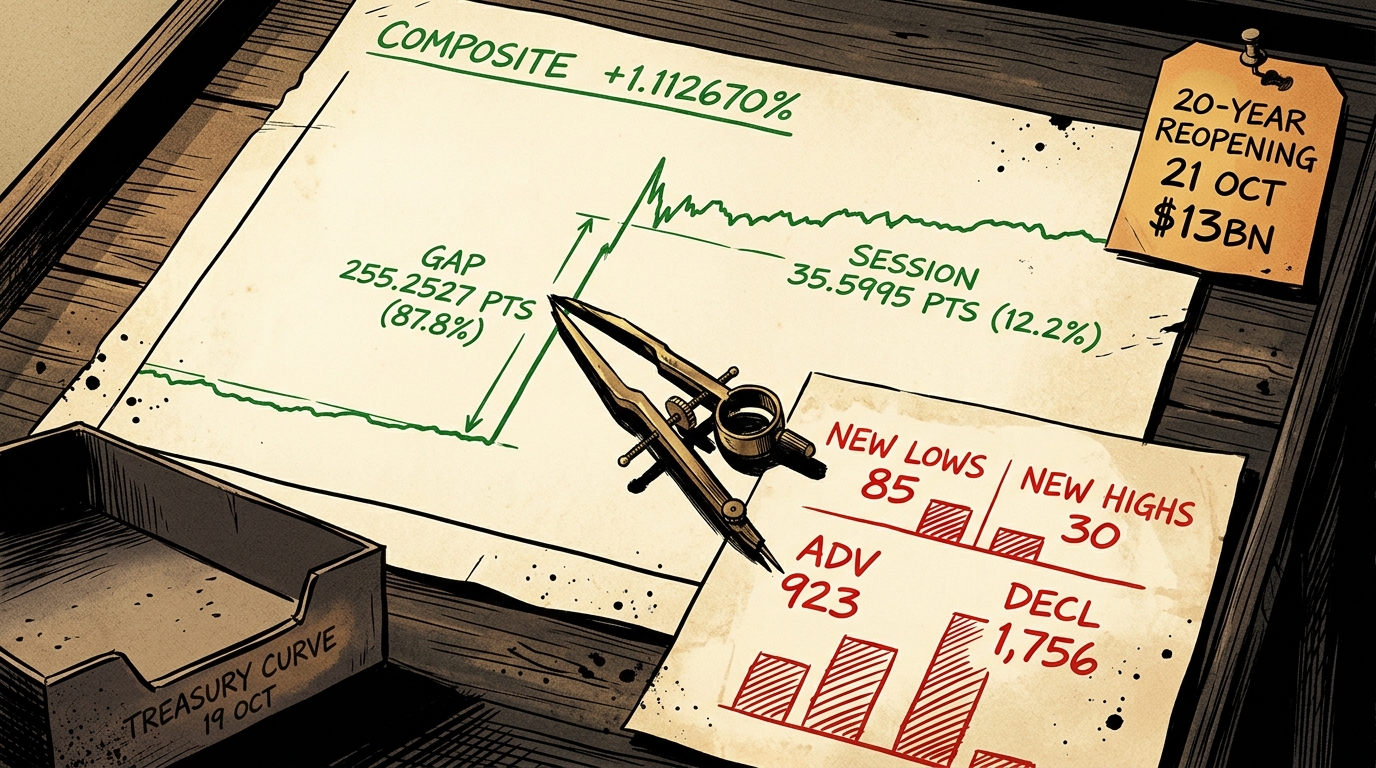
The arithmetic takes two lines and will not leave you alone. The Nasdaq Composite gained 290.8522 points on Monday: 255.2527 as an opening gap, 35.5995 during the six and a half hours the exchange was open. That is 87.760278% against 12.239722%. Most desks will report the 1.112670% and move on.
Set it against the issue counts. On the same session 923 NYSE issues rose and 1,756 fell, new lows more than doubled from 38 to 85 and new highs fell from 58 to 30. Nasdaq counted 16 new highs against 136 new lows.
The textbook expectation is specific enough to test. A broad index and its breadth should agree, an index being a weighted average of the things breadth counts. When they disagree, the orthodox reading is that a few very large constituents are carrying the index, and the orthodox forecast is that the narrow leg wins.
What the tape did was stranger. The index did not grind higher against falling breadth. It arrived higher, before the bell, and four of five then gave ground: the S&P 500 gapped 43.33 points and handed back 12.04. So the disagreement has two layers, not one.
Which answers the first half of the question, and not in the index’s favour. Yes, it can: a weighted average may rise whilst most of its members fall. A gap is a price struck when few can object; a cash session is six and a half hours of objection, and Monday’s objection was mild in the averages and emphatic in the counts.
We cannot tell you what caused the gap: no cause is named for Monday here, and the only US release with a reliable timestamp landed after the open. Nor what the Treasury curve did, there being no published 19 October curve on three routes. Hold that against the thesis above: it is a claim about the long end, and the long end is unobservable for the session this letter describes.
On the second half we lean towards the counts, with a condition. Eighty-five new lows measures the many; 1.112670% measures the few. If the gap keeps doing the work for three sessions whilst new lows keep expanding, the counts are describing tomorrow. If the cash session starts adding rather than giving ground, Monday was positioning and the counts were noise.
Phil’s Musing
I have more time for the counts than the averages this morning, and not because the counts are gloomier. An average can be moved by a handful of large members; a count cannot. And I notice the thesis line above is about the long end, which is the one thing I cannot see this morning at all.
Happy trading,
Phil
Less Brain, More Gain
…and may your trades be smoother than a cashmere codpiece
P.S. – Phils Footnote I had assumed, wrongly and for a long while, that a gap and a drift were the same animal measured at different speeds. Monday says otherwise. A gap is a price nobody argued with; a drift is a price everybody did. I cannot now think why I treated them as interchangeable.
🗂 Desk Notes – Part 232 | 20 Oct 2026
Raw briefing. Observations, not trades.
Session read (§8.4)
SESSION BRIDGE: prior session (Mon 19 Oct) full reaction December ES +0.392640%, December NQ +1.126176%, December YM -0.061286%, December RTY +0.248583%; live premarket ES +0.077575% / NQ -0.227101%, VIX 18.44 prior-session official cash close (no premarket VIX exists on this stack); threshold: none.
Threshold reasoning. §8.4.1 is specced on S&P futures and December ES moved 0.392640%, inside the normal envelope, so no carry-over fires. The volatility leg did not fire either: VIX moved 7.75388%, under the ±8% condition, and by 0.24612 of a percentage point. The commodity leg did not fire: December WTI moved 0.484751% against a ±4% condition. December NQ at 1.126176% sits in the investigate band on its own leg but the spec measures ES, and this is recorded rather than used.
§8.4.2 cash-magnitude triggers (Open Rulings item O), all three computed. Limb (a) FAILS on every index: the largest absolute move of the 49-observation window is the Composite’s own 2.260526% on 21 September, and Monday ranks 11th on the Composite, 9th on the 100, 29th on the S&P, 43rd on the Russell and 46th of 49 on the Dow. The 49-session dated series is held by the equities lane and is NOT carried in the lock, so those five ranks are attributed to the lane rather than restated as locked; only the 2.260526% and the window size are filed. Limb (b) FAILS: the best-to-worst sector spread is 3.792151 points against a 4.0 condition, having tripped at 5.547454 the session before. Limb (c) TRIPS: Cleveland-Cliffs moved 16.336634%. One of three trips, so the §8.3 board and the item P decomposition are both mandatory and both were run.
Close-to-open window. Monday cash close 16:00 ET to Tuesday premarket capture 06:30 to 06:35 UTC. The capture bar was read twice and returned byte-identical open, high, low, close and volume on all four December contracts, with the then-forming 07:05 UTC bar mutating on all four between the reads as the control. Four-contract confirmation is held for a second consecutive edition.
🔴 Capture timing, stated rather than certified away. The capture was taken at 07:08 UTC against a ~06:50 UTC maturity point, for a third consecutive edition, and the cause is identical each time: the main thread cannot act whilst blocked on parallel research lanes. No data was lost, a matured bar being settled history, and the bar window is stamped. The maturity point is roughly 06:50 UTC because a 5-minute bar is unsafe until about fifteen minutes after it CLOSES, and this bar closed 06:35. Lesson 126’s fix as written (capture first, then dispatch) is not executable when the run begins after 06:30 UTC, which it did. See the carried-forward note at the foot of this file.
Contract roll (§2.5). Not a quarterly equity-index roll. It is a crude roll: NYMEX:CLX2026 last trades about today, 20 October. December is decisively front month on both products, WTI December 290,820 lots against November’s 47,869, a ratio of 6.075331 from 3.384469 on Friday. Both products are front-December, so the standing “the two products run opposite ways” note stays lapsed.
The mechanism read (full)
The CMT table cannot be published for this session. There is no 19 October row in the Treasury CMT file, established on four distinct cache-busted fetches, one of which was asked the direct question and answered that the date does not occur anywhere in the document. H.15 dated 19 October carries its last data column at 16 October. The fiscal data auctions API returns null result fields for the two 19 October bills that have already auctioned, whilst 13 to 15 October rows are fully populated. Three structurally independent Treasury-side routes are all exactly one session behind, which is itself the finding: this is a publication lag, not three faults.
The latest published curve is therefore 16 October, carried for reference only and not restated as current: 2-year 4.74, 10-year 5.09, 20-year 5.47, 30-year 5.43; 2s10s +35.0bp, 2s30s +69.0bp, 20-year clearing the 30-year by 4.0bp. The 20-year holds the strict maximum of all fourteen tenors. The verified clearance run is 26 consecutive published sessions, 10 September to 16 October, with the break retrieved at 9 September on a 0.0bp print, so the window is bounded rather than truncated. It cannot be advanced to 27: there is no 19 October row to advance it with.
What moved. The Nasdaq Composite closed 26,430.8862, up 1.112670%, and the 100 closed 29,529.3445, up 1.171033%, 5.8363 basis points apart. The S&P 500 took 0.408516%, the Russell 0.254579%, and the Dow lost 0.069958%. Volatility fell 7.75388% to 18.44 against a three-month at 19.60, a ratio of 0.940816 and a spread of 1.16 points, so the curve stayed in contango and deepened: on Friday the ratio was 0.975122 and the spread 0.51. Bond volatility rose 0.19513% to 101.3087. The dollar firmed 0.19061% to 101.973 and the yen weakened to 158.486.
What it implies. The causal picture is a gap, and the gap has no antecedent this book can name. The item P decomposition on the Composite is 87.760278% opening gap against 12.239722% intraday, summing to 100 with a residual inside 1e-6. The only tier-1 timestamped US release of the session, the NAHB index at 29, landed 10:00 ET against a 09:30 ET cash open, so it is after the gap entirely and cannot have bought any of it. lock_part232.json is filed with named_cause: null and majority_unexplained: true and validates clean at 312 figures, zero failures, zero warnings.
🔴 Lesson 124 applied, and it bit on three indices this session. The decomposition was computed on all five. The gap and the total share a sign on all five, but the proportion test fails on the S&P, the 100 and the Russell: each gapped up and then partially reversed, giving shares of 138.478747%, 102.916098% and 111.273086% against negative intraday legs. A share above 100 is not a proportion and a negative share is not a contribution, so those three are published in points only. The Composite at 87.760278 / 12.239722 and the Dow at 65.503024 / 34.496976 are the two publishable as proportions, and the Composite is the spine.
The one artery. Not a release and not a sector. It is the open itself. Four of five indices did their net work in the gap and then leaked inside the cash session, whilst the issue counts went the other way: NYSE advancers 923 against 1,756 decliners for a ratio of 0.525626, new lows up from 38 to 85 and new highs down from 58 to 30, Nasdaq 16 new highs against 136 new lows. Up volume took 34.012425% of NYSE’s advancing-and-declining total whilst Nasdaq’s took 53.312680%, which is a cap-weighted bounce on narrow participation. These are two different quantities and no reconciliation between them is claimed or available.
Volume integrity. NYSE up plus down volume is 1,129,249,117 against a total of 1,138,710,730, a residual of 9,461,613 shares and 0.830906%. Positive, so the standard framing is publishable. The tracked series now reads 1.689428%, 1.296365%, -0.863378%, 0.911154%, 1.146937%, 0.830906%, with the 14 October negative remaining the one logged exception. Monday’s is the smallest positive of the six, stated as a six-session observation and no more. Nasdaq’s residual remains not computable and no canonical Nasdaq total-volume prefix was tested this run, so it is untested rather than unavailable.
Overnight Excitement (§8.5)
Did not fire, and nothing is manufactured. The trigger is US futures overnight movement and the largest absolute reading across the four December contracts is YM at 0.283623%, below even the 0.3% floor of the normal band. No non-US central bank decision landed inside the 19 October session itself.
For the record rather than as a trigger: the People’s Bank held both loan prime rates at 3.0% and 3.5% at 01:00 UTC today; China’s Q3 bloc landed on 19 October with GDP 4.5% year on year, retail sales 1.1% and industrial production 5.5%, and no forecast for any of the three is held here, so none is called a beat; UK employment change printed 102,000 against a 20,000 forecast this morning; and German producer prices accelerated to 6.7% year on year from 4.6%, the overnight print most worth a second look, and it sits beside rather than on the crude thread: no instrument held here links the two. European equities closed lower on Monday, on syndicated reports, direction only. No non-US cash index level is published, there being no tier-1 route to any on this stack. Asian equity direction for the 19 to 20 October overnight is not established here and is not asserted.
The forward catalyst slate
- Today, 20 Oct: housing starts and building permits 08:30 ET, both timestamps established on the TradingView route rather than by ForexFactory layout adjacency. ADP weekly employment 08:15 ET. Pending home sales 10:00 ET. State employment and unemployment 10:00 ET, confirmed on the BLS primary and absent from both the TradingView and ForexFactory calendars entirely. A 6-week bill auctions 11:30 ET. Forecast and previous figures conflict across the two routes on every major row, so none is published as a point figure.
- Tomorrow, 21 Oct: the $13bn 20-year reopening prices 13:00 ET, on the
19-Year 10-Monthstring, CUSIP 912810UX4, landing directly on the tenor that has held the strict curve maximum. Usual weekly earnings 10:00 ET. - 22 Oct: a $26bn 5-year NOTE, CUSIP 91282CRR4. 🔴 One calendar labels the same 13:00 ET slot a 5-year TIPS auction. The fiscal data API returns exactly one record and it is nominal. A TIPS auction is not confirmed and is not published. Initial claims 08:30 ET, Kansas City Fed 11:00 ET.
- 23 Oct: S&P Global flash PMIs 09:45 ET, Michigan final 10:00 ET.
- 27 to 28 Oct: FOMC, two days, statement 14:00 ET on the 28th, press conference 14:30, no projection round, re-confirmed from the Fed’s own October page.
- What is NOT this week, and it is commonly misplaced: there is no CPI and no PPI inside any ten-session window from here. September CPI released 14 October and September PPI 15 October; the next CPI is 10 November and the next PPI 13 November, both confirmed against the BLS October and November schedules. The 27 to 28 October FOMC therefore meets with no further CPI or PPI print in hand.
- Coiled: the November WTI contract expires today, so no multi-session WTI front-month superlative is publishable past today without a splice, and a mixed-contract window is forbidden.
Shot marks. Both live shots are scored in the refreshed ledger for this edition and not here: the Part 225 cross-exchange breadth shot and the Part 229 credit shot. Neither verdict appears in any outward file.
Divergence flags
- 🔴 The index rose and the issue counts fell, on both exchanges. Ratios 0.525626 and 0.891892, both below 1.000, with new highs and new lows also both below 1.000 on both exchanges. Third consecutive edition on which breadth has not ratified the index.
- 🔴 Investment grade and high yield moved in opposite spread directions. Duration-neutral against the long Treasury proxy: investment grade captured 0.502901% against an expected 0.376466% on a 0.510782 duration ratio, a residual of -0.126435 points, so spread widened; high yield captured 0.039032% against an expected 0.159924% on a 0.216981 ratio, a residual of +0.120892 points, so spread tightened. The published option-adjusted spreads agree on each sign independently, 3.30bp wider and 3.66bp tighter. Two caveats, and together they make both signs INDICATIVE rather than established, which is how all four outward files now carry them. First, the durations AND the published spread changes are stamped 15 to 16 October whilst the price move is 16 to 19 October, so the corroborating route measures a different period from the claim. Second, the two funds sit at different points on the curve, so a curve-shape move is conflated with a pure spread move.
- 🔴 A Goldman Sachs buy upgrade with a 31% target raise sat beside a lower close. CoreWeave, target lifted to $139 from $106 on a tier-3 relay with the house named, closed 0.439811% lower on 2.555224 times its 20-session mean volume whilst its sector rose 1.730882%. It is also down 21.449685% compounded over four sessions, which is the larger fact and is published in the Snippet. No order of events is asserted: the article body stamps the note 10:00 ET and the feed stamps it 15:49 ET, and on either stamp it fails the majority test. This is an item N column-two candidate, though not at full strength whilst the stamp is unresolved.
- 🔴 A $235m contract award sat beside a 0.95% lower close, reported pre-open on a single secondary route. Both figures are tier-3 relays and neither appears in any outward table.
- 🔧 The two semiconductor proxies diverged 0.124702 points, SOXX 1.730882% against SMH 1.606180%, the narrowest of the five held observations. Two proxies confirm direction and magnitude and never each other’s figure.
- 🔧 Volatility fell 7.75388% whilst bond volatility rose 0.19513%. A 7.94901-point divergence in the opposite configuration to Friday’s, when equity volatility rose 21.44593% and bond volatility fell 1.351941%.
- 🔧 Bitcoin took its largest held-window inflow on the session ether logged its fourth consecutive outflow. $526.7m against -$103.3m, and ether fell only 0.467365 times bitcoin’s magnitude, the first inversion in a collapsing series that ran 1.269, then 1.016055.
- 🔧 Zero of 70 sampled posts across the seven loudest tickers referenced today’s scheduled US data. This is a fresh observation on a different denominator and symbol basis from the carried nine-of-thirty reading and must not be differenced against it. No other count from that sample is published anywhere.
The §8.3 candidate cause board (Open Rulings items N and R)
Column one, effects without causes.
| Candidate | Class | Timestamp | Precedes the majority? | Large enough? |
|---|---|---|---|---|
| The Composite’s 87.760278% opening gap | 6, none identified | gap complete at 09:30 ET | n/a | n/a |
| NAHB at 29 | 1, scheduled release | 10:00 ET | NO, after the open and the gap | no |
| China Q3 bloc, actuals only, no held forecast | 1, scheduled release | 02:00 UTC 19 Oct | yes, precedes the gap | unquantifiable here, no US transmission instrument held |
| “Investors returned to the AI play” | 3, headline | 19:00 ET, 3h after the close | NO | n/a, post-hoc description |
| Broker upgrade of a neocloud name | 2, named event | 10:00 ET per the article body, 15:49 ET per the feed stamp | NO on either stamp for a full-session move | no, and it moved the name the wrong way |
| Treasury Secretary remarks on the September print | 3, headline | 08:23 ET, 1h37m pre-open | yes, and 1 of 2 antecedents on this board | not sized, and no instrument ties it |
🔴 The hard constraint, and it is the strongest finding of the run. The same 08:23 ET wire records in its own body that the Nasdaq-100 was already up 1.10% in premarket trading, a figure quoted from that body on a tier-3 relay and not a lock measurement. It closed up 1.171033%. Almost the whole of the session’s net index gain was therefore on the board before the US cash open, and the cash session subtracted from it: the locked intraday share is minus 2.916098%. Every intraday Monday headline is a candidate for a negative share of the day’s net index move rather than a positive one. No cause is crowned. The item Q sentence is published instead. Stated by block rather than certified: the licensed quantified form sits in the AntiVestor Edge PART 2 cold-open body prose, second paragraph, and nowhere else in quantified form; unquantified variants sit in the Inside Edge cross-asset read-block paragraph, the Macro Edge letter body and a Social Snippet body paragraph. The AntiVestor Edge cold-open also states the admission’s scope boundary in prose, because the admission covers the Composite and nothing else.
Column two, causes without effects. This column is not optional and it is not an appendix item.
- A buy upgrade and a 31% target raise on a neocloud name, which closed lower whilst its sector rose 1.730882%. Full strength.
- The most apocalyptic AI-capex call on the tape, restated on Monday, against the best Composite session in nearly a month. Feed stamped 18:07 ET, after the close, so it is untestable against Monday and is reported as such rather than as a cause.
- A $235m defence contract award that moved its recipient 0.95% lower, on a secondary route, pre-open.
- China printing an entire quarterly bloc with no US instrument responding to it that this book can isolate.
Null rate note (Open Rulings item S calibration). No sufficient cause was identified. That is the third consecutive edition returning a null on the cause question, and the calibration warning cuts both ways: a board that finds a cause every day is confabulating, and a board that finds none for twenty editions is not reading the market either. Three is not yet a pattern to worry about.
Carry-over note (§10.6)
Does not fire. §8.4.1 returned none on every leg and Phil has flagged no catalyst. No recap is manufactured.
Regime and sensitivity read (§17.3)
Running LOOSE, forty-third consecutive edition, stated openly rather than presented as neutral. The diagnosis is unchanged and remains specification rather than tuning.
And this edition sharpens it in a ninth consecutive way. The spine is a decomposition of an index move into a gap and an intraday leg, and not one of the six candidates is pointed at market microstructure or at the open itself. Five are rates or dollar candidates and the sixth is retired. The proposed eighth candidate from Part 231, the spot-to-three-month volatility ratio rising more than 0.070 in a session without inverting, is scored this edition and does NOT fire: the ratio FELL 0.034306, from 0.975122 to 0.940816. A candidate that fires once and then correctly stays silent is behaving like a threshold, which is more than two of the existing six can say.
🔴 Proposed ninth candidate, with a numeric threshold attached at proposal, because the spine has now landed outside the candidate set on nine consecutive mornings: the opening gap accounting for more than 80% of a headline index’s net daily move, on three or more sessions inside ten, whilst that exchange’s advance/decline ratio closes below 1.000 on the same sessions. Monday satisfies both limbs on one session, which is one of the three the condition requires, so the candidate has NOT fired and could not have on a single session. It needs five figures this book already fetches every edition, no duration, no positioning data and no flow series, which is the test the other six keep failing. 🔧 It cannot be scored as a base rate yet: the gap decomposition has been computed on two editions, which is the same two-observation problem that declined the volatility shot, and that is the honest limitation.
Weathervane turn condition: progress 0 of 2, twenty-second consecutive non-advance, and inapplicable on the antecedent limb for a fourth consecutive edition. No Board governor prepared speech text exists for 19 or 20 October, established on two cache-busted reads of the authoritative path, and in any case there is no 19 October DGS2 print to measure a move against. Splitting the condition into two separately scored legs, one for communication-driven moves and one for data-driven moves, remains the strongest standing recommendation in the ledger and is now twenty-one editions unanswered.
Operational notes carried forward
- 🔴 Lesson 126 is not executable as written and wants re-specifying. It says the main thread’s first action after pre-flight is a timed wait to the capture-bar maturity point and the capture, and only then the dispatch. This run began at 06:16 UTC, before the 06:30 UTC capture bar existed, and the wait to maturity would have been roughly thirty-five idle minutes against an 08:30 UK review. The run dispatched first and captured at 07:08 UTC. The protocol passed on all four contracts and no data was lost, but the capture was late for a third consecutive edition. The real constraint is that a main thread blocked on parallel lanes cannot act, so the only executable forms are: start the run before 06:30 UTC and capture first, or accept the idle wait as a budgeted cost. This is Phil’s call and is flagged rather than resolved.
- 🔴 ForexFactory served Eastern Time directly this edition with no minus-one-hour offset, its page stating
America/New York, verified against two independent TradingView UTC stamps. The standing registry note adds an hour. Applying it would have put NAHB at 11:00 ET and building permits at 09:30 ET, both wrong. The offset is evidently conditional on the page’s own timezone setting. Registry note needs a condition and the timezone string wants checking every fetch. - 🟢
mcp-tv-get-economic-calendartakesdate_fromanddate_to, notfromandto. A new schema trap, cost one failed call, worth recording beside theinterval/countone. - 🟢 An independent sector route exists and reconciles. It matched the leader ordering and the eight-down count exactly. It is itself an ETF-proxy read, so the cap-weighted basis stays unreconciled, but the registry’s claim that no such route survives is out of date.
- 🟢 The high-yield iShares page was NOT stale this run, returning 3.22 years and 293.16bp stamped 16 October rather than the warned June figures. Recommend reclassifying it from “known stale” to “intermittently stale, verify the stamp”.
- 🟢 ICE Brent’s bar stamping is rule-governed, not arbitrary: Monday trade dates carry the Sunday 22:00 UTC stamp and Tuesday to Friday carry 00:00 same-day, verified across 30 consecutive December sessions.
- 🟢 The EnergyNow dated-article route works and restates prior settlements to the cent; its category index remains broken and its same-session marks are pre-settlement indicative and barred from any settlement dispute.
- 🔴 The §18 migration backlog now runs Lesson 39 through Lesson 136, ninety-eight lessons deep, and §18 still ends at Lesson 38. Not actioned unattended. MIP 11.1 still does not exist, so
AVE_Open_Rulings.mditems M to AC remain operative instruction over MIP 11.0. - 🔴 The Part 209 ruling on whether a routine scheduled auction counts as an issuance-side operation is now fifteen days past its deadline with thirteen auctions unscored, and a $13bn 20-year reopening prices tomorrow directly onto the tenor that thread tracks.