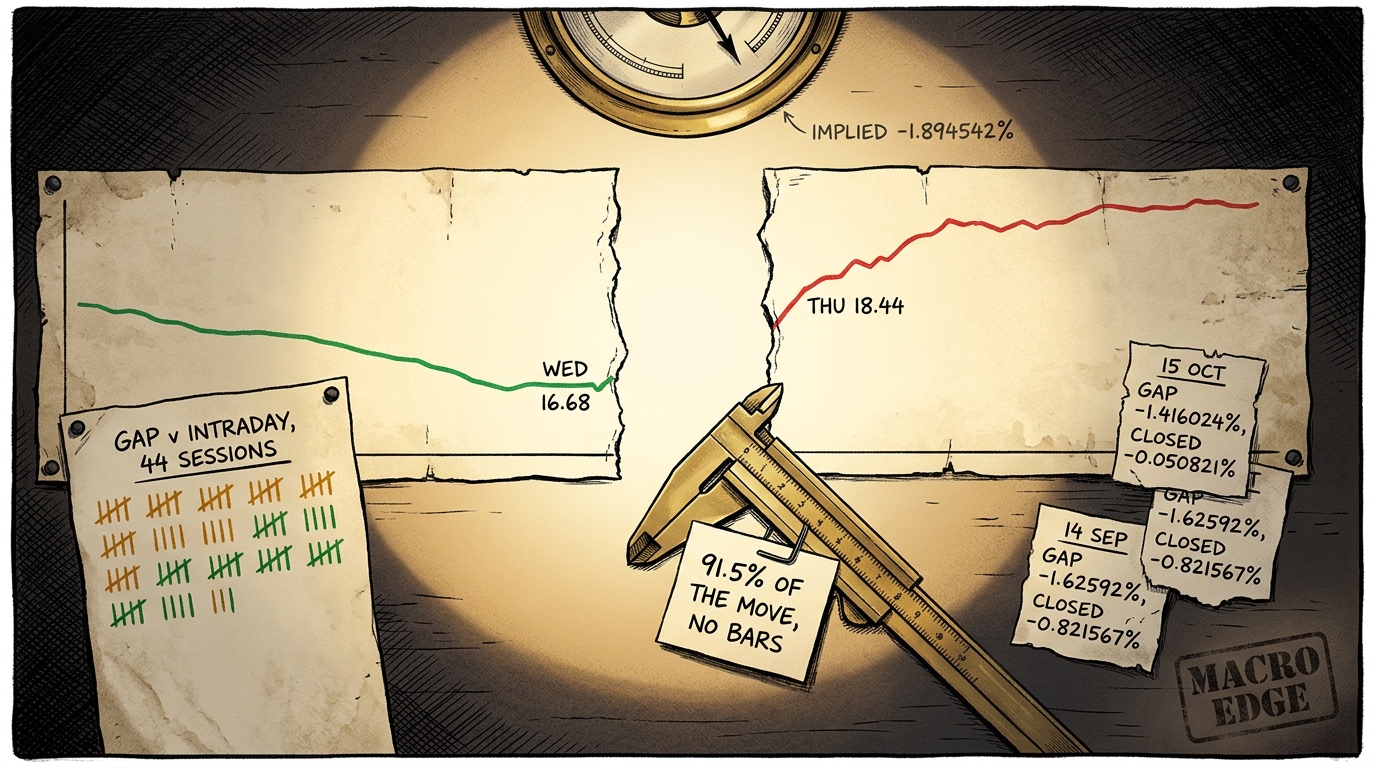
Equity volatility closed 16.68 and reads 18.44 before the open, and 91% of that move is unobservable
⚓ Weathervane. The wind is coming from the long end. The policy rate has been frozen for most of the year whilst the term premium does the tightening, and the price of long money is set by deficits, issuance supply and a synchronised global duration bid rather than by the committee. Higher-for-longer stopped being a Fed decision and became a bond-market fact. The cruise ship is holding this heading.
 Ahoy there, Trader! ⚓️
It’s Phil…
If both volatility measures fell on Wednesday and equity volatility is 10.6% higher before Thursday’s open, which of those two prices was wrong?
Put the two sessions side by side. Wednesday: equity volatility 16.68, down 3.6%; bond volatility 95.9, down 5.7%, its largest fall of the nine observations held; the Nasdaq 100 up 1.1%; the volatility curve comfortably in contango. Thursday premarket: equity volatility 18.44 on the 09:15 UTC bar, up 10.6%; December Nasdaq futures 1.9% lower; Brent 2.9% dearer. Two of Wednesday’s four legs have reversed. The other two, bond volatility and the term structure, have no premarket series on this stack, so the honest count is two of four rather than all of them.
A volatility measure is a forecast, so Wednesday’s 16.68 was a statement about Thursday. Thursday disagrees by 10.6%.
The uncomfortable part is a limit, not a finding: the series that moved most cannot be timed. CBOE’s index publishes no bars from 20:15 UTC on Wednesday to 07:15 UTC on Thursday, and the first bar after that eleven-hour hole opens at 18.29. So 1.61 of the 1.76 points, 91% of the move, happened where there are no observations. The level reproduces on two reads. The minute does not exist, and nor does the reason.
Now the open’s question, on the population that matches it. The implied gap, 1.9% off a same-index basis struck as 30,007 less 29,822.5, is steeper than any gap in the 44 sessions from 20 August to 21 October. Of the 22 that opened lower, four closed above the prior close, and the steepest to manage it was 24 September’s 0.8%, under half this morning’s. No counter-example in 22 observations: a gap this steep does not fully reverse.
What it does get is clawed back, by wildly varying amounts. The five steepest recovered 96% of the gap on 15 October, 63% on 13 October, 49% on 14 September, 5% on 1 September and 2% on 10 September. Same setup, almost nothing to almost everything.
So the direction is close to settled, the magnitude is not, and a view on the magnitude before 14:30 UK carries a very wide prior.
Phil’s Musing
I have spent too many editions writing “no cause is available” and treating that as the end of the work. It is the end of the evidence, which is a different place to stop. So this morning I named candidates, and the checking pass then did to me what it should: the framing I led with is stamped 08:38 and 09:00, by which point the futures had made 98% of the move. My lead candidate post-dates nearly all of what it explains. Speculating was not the error. Letting a candidate go first without clearing the clock was.
Happy trading,
Phil
Less Brain, More Gain
…and may your trades be smoother than a cashmere codpiece
P.S. – Phils Footnote My wrong assumption was that the overnight is a footnote to the session. Here it is larger on every instrument I hold. Two fixes: widen the set of figures I re-quote before publishing, because crude was not in it and moved nearly 3%, and check every implied open against its own index’s basis, because I used the S&P’s and was out by 141 points.
🗂 Desk Notes – Part 234 | 22 Oct 2026
Raw briefing. Observations only. Nothing here names a trade.
Session read (§8.4)
SESSION BRIDGE: prior session (Wed 21 Oct) full reaction cash SPX +0.58% to 7,757.17, NDX +1.13% to 29,822.52, IXIC +1.05%, DJI +0.69%, RUT +0.16%, plus five heavyweight reporters after the close; live premarket ES -0.92% / NQ -1.65%, VIX 16.68 prior-session cash close; threshold: soft.
Threshold reasoning. The prior cash session sat inside the normal envelope at 0.58%. The premarket leg did not: December S&P futures at minus 0.92% is outside the roughly 0.6% band this book calls normal, which fires the soft trigger on its own leg provided a catalyst can be named. One can be: Meta, Tesla, IBM, Texas Instruments and Lam Research all filed results on 21 October, confirmed on filings rather than on a calendar. So the carry-over note below fires.
🔴 A GAP IN THE BRIDGE, STATED RATHER THAN SMOOTHED. §8.4.1’s thresholds are specified on S&P FUTURES and this edition holds no December ES session change for 21 October, only its 21 October settlement of 7,800.25. The cash index is used as the prior-session proxy and prior_session_pct in the lock carries the cash figure. That is a substitution and it is named here rather than left to be inferred.
Volatility leg: VIX moved 3.64% against a ±8% condition, missing by 4.36 percentage points. Does not fire. Commodity leg: December WTI moved 0.68% against ±4%, missing by 3.32 percentage points. Does not fire.
§8.4.2 cash-magnitude trigger, all three limbs scored.
- Limb (a), an index posting its largest or second-largest daily move of the held window: NOT ESTABLISHED. No return window is held for any headline index this edition. Recorded as not established rather than as not fired, per Lesson 142.
- Limb (b), best-to-worst sector spread above 4.0 percentage points: FAILS at 2.78 percentage points, 1.22 below the condition.
- Limb (c), a named constituent in the tables moving more than 10%: FAILS. The largest in the retrieved set is SpaceX at 7.79%, 2.21 percentage points short. A board row shows a biotech at minus 11.04%, but it is a POST_MARKET attention-board figure rather than a verified close and it is not a named constituent in either table, so it is not used.
The §8.3 board and the timestamp decomposition were run anyway, both being mandatory every edition.
Close-to-open window. Wednesday’s cash close 20:00 UTC to the 06:30 UTC capture is 10 hours 30 minutes, with five result filings inside it.
Contract roll (§2.5). No quarterly equity-index roll is near: the third Friday of December is 18 December. December is front on all four equity contracts. 🔴 Two commodity rolls do matter. November WTI expired 20 October, so December WTI is front and no multi-session WTI front-month superlative is publishable without a splice; the only legitimate window is CLZ2026‘s own series. December Brent last trades 30 October, six trading sessions after today, by the contract rule and without a fetch. Its front-month volume ratio has already narrowed to 1.28 from 1.33 whilst WTI’s widened to 2.61 from 2.36. The two products run opposite ways and each front month was re-established on its own volumes.
Mechanism read (full)
The front end. 2-year CMT 4.79 on the newest published session, which is 20 October, up 2.0 basis points from 4.77.
The long end. 10-year 5.12, down 3.0. 20-year 5.47, down 6.0. 30-year 5.42, down 6.0. A twist flattener: the 2-year rose 2.0 whilst the long end fell, which is the inverse shape of 19 October’s bear steepener. 2s10s 33.0 from 38.0, flattening 5.0. 2s30s 63.0 from 71.0, flattening 8.0. 20s30s unchanged at 5.0.
The full published curve, 20 October, parsed by header name after asserting the schema literally.
| Tenor | 20 Oct |
|---|---|
| 1 Mo | 4.10 |
| 1.5 Month | 4.13 |
| 2 Mo | 4.17 |
| 3 Mo | 4.26 |
| 4 Mo | 4.34 |
| 6 Mo | 4.36 |
| 1 Yr | 4.51 |
| 2 Yr | 4.79 |
| 3 Yr | 4.86 |
| 5 Yr | 4.94 |
| 7 Yr | 5.02 |
| 10 Yr | 5.12 |
| 20 Yr | 5.47 |
| 30 Yr | 5.42 |
The 20-year holds the strict maximum of all fourteen tenors at 5.47, recomputed in code: exactly one tenor equals the maximum. The verified run extends to 28 consecutive sessions, 10 September to 20 October inclusive, bounded at the start by a 5.28 tie with the 30-year on 9 September. The prior 27 sessions are carried as verified and 20 October is verified here.
🔴 THE TREASURY PUBLICATION LAG IS NOW THREE EDITIONS OLD AND HAS ADVANCED ONE SESSION WITHOUT CLOSING. Parts 232 and 233 topped out at 19 October; this edition tops out at 20 October. Three cache-busted fetches agree, the third asked the existence question directly and returned an explicit no, and H.15 released 21 October carries its last column at 20 October. H.15 matched 55 of 55 overlapping cells with all five date columns mutually distinct, so the duplicate-and-relabel bug did not recur. Treat a missing newest session as the expected state.
🔴 AND THE 20-YEAR REOPENING HAS NO RESULT AT ALL. The 13 billion dollar reopening priced 13:00 ET on 21 October. The fiscal data record for that date exists and every one of its seven result fields is null: high yield, average median yield, bid-to-cover, total accepted, primary dealer accepted, indirect accepted and direct accepted. Publish no stop, no cover and no shares. The comparator is the identical bond’s September reopening at a 5.42 stop on a 2.57 cover, with indirect 52.47% and dealer 16.85%. September’s 5.42 against July’s 5.16 is 25.7 basis points, which is why July is the wrong comparator; today has no stop at all, so there is nothing to compare in either direction. No when-issued level is obtainable on any permitted route, so no tail is computable and none is published.
🔴 A RELAY CARRIES A STOP AND IT IS NOT PUBLISHED. The economic calendar reports a 20-year bond yield actual stamped at the exact 13:00 ET pricing time, with a previous that correctly matches September’s 5.42. It is plausible, internally consistent and correctly timestamped, and it is a tier 3 relay against an empty tier 1 primary. Its value is therefore recorded nowhere, here included, because Desk Notes is itself an outward file.
The dollar. 101.69, minus 0.04%. Under four basis points of index change on a session when bond volatility fell 5.66%. The move did not transmit to foreign exchange at all. The yen at 158.13 was 0.01% stronger, which is nothing. The six-leg rebuild is on its every-third-edition schedule and was not run; the yen leg was captured regardless as a standing panel leg.
Volatility. VIX 16.68, minus 3.64%. VIX3M 18.72, minus 1.42%. Ratio 0.89 from 0.91, so the curve deepened into contango, spread 2.04 points from 1.68. 🔴 AND THE WHOLE OF THAT READING IS ALREADY REVERSED: the premarket series reads 18.44 on the 09:15 UTC bar, up 10.6% on the close, high 18.57, low 18.18 across nine fifteen-minute bars. See the route finding below, because this series is not supposed to exist on this stack. Recomputed over the twelve sessions 6 to 21 October: all twelve below 1.00, no inversion anywhere in the window. 21 October’s 0.89 is not the window low, which is 9 October at 0.84, so no superlative on the ratio is available or claimed.
Bond volatility. 95.95 from 101.70, minus 5.66%. The largest single-session decline across the nine return observations from 7 to 21 October, window held in the lock as returns rather than closes so the window measures the same quantity as the claim.
The one artery, and the first cut of this read was wrong about it. Both volatility measures fell and the two exchanges then filed opposite reports on participation. New York closed 1,318 up against 1,344 down for a ratio of 0.98, up volume 0.91 of down volume. Nasdaq closed 2,726 up against 2,138 down for a ratio of 1.28, up volume 1.73 of down volume. Both counts cover every listed issue on their exchange. One narrowed and one broadened, and the only internal they agree on is net new highs less new lows, minus 5 and minus 31. 🔴 The first cut of this edition asserted that participation did not broaden, which is true of New York and false of Nasdaq, and the index the spine sits on trades on Nasdaq. The §14.2b pass caught it. The Nasdaq 100’s move was 65.23% an opening gap and technology was the only sector proxy above 1%, so leadership was narrow on that index whatever the exchange count did. No ordering between the volatility fall and either equity reading is asserted: they are same-day closes and nothing separates them in time.
Credit and duration. High yield plus 0.20%, investment grade minus 0.01% (one cent, indistinguishable from unchanged), long Treasury plus 0.14%. 🔴 No spread sign is assertable in either direction. Effective durations are now held, 2.99, 7.59 and 14.85 years, but the high-yield figure is stamped 18 June 2026, four months before the price move it would be applied to, and the other two are stamped 20 October against a 20-to-21 October move. A duration stamped outside the window measures a different period from the claim. Lesson 134 applied for a third edition.
The named set. SpaceX plus 7.79% and Strategy plus 7.54% are the two largest single-name moves in the retrieved set, both on a day the Nasdaq 100 added 1.13%. Dell plus 5.27%, Palantir plus 4.74%, Nvidia plus 2.54%, Micron plus 1.96%, TSMC plus 1.60%, CoreWeave minus 0.50%, Amazon minus 0.10%. 🔧 Of those nine, only Dell carries a timestamped antecedent. Strategy is a bitcoin-proxy and no cause is asserted for it; the only timestamped candidate retrieved for it is a bitcoin headline stamped 19:14:06Z, which is five and three quarter hours into a six and a half hour session.
Semiconductors. Both proxies up, 2.07% and 1.89%, outperforming the Nasdaq 100’s 1.13% and technology’s 1.67%. Divergence 0.18 percentage points, the seventh held observation and the fourth-smallest of the seven. Series: 0.31, 0.53, 0.14, 0.73, 0.12, 0.000, 0.18. The open shot filed yesterday scores this as a non-falsifier session.
Breadth integrity. NYSE up volume plus down volume falls short of total volume by 30,607,006 shares, a residual of plus 2.62%, the highest of the tracked series and comfortably positive. The standard framing is therefore publishable this session, unlike at Part 229 where the residual went negative. Series: 0.99%, 2.04%, 1.50%, 1.69%, 1.30%, minus 0.86%, plus 2.62%. Nasdaq’s residual remains uncomputable, there being no working Nasdaq total-volume symbol.
🟢 A GAP CLOSED, AND IT OVERTURNS A FRAME THIS BOOK WAS USING. The 24 September to 19 October interval of the NYSE advance-decline series had never been pulled. It was retrieved this morning in one call as a dated series. 15 October printed 3.03, which is higher than 20 October’s 2.11 and sits squarely in the stretch nobody had looked at. So 20 October was neither the first session above 2.0 nor the outlier of the stretch, and the held base rate of thirty-two sessions with zero above 2.0 remains accurate for its own window and is false for 24 September onwards, which has two. The full 40-session window, 26 August to 21 October, is frozen into the lock: median 0.81, mean 0.95, min 0.25, max 3.03.
Route finding: the premarket VIX series exists, which overturns a standing registry entry
🟢 CBOE:VIX PUBLISHES A PREMARKET SERIES AND THE REGISTRY SAYS IT DOES NOT. Part 218 recorded, as a structural absence to stop retrying, that there is no premarket VIX bar on this stack. There is. Read twice at 5m and 15m with agreeing values, the series carries nine fifteen-minute bars from 07:15:00Z to 09:29:59Z on 22 October: opens 18.29, high 18.57, low 18.18, latest completed close 18.44. The last bar of the 21 October cash session closes 16.68, matching the locked official close exactly, which is what dates the series rather than an assumption about it.
🔴 AND THE SERIES HAS AN ELEVEN-HOUR HOLE IN IT, WHICH IS THE MORE IMPORTANT HALF. No bars publish between 21 October 20:15:00Z, when the bar stamped 20:00:00Z closes, and 22 October 07:15:00Z. The first bar after the break opens at 18.29, so of the 1.76-point total rise, 1.61 points, 91.48% of the move, arrived inside a window containing no observations. Consequences, applied: the level and the change are published at tier 1; no timestamp inside the break may be cited and no cause may be dated to it, and nothing in the five outputs does so.
🔧 Registry deltas owed: promote CBOE:VIX premarket to a known series beginning 07:15:00Z; record the 20:00:00Z-to-07:15:00Z publication hole as a standing characteristic rather than a failure; and retire Part 218’s “permanent absence” wording, which has caused this series to go unretrieved for sixteen editions. The lesson is that a documented permanent absence needs re-testing on a schedule rather than retiring forever; no count over this book’s own history is claimed, because no such history is held.
Overnight Excitement (§8.5)
🔴 FIRES, AND LEADS, FOR THE FIRST TIME SINCE PART 229. December Nasdaq futures read 29,512.25 at the 07:30 UK capture against a 30,007 settlement, minus 1.65%. That clears the 1.0% trigger by 0.65 percentage points and the 1.5% lead threshold by 0.15, and falls 0.35 short of the 2.0% line at which a figure becomes a spine candidate in its own right. December S&P minus 0.92%, Dow minus 0.56%, Russell minus 0.85%.
Capture protocol, all four contracts. Container clock verified before the capture. The 06:30 UTC bar was read at roughly 06:51 and again at 06:57, byte-identical on open, high, low, close and volume on all four contracts, with the adjacent 06:50 forming bar mutating on all four between the reads. That control is what makes the capture evidence rather than assertion. This restores four-contract confirmation after Part 229 ran it on two of four.
Foreign colour, direction only, no level. Asia-Pacific shares outside Japan rallied around 1% on Wednesday led by Korea, and European markets were broadly higher, on syndicated reports. No level is publishable for any non-US cash index because no tier-1 route to one exists on this stack. Tokyo and Shanghai were both open on 22 October, demonstrated by successful constituent pulls returning the expected date; those are closure tests and nothing more and are not read as index direction.
🔴 FLAGGED FOR THE NEXT STEP ZERO. The §8.5 block will be on tomorrow’s published page for the first time since the Part 229 edition, which makes the mid-clause bullet-split defect testable after thirteen consecutive editions of being untestable. The Part 220 condition is explicit: one more clean firing closes it. This block is delivered as prose rather than bullets, which is what §8.5 specifies and what the Part 220 page showed.
The §8.3 candidate cause board
Both columns, every candidate routed, none permitted to simply stop appearing.
Column one, effects without causes.
| Candidate | Class | Timestamp | Precedes the majority? | Carried where |
|---|---|---|---|---|
| Bond volatility minus 5.66%, window’s largest fall | 6 | 21 Oct close | No candidate exists to precede it | Published as a named refusal |
| Palantir plus 4.74%, entirely intraday, opened lower | 6 | 21 Oct close | Nothing is timestamped ahead of it | Published as a coincidence |
| The two crudes settling on opposite sides | 6 | 21 Oct 18:30Z | No candidate | Here only, below |
| ETHA’s share halving to 39.86% | 5 | 21 Oct 00:00Z | No candidate retrieved | Published |
Column two, causes without effects. This is the one causal claim this book can make at full strength and it belongs in the letter.
| Candidate | Class | Timestamp | Precedes the majority? | Carried where |
|---|---|---|---|---|
| Dell AI Factory expansion with Nvidia | 3 | 21 Oct 11:50Z | YES, and it is the only one | Published, scoped to Dell alone |
| The 21 October earnings wall, over 100 reporters | 1 | 21 Oct ~20:30Z | No | Published as a refusal |
| A wire calling crude a 5-week high | 3 | 21 Oct 10:45:35Z | It lands inside the hour of the trade-date high, before the drawdown, and is still unsupportable on the dated contract | Published as a refusal |
| EIA inventories, two wires disagreeing on its sign | 1 | 21 Oct 14:30Z | No, it sits between the trade-date high and the low | Published as a refusal |
| State Department Persian Gulf embassy departures | 3 | 21 Oct 19:25:53Z | No, 55 minutes after the settlement | Published as a coincidence |
| The SpaceX merger and re-rating narrative, 45 items | 3 | 21 Oct 17:44:03Z | No, 3h44m after the high bar | Published as a coincidence |
| Warsh saying he had failed on bank supervision | 3 | 19 Oct 10:21:55Z | No measurable effect to attach | Published as a coincidence |
| The 20-year reopening with no published result | 2 | 21 Oct 17:00Z | No, and it cannot be characterised at all | Published as a refusal |
| Fed communications null for 20 to 22 October | 6 | 22 Oct | Nothing was said, so nothing caused anything | Published as a refusal |
Routed here with reasons, not published.
- France’s 10-year at a 24-year high on Wednesday and Carrefour down almost 13%, on Reuters’ reporting at 11:09:23Z. A European sovereign and single-name event with no retrievable transmission route to any US instrument this book holds, and no level is publishable for any non-US sovereign or cash index on this stack. The superlative is the wire’s and is not adopted.
- Defence attention accelerating on one route and absent on another. One provider’s three-day attention growth is positive on two defence names whilst not one defence instrument appears on any of the three attention boards at depth 25. The two routes disagree in direction on the same sector, neither is a price claim, and the correct status is an attention finding with no publishable effect.
- The Shaybah drone attack on Saudi Aramco, two killed, 23:24:53Z, with the United States ordering some embassy personnel out of Saudi Arabia. Its feed stamp falls after the 21:00Z close of the 21 October CME trade date, so it belongs to the 22 October session this edition does not measure. That is what distinguishes it from the 19:25:53Z State Department item, which sits inside Wednesday’s trade date after its settlement and is published as a coincidence on exactly that basis. Flagged for the Part 235 board, where it will be in scope.
- Lam Research and Texas Instruments reporting after the close. The releases precede the overnight move in clock terms, but no release timestamp finer than “after the close” was obtained, so the §8.4.2 majority test cannot be evaluated against the 17:00 ET trade-date close, which the lock’s daily bars stamp at the 22:00Z session re-open per the standing bar-stamp convention and no cause is asserted for the overnight leg. This is the honest reason the edition sets
majority_unexplainedand names no session cause.
🟢 AND THE NULL RATE BREAKS AT FOUR OF FOUR, IN THE CALIBRATED DIRECTION. Four consecutive editions declined to name any cause. This one names exactly one, Dell’s, scoped to one instrument, because it is the only candidate whose timestamp precedes the whole of the move it is offered against: a release at 11:50Z, an open at 13:30Z, and a gap that was 145.72% of the net move. The session itself still has no named cause and the lock says so. Item S’s calibration warning cuts both ways and one instrument-scoped cause in five editions is not a machine finding causes everywhere.
🔧 A TAXONOMY GAP FOUND BY USING IT. Ruling AD’s three dispositions are coincidence, refusal and desk_notes_only. There is no disposition for “published as a cause”. Dell passes the clock and is published as a cause, and the only available published disposition is coincidence, which fires a validator warning saying exactly that. The gate is right to warn and the taxonomy is one option short. Recorded as a lesson rather than worked around.
Forward catalyst slate
- Today, 13:00 ET: a 26 billion dollar 5-year inflation-indexed auction, CUSIP confirmed, offering amount confirmed on tier 1, prior real yield 1.96% at tier 2. It reads on real yields rather than nominal coupon supply. 🔧 The inflation-indexed field is not exposed on the upcoming-auctions endpoint, so the TIPS characterisation is corroborated two other ways rather than primary-confirmed: two distinct 5-year CUSIPs five days apart, and a calendar row naming it a TIPS auction with a real-yield previous.
- Today, 08:30 ET: weekly jobless claims, where the two routes agree on both the forecast and the previous, which is the only reason a figure could be used at all. 10:00 ET leading index. 10:30 ET natural gas storage. Two Kansas City Fed surveys at 11:00. H.4.1 at 16:30.
- Tomorrow, 23 October: flash manufacturing, services and composite surveys at 09:45 ET and revised consumer sentiment at 10:00. 🔴 Four of these carry route conflicts on their forecast or previous fields and none of those fields may be published as a point figure. The documented contamination fired exactly as predicted: on the consumer sentiment row one route shows a forecast and a previous that are identical to one another, which is the signature of
previousbeing filled withforecaston a revised release, whilst the other route gives a materially different previous. Neither value is recorded here. - 27 and 28 October: FOMC, statement and press conference on the 28th, no projection round, established by explicit enumeration of the four 2026 meetings that carry the projection marker. 🔧 The 14:00 and 14:30 ET times are conventional and were not retrieved from primary; the calendar page carries no times for any 2026 meeting. Not asserted.
- No consumer or producer price print inside any ten-session window from here. Next consumer prices 10 November, next producer prices 13 November, both re-verified against the statistical schedule. The committee meets with no further inflation print in hand.
- 26 to 29 October: a 2-year, a 5-year, a second 2-year and a 7-year, plus bills. 🔧 Two records read “2-Year” on different dates and
security_termalone cannot separate them, so neither is characterised beyond its CUSIP and date. - 30 October: December Brent last trades. Six trading sessions from today. The January contract takes over inside this edition’s horizon.
- Coiled: whether the Treasury lag closes; whether the 20-year reopening result ever publishes; the ether flow shot’s third scorable session; the cross-exchange breadth shot’s last two sessions, 22 and 23 October.
🔴 AND THE CROSS-EXCHANGE BREADTH SHOT SCORED A STRADDLE ON 21 OCTOBER, WHICH THE FIRST CUT OF THIS EDITION MISSED ENTIRELY. Its falsifier needs cross-exchange sign disagreement on fewer than three of ten sessions to die. New York’s 0.98 is below 1.00 and Nasdaq’s 1.28 is above it, so 21 October straddles. The count moves from 1 of 10 to 2 of 10 with eight of ten sessions scored, and the shot now needs one further straddle from the two remaining sessions to survive. This book predicted a miss on two consecutive editions; that prediction is now materially less likely to come true, and it is recorded here rather than quietly dropped.
Divergence flags
- Both volatility measures fell on Wednesday and breadth broadened on one exchange and not the other. 🔴 The first cut of this flag read “breadth did not broaden”, which is true of New York and false of Nasdaq, and is corrected at the artery paragraph above. The subject of today’s Macro Edge is the volatility reversal, not breadth.
- The two crudes settled on opposite sides. December WTI minus 0.68%, December Brent plus 0.03%. Any sentence saying “crude fell” is false of Brent.
- Gold spot moved 2.21 times the December leg, 0.39% against 0.18%. Name the basis or say nothing.
- The Composite and the Nasdaq 100 are 7.44 basis points apart, 1.05% against 1.13%. Never accept a bare “the Nasdaq”.
- A tier 3 relay carries a 20-year stop against an empty tier 1 primary. Flagged, not published.
- Two Zacks routes return different price targets for one name at one capture, differing by more than a fifth. Flag, never merge, and neither figure is recorded.
- One provider’s two articles give two different per-share earnings figures for one quarter on one name, with a third route breaking the tie. No per-share figure for that name is published anywhere.
- The equities and all-asset attention boards returned byte-identical payloads across all 25 rows, which is probably a route defect on the all-asset board rather than a finding about blended rank. No “absent from the all-asset board” claim is made about any crypto name this edition.
- One provider’s metrics route is a full session stale, returning a 20 October last trade date at a 22 October capture. Looks like a conflict against a board reference close and is not one.
- 18 of 23 overnight attention rows print a price outside their own stated high and low, because the open, high and low on an overnight row belong to the prior session. No range position is computed from any board row.
- Four of eight pulsed symbols reverse direction between the canonical sentiment score and the legacy tagged split. Canonical only is published, with its basis named.
- Three of six on-board names mismatch between the board rank and the pulse rank field, worst case a board leader reading 26 on the pulse field. The board arrays only.
- One provider’s two attention lists have zero overlap across twenty rows, so the documented same-name opposite-sign test on that provider could not be run at all. The disjointness is itself the finding.
- Yesterday’s Macro Edge is not published. Three fetches on the dated slug, two of them cache-busted, all returning a client error. Desk Notes therefore did not publish either, and yesterday’s teaser bridge points at a letter that is not there. The News Edge page is live and complete. 🔴 Operational, Phil’s side, and worth saying once.
- The high-yield effective duration is stamped 18 June 2026, four months stale against a 21 October price move, on the same provider’s page family where the other two read 20 October.
Carry-over note (§10.6)
Fires, on the premarket leg. The noteworthy thing is not that the futures are lower. It is that the two Wednesday legs that can be re-observed overnight have both been contradicted, and the contradiction deepened on each successive read. Bond volatility and the term structure have no premarket series here and are neither confirmed nor denied. Two volatility measures lower on Wednesday and equity volatility 10.6% higher before Thursday’s open. A Nasdaq 100 up 1.13% and its December contract 1.88% lower. Two crudes that finished Wednesday 0.71 percentage points apart, both now higher, by 2.48% and 2.95%. An implied opening gap of 1.89%, steeper than any of the 44 sessions from 20 August to 21 October.
What to carry rather than any of the figures: the base rate refuses to take a side. Gap and intraday ran opposite ways on 22 of 44 sessions, exactly 50.0%, 4 of 22 down-gap sessions closed above the prior close, and the nearest comparator to this morning, 15 October at a 1.42% gap, closed 0.05% lower. The largest, 14 September at 1.63%, closed 0.82% lower. So this is a genuine coin and tomorrow’s edition should score which way it fell rather than pretend this morning knew.
Regime and sensitivity read (§17.3)
Sensitivity is running LOOSE, forty-fifth consecutive edition, stated openly rather than presented as neutral. The diagnosis remains specification rather than tuning: four of nine candidates still carry no numeric condition text in the live ledger, and a candidate without its own threshold cannot be scored against anything.
🟢 AND THE PART 233 OBSERVATION HOLDS FOR A SECOND EDITION. Candidate 8, the volatility term-structure tripwire, is scored and correctly silent for a fourth consecutive edition: its condition is the spot-to-three-month ratio rising more than 0.07 in a session without closing at or above 1.00, and the ratio fell 0.02, from 0.91 to 0.89. Candidate 9 is scoreable on both limbs and does not fire: the Nasdaq 100’s gap share is 65.23%, below the 80% condition, and both exchanges’ advance-decline ratios did not both close below 1.00. Two of nine candidates are now behaving like thresholds. The other seven remain the problem.
Duration flag. The 20-year holds the strict maximum of all fourteen tenors at 5.47 on 20 October, run extended to 28 consecutive sessions, clearance over the 30-year unchanged at 5.0 basis points, 5.47 against 5.42 and 5.53 against 5.48 the session before. A 13 billion dollar reopening priced directly onto that tenor on 21 October and its result does not exist.
Drift gate (§11.9.1), both limbs
Limb one, price distance. The live-key set was WRONG and that is this edition’s most serious process finding. At delivery the gate checked four keys, December Nasdaq futures, December S&P futures and the two volatility closes, and reported none over the 2% threshold: 29,512.25 to 29,454.00 at minus 0.20%, and 7,728.25 to 7,718.50 at minus 0.13%. 🔴 The crude contracts were not in the key set, and December Brent moved 2.95% between its Wednesday settlement and the 09:20 UTC re-quote. A published figure moved nearly 3% whilst the gate reported four clean keys, because the gate was never pointed at it. §11.9.1’s key set must be defined as every published figure capable of moving, not a fixed list of four, and that is a specification change rather than a run-time slip.
Limb one, re-run with the corrected key set at the 09:20 and 09:25 UTC bars. December Nasdaq futures 29,442.00, price drift minus 0.24% from the capture. December S&P futures 7,714.75, minus 0.17%. December Dow 52,695, minus 0.13%. December Russell 2,768.80, minus 0.06%. December Brent 112.03, plus 2.95% on its settlement. December WTI 99.56, plus 2.48%. Equity volatility 18.44 against a 16.68 close, plus 10.6%. 🔴 Three keys are over the 2% threshold and all three are published in this edition. Every affected passage has been requalified to the re-quote rather than left at the capture.
Limb two, distance to a specification threshold, and two lines were crossed. December Nasdaq futures at the capture read minus 1.65%, sitting 0.15 percentage points past the 1.5% lead threshold and 0.35 short of the 2.0% spine line. At the 09:25 re-quote the same contract reads minus 1.88%, so clearance over the lead threshold has widened to 0.38 percentage points and the contract now sits 0.12 short of 2.0%, which is the closest this book has come to a spine-candidate overnight. 🟢 §8.5 fires and leads on both marks, so no section placement changes. 🔴 December S&P futures crossed the 1.0% trigger, and it crossed EARLIER than the first cut said. Minus 0.92% at the capture, minus 1.05% by 08:05, so already through the line before the 08:16 delivery, and minus 1.10% at the 09:25 re-quote, on a total price move of only 0.17%. The first cut dated the crossing to the re-quote; it had happened inside its own pre-delivery drift bar. A gate measuring distance travelled passes that and sees nothing. Second recorded crossing after Part 225. Both limbs reported, which is house practice and should be written into §11.9.1 along with the key-set correction above.
Re-cut record (§14.4), because this edition was delivered once and rebuilt
🔴 Delivered gate-clean at 08:16 UTC; re-cut on editor direction at 09:30 UTC; a second corrective pass after both §14.2 limbs ran on the re-cut. The 10:30 UTC set stands. The full narrative is in the run-log addenda; this is the record.
First cut, what was wrong: the §11.9.1 key set omitted crude and a 2.95% move in a published figure went unmeasured; the Snippet asserted nobody had read the after-hours results when wires had Meta and Tesla reactions before 06:00Z; the crude block was built on a 0.03% session move whilst a 2.95% overnight move was in progress; the 21 October cross-exchange straddle was missed; and “no cause is available” was published as an exhaustive claim about the world rather than “none retrievable to this book’s standard”. The refusal itself was correct and remains correct. Wire consensus arriving later is not a retrieval.
Re-cut, what was wrong, found by the §14.2b limb: 🔴 the lock header’s index_basis of 43.08 is the S&P pairing and was applied to a Nasdaq contract. Same-index basis 184.48; implied gap 1.89% not 1.42%; the ranking inverted to steepest of the window; 15 October is 48 basis points away, not 0.4, which killed the comparator the re-cut leaned on. The correct point figure was already in the lock as nq_requote_0925_point_change. 🔴 “Every leg of Wednesday’s calm has been unwound” was two of four; no MOVE or VIX3M premarket series exists. 🔴 The Part 215 error, in the edition carrying a paragraph about Part 215: the speculation block led with 08:38:00Z and 09:00:41Z framings when the lock’s 08:05 read already had 97.9% of the move done, and the copy said the majority test could not be run when three locked reads were there to run it. Now run, negative, published. 🔴 The 50.0% see-saw rate counted up-gaps and was the wrong population; the matching figure is 4 of 22. 🔴 The four full reversals are all August and September, none in October, and were unnamed. 🔴 The VIX measurement limit was declared for all five files whilst three pre-capture stamps were cited; the limit belongs to the VIX series alone.
Second pass, §14.2a limb, 16 errors, 14 fixed, 2 overruled: two claw-back figures that reproduced only from unrounded inputs, now locked as point pairs; a truncated drift figure; a dead 15 October comparator in an alternate sub-headline; unbounded “ever” on window-scoped figures; the implied gap asserted as a member of a window ending the day before; YM and RTY re-quotes from the 09:25 bar whilst NQ and ES came from the 09:20 bar, now stamped individually; the VIX hole start at 20:15:00Z not 20:00:00Z; “bull flattener” on a session where the 2-year rose; and an unlocked window minimum. Overruled: the limb asserted no MOVE window exists in the lock when it is the embedded nine-element array on move_pct_change, which is the Part 216 verifier error repeating; and it flagged 12 October as a gap in that window when the bond market was closed that day, verified at Part 226. The verification brief must carry both as standing instructions.
🟢 Authorised change of standard, recorded because it alters house practice. The editor has authorised labelled speculation on possible causes, for confirmation or burial in a future edition. Applied in the AVE letter and the Snippet under explicit headings, with wire stamps and the sentence that none is a retrieved cause. Rule 16 is unchanged outside those blocks and nothing in Inside Edge carries any of it.
🔧 Open from the figures pass, for the next run: two §8.3 board rows in column one are not on the lock’s candidate board, one with an undefined class; the “18 of 23” attention-row denominator has no lock entry against a board depth of 25; the ETHA share series skips 16 October without saying so.
🔧 Gate limitations recorded rather than worked around, per §14.1, and the second is the one that matters. Ruling AE’s session_window_phrase was applied this morning to extremums only, not to point-in-time quotes whose as_of carries the time. And the companion-figure rule requires a five-digit anchor, which no figure published at the house standard of one or two decimal places can supply: 1.9% cannot anchor 0.9, 18.44 cannot anchor 1.61. Companions were dropped from five trivially rebuildable records where the rebuild sits in the same sentence. The gate needs its anchor threshold changed from five digits to three significant figures, or it will fail every edition written for a human. Neither gate was patched this run.