The chips fell 6.8%, the long bond rose 1.9%, and high yield did not keep up
⚓ Weathervane. The wind is coming from the long end. The policy rate has been frozen for most of the year whilst the term premium does the tightening, and the price of long money is set by deficits, issuance supply and a synchronised global duration bid rather than by the committee. Higher-for-longer stopped being a Fed decision and became a bond-market fact.
 Ahoy there, Trader! ⚓️
It’s Phil…
Semiconductors fell 6.8% and six of eleven sectors rose, so was Thursday a de-risking or a rotation?
The index argues for de-risking: the Nasdaq 100 lost 2.90%. Against it, the Dow gained 0.02%, six of eleven sector proxies closed higher, and the long Treasury fund rose 1.87% on roughly double its recent volume, all in the same session. We cannot see money move between them, because this book holds no equity flow data, so what we have is a signature and not a mechanism.
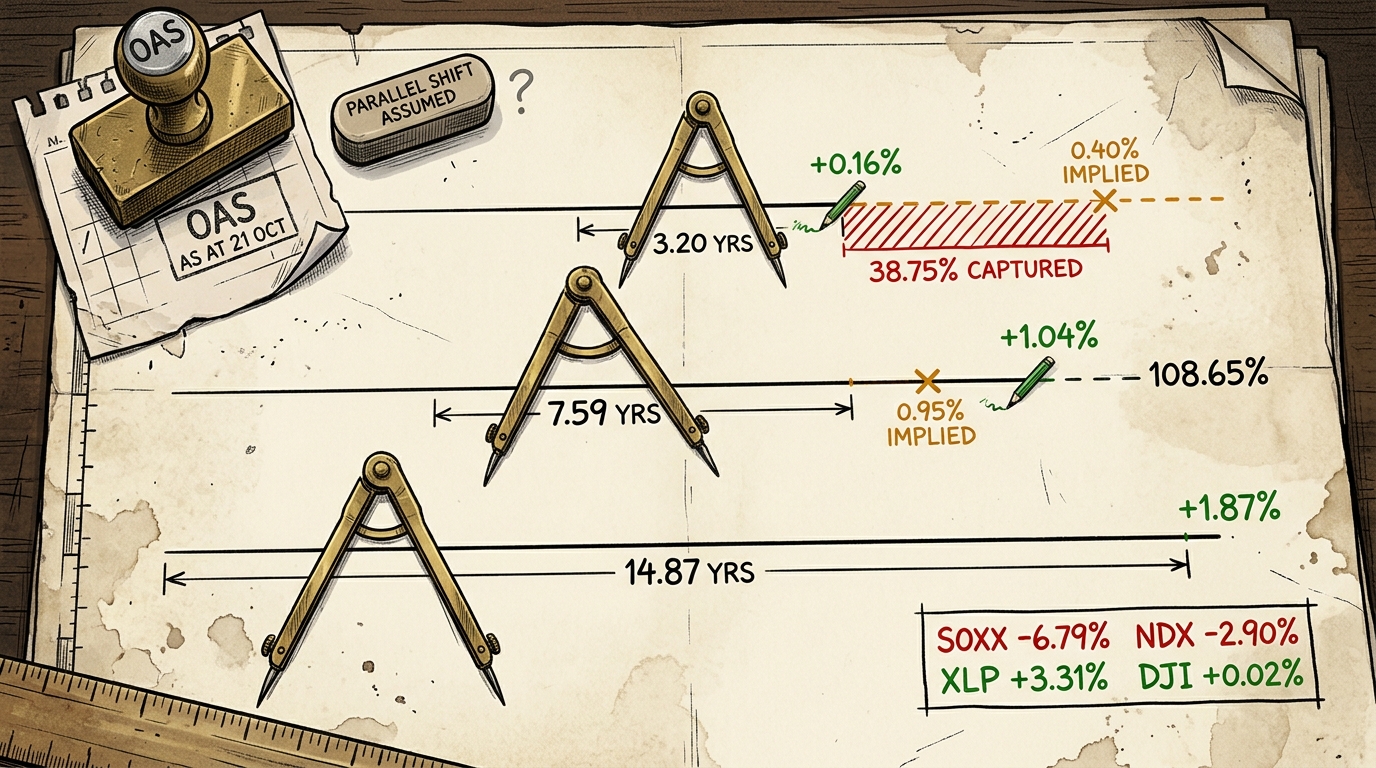
Credit is the instrument that would settle it, and here is the number nobody else will put beside another number today. High yield rose 0.16%, investment grade 1.04% and long Treasuries 1.87%. As three prices that is three rallies and the matter looks closed. Against duration it is not one event, and for the second edition running we can do that arithmetic, because the issuer publishes effective duration: 3.20 years, 7.59 years and 14.87 years.
Scale the Treasury move by the duration ratio and high yield’s implied return is 0.40%. It delivered 0.16%, which is 38.75% of it. Investment grade’s implied return is 0.95% and it delivered 1.04%, which is 108.65%. So the middle rung slightly beat what its duration asked for and the bottom rung delivered about two fifths of it.
One caveat on the method, because it is doing the work. Duration scaling assumes the curve moved in parallel and Thursday’s did not: the three-year fell 17 basis points, the twenty-year 15, the thirty-year 13. The short end rallied harder, which flatters a short-duration fund rather than punishing it, so high yield came in at two fifths on a day tilted in its favour. That makes the shortfall harder to explain away, not easier.
The textbook is unambiguous: a bond fund’s return is what the rate move gave it less what the spread took away. Two fifths on a strong rate day is the shape of spread working against high yield whilst investment grade shows none of it.
And here is why we are not calling it anyway. The option-adjusted spread the issuer publishes is dated 21 October: 287.23 basis points for high yield, 90.86 for investment grade, and nothing at all for Thursday. A spread change across a session cannot be computed from a level that stops the day before. We can give you the duration. We cannot give you the spread, and we are not going to name a widening we have not measured.
Phil’s Musing
A rotation with a 6.79% hole in it still spends like a correction if you happen to own the hole. What makes Thursday readable rather than frightening is that the buying turned up in instruments we can price, on volume we can count. The thing that would change my mind is a high yield spread print confirming the lag, and it is not in this morning’s data.
Happy trading,
Phil
Less Brain, More Gain
…and may your trades be smoother than a cashmere codpiece
P.S. – Phils Footnote I came in assuming credit would be the easy part of this letter and the sector story the hard one, and it was the other way round. Three durations finally arrived this week after the registry spent a month calling them the most useful number we did not have, and I had a cheerful ten minutes thinking the question was settled, right up to the point where the spread turned out to be stamped Wednesday. Having the right instrument and the wrong date is a newer kind of annoying than simply not having it.
🗂 Desk Notes – Part 235 | 23 Oct 2026
Observations, not trades. Raw working notes behind today’s edition.
Session read (§8.4)
SESSION BRIDGE: prior session (Thursday) full reaction [December ES minus 1.228%; cash S&P minus 1.208%, Nasdaq 100 minus 2.897%, Composite minus 2.599%, Dow plus 0.022%, Russell plus 0.108%; semiconductor proxies minus 6.793% and minus 5.991%; equity volatility plus 14.089%, bond volatility plus 11.36%]; live premarket ES +0.058% / NQ +0.306% on the 06:45 to 06:50 UTC bar, VIX 19.17 on the 07:15 UTC premarket bar against a 19.03 close; threshold: soft.
Threshold reasoning, leg by leg. The premarket equity leg is silent: ES at plus 0.058% sits well inside the roughly 0.3% normal band. The prior-session leg on the December contract reads minus 1.228%, inside the 1.0% to 2.0% investigate band, which fires the soft trigger where a catalyst is nameable. One is nameable at constituent scope only, and the edition says so: no cause is named at sector or index scope. The volatility leg fires outright and independently: the VIX session move of plus 14.089% clears the plus or minus 8% condition by 6.089 percentage points. The commodity leg does not fire: front-month WTI moved plus 2.388% against a 4% condition, short by 1.612 points. Net: soft, carried on the volatility leg with the equity leg concurring.
A gap in the bridge that is closed this edition rather than declared. Part 234 carried the cash S&P as a proxy for prior_session_pct for want of a December ES session change. That figure is held today: ESZ2026 closed 7704.50 on the 22 October trade date against 7800.25 on 21 October, minus 1.228%, from daily bars stamped at the session open with trade date equal to stamp plus one.
Close-to-open window. 22 October cash close 16:00 ET to the 23 October capture at 02:45 ET, 10 hours 45 minutes. No contract roll warning: the third Friday of October was the sixteenth, October is not a quarterly month, and all four equity index contracts are December 2026 with no roll inside this edition’s horizon. December Brent last trades 30 October, five trading sessions out, and the January contract takes over inside the horizon.
Overnight Excitement (§8.5)
Does not fire, and nothing is forced. The largest overnight move on any of the four December contracts is Nasdaq at plus 0.306%, which falls 0.694 percentage points short of the 1.0% trigger. ES plus 0.058%, YM minus 0.168%, RTY minus 0.071%. Three of four sat below the 0.3% normal band entirely. Asia opened lower on syndicated reports, direction only, with no level published because no tier-1 route to any non-US cash index exists on this stack. Toyota and Kweichow Moutai both returned bars for 23 October, so neither Japan nor China was closed; that is a closure test and nothing more and is not read as index direction.
§8.3 candidate cause board
§8.4.2 trips on all three limbs, so this board and the timestamp decomposition are mandatory rather than discretionary. Limb (a): the Nasdaq 100, the Composite and the S&P 500 each posted their largest daily fall of the thirteen sessions 6 to 22 October, and all three windows are locked as dated daily-change series after the verification pass found only the first of them held. Limb (b): the best-to-worst sector spread is 6.595 points against a 4.0 point condition. Limb (c): four named constituents moved more than 10%.
Column one, effects without causes.
| Candidate | Class | Stamp | Precedes the majority | Disposition |
|---|---|---|---|---|
| Lam Research 8-K and call, 21 October | 2 | 21 Oct, filing date, minute not held | Yes, 85.812% gap share | published_cause, scoped to LRCX alone |
| The 40.01% intraday leg of the Nasdaq 100 fall | 6 | 22 Oct 13:30Z open | No | refusal, published |
| Gold spot minus 2.816% on a session every other haven rose | 6 | 22 Oct 21:00Z | No | refusal, published |
| Moderna phase 3 readout and the broken embargo | 3 | 22 Oct 17:55Z earliest | No, 86.834% of the move is intraday | labelled speculation, Snippet |
| Meta capital expenditure guidance, 8-K 21 October | 2 | 21 Oct, filing date | No, 56.503% intraday | refusal, named as failing the test |
| US and Israel strike-plan reports | 3 | 22 Oct 19:11:51Z | No, 41 minutes after the WTI settlement | refusal, published with its stamp |
Column two, causes without effects. This is the column that needs no mechanism, no duration and no positioning data, and it is where the best claim of the day sits.
| Candidate | What was loud | What moved | Disposition |
|---|---|---|---|
| Energy | December Brent plus 3.997%, December WTI plus 2.388%, strike-plan reports carried widely | Energy sector proxy minus 0.866%, and no oil-and-gas major and no oil exchange-traded fund on any of the three attention boards at depth 25. Two power and gas names do sit on the equities board, so the unqualified form of this claim was cut on the verification pass | coincidence, published |
| Initial claims | 194,000 against a 200,000 forecast at 12:30:00Z, a stronger labour print | Ten-year CMT minus 17bp with no step at the release and the wrong sign throughout | refusal, published |
| A record state privacy judgment | A 25 billion dollar New Mexico penalty against Meta, called “the beginning” for the industry | Meta absent from all three attention boards at depth 25 | coincidence, Snippet |
| Federal Reserve communication | Nothing at all, fifth consecutive edition of complete silence, established on two cache-busted reads of the authoritative Board path plus the October events page | Two-year CMT minus 16bp | desk_notes_only: a null with no instrument attached. It explains nothing and is recorded as the absence it is. |
| Tesla and SpaceX merger committees | Reported in the 21 October wrap, special committees formed to discuss a merger | Neither name reached any attention board at depth 25 | desk_notes_only: it belongs to a session this edition does not measure. |
| Asia overnight | Korea, Japan, China and Australia all reported negative, 02:59:55Z | December Nasdaq futures plus 0.306%, inside the normal band | desk_notes_only: a level is barred for want of a tier-1 route and §8.5 is silent. |
The licensed sentence, stated plainly and in the letter rather than here: 40.0% of the Nasdaq 100’s fall has no named cause in this book. The gap carries 59.99% and two filings sit inside the window that produced it, neither of which this book will extend from one company to an index.
Ruling U mark on the prior edition’s named cause. Part 234 named one cause, a Dell product release stamped 11:50Z, scoped to Dell alone. Scored today on follow-through: MARKED-MISS on follow-through. Dell does not appear in this edition’s locked figures, reached no attention board at depth 25, and no instrument kept responding to the named driver. Naming it scoped to one instrument was right; the follow-through did not arrive.
Ruling Y, applied and recorded either way. Two divergence flags have now appeared in three consecutive editions and are therefore mandatory board candidates. The cross-exchange breadth divergence is on the board and is NOT crowned, because it is the measure the Part 225 shot already turns on, so crowning it would be concentration of source and of risk at once. The crypto venue-pair widening is not promoted to the board because it is a registry observation barred from outward files, and the board exists to route things toward readers.
§8.3 null rate, recorded per ruling S. This edition names one cause, scoped to one constituent, and admits the session-level move as unexplained. That is two consecutive editions naming a cause and five of the last six declining a session-level one. Ruling S’s calibration warning cuts both ways and the rate is not near zero.
Mechanism read (§8), full
The one artery. One sector repriced and everything else in the session is arithmetic downstream of it. The semiconductor proxies fell 6.793% and 5.991% against a worst-sector reading of minus 3.288%, so the index fall is the sector fall with weightings applied, and the Dow, which holds little of it, closed plus 0.022%.
What else rose, in the same session. This book holds no equity flow data, so what follows is co-occurrence and not an observed transfer: TLT plus 1.869% on 65,635,115 shares against 28.5, 30.9 and 36.3 million on the three prior sessions; LQD plus 1.037%; staples plus 3.306%, utilities plus 2.071%, health care plus 1.319%. Six of eleven sector proxies rose.
The leg that refuses the de-risking reading. HYG rose 0.156%. Read duration-aware, which this book can do for the second edition only: on the published effective durations of 3.20, 7.59 and 14.87 years, TLT’s 1.869% implies 0.402% for an instrument carrying HYG’s interest-rate exposure, and HYG delivered 38.753% of that. That is the signature of credit lagging its own duration, and it is NOT published as a spread widening, because the option-adjusted spread is served only as at 21 October and a spread change across the 22 October session cannot be computed from a one-day-stale level. Both limbs are stated wherever either appears.
CMT, 22 October, all fourteen tenors. 1 Mo 4.11 (+2bp), 1.5 Mo 4.10 (-2), 2 Mo 4.16 (0), 3 Mo 4.22 (-3), 4 Mo 4.29 (-5), 6 Mo 4.29 (-6), 1 Yr 4.41 (-11), 2 Yr 4.65 (-16), 3 Yr 4.72 (-17), 5 Yr 4.78 (-17), 7 Yr 4.86 (-17), 10 Yr 4.96 (-17), 20 Yr 5.32 (-15), 30 Yr 5.29 (-13). 2s10s plus 31bp from plus 32, 2s30s plus 64 from plus 61, 20s30s minus 3 from minus 5 and still inverted. The twenty-year holds the strict maximum of all fourteen tenors, recomputed in code with exactly one tenor equal to the maximum. Three cache-busted fetches were required and the first two agreed on a stale top row, which is a new failure shape: two agreeing cache-busted fetches were not a clean read and the cure was varying the parameter NAME rather than its value. H.15 matched 55 of 55 overlapping cells with no 22 October column, confirmed before any comparison was attempted.
Volatility. VIX 19.03 (+14.089%), VIX3M 20.12, ratio 0.946 from 0.891, so the curve steepened toward inversion without reaching it and remains in contango. MOVE 106.849 (+11.36%). Both measures rose, bond volatility by slightly less than equity volatility, which is the exact mirror of the prior session where both fell and bond fell harder.
Dollar and carry. DXY 101.616, minus 0.07%, held flat by the euro whilst the yen gained 0.87% and the franc 0.48%. The six-leg rebuild is on its every-third-edition schedule and was not run. The aligned gold carry was run: December settle 4060.4 less the XAUUSD 17:00 UTC bar close of 4046.05 gives 14.35 against a band of 25.43 to 39.49, a breach of 11.08 below the floor. The 14 October carry level was 23.62, a breach of 1.81, so this one is six times as deep. The definition was checked first: timezone correct, bar straddles the settlement, December contract and trade date both correct. The breach stands, the band has now broken twice in October in the same direction, and the band itself should be rebuilt rather than the breach cleared. At the 07:30 UTC re-quote the carry reads 14.31, so the breach is not an artefact of a single instant.
Capture-to-publish re-quote (§11.9.1, both limbs)
Fourteen movable figures re-quoted, zero over the 2% threshold, zero movable figures absent from the live set. Ranked by absolute move, the four largest are December silver minus 1.767% to 54.035, December WTI plus 1.086% to 100.55, December Brent plus 0.99% to 114.29 and January WTI plus 0.872% to 98.37. Below them: ether plus 0.76%, the VIX premarket re-quote plus 0.74%, December gold minus 0.66%, copper plus 0.58%, bitcoin plus 0.39%, then the four equity contracts, every one of them inside a quarter of one per cent of its own capture, and gold spot at minus 0.12%.
Limb two found a crossing that limb one cannot see, and this is the third consecutive edition that limb two has been the finding. On a price drift of under a quarter of one per cent, two contracts changed specification band in opposite directions. December Nasdaq went from plus 0.306% at the capture, marginally outside the 0.3% normal floor, to plus 0.134% at the re-quote, inside it, widening its clearance of the 1.0% trigger from 0.694 to 0.866 percentage points. December Dow went the other way, from minus 0.168% to minus 0.384%, crossing OUT of the band. Neither crossing changes a published section, because §8.5 does not fire on either reading, but a 0.17% price move relocating a contract across a written line is exactly the defect recorded at Part 225 and still not in the spec.
Enumeration of locked single-name moves (R8)
Floor set at 5% absolute. Every one is published, admitted or excluded with the exclusion stated. Moderna minus 17.566% (Snippet, labelled speculation). Pool Corp plus 14.364% (AVE and Snippet). Lam Research minus 11.756% (AVE, Inside Edge, Snippet). Spotify plus 11.101% (AVE, Inside Edge, Snippet). Allegion plus 11.019% (AVE, Inside Edge, Snippet). Advanced Micro Devices minus 8.104% (AVE, Inside Edge, Snippet). Meta minus 6.978% (AVE, Inside Edge, Snippet). Procter and Gamble plus 5.579% (Inside Edge, AVE read block). Nothing above the floor is absent from every outward file.
Divergence flags
- The energy inversion. A 3.997% Brent settlement against a minus 0.866% energy sector proxy. Second mechanism-free claim of the week and the strongest publishable item in the edition.
- Gold against every other haven. Spot minus 2.816% whilst the yen, franc and long bond all rose. No mechanism retrieved. Flagged, not explained.
- Breadth by exchange. NYSE 1.33, Nasdaq 0.765, straddling 1.000 on the same session, and the two counts cover different populations from the indices built on them.
- Composite against the 100. 29.76 basis points apart this session against 14 at Part 229. The edition’s argument sits on the 100 and both are reported separately.
- Semiconductor proxies. 0.802 percentage points apart, the eighth held observation. No superlative is published on it and none is stated here either, because the series is held as values without dates and an undated window cannot be checked. The figure is above the Part 233 shot’s 0.100 point line, so the session scores as a non-falsifier: two of ten scored, none of the four the shot needs to die.
- Crypto venue pairs. The two pairs read 0.054% and 0.057% apart against an established 0.011% to 0.038% tolerance, so this is the third observation and the second consecutive widening, and BOTH pairs now sit outside tolerance. That is a FAILED check, not a passed one. It is a registry observation marked do-not-publish-outward and it is published in no outward file, including this one’s own first cut, where a sentence calling it a clean cross-venue agreement was cut on the verification pass.
- Attention against price. Bitcoin carries 684,636 watchers, the largest of the eleven symbols pulsed rather than the largest in the capture, which is Apple at 998,244 on the equities board. Its normalised volume reads low and it is absent from the crypto board top 25. One observation. No shift computable.
Carry-over note (§10.6)
The noteworthy thing is not the fall. It is that six of eleven sectors rose during it and the instrument that gets nervous for a living went up 0.156%. Markets were set up for a de-risking signature and produced a rotation signature instead, and the only place that distinction is visible is in credit and in the exchange split.
Forward catalyst slate
- Today, 23 October. American Express, SLB, HCA Healthcare and Booz Allen before the open, each corroborated on three routes. Chevron, Exxon Mobil and AbbVie appear on one calendar only and are NOT established as today’s reporters. Flash manufacturing, services and composite purchasing managers’ indices 13:45Z; final Michigan sentiment and inflation expectations 14:00Z; Baker Hughes rig counts 17:00Z.
- Monday 26 October. Chicago Fed national activity 12:30Z, Dallas Fed manufacturing 14:30Z, 13-week and 26-week bills 15:30Z, two-year note 17:00Z.
- Tuesday 27 to Wednesday 28 October. FOMC, no projection round, with no further consumer or producer price print in hand before it. Five-year note and 52-week bill on the twenty-seventh.
- Thursday 29 October. Seven-year note. Strategy earnings reported for the twenty-ninth.
- Not this week. No consumer price print until 10 November and no producer price print until 13 November, re-verified against the statistical schedule.
- Coiled. Thursday’s five-year inflation-indexed auction has no published result at all, and nor does Wednesday’s twenty-year reopening. Both carry every result field null. Sixteen auctions are now unscored against the Part 209 ruling, which is eighteen days past its deadline.
Regime and sensitivity read (§17.3)
Sensitivity is running LOOSE, forty-sixth consecutive edition, stated openly rather than presented as neutral. The diagnosis is specification and not tuning: four of nine candidates still carry no numeric condition text in the live ledger, and a candidate without a threshold cannot be scored against anything.
Turn condition: 0 of 2, twenty-fifth consecutive non-advance, and for the first time in some while it fails on the conjunction rather than on the magnitude. The two-year moved 16bp, which clears the 10bp limb outright. The thirty-year moved 13bp, which is not less than half of 16bp, so the second limb fails. The communication limb is inapplicable: no Board governor prepared text and no Reserve Bank president primary text exists for 22 October. A condition whose limbs have each now fired separately is a condition that wants splitting, and that recommendation is twenty-five editions unanswered.
Candidate 4, retired at Part 207, would have fired today. The two-year moved 16bp against no timestamped release of any kind, the only scheduled surprise having the wrong sign. That is the twenty-fifth instalment of evidence for a retired candidate.
Candidate 8 is scored and correctly silent for a fifth consecutive edition. The condition is a spot-to-three-month ratio rise of more than 0.070 in a session without closing at or above 1.000. The ratio rose 0.055, from 0.891 to 0.946, clearing the condition by 0.015 and staying in contango. A candidate that fired once and has stayed correctly quiet five times is doing more work than four of the original six and should be adopted.
Candidate 9 is scored on both limbs and does not fire. The three held gap shares are 66.727%, 59.99% and 59.504%, all below the 80% condition. Both exchanges did not close below 1.000; one closed above and one below. Zero of two limbs, fourth consecutive recommendation for adoption.
Candidate 1 is NOT SCORED for a twenty-third consecutive edition. The dollar moved 0.07% on a session carrying a 16bp two-year print, and the candidate’s full condition text is still not carried in the live file.
Candidate 3, retired at Part 207, is vindicated a twenty-fifth time and in the mirror configuration to Part 234. Both volatility measures ROSE, equity by more than bond, and the term structure steepened toward inversion without reaching it. A one-sided suppression leg sees neither direction.
Candidates 5, 6 and 7. Candidate 5 is unscored with sixteen auctions outstanding and two of this week’s three coupon results entirely null. Candidate 6 remains unscoreable for want of its own numeric threshold, eighth consecutive edition, and today’s near-parallel rally is precisely the cross-section it was built to read. Candidate 7 is scoreable and does not fire.
Retrieval and route notes
- 🔧
CBOE:VIXHAS a premarket series, and the correction to the standing record belongs to the PRIOR edition rather than this one. The 07:15:00Z bar reads 19.17 against a 19.03 official close, with an eleven-hour publication hole from 20:15:00Z. Part 234’s lock already holds a nine-bar premarket series on this symbol, so this edition is the second to hold one and the first to carry it inside the session bridge line itself. The registry’s “PERMANENT ABSENCE” entry is still wrong and should still be struck. No count of editions lost is published, because the first edition to find the series is the one that bounds it and that was not this one. - 🟢 The iShares fund-page route returned effective duration for all three credit and duration instruments, 3.20, 7.59 and 14.87 years, plus option-adjusted spread for the two credit funds. It should be added to the standing fear panel. The residual gap is temporal rather than retrieval: the issuer serves 21 October only.
- 🔴
mcp-tv-get-ohlcvreturns NO extended-hours bars on single equities either, not only on indices. Tested twice on two tickers, 78 regular-session bars each, with the payload’s own notice stating regular session only. The after-hours leg specified for the commodity lane has no price route on this stack, so of roughly 85 post-close reporters an extended-hours move was established for two and a direction for one. - 🔴 Three cache-busted CMT fetches were required and two agreeing ones were not a clean read. Varying the parameter value hits the same cache entry; varying the parameter NAME cured it. The protocol should require two different URL shapes.
- 🔴 The flow table’s truncation broke its own rate, moving the earliest row five trading sessions rather than one, so Part 234’s published prediction of 6 October is refuted by a step.
- 🔴 Two dateline traps caught before use. A “notable companies reporting after the close” page fetched cleanly and was a 2024 article. Intel was listed by one route as a 22 October after-close reporter and is not one; it reports on 29 October. Intel was excluded and would have been the most futures-relevant name in the set had it been real.
- 🔧 Zero scanner calls and zero 429s across four research lanes, one diff agent and the main thread, twelfth consecutive clean run on the two-call batch discipline.