Five basis points, held for two sessions, in the week nobody was looking at bonds
⚓ Weathervane. The wind is coming from the long end. The policy rate has been frozen at 3.50% to 3.75% since July whilst the term premium does the tightening, and the price of long money is set by deficits, issuance and a global duration bid rather than by the committee. Higher-for-longer has stopped being a Fed decision and become a bond-market fact. The cruise ship holds this heading, though this week put a hand on the wheel.
 Ahoy there, Trader! ⚓️
It’s Phil…
Right then. Let me start somewhere uncomfortable, because it is the honest place to begin.
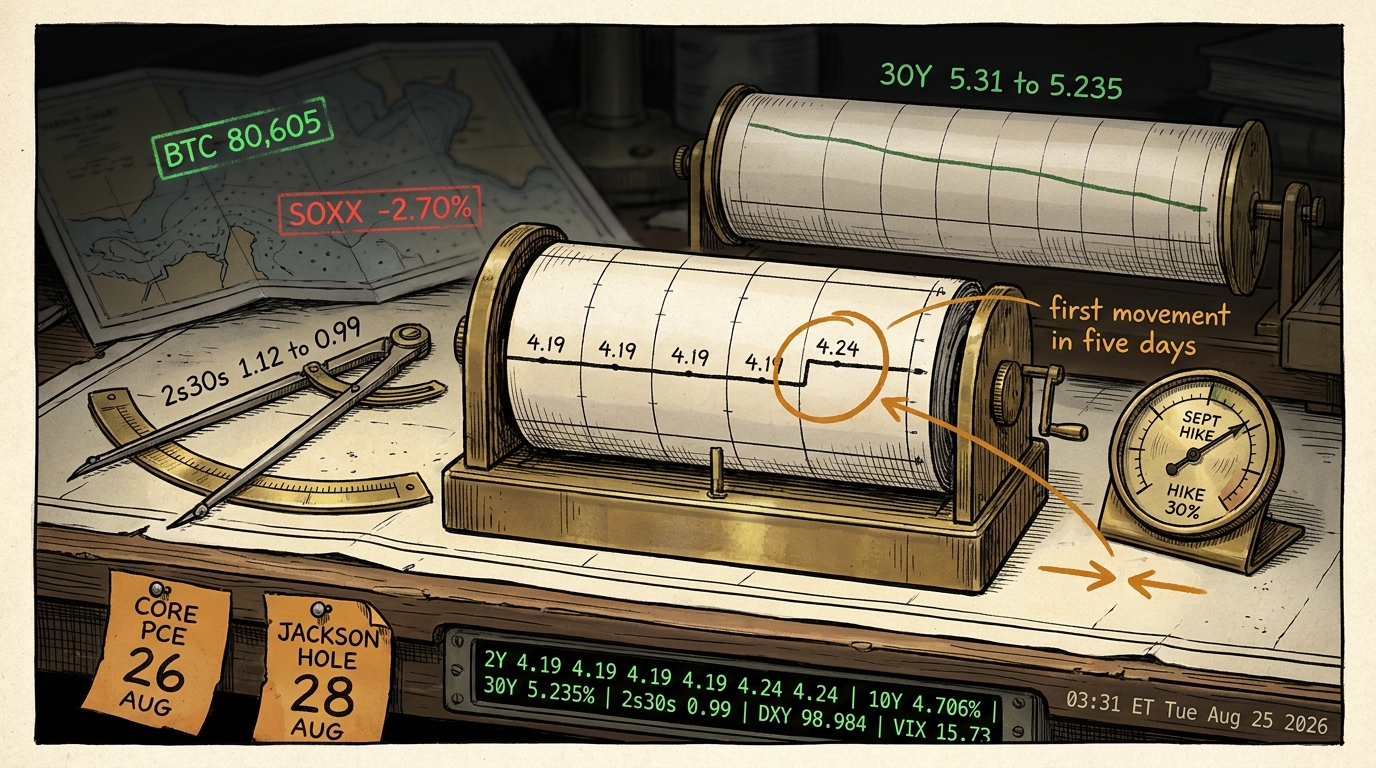
For five editions I have argued that the 2-year Treasury had stopped functioning as a price. Four consecutive sessions from 17 to 20 August, four closes at exactly 4.19%, and between them a doubled Treasury buyback, minutes in which officials openly discussed raising rates, and a Dow down 700 points. The instrument built to express what the Fed does next expressed nothing about any of it.
Then on Friday it closed at 4.24%. On Monday it closed at 4.24% again.
So the question I want to sit with today is this. Why did the two-year go up in the same week that everything else priced relief?
Because that is genuinely odd, and I would rather walk the dots than pretend I already know.
Everything else in the same window went the other way. The 30-year eased to 5.235%, eight basis points below its 17 August close. The 10-year slipped to 4.706%. Bitcoin cleared 80,000 dollars. Gold sat within six dollars of a record. Crude fell over 2% on the day the sanctions everyone feared were delivered. Every one of those is a relief trade.
And the 2-year went up.
The textbook is clear. When the short end rises whilst the long end falls, the market is pricing a tighter near-term path into a softer medium-term outlook. Higher rates sooner, lower growth later. It is a reliable signature, and 2s30s has compressed from 1.12 to 0.99 in five sessions, which is not a rounding error.
But here is the gap I cannot close. Over the same four weeks the odds of a September hike fell from about 57% to roughly 30%. Every screen says the Fed is less likely to move. The instrument that exists to price exactly that says the opposite, twice. Both cannot be right.
The generous reading is that the 2-year is early, as it sometimes is, and somebody is positioning ahead of Wednesday’s core PCE. The deflating reading is that 5bp is a few desks squaring up before a heavy calendar, and it unwinds by Thursday lunchtime.
I do not know which. I do know it gets settled Wednesday at half past eight, and that I was wrong to call the instrument switched off when it was more likely just waiting.
Phil’s Musing The bit that nags is that I built a thesis on an absence. Four identical prints felt structural, and I wrote it up as the front end being retired from the argument. One 5bp move showed me I had mistaken quiet for broken. That is a lesson about me, not the bond market. The heading stands, but I want to stop treating the front end as furniture. If 4.24% holds through core PCE, it has rejoined the conversation. If it is back at 4.19% by Thursday, four identical prints was a coincidence and I should not have built anything on it.
Happy trading,
Phil
Less Brain, More Gain
…and may your trades be smoother than a cashmere codpiece
P.S. – Phils Footnote The hardest of these to write are the ones where I mark my own homework in public. Last week I was pleased with the switched-off argument. This week the thing it described moved, and the honest response is not to explain why that does not count. It is to say the argument was weaker than I thought. I would rather be corrected by a print than by a reader.
🗂 Desk Notes – 25 Aug 2026
0. Close-to-open read
SESSION BRIDGE: prior session (Monday) full reaction [S&P 500 -0.28% to 7,652.86, Nasdaq Composite -0.76% to 25,980.19, Dow +0.26% to 53,417.16, Russell -0.76% to 2,995.08; chip-led, no material after-hours catalyst, no late print to weight past the cash close]; live premarket ES +0.20% / NQ +0.50%, VIX -0.69%; threshold: none.
Monday’s move sits at 0.28% on the S&P, comfortably inside the sub-1% normal envelope. Premarket at +0.20% sits inside the ~0.3% typical band. Neither the hard nor the soft trigger fires and Phil has flagged no catalyst manually, so no carry-over note rides the tiers this edition.
One qualifier worth logging even though the threshold does not fire. The index-level number is quiet because two halves of it cancelled. The Dow rose 0.26% whilst the Nasdaq fell 0.76%, a spread of more than a point inside one session. That is the sixth consecutive session of the dispersion pattern, and it is invisible to a threshold specified on index-level percentage moves. Recorded here rather than escalated.
1. The mechanism read (full)
What moved. Instruments at Monday’s close, taken from the Treasury daily par yield curve (CMT), which is the primary series and was retrieved cleanly this session after refusing automated access last edition.
| Date | 2 Yr | 10 Yr | 30 Yr | 2s30s |
|---|---|---|---|---|
| 17 Aug | 4.19 | 4.72 | 5.31 | 1.12 |
| 18 Aug | 4.19 | 4.71 | 5.28 | 1.09 |
| 19 Aug | 4.19 | 4.65 | 5.19 | 1.00 |
| 20 Aug | 4.19 | 4.69 | 5.23 | 1.04 |
| 21 Aug | 4.24 | 4.74 | 5.27 | 1.03 |
| 24 Aug | 4.24 | 4.70 | 5.23 | 0.99 |
Dollar index 98.984 in early European hours, up 0.15%, fifth session inside a narrow band. VIX 15.73, down 0.69%. Gold 4,694.9 dollars. WTI 84.48 dollars on Phil’s tape at 03:31 ET after Monday’s fall of roughly 2.5% to 84.89.
What it implies. The four-session identical print at 4.19% ended on 21 Aug. The 2-year stepped up 5bp and then held the new level for a second session rather than reverting. A step-and-hold is a different object from noise: noise reverts, repricing persists. Two sessions is not yet proof of persistence, but it is no longer a single print.
The long end went the other way over the same window. The 30-year is 8bp below its 17 Aug close of 5.31% and the 10-year 2bp below its 17 Aug level. So 2s30s has compressed from 1.12 to 0.99, thirteen basis points of flattening in five sessions, and the compression is being driven from both ends toward the middle rather than by the long end alone.
Textbook reading of a front-led flattening: policy risk is being repriced upward whilst growth and term-premium expectations soften. That is the standard signature of a market starting to price a tighter near-term path into a weaker medium-term outlook.
The complication is timing. This began on Friday, before core PCE and before the Jackson Hole keynote, and it began whilst the widely quoted September hike probability sat near 30%. Either the front end is anticipating something the odds screens are not, or 5bp is positioning ahead of event risk and will unwind on Wednesday. Both readings are live and the notes do not choose between them.
The one artery. The 2-year at 4.24%. It is the only instrument on the board that changed state this week rather than merely changed level, and the standing house thesis for five editions has been that it had stopped functioning as a price. That thesis now has a dated, primary-source datapoint against it.
2. Forward catalyst slate
- Wed 26 Aug, 08:30 ET. July core PCE, forecast +0.3%. Alongside a Q2 GDP revision expected lower. The direct test of whether Friday’s 5bp was anticipation or noise.
- Wed 26 Aug, after the close. Nvidia. Roughly 5tn dollars of market value, consensus near 2.09 dollars a share, informal revenue bar circulating around 91bn dollars. Watch data-centre revenue, Rubin platform timing, China exposure, and the vendor-financing arrangements now attracting attention.
- Fri 28 Aug. Warsh’s first Jackson Hole keynote as chairman. The pre-registered most likely killer for three open ledger shots. Fed independence is the live subtext after Treasury’s move onto the central bank’s turf.
- Wed 9 Sept. Treasury buyback operations begin, rising from 2bn to at least 4bn dollars per operation, running through 4 Nov. The announcement has been priced; nothing has actually been bought yet.
- 15 to 16 Sept. FOMC with a fresh SEP.
- Ongoing. CNBC reported Treasury may fund buybacks from the General Account. If confirmed, that changes the funding mechanism of the intervention materially and is worth watching for follow-up.
3. Divergence flags
- Front end up, long end down, same window. 2-year +5bp from its freeze whilst the 30-year sits 8bp off its 17 Aug high. Flattening from the short side after a month of long-end-led steepening. This is the cleanest unreconciled item on the board.
- Hike odds falling whilst the instrument that prices hikes rises. September probability has tracked 57% to roughly 30% over four weeks. The 2-year went up anyway. One of the two is wrong and core PCE arbitrates on Wednesday.
- Crypto and AI have decoupled. Bitcoin +2.06% through 80,000 overnight and up more than 23% in seven days, whilst the semiconductor complex fell 2.7% on Monday. These two traded as one risk expression for most of the year. They are no longer doing so.
- Dispersion without index volatility, sixth consecutive session. Dow +0.26% against Nasdaq -0.76% with VIX at 15.73. The index-level tape reports calm that the sector-level tape does not contain.
- Gold and the dollar both inert together. Gold 4,694.9 and unable to close above 4,700 across four sessions; dollar index inside a fifth narrow session at 98.984. Ordinarily one moves when the other does. Neither is expressing anything.
- Strategy raised 2bn dollars from equity, not coin, during the best bitcoin week since 2023. 18,261,118 shares between 17 and 23 Aug at roughly 109.88. The observation is about mechanism, not judgement: a treasury vehicle chose dilution over disposal at a point when disposal was maximally attractive. That says something about which constraint is binding.
4. Levels that surfaced
- 2-year: 4.19% is the four-session floor now broken. 4.24% is the level to watch holding or failing through Wednesday.
- 30-year: 5.31% is the highest daily close on the CMT series in the run-up. 5.337% was an intraday print and is not a close on this series.
- 10-year: 4.75% is being described on the sell side as the sensitive level. Monday closed 4.706%.
- Bitcoin: 79,500 to 80,000 was the resistance band and is now cleared. Next cited resistance near 83,000. Support cited 74,000 to 76,000.
- Gold: 4,700 dollars, four sessions unclaimed.
- S&P 500: 7,652.86 Monday close.
5. Regime status, Weathervane and sensitivity read (§17.3)
⚓ Weathervane: carried unchanged. The wind is still coming from the long end and the cruise ship holds this heading. The previous edition proposal to add a second limb naming the front end as having gone quiet is withdrawn, because the front end moved on Friday. Full reasoning in the ledger Part C.
Regime Flag: not tripped. Two candidates carried, and one of them has materially changed character this session.
- The dollar’s non-response. Still the strongest candidate, but now needs re-reading. DXY has held its narrow band for a fifth session. The previous edition’s reading was that the currency had gone inert alongside the front end, which made the pair of them a single phenomenon. That reading is now half-dead, because the front end has moved and the currency has not. The dollar being inert whilst the 2-year is also inert is one story. The dollar being inert whilst the 2-year reprices is a different and arguably more interesting one.
- Dispersion without index volatility. Held, sixth consecutive session. Unchanged in character.
Sensitivity: running LOOSE, sixth consecutive edition. The tripwire remains specified on index-level S&P conditions and remains blind to everything that has actually happened this month. It did not see the Korean drawdown or recovery, has not seen a 23% week in bitcoin, has not seen a currency ignore five extraordinary sessions, and did not see the front end break a four-session freeze on Friday.
The standing recommendation is unchanged and now six editions old: add a dispersion leg, a cross-asset leg and an inertia leg alongside the proposed volatility leg in §8.4.1. One refinement this edition. The inertia clause proposed last edition would fire when a mechanism instrument records four or more consecutive sessions inside a 0.25% band whilst a tracked hard asset makes a new high. That clause would have fired on 20 Aug and then stood down on 21 Aug when the 2-year moved. That is the correct behaviour and it argues the clause is well specified. Recommend it to Phil ahead of the other two.
Public tell: HOLSTERED. No mainsail language.
Observations only. No positions, no trades, no recommendations. Desk Notes captures the working behind the Macro Edge read.