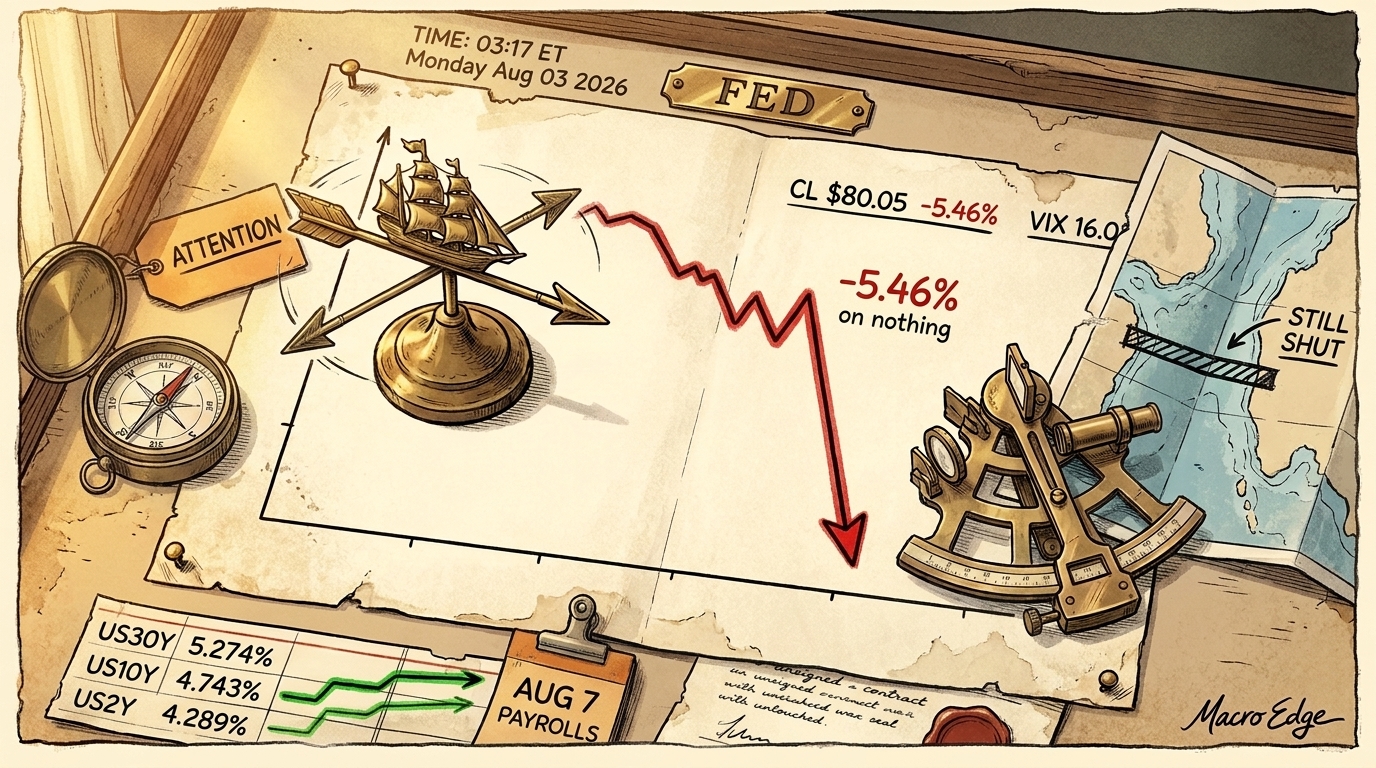
A twentieth of the oil price left on a cancelled operation, and the strait is exactly as shut as it was on Friday.
⚓ Weathervane: The tightening is arriving and nothing is transmitting it. The whole curve rose through July, the thirty-year to a nineteen-year high, and the S&P still closed the month up. What actually reprices now is attention rather than risk: premiums leave oil, volatility and equities the moment headlines stop arriving, whether or not anything on the ground has changed. Multiples answer to the news cycle, and the bill for that arrives in one session rather than gradually.
 Ahoy there, Trader! ⚓️
It’s Phil…
A twentieth of the crude price left the market this morning on the news that a bomb stayed on the rack. The surface reading is straightforward and most desks would take it without argument: a strike was called off, war risk fell, so the war premium fell with it.
Look a little deeper and the tidiness comes apart. Nothing about the physical position changed over the weekend. The Strait of Hormuz is shut this morning exactly as it was on Friday afternoon. Nothing was signed. And the proposal leads with the immediate, complete and total opening of that strait, whilst Iran’s own foreign ministry says the talks now in their final stages with Oman do not cover whether the waterway is open or closed. The price has paid for a clause both sides agree is not being negotiated.
How does a risk premium come out of the price before the risk comes out of the water?
The pieces are all on the table, so the question is whether they make a picture we can read.
Crude sits at $80.05, down 5.46% and a three-week low, after a July that added more than 20%. Volatility sits at 16.08, a second session below 18, in a week carrying Friday’s payrolls. The thirty-year closed Friday at 5.274%, its highest since July 2007, with the ten-year at 4.743% and the two-year at 4.289%, all three rising together, and the S&P added 0.70% into that. Bitcoin is the one instrument that declined to join in, down 1.57% and through a level that held on Friday.
The textbook is reasonably firm on two of these. When the entire curve rises at once, that is a repricing of the whole policy path rather than a term-premium quirk, and equity multiples are supposed to compress against it. Friday was the second consecutive session in which they did the opposite. And a risk premium is supposed to track the risk, not the coverage of it.
One way the pieces fit is that what is being repriced here is not risk at all, but attention. Premiums appear to leave a price the moment headlines stop arriving, regardless of whether the position underneath has moved. That would account for the oil, the volatility and the multiple at once, using one mechanism instead of three.
What is not known is whether this is a market being efficient about a genuine de-escalation it can see and we cannot, or a market that has stopped pricing anything it is not currently being told about. Telling those two apart needs more clues than one Monday offers. If it is the second, the tell will be a premium that comes back without any new escalation to justify it, and that is worth watching this fortnight.
Phil’s Musing
The lean I would hold loosely is that attention is doing more of the pricing than risk at the moment, and that a premium which leaves on silence tends to return on noise. I would rather be wrong about that cheaply than right about it late.
Happy trading,
Phil
Less Brain, More Gain
…and may your trades be smoother than a cashmere codpiece
P.S. – Phils Footnote Reading the headlines on Sunday night, I assumed the oil move meant something had actually changed in the Gulf. It took me until this morning to notice that the deal’s headline term is the one thing the negotiators say is not on their agenda. That is the second time in a fortnight I have taken a price move as evidence of a fact rather than evidence of a mood, and I would rather like to stop doing that.
🗂 Desk Notes | Monday, August 3, 2026
Raw briefing export. Observations, not trades.
Session read (§8.4)
SESSION BRIDGE: prior session (Friday Jul 31) full reaction was a 0.70% S&P gain to 7,489.72 with all three tenors rising, Amazon up more than 15% and Apple lower, plus a weekend tail in which Trump cancelled a planned Iran strike on Sunday; live premarket ES +0.47% / NQ +0.61%, VIX +0.50% at 16.08; threshold: soft.
Threshold reasoning, stated plainly. On the equity leg alone this is a nothing morning. Friday’s cash move was 0.70%, well inside the sub-1% normal envelope, and ES at +0.47% sits at the top of the 0.3% to 0.6% premarket band rather than outside it. Mechanically there is no trigger. The soft designation fires on two other grounds: crude at -5.46% is many multiples of any normal overnight envelope for CL, and the catalyst clause is unambiguous, since a cancelled military operation described by the president as the largest planned since 1945 is not an ambiguous input. Phil also supplied the live tape manually. Carry-over therefore fires under §10.6 on the catalyst clause, not on the index percentage.
1. Mechanism read (full)
What moved (four instruments, Friday close plus weekend tail).
- 2-year: 4.289%, up 6.2bp Friday, up 15.1bp across July, a fifth consecutive monthly rise, up 82bp year to date.
- 10-year: 4.743%, up 8.1bp Friday, up 32bp in July, highest since January 2025.
- 30-year: 5.274%, up 6.8bp Friday, up 37bp in July, highest since July 2007.
- DXY: closed below 100, and finished July down more than 1%, its worst month since April. Trades 99.803 this morning, down 0.17%.
- VIX: 16.08, a second consecutive print below 18, against a 20.66 close on 29 July.
What it implies. Thursday’s read had a tidy explanation available: the tightening had moved to the long end, a term-premium and fiscal story that leaves the policy path alone. Friday removed that explanation. All three tenors rose together, 6.2bp, 8.1bp and 6.8bp. A simultaneous move across the front end, the belly and the long end is not a term-premium story. It is a repricing of the entire path. And the equity market rose 0.70% into it for the second consecutive session.
So the honest reading is not that the transmission channel has moved from the front end to the long end. It is that no transmission channel is currently operating at all. The bond market is tightening across its full length and the equity multiple is expanding anyway, with volatility collapsing underneath.
The one artery: the market is repricing attention, not risk. The weekend supplied an almost laboratory demonstration. Crude fell 5.46% to $80.05, a three-week low, because a strike was called off. Supply did not increase. The strait did not open. No agreement was signed. What changed is that a headline which was expected to arrive did not arrive. The same mechanism explains VIX at 16.08 into a week carrying payrolls and three major prints, and it explains equities absorbing a nineteen-year yield high twice in three sessions. Premiums are leaving prices when the news flow goes quiet, independent of whether the underlying position has changed at all.
The fact that makes this checkable rather than rhetorical. Trump’s proposed deal leads with the immediate, complete and total opening of the Strait of Hormuz. Iranian foreign ministry spokesman Baghaei stated that the Iran-Oman talks now in their final stages do not cover whether the waterway will be closed or open. The IRGC-aligned Fars agency dismissed the proposal. The acting defence minister characterised the statements as psychological warfare. The market has therefore priced the headline term of an agreement that the counterparty says is not on the agenda of the negotiation actually taking place.
2. Carry-over note (§10.6, fires on the catalyst clause)
The noteworthy thing is not that crude fell. It is what crude fell on. July delivered a crude gain of more than 20%, essentially all of it premium for a live conflict. A single Sunday statement removed a twentieth of that before the European open, with the physical position unchanged in every respect that matters: the strait shut, strikes paused but not ended, no signature anywhere.
Ladder placement for the tiers: AVE takes the deflating verdict (the market paid 5.46% for a bomb staying on the rack). The Snippet takes the one-liner (the deal’s headline term is not in the deal). Macro Edge takes the dissection, which is the “they thought X but it was really Y” job in its purest available form this month.
3. Forward catalyst slate
- Monday 3 Aug, after the close: Palantir Q2. Consensus $1.812bn revenue, $0.34 adjusted EPS, webcast 17:00 ET. Options imply roughly 9.6%, about $31.6bn of market cap. Eight consecutive beats into a 40% drawdown from the November 2025 high.
- Monday 3 Aug: Strategy’s weekly treasury filing. Resolves whether “Bitcoin Drive engaged” precedes a purchase or a sixth idle week.
- Monday 3 Aug, afternoon: the Iran talks Trump has scheduled. Iran’s ministry has already said the strait is outside their scope.
- Tuesday 4 Aug: Caterpillar, AMD, and SpaceX’s first quarterly report as a public company. AMD consensus near $11.2bn revenue, $1.67 non-GAAP EPS.
- Later in the week: Eli Lilly, Shopify, HSBC, MUFG, Oklo. ISM manufacturing and services, JOLTS, ADP, jobless claims.
- Friday 7 Aug: July non-farm payrolls. The first full labour read since the Fed held with three dissents in favour of a hike, and the last major input before September. Also the terminal date of the Part 179 Amazon shot.
- Standing: contract DRAM pricing for Q4 2026 and Q1 2027, the falsifiable version of the chipflation flag.
4. Divergence flags
- Crude priced a clause that both parties say is not being negotiated. The single cleanest divergence available today, and it is documentary rather than interpretive.
- Bitcoin refused the risk-on tape. Every equity future is green this morning and BTC is down 1.57% through the $63,150 retracement. The July correlation broke on the one morning appetite returned. Either bitcoin is reading flows rather than headlines, or it is early.
- The full curve rose and the multiple expanded. Second consecutive session. This is now a pattern rather than an odd day, and it is direct counter-evidence to the duration flag’s own thesis.
- The market split the AI trade by cash conversion, then split it the other way. Amazon printed a minus 4.4% free cash flow margin and closed up more than 15%. Apple, with the lighter capital bill, fell. The variable that explained Meta on Wednesday did the opposite on Friday.
- Korea made a record and gave it back in one session. Kospi +17.91% Friday, -4.88% this morning. Retail sold a record amount into the record gain. Morgan Stanley upgraded to overweight into the same move. Two names carry half the index.
- The refining complex is long the conflict. Four refiners at all-time highs on Thursday, PBF up 170% year to date on crack spreads the war widened. Today’s headline is the first genuine test of that positioning.
- September pricing source conflict, flagged not resolved. CME FedWatch reads 65% for a September hike on Friday, up from 63% Thursday and down from 82% a week earlier. The prior ledger entry carried roughly 55% from a different source. FedWatch is the more authoritative instrument and is used here; the discrepancy is noted rather than quietly overwritten.
5. Regime status and sensitivity (§17.3, lives here not in the chat)
⚓ Weathervane: REWRITTEN today. The 30 July rule set the next candidate at not before Monday 3 August, and Friday made the rewrite mandatory rather than optional. Both legs of the prior banner failed on the tape. Leg one held that the bond market was doing the tightening and constraining multiples; the whole curve rose on Friday and the multiple expanded 0.70% anyway. Leg two named cash conversion as the deciding variable; Amazon printed the worst cash conversion of the week and closed up more than 15%. New banner in the ledger Part C and at the head of today’s Macro Edge.
⚓ REGIME FLAG (duration): all three hardening conditions now MET, and it is still not hardened. Core PCE at 3.3% met. September pricing at 65%, below the 75% ceiling, met. The 30-year held above 5.15% through Friday’s close at 5.274%, the third condition, now met. It is not hardened because the conditions measure the yield level and the thesis is about transmission, and the transmission evidence has moved decisively the other way across two sessions. Recommendation to Phil, and this is the substantive one: the conditions are mis-specified rather than the flag being wrong. They should be rewritten to test whether equities actually respond to the long end, not whether the long end reaches a level. A candidate respec is a five-session window in which the 30-year holds above 5.15% and the S&P fails to make a new closing high.
Vol regime: BROKEN designation retired, replaced with SPIKE-AND-REVERT, unclassified. The BROKEN call rested on VIX persisting above 18. That persistence ended at 17.08 on Thursday, held through the month-end close, and this morning prints 16.08. Six sessions above 18 resolved in two. That is not a restored compression regime and it is not a broken one either; it is a spike that reverted, and calling it anything firmer would be defending a label.
Sensitivity read: HIGH-TIGHT, hold at yellow. Third occasion in a week the tight setting has been vindicated. A hardened duration flag would now be carrying a live contradiction into payrolls week. The lever, if Phil wants earlier signal, remains loosening to amber on duration only whilst keeping chipflation tight, but the more useful move this week is respecifying the duration conditions rather than adjusting sensitivity.
Public tell: NOT triggered. “Hoist the mainsail” stays holstered.
Desk Notes are observations only. No trade names, sizes, levels to act on, or directional recommendations appear here by design (§10.3).