⚓ Weathervane: The tightening is arriving and nothing is transmitting it. The whole curve rose through July, the thirty-year to a nineteen-year high, and the S&P still closed the month up. What actually reprices now is attention rather than risk: premiums leave oil, volatility and equities the moment headlines stop arriving, whether or not anything on the ground has changed. Multiples answer to the news cycle, and the bill for that arrives in one session rather than gradually.
Carried unchanged. Thursday was the fourth consecutive session to confirm it, and the cleanest yet.
 Ahoy there, Trader! ⚓️
It’s Phil…
Two sessions, two inputs, and both responses came out upside down. Here is the question we cannot let go of. If the front end moves seven basis points for a draft nobody has voted on and nothing at all for a jobs number that missed, what is it actually pricing at half past eight this morning?
Walking the dots.
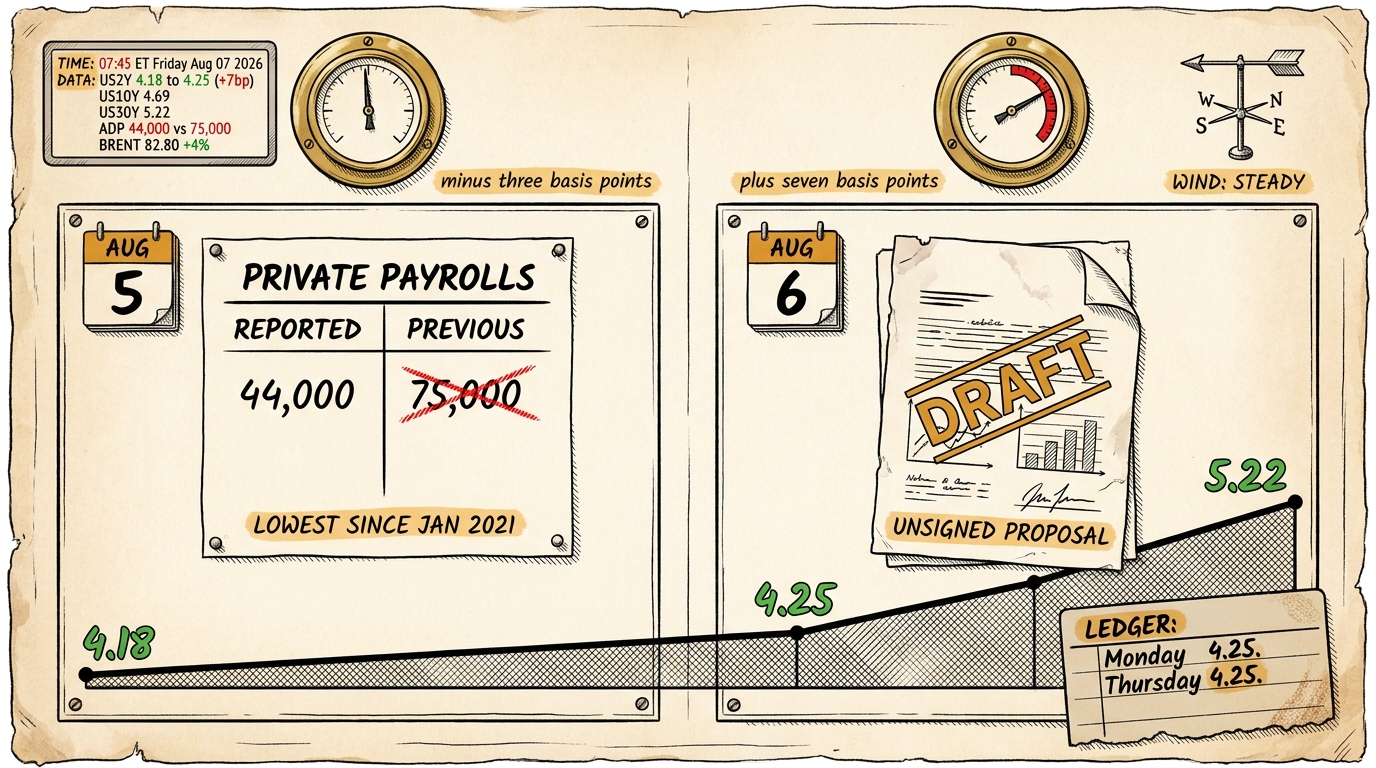
Start Wednesday. ADP put July private hiring at 44,000 against 75,000 expected, the weakest since January and down from June’s revised 95,000. A real miss, in the exact variable the Fed is mandated to watch. The two-year eased three basis points to 4.18%, and September hike pricing sat near 57% both before and after.
Now Thursday. An Iranian parliamentary committee was reported to be analysing a draft proposal on Hormuz transit: US and Israeli vessels barred, compensation demanded from hostile states, penalties at 20% of cargo value, reopening conditional on the US lifting its blockade. Nothing voted, nothing signed, nothing changed about a strait shut since February.
Brent rose more than 4% toward $82.80. The two-year rose seven basis points to 4.25%, the ten-year to 4.69%, the thirty-year to 5.22%. The Dow gave up 464 points.
The chain is legible. Crude led, the curve followed, equities followed the curve. This was not a rates market pricing a Fed reaction function. It was a rates market pricing an oil price, and taking that oil price from a committee’s reading list.
What the textbook says should have happened.
The textbook version is the opposite of this. A soft labour print lowers the expected policy path, so the front end falls meaningfully. A geopolitical headline with no change in physical supply is noise, so the curve shrugs and the move fades intraday. We got a small move on the first and a large, persistent one on the second.
There is an honest alternative, and it deserves stating rather than dismissing. Perhaps the front end is not ignoring labour data. Perhaps it has decided that with ISM services prices paid at 70.3 and rising, no employment number short of a collapse buys a dovish repricing, leaving crude as the only live input. On that reading both sessions were rational. Four sessions of data cannot separate the two explanations, and pretending otherwise would be the fun kind of wrong.
The detail to carry into the print.
The two-year closed Monday at 4.25% and closed Thursday at 4.25%. In between it absorbed a Treasury remark, a labour miss and a draft proposal, and finished exactly where it started. Whatever it does at 08:30, it has spent the week showing us its priorities, and jobs were not near the top.
Phil’s Musing
I have been treating the front end as the honest instrument here for weeks, on the grounds that it moves for information whilst equities move for mood. This week has made me less sure. If a yield shifts twice as far for a document being read as for a statistic being published, it is not measuring the economy, it is measuring the headline flow into an oil price. That does not make it useless. It does mean I should stop calling it the grown-up in the room. I want two more sessions before I commit, and today gives me one.
Happy trading,
Phil
Less Brain, More Gain
…and may your trades be smoother than a cashmere codpiece
P.S. – Phils Footnote I sat with the seven-versus-three thing a long time this morning and could not talk myself out of it. My instinct was that I must be missing something technical, an auction or a positioning quirk that makes it a non-story. Maybe there is one. But the simplest reading is that the market has quietly agreed the jobs number is no longer the important input, and nobody told us. I will watch 08:30 less for the headline than for what the two-year does in the ninety seconds after it.
🗒️ Desk Notes | Friday, August 7, 2026
Raw briefing export. Mechanism read, catalyst slate, divergence flags. Observations, not trades.
Session read (§8.4)
SESSION BRIDGE: prior session (Thursday) full reaction: S&P 500 -0.18% to 7,709.96, Dow -464.02 (-0.85%) to 53,885.10, Nasdaq Composite -0.06% to 26,348.35, Russell 2000 -0.58% to 3,001.55; curve reversed with 2yr 4.18% to 4.25%, 10yr 4.63% to 4.69%, 30yr 5.17% to 5.22%; Brent +4% toward $82.80; VIX -4.18% to 15.14; overnight tail Nikkei -0.57%, Kospi -70.18pts, Sensex -0.55%, Hang Seng +0.24%, Shanghai +0.49%, after-hours Airbnb +8%, Cloudflare +16%, DraftKings -3%; live premarket ES -0.02% / NQ +0.16%, VIX n/a pre-cash; threshold: none.
Threshold reasoning, stated rather than assumed. The equity test reads clean: prior session under 1% on the cash index, premarket at 0.02% and comfortably inside the 0.3% to 0.6% normal band. No carry-over fires on the §8.4.1 arithmetic, and Phil flagged no catalyst manually.
What the threshold does not measure, flagged deliberately. The reaction that mattered on Thursday did not happen in equity futures. It happened in the curve and in crude, neither of which the noteworthiness test looks at. A 4% move in Brent and a seven basis point reversal on the front end sit inside a session the equity threshold scores as unremarkable. Logged as a limitation of the instrument rather than quietly ignored, because a second session of the same shape would be a genuine gap in the test.
The mechanism read (full)
What moved.
- Front end, 2yr: 4.18% to 4.25%, +7bp. This is the artery. Constant maturity, US Treasury, published 16:15 ET Thursday.
- Long end, 10yr: 4.63% to 4.69%, +6bp. 30yr: 5.17% to 5.22%, +5bp. Curve rose roughly in parallel, marginally front-led.
- Dollar, DXY: 99.69 into Thursday’s close, 99.965 in Friday premarket, +0.28%. Firming with the curve, back at the round number.
- Volatility, VIX: 15.80 to 15.14, -4.18%. Sixth consecutive close under 18 and the lowest print of the current run.
- Crude: Brent above 4% toward $82.80 after three sessions of declines. WTI $78.10 in premarket, +1.05%.
- Gold: $4,334.80 premarket, +0.82%, having eased slightly on Thursday from Wednesday’s $4,305.20 settle.
What it implies.
The causal order is unambiguous and runs against the usual direction. Crude led, the curve followed, equities followed the curve. The input was a Reuters and Trading Economics report that an Iranian parliamentary committee is analysing a draft proposal setting restrictive Hormuz transit conditions: a bar on US and Israeli vessels, compensation demanded from states deemed hostile, penalties at 20% of cargo value, and full reopening conditioned on lifting the US maritime blockade. Nothing has been voted, signed, ratified or enforced. The physical position of the strait is identical to Monday’s.
That input produced a larger move in the two-year than Wednesday’s ADP miss produced, in the opposite direction, and more than twice as large. Wednesday: private hiring 44,000 against 75,000 consensus, a 21,000 miss following June’s revised 95,000, and the two-year eased three basis points whilst September pricing held near 57%. Thursday: a committee reading a document, and the two-year rose seven.
The one artery. The front end is transmitting inflation risk sourced from energy headlines and is not transmitting labour data. That is a mechanically different animal from a rates market pricing a Fed reaction function. It also means the instrument most likely to move on today’s 08:30 release has spent the week demonstrating that it does not weight releases of that type heavily.
The round trip nobody has noted. The two-year closed Monday 3 August at 4.25%. It closed Thursday 6 August at 4.25%. In between: a Treasury remark that took September pricing down ten points, a labour print that moved it none, and a draft proposal that reversed the lot. Four sessions of catalysts and a net change of zero basis points.
Forward catalyst slate
- Fri 7 Aug, 08:30 ET. July employment situation. Consensus 83,000 (WSJ survey) against 80,000 (Bloomberg), 85,000 (broad economist group) and 97,500 (FactSet median). June was 57,000. Unemployment expected unchanged at 4.2%, with several houses flagging risk of 4.3%. Average hourly earnings +0.3% m/m, +3.5% y/y expected. The revisions line matters as much as the headline: April and May were revised down by a combined 74,000 in the prior release, and Goldman has flagged that July prints have historically undershot with sharp back-revisions.
- Fri 7 Aug, post-print. CME September hike pricing. Sits near 57% to 58%, down from 68% on Monday. This is the measured variable for the Part 182 shot, which resolves today.
- Fri 7 Aug close. Amazon’s close against the $235.50 benchmark of 30 July. Terminal date for the Part 179 shot.
- Ongoing. The Iran and Oman shipping corridor joint statement is described as under review and in final drafting. A formal announcement is the contamination event for the Part 182 measurement and the trigger condition for the Part 180 falsifier’s MISS branch.
- Mon 10 Aug. Barrick Mining, Rocket Lab, Hims & Hers, Ferguson report.
- Tue 11 Aug. EIA Short-Term Energy Outlook. July’s edition had Brent averaging $65 in forecast, which is now $18 below spot.
- Mon 17 Aug. Alibaba earnings. Feeds the China open-weight models thread.
- Watch, undated. SpaceX insider selling volume in the sessions following Thursday’s unlock, which is the only way to convert the lockup from a non-event into a supply event.
Divergence flags
One. Volatility printed its lowest reading of the run on a risk-return day. VIX 15.14, -4.18%, on the session the whole curve reversed, crude added 4% and the Dow lost 464 points. This is the sharpest divergence on the board and it is the second consecutive session it has appeared in a different form. Wednesday it printed 15.80 on the eve of a Korean exchange halt. Thursday it fell further into a visible return of energy risk. Either the vol complex has correctly read both events as local and non-transmitting, or it is not pricing the transmission channel at all. Today’s print is the arbiter.
Two. Every labour signal contradicts the next, forty-eight hours before the arbiter arrives. ADP 44,000, weakest since January. Challenger announced cuts 33,429, the lowest monthly total in two years and 46% below July 2025. ISM services employment 47.4 from 51.2, back into contraction. Hiring is deteriorating, firing is at a two-year low, and services employment says contraction. A consensus of 83,000 is being asked to reconcile three signals that do not reconcile.
Three. Crypto sentiment and crypto positioning point opposite ways inside the same asset. Spot bitcoin funds took $244.4m Wednesday and $626m across three sessions with zero net outflow days in August, against $172.4m for all of July. The Fear and Greed index read 25, extreme fear, down from 27. Money is arriving at a pace not seen since April whilst the sentiment gauge sits at a level normally associated with capitulation.
Four. The ether flow narrative has now reversed twice in six sessions. Out on 4 August, in on 5 and 6 August at $60.9m and $114.6m across two days. This thread has supplied a structural read to a five-day pattern twice now and been wrong twice. Logged as a caution on the thread itself, not on the data.
Five. The largest insider release on record produced a positive session. SpaceX unlocked roughly 911.5m shares worth about $116bn and closed up 2.84% at $111.34, one session after a record low close of $108.27. Either the event was fully discounted across the three weeks the stock spent below its $135 IPO price, or the selling has not started yet. Put/call on the 7 August chain at 1.42 suggests hedging rather than conviction.
Part C: regime read and sensitivity (§17.3)
Weathervane: CONFIRMED, fourth consecutive clean session. Carried unchanged. The banner claims attention rather than risk is the repriced variable. Thursday supplied the cleanest single measurement in the series: an unvoted, unsigned draft moved crude 4%, the entire curve five to seven basis points, and 464 points of the Dow, whilst the physical position of the strait did not change by a metre. Next rewrite candidate remains not before Monday 17 August.
⚓ REGIME FLAG (duration, SOFT): carried, and the proposed respec is now measurable and running. Under the respec logged 3 August, replacing three level conditions with one transmission condition, the window requires five consecutive sessions where the 30yr holds above 5.15% and the S&P 500 fails to make a new closing high. The 30yr has printed 5.23, 5.18, 5.17 and 5.22 across the last four sessions, all above 5.15. The S&P made its most recent record close on Tuesday 4 August and has failed to make a new one on 5 and 6 August. That is session two of a five-session window, live now. Today is session three if the index does not close at a new high. Phil’s call on adopting the respec is now the difference between a flag that can be marked and a fifth consecutive session of a flag that cannot.
⚓ REGIME FLAG (Korea / memory-complex transmission, SOFT): carried, zero qualifying sessions. The Part 183 shot requires a Nasdaq Composite close down more than 0.5% to generate a qualifying session. Thursday’s -0.06% does not qualify. One of five sessions elapsed, no evidence either way.
⚓ REGIME FLAG (chipflation supply side, SOFT): carried, unchanged. No memory contract pricing data. Western Digital -13% and Sandisk -6% are memory equity moves, not memory prices, and are explicitly not counted here. The Part 169 conflation error remains this flag’s exposure.
Vol regime: SPIKE-AND-REVERT, revert leg extended to six sessions and now the standing anomaly. 20.66 on 29 Jul, 17.08 on 30 Jul, 16.08 on 3 Aug, 16.04 on 4 Aug, 15.80 on 5 Aug, 15.14 on 6 Aug. That is a monotonic decline through a Korean exchange halt, a 4% crude move and a full curve reversal. Classification of the spike as fully reverted was due today. It is now overdue, and the reason to keep it open is no longer the level, it is the disregard for inputs that ought to lift it.
Sensitivity read (§17.3): HIGH-TIGHT, hold at yellow. No change recommended, seventh consecutive vindication. The tight setting is doing visible work today in three places: it is why the threshold is honestly recorded as none rather than nudged to soft to justify a better story, why the duration flag is stated as measurable rather than declared tripped, and why the Korea flag records zero qualifying sessions rather than reading Thursday’s small Nasdaq decline as supporting evidence. The useful lever remains the duration condition respec, not the dial.
Public tell status: NOT triggered. “Hoist the mainsail, the macro winds have changed” stays holstered. A fourth confirmation of an existing banner is a banner working, not a wind changing.