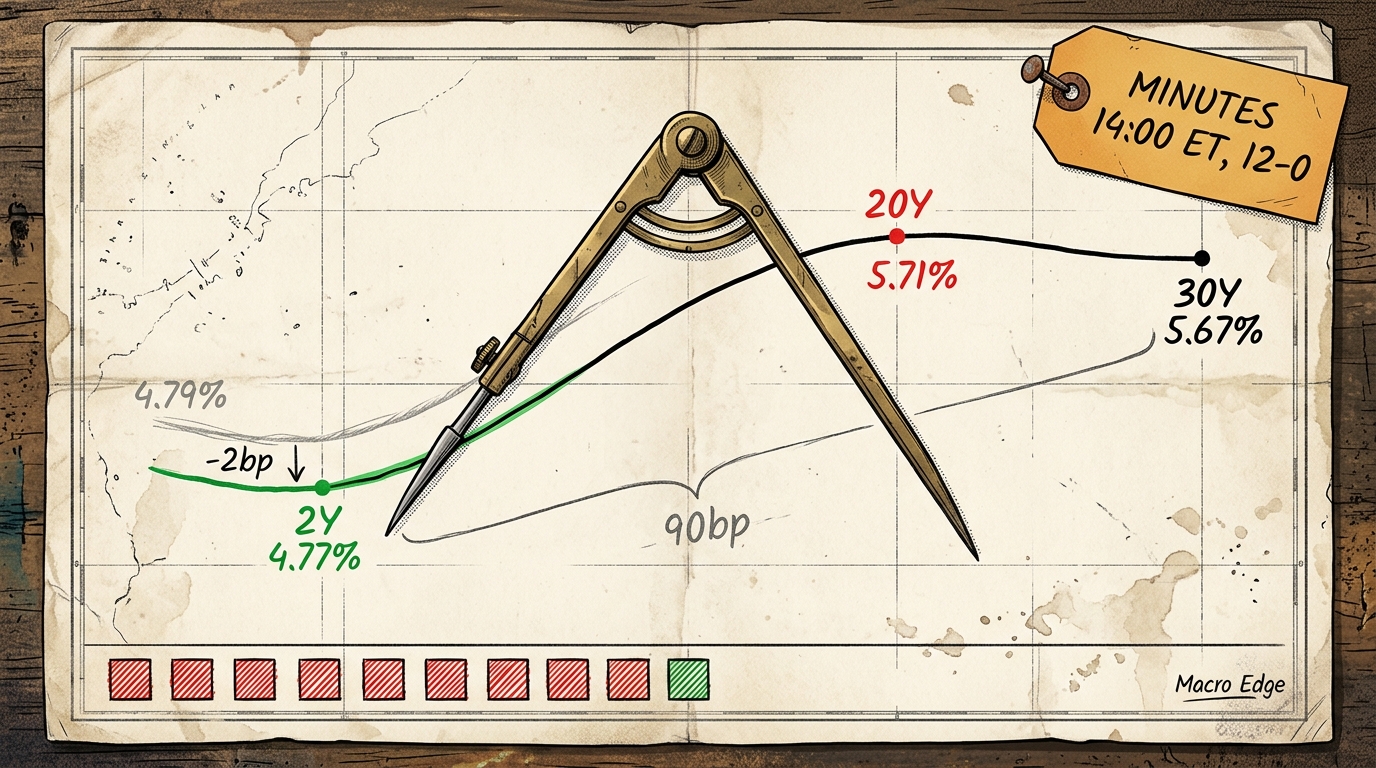
The 2-year fell 2 basis points, the 20-year rose 3, and 2,155 stocks fell the same afternoon
⚓ Weathervane. The wind is coming from the long end. The policy rate has been frozen for most of the year whilst the term premium does the tightening, and the price of long money is set by deficits, issuance supply and a synchronised global duration bid rather than by the committee. Higher-for-longer stopped being a Fed decision and became a bond-market fact. The cruise ship is holding this heading.
 Ahoy there, Trader! ⚓️
It’s Phil…
If most of the committee wants one more hike this year, why did the front end get cheaper and the long end dearer?
Wednesday handed us a clean experiment, which almost never happens. One dated catalyst, at 14:00 Eastern, and nothing else worth the name. The September minutes recorded that most participants judged another increase would likely be appropriate by year end, and the move to 3.75% to 4.00% as unanimous, twelve votes to none.
Then the 2-year closed at 4.77%, two basis points cheaper. The 20-year closed at 5.71%, three dearer, its thirteenth consecutive session as the dearest money on the curve. The gap from two years to thirty widened to ninety basis points, the widest of those thirteen sessions. Underneath all of it, 2,155 NYSE issues fell against 572 that rose, and the hardest falls were small, domestic and long-financed: small caps down 1.31%, industrials down 2.18%, real estate down 1.29%.
The textbook is unambiguous here. A committee signalling more tightening lifts the front end, because the front end is a forecast of the policy rate and nothing else. The long end should move less, since the terminal destination is unchanged. We got the opposite on both legs.
So here is the thing worth taking away, and it took the intraday path to see it. The 2-year and the 10-year did not move in opposite directions at all. Both peaked in the nine o’clock hour, before the bell, both fell together through the afternoon, and both turned back up into the close. The 10-year simply retraced further, far enough to finish above where it started. Opposite-sign closes, same direction of travel. That is unequal retracement, and reading two closes without the path between them would have had us describing a fight that never took place. We have no intraday path for the twenty-year, so the same test has not been run on it and we are not claiming it has.
Which leaves the committee’s own wording doing the work. It said “by year end”. Two meetings are left, the twenty-seventh and twenty-eighth of this month and the eighth and ninth of December, and only December carries a projection round. A front end that falls on a hawkish majority is not disagreeing about whether; it is pricing when, and it has picked the later door. What settles this is not another speech. It is which of those two meetings the committee uses.
Phil’s Musing
The part that nags at me is the equity reaction. If the front end is pricing a December move rather than an October one, that is a reprieve, and reprieves do not usually arrive with 79% of the moving issues going down. Unless the small caps were never reading the front end, and were reading the twenty-year instead. That would mean the two halves of the market take their instructions from different ends of one curve. It might just be two markets wearing one index.
Happy trading,
Phil
Less Brain, More Gain
…and may your trades be smoother than a cashmere codpiece
P.S. – Phils Footnote I had assumed, for most of this year, that a hawkish Fed communication was a front-end event and that the long end would shrug. Wednesday has the long end doing the moving and the front end going the other way, and I was wrong about which end listens. The uncomfortable version is that the committee’s voice now matters mostly for timing, and the price of money for anyone borrowing beyond ten years is being set somewhere else entirely, by people who were not in that room and did not take a vote.
🗂 Desk Notes – Part 224 | 8 Oct 2026
Raw briefing. Observations, never trades.
Session read (§8.4)
SESSION BRIDGE: prior session (Wed) full reaction SPX -0.219467% to 7,801.77, DJI -0.662658%, RUT -1.310587%, 572 NYSE advancers against 2,155 decliners, December ES settled 7,852.75; live premarket ES -0.23877% / NQ -0.402041% / RTY -0.522722%, VIX 15.08 prior-session official cash close carried; threshold: none.
The threshold call and why. §8.4.1 is specified on S&P futures percentages. The prior cash session was 0.219467% lower, inside the normal envelope, so no editorial carry-over fires and the bridge stays silent on that limb. The premarket band runs 0.23877% to 0.522722% across the four contracts, inside the 0.3% to 0.6% normal range. The volatility leg did not fire either: VIX moved 0.4664%, far short of the 8% trigger. The commodity leg did not fire: November crude moved 1.296959%, short of 4%.
The call is nonetheless uncomfortable and it is worth saying so. Every percentage gate in §8.4.1 reads “normal” on a session in which 2,155 of 2,727 NYSE issues fell, new lows beat new highs on both exchanges, and ten of eleven sector proxies closed lower. The thresholds are specified on index percentages and the session’s information was entirely in its breadth. That is a specification observation rather than a threshold trip, and it is recorded here instead of being smuggled into a carry-over note.
Close-to-open window. Cash close 20:00 UTC Wednesday to the 06:30 UTC capture Thursday is ten and a half hours. The 06:30:00 to 06:34:59 UTC capture bar was read at 06:50 UTC and re-read at 06:55 UTC, and all four dated contracts came back byte-identical on open, high, low, close and volume on both reads. The adjacent still-forming 06:40 UTC bar moved on all four contracts across three reads, at 06:49, 06:50 and 06:55 UTC, which is the control. Sixth consecutive confirmation of the two-read protocol.
Contract roll. No quarterly roll this week. October is not a roll month, and the third Friday falls on 16 October. December remains front for the equity index complex. WTI November expires in roughly a fortnight and the front-to-next volume ratio has already fallen 1.578 to 1.391 in one session, so any WTI volume narrative from here is roll rather than conviction. Brent December last trades 30 October by the ICE rule.
Index basis. December ES settlement 7,852.75 against cash SPX 7,801.77 at the same 20:00 UTC instant is 50.98 points, narrowed 4.09 from 55.07 on Tuesday.
Mechanism read (full)
The front end. 2-year CMT closed 4.77%, down 2 basis points. It is the third-lowest close of the thirteen sessions held since 21 September, behind 22 September’s 4.71% and 21 September’s 4.76%. The 1-year fell 4 basis points to 4.42%.
The long end. 10-year 5.28%, up 1. 20-year 5.71%, up 3. 30-year 5.67%, up 3. The 20-year was the strict maximum of all fourteen published tenors at every one of the thirteen closes held since 21 September. No longer run is claimed, because no earlier comparison is held. 20s30s stayed inverted at minus 4 basis points.
| Tenor | 7 Oct | 6 Oct | Change (bp) |
|---|---|---|---|
| 1 Mo | 4.07 | 4.06 | +1 |
| 1.5 Month | 4.13 | 4.12 | +1 |
| 2 Mo | 4.14 | 4.13 | +1 |
| 3 Mo | 4.22 | 4.21 | +1 |
| 4 Mo | 4.28 | 4.26 | +2 |
| 6 Mo | 4.28 | 4.28 | 0 |
| 1 Yr | 4.42 | 4.46 | -4 |
| 2 Yr | 4.77 | 4.79 | -2 |
| 3 Yr | 4.87 | 4.88 | -1 |
| 5 Yr | 5.03 | 5.03 | 0 |
| 7 Yr | 5.15 | 5.15 | 0 |
| 10 Yr | 5.28 | 5.27 | +1 |
| 20 Yr | 5.71 | 5.68 | +3 |
| 30 Yr | 5.67 | 5.64 | +3 |
Spreads. 2s10s 51 basis points from 48, 2s30s 90 from 85. Both are the widest of the thirteen sessions held, 21 September to 7 October, and that window measures closing spreads only. No unbounded claim is licensed.
The dollar. DXY 102.249, up 0.3967% and 0.404 points. The six-leg rebuild summed to +0.42007265 percentage points against an actual of +0.39668123, a residual of -0.02339142. All six legs, unrounded, so the sum can be checked in print: euro +0.3223222, sterling +0.05522291, Canadian dollar +0.03151426, Swedish krona +0.00757287, Swiss franc +0.00662338, yen -0.00318298. The euro alone is 76.73% of the rebuild. “The dollar rose” mostly means “the euro fell”.
Volatility. VIX 15.08, up 0.07 points and 0.4664%. No superlative is licensed: five sessions in the held window closed lower, the window minimum is 14.21 on 22 September, and the prior edition’s low-since claim attached to Tuesday’s close and does not carry forward.
The causal read, and the restraint on it. The day’s only dated catalyst was the September FOMC minutes at 14:00 ET, which recorded that most participants judged another increase would likely be appropriate by year end and recorded the September hike as 12-0 with no dissent. The curve’s close-to-close shape around it was a bear steepening. The equity damage was concentrated in long-duration, domestic and small-capitalisation exposure: Russell 2000 down 1.310587%, industrials down 2.179741%, materials down 1.508144%, real estate down 1.289538%, health care the only one of eleven proxies higher at 1.029385%.
🔴 A correction the intraday path forces, and it changes the sentence. The opposite-sign closes at 2 years and 10 years read as the two ends moving in opposite directions. They did not. Both tenors peaked in the 09:00 ET hour on the cross-validator instruments, fell together through the afternoon, and both retraced into the close. The 10-year retraced further, back above its prior close, and the 2-year did not. This is unequal retracement, not opposed direction. Shape only from those instruments; no basis-point magnitude from them appears anywhere in the five outputs.
🔴 And no equity attribution is made. No intraday equity path was retrieved against the 14:00 ET release, so the minutes are stated as the session’s catalyst and as a sequence, and nothing claims the release moved any particular bar. The 10-year reopening closed at 13:00 ET, an hour before the minutes, and the 10-year’s own session low falls in the auction hour whilst the 2-year’s falls in the minutes hour. Hour resolution cannot separate those from continuation of a move already three hours old, and finer bars were not pulled.
The one artery. The committee asked in print for dearer money; the tenor the committee does not set got dearer and the tenor closest to the policy rate got cheaper; and the smallest, most domestic and longest-financed parts of the equity market fell hardest whilst the index, being a weighted average dominated by the largest, recorded 0.219467%. No bar-level cause is asserted for any of that.
Overnight Excitement (§8.5)
🔴 DOES NOT FIRE. Largest overnight leg across the four dated contracts was December RTY at 0.522722% below its own settlement, with December NQ at 0.402041%, YM at 0.359579% and ES at 0.23877%. All four sit inside the 0.3% to 0.6% normal and silent band; the 1.0% trigger was not approached. Fifth consecutive edition without firing, after Parts 220, 221, 222 and 223.
Colour, for the record and not for publication as levels. Asian equities were mostly lower on syndicated reports, with Japan, Korea and Australia described as lower and China and Hong Kong described only as subdued. Mainland China reopened on 8 October after five sessions absent from a successful constituent pull, which demonstrates the closure rather than reporting it. Japan was open on 8 October, likewise demonstrated. Europe had not opened at capture time, so there is no European overnight direction this edition and none is inferred. No non-US cash index level is published anywhere; a syndicated Nikkei level was offered and declined for the fourth consecutive edition.
Non-US policy. India’s central bank raised its repo rate 25 basis points to 5.50% on Wednesday at 04:39 UTC, on a tier-2 liveblog of its own committee. No G10 central bank decision and no G10 policy speech landed in the 8 October overnight window.
Geopolitical events, timestamped, carried as events and not as measurements. A report that US forces were ordered ready for a possible resumption of strikes on Iran carries a derived timestamp of roughly 23:57 UTC on 7 October and is approximate to within half an hour. An oil tanker assembly site reportedly exploding near the UAE, with a fire in the Gulf of Oman about thirty nautical miles east of Fujairah, carries an exact feed stamp of 05:37 UTC on 8 October. The sequence runs the right way for the 8 October crude move: the first report precedes the rebound and the rebound precedes the second report. No transit count and no regional export figure is published.
Forward catalyst slate
Today, Thursday 8 October. Fed Governor Waller on the economic outlook in Istanbul at 04:30 ET, confirmed on the Fed’s own calendar and the vendor calendar; this is a European-hours slot and explains an unusual time for a governor. Initial and continuing claims at 08:30, consensus 200,000 against 197,000 prior on both routes. EIA natural gas storage at 10:30. 4-week and 8-week bill auctions at 11:30, 110 billion and 105 billion dollars. The 29-Year 10-Month bond reopening at 13:00, 22 billion dollars; the vendor calendar says 13:01 and the one-minute disagreement is flagged rather than reconciled. St Louis Fed President Musalem at 13:40, who is a Reserve Bank president and not a Board governor whatever the calendar’s title field says. H.15 at 16:15, which will carry the 7 October column. H.4.1 at 16:30.
Friday 9 October. Michigan preliminary at 10:00, a five-release cluster at one timestamp. WASDE at 12:00. Baker Hughes rig counts at 13:00. Boston Fed President Collins at 16:00.
Monday 12 October. 🔴 Columbus Day, confirmed on three independent routes including the Fed’s own calendar, which states that daily and weekly statistical releases scheduled for that day will be released on Tuesday 13 October. Bond market closed and no CMT row will publish. Monthly budget statement at 14:00, prior minus 167 billion dollars.
Tuesday 13 October. NFIB at 06:00. ADP weekly at 08:15, which is not 08:30 and does not belong in any 08:30 cluster. Existing home sales at 10:00. Three bill auctions at 11:30. Plus everything deferred from the 12th.
Wednesday 14 October. 🔴 September CPI at 08:30, confirmed on the Bureau of Labor Statistics primary schedule and the vendor calendar, as a seven-release cluster including real earnings. Beige Book at 14:00.
Thursday 15 October. September PPI at 08:30. Friday 16 October. Import and export price indexes at 08:30, industrial production at 09:15.
Not this week, and commonly misplaced. FOMC is 27 to 28 October, two days, no projection round; the December meeting on the 8th and 9th carries one. The minutes said “by year end”, which is a two-meeting window and not an October statement.
What is coiled. The Part 215 open shot closes on today’s session. The Part 221 shot has seven sessions left and took its first hit on Wednesday. The Bureau of Labor Statistics October schedule carries no lapse, postponement or blackout notice, but the page’s own last-modified date is February 2026, so its silence is weak evidence about appropriations rather than an affirmation. The continuing resolution expires 11 December, which is after every release above and before the December FOMC.
Divergence flags
- 🔴 The index and its own constituents. SPX minus 0.219467% against an NYSE advance-decline ratio of 0.265429 and 90 new lows to 16 new highs. Nasdaq 1,497 up against 3,449 down. The two measurements of the same session do not reconcile in any ordinary reading and the breadth is the larger fact.
- 🔴 Volatility did not confirm. VIX up 0.07 points on that session. A breadth collapse with no volatility response is the divergence of the edition.
- 🔴 Sector count conflicts across bases. The ETF proxies give 1 higher and 10 lower. One secondary wrap states three of eleven higher. XLU at minus 0.024295%, XLP at minus 0.122249% and XLK at minus 0.30198% are all close enough to zero that cap weighting could plausibly flip them, so this is most likely a genuine basis difference rather than an error in either. Both are reported; the published count names the ETF-proxy basis.
- 🔴 The Dow percentage. Bars give minus 0.662658%. One provider’s headline says 0.68% and another’s wrap says 0.6%. The bars govern and the conflict is noted rather than smoothed. No single name’s share of the 341.41-point fall is claimed anywhere: there is no Dow divisor on this stack, and Caterpillar at minus 5.745622% on a high nominal price is exactly the trap Part 216 fell into.
- 🔴 Aligned gold carry: the measure is not usable this edition and the reason is serious. Part 223’s value of 26.20 for 6 October cannot be reproduced from any hourly spot bar on that date; the twenty-three hourly closes run 4,119.90 to 4,175.66 and none implies it. On the pinned definition the band floor was already breached on 2 October at 25.03 and harder on 5 October at 20.14. No aligned-carry figure and no band or breach language appears in any of the four reader-facing letters; the figures in this paragraph are internal to these notes and to the ledger. This needs a ruling and must not be re-based onto 26.20, which is what Part 217 did and why the band broke immediately afterwards.
- 🔴 Two attention routes disagree about direction of travel on the same name. One research route has Constellation’s three-day attention accelerating whilst the board route has it off the top 25 on all three boards. The partial reconciliation is that board rank fell and message volume did not move at all, holding at 84 and extremely high, the identical figure to Tuesday. The split is between rank and volume, not between providers.
- 🔧 Breadth volume integrity. Up volume plus down volume is 1,167,261,743 against total volume of 1,193,216,090, a residual of 2.175159%, the widest of the five tracked observations. Tracked series 0.99%, 2.045%, 1.5037%, 1.4391%, 2.175159%. Unchanged-issue counts remain unretrievable, so total issues stays unavailable.
- 🔧 Canonical and legacy sentiment inverted on 9 of 16 non-degenerate rows, and on all five crypto majors at one capture. Five of five after three of three last edition makes it a route property rather than coincidence. Canonical published alone throughout; four degenerate legacy shapes recognised and discarded, including two with no delta field at all.
- 🔧 Two research routes gave different quality ranks for one ticker at one capture, which is a recurrence rather than a new finding. Flagged, never merged. A second internal split on the same name sits between a daily-recomputed rank and an analyst position with its own publish date; presented in time order.
- 🔧 One secondary route is a full session behind and its price targets sit below the live marks on all three names tested. Useful as independent confirmation of Tuesday’s close, useless as a current characterisation, and said so rather than passed off.
- 🔴 An earnings calendar failure, two modes at once. Every actual and every session-timing cell was empty for all twenty names across three days, and the sweep also omitted three reporters a second calendar carries. The calendar was treated strictly as an incomplete name sweep and every date used was corroborated on a second route.
- 🔴 The fiscal-period trap fired and was caught. One aggregator labelled a data-centre operator’s release “2026” against the company’s own “fiscal first quarter 2027”, wrong by a full fiscal year. No fiscal period is printed from any aggregator headline anywhere in the five outputs, and the only company-sourced period in the edition is Levi Strauss’s quarter ended 30 August 2026.
- 🔧 A quarter-end date conflict, resolved to the filing. One wire gave Levi Strauss’s quarter as ended 31 August; the company’s own 8-K exhibit says 30 August. The filing is published.
- 🔴 Two separate power agreements were being conflated in one attention stream. A 20-year agreement with one technology counterparty announced 6 October and a separate 20-year agreement with a different counterparty are distinct deals, resolved on a second route. Both are locked as events at tier 2 and neither is offered as a cause of any price bar.
- 🔧 The all-asset attention board returned rank-for-rank identical to the equities board at depth 25, for the first time on the ledger. That is not licence to conflate them; both were pulled and both are labelled.
Carry-over note (§10.6)
🔴 DOES NOT FIRE. §8.4.1 did not trip on any leg and no catalyst has been flagged manually. The breadth observation above is a mechanism finding and a specification observation, not a carry-over, and it is deliberately not dressed as one.
Regime and sensitivity read (§17.3)
Sensitivity is running LOOSE, thirty-fifth consecutive edition, and that is stated openly rather than presented as neutral. The diagnosis is unchanged: this is specification rather than tuning, and adjusting sensitivity will not fix a candidate set pointed at the wrong things.
Wednesday produced three regime-grade observations and the tripwire saw none of them. An index lost 0.219467% whilst 79.0246% of the NYSE issues that moved declined. A dated Federal Reserve communication finally landed after four sessions without one, and moved the 2-year two basis points. And the volatility index rose seven hundredths of a point on a session with 198 new lows across the two exchanges.
🔴 The turn condition engaged on both limbs for the first time in five editions and failed on magnitude. The condition requires two sessions in which a dated Federal Reserve communication moves the 2-year by 10 basis points or more whilst the 30-year moves by less than half. Wednesday had the communication and had the published series. The 2-year moved 2 basis points and the 30-year moved 3, so the first limb failed by 8 basis points and the second limb failed outright on sign. Progress 0 of 2, fourteenth consecutive miss. A condition that has now failed by absence of a communication, by absence of a series, by spurious satisfaction and by magnitude is a specification problem, and splitting it into two separately scored legs remains the strongest standing recommendation after the cross-exchange leg.
Candidate notes. Candidate 1, dollar non-response: the dollar rose 0.3967% on a session the 2-year fell 2 basis points, and the candidate is still not scored because its full condition text is not carried in the live ledger, twelfth consecutive edition. Candidate 2, rates versus energy, retired: eleventh consecutive session of fresh evidence, with November crude at its lowest settlement since 3 September whilst the long end cheapened. Candidate 3, volatility suppression, retired at Part 207 with its replacement two-sided leg now nineteen editions overdue: vindicated a fourteenth consecutive time, and this is the sharpest instance yet. Candidate 4, the front end’s selective deafness, retired: a thirteenth vindication, since the front end heard a hawkish communication and fell. Candidate 5, official demand at the long end: the Part 209 ruling is now three days past its Monday deadline, Wednesday’s reopening was not scored, and today’s prices at 13:00 ET. Candidate 6, term premium without a policy move: the disqualifier applies for the first time in four editions, because a dated communication did land, so the session is ineligible on that limb.
Recommendation order, unchanged in substance with one promotion.
- The cross-exchange breadth-sign leg. Thirteen dated observations, base rate 3 of 13, and session 13 agreed in sign. It becomes fileable once the Part 215 shot closes.
- A leg on series availability as a regime observable, which last edition could not be scored because the curve did not publish and this edition could not be scored because it published normally. The absence of a measurement is still not an event anywhere in the candidate set.
- A two-sided volatility leg. Nineteen editions overdue and today is its best advertisement.
- Split the turn condition into two separately scored legs. Fourteen attempts, four distinct failure modes.
- A leg on the new-high and new-low counts rather than the advance-decline ratio. Wednesday is the clearest instance yet: 90 to 16 on the NYSE and 108 to 19 on the Nasdaq on a 0.22% index session.
- The intraday-path requirement on the attribution limb. Vindicated a fifth consecutive edition, and this edition it prevented the curve twist being described backwards.
- A leg on data-to-price transmission failure. Fourteenth instalment.
- A leg on calendar-driven price formation. Carried unchanged.
Drift gate (§11.9.1), run at 07:58 UTC immediately before delivery
First limb, price distance: CLEAN. 4 of 4 keys inside the 2% threshold. December ES 7,834.00 to 7,828.50 (-0.07%), December NQ 31,276.00 to 31,256.50 (-0.06%), December RTY 2,797.50 to 2,788.30 (-0.33%), bitcoin 83,310.18 to 82,970.14 (-0.41%). No figure was refreshed and no copy was requalified on price.
🔴 SECOND LIMB, DISTANCE TO A SPECIFICATION THRESHOLD: THE PART 219 FINDING HAS A SECOND INSTANCE, AND IT IS WORTH MORE THAN THE FIRST LIMB TODAY. Re-quoted against their own settlements, the four overnight legs now read ES -0.308809%, NQ -0.464139% and RTY -0.849868%, which is 0.150132 percentage points from the §8.5 1.0% trigger. The price move on RTY was only -0.327146 percentage points, comfortably inside the 2% refresh threshold, so §11.9.1’s first limb cannot see it. §8.5 still does not fire and the section is still absent from the letter, correctly. But the section moved from the middle of the silent band to the edge of the trigger on a move the gate reads as nothing, which is exactly the gap the Part 219 proposal named. The proposal stands: §11.9.1 should gain a second limb measuring distance to a specification threshold rather than only distance travelled by a price.