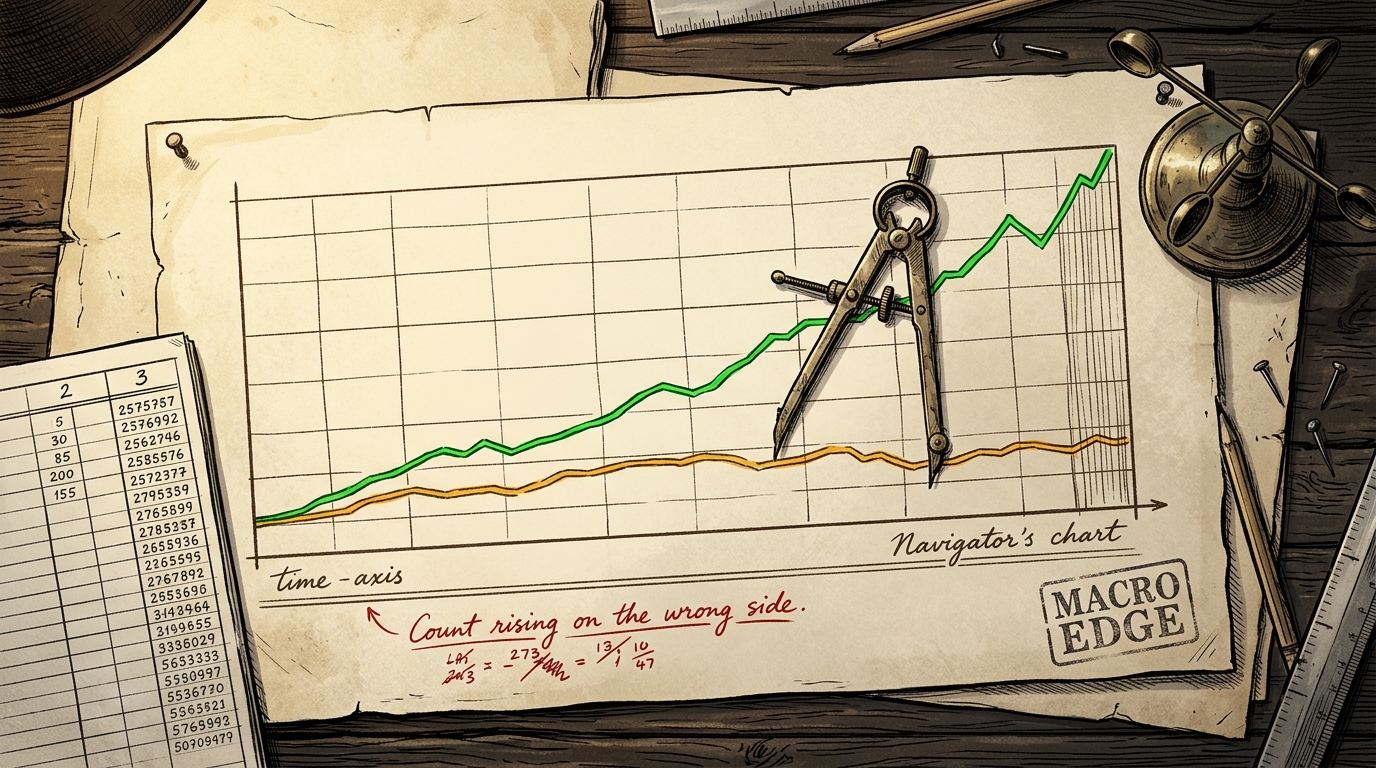
2,519 Nasdaq stocks rose, 2,436 fell, and the index weighed by neither of them
⚓ Weathervane. The wind is coming from the long end. The policy rate has been frozen for most of the year whilst the term premium does the tightening, and the price of long money is set by deficits, issuance supply and a synchronised global duration bid rather than by the committee. Higher-for-longer stopped being a Fed decision and became a bond-market fact. The cruise ship is holding this heading.
 Ahoy there, Trader! ⚓️
It’s Phil…
If an index can set a record close whilst more of its own stocks make new lows than new highs, what is that record measuring?
Start with the instruments, because three of them measured Tuesday and returned three answers. A capitalisation-weighted index is a weighing machine: every company enters in proportion to what it is worth, so a handful of the largest names can set the level whilst most of the fleet barely registers either way. The advance-decline line is a show of hands. One vote each, regardless of size, and on Tuesday that vote came back 2,519 to 2,436. A margin of eighty-three on an exchange of thousands.
Now the third instrument. Nasdaq up volume beat down volume 1.619909 to one on the same session, whilst advancing issues beat decliners 1.034072 to one. The money that traded was emphatic. The headcount was almost exactly tied. The index weights by size and reported neither, landing far nearer the money than the vote. That is the arithmetic signature of concentration. New York showed a milder version of the same shape, 1.942985 against 1.457766.
The textbook is worth stating precisely, because a precise expectation is a testable one. Narrow leadership is supposed to mark a late phase: capital crowds into a shrinking set of names, the index keeps printing highs, and the breadth line rolls over first. The sequence is breadth, then index. Most desks read a record close on deteriorating internals as a warning with an unreliable fuse.
What happened is stranger than that, because participation was not narrow. Ten of eleven sector proxies closed higher and both exchanges’ advance-decline ratios finished above one. What was narrow was the money. And the sector that led is not the one the story requires: the utilities proxy added 2.9772%, more than five times the technology proxy’s 0.5325%, sixth of eleven, whilst the index measuring semiconductors managed 0.3423% and underperformed the S&P 500. Those are tier-2 ETF proxies, not cap-weighted indices. So the precondition is half present, and the present half is the half nobody watches.
We cannot close the question and we can name what would settle it. A record close on concentrated money resolves one of two ways: the laggards catch up within a fortnight, which is rotation, or the leaders stop and nothing takes over, which is exhaustion. The observable is the new-low count rather than the ratio, because the count is the only one of these measures that went backwards. Fifty-six against fifty-three is a near tie; a week of fifty-six against twenty would be an answer.
Phil’s Musing
My instinct is that this is a concentration story and not yet a distribution story. The gap between a 1.62 volume ratio and a 1.03 issue ratio tells you where the money is, not that it is leaving. What would change my mind is the new-low count widening whilst the index still prints highs, and that is a two-week observation rather than a one-day one.
Happy trading,
Phil
Less Brain, More Gain
…and may your trades be smoother than a cashmere codpiece
P.S. – Phils Footnote I spent yesterday refusing to write the word record because nobody could show me a window, and I spent this morning finding the window in a single query. That is not a comfortable pair of facts to put next to each other. The assumption I was carrying is that an all-time-high claim on a 36-year series would be expensive to verify, and it was not. I have been treating caution and effort as the same thing, and on Tuesday they came apart.