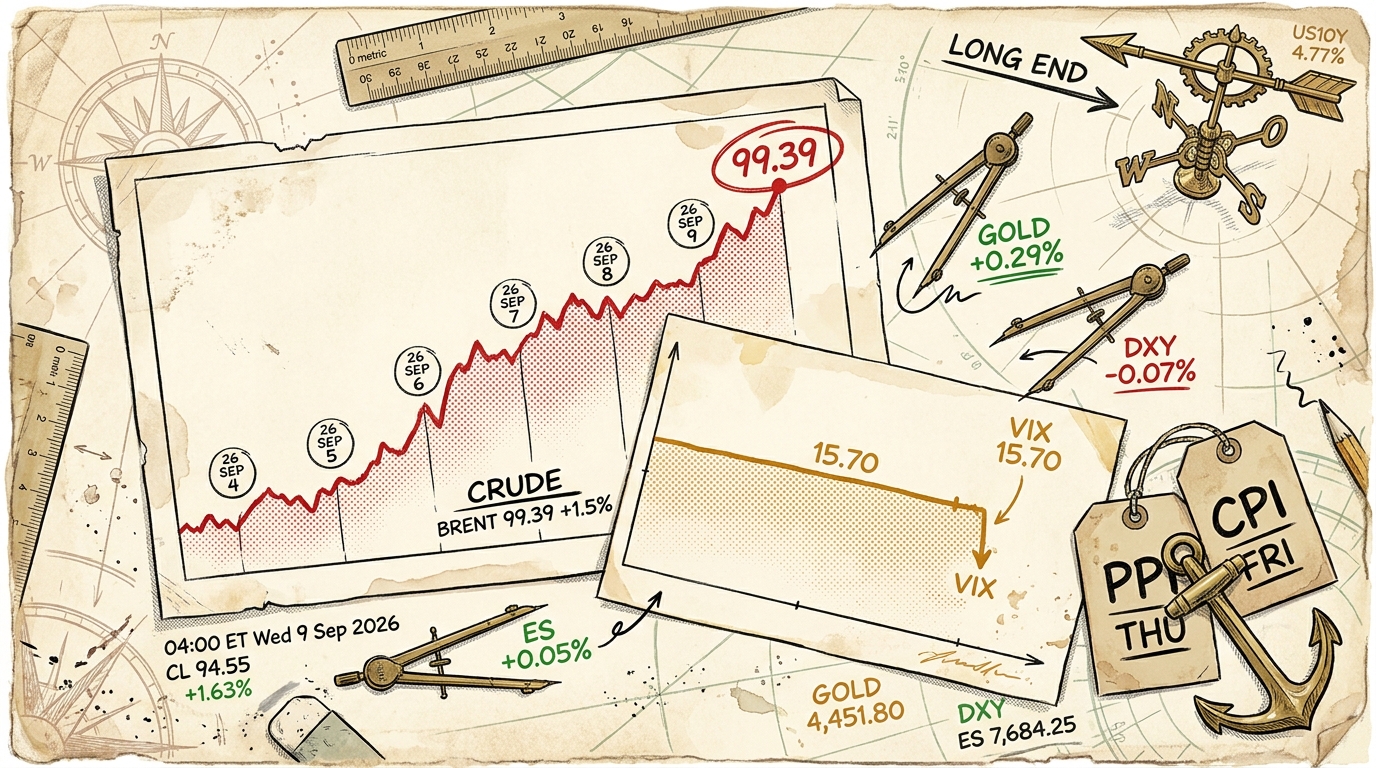
Five tankers were destroyed overnight and the price of insuring the index went down
⚓ Weathervane – The wind is coming from the long end. The policy rate has been frozen at 3.50% to 3.75% since July whilst the term premium does the tightening, and the price of long money is now set by deficits, issuance supply and a synchronised global duration bid rather than by the committee. Higher-for-longer has stopped being a Fed decision and become a bond-market fact. The cruise ship is holding this heading.
One nudge worth logging. This week the tightening impulse is arriving from the energy price rather than from issuance. Same heading, possibly a different wind. That is a re-specification question, not a turn, and the banner rides unchanged until it earns a rewrite.
 Ahoy there, Trader! ⚓️
It’s Phil…
Why does insurance on the S&P still cost 15.70 with tankers burning in the Gulf and three dated policy events inside eight days?
That is the question this morning hands us, and the honest answer is that we do not know yet. What we can do is lay the pieces beside each other and see which refuse to fit.
Start with what is not in dispute. US forces destroyed five tankers linked to Iran’s Revolutionary Guard, four in the Gulf of Oman and one beside Kharg Island. Tehran answered with missiles into Jordan and an instruction to tanker crews at Kuwaiti and Bahraini piers to abandon their vessels. November Brent rose 1.5% to 99.39 dollars, its sixth consecutive daily advance and its longest run since March. Brent is up better than 60% this year. That is not a rumour or a communiqué. Ships were destroyed.
Now the pieces that do not fit. Gold rose 0.29%. The dollar fell 0.07%. S&P futures rose 0.05%. And the VIX, the instrument whose entire job is to price the chance that the next eight days go badly, printed 15.70 and eased.
The common view says a supply shock in a shooting war lifts the haven complex together: gold bid, dollar bid, volatility bid, equities offered. Most desks would have written that sequence down without checking it. The tape did roughly one quarter of it. Crude moved, and nothing else corroborated.
There are two readings and they lead to opposite places. The first is that the market has correctly identified this as a supply event with no macro content, in which case energy reprices, the sector rotates, and the index is right to move on. The second is that the risk premium is real, that crude is simply the fastest instrument, and that the other three are slow rather than clever. That second reading has an uncomfortable feature: it would mean the cheapest asset on the board this morning is the one that pays out if it is correct.
Tuesday gives us a partial answer, and it is not a comfortable one either. The Dow fell 1.18% whilst the Nasdaq Composite fell 0.32%. The energy shock did reach the equity market. It reached the constituents that buy fuel, and it was masked at the index level by Qualcomm rising 9.5% on a 60 billion dollar commitment from Amazon. So the transmission is working. It is being netted out by something unrelated and larger, which is not the same thing as being absent.
What tips this is the data. Producer prices land Thursday, with consensus looking for acceleration. Consumer prices land Friday. If energy pass-through shows up in either, the index will have to price a shock it has so far treated as somebody else’s sector, in the same week it prices a Federal Reserve meeting where roughly 60% odds sit on a rise. If it does not show up, the market was right and we were pattern-matching to old wars.
Phil’s Musing
The bit I keep returning to is that this is not a market ignoring risk, it is a market that has priced this specific risk as narrow. That is a considered position, not complacency, and it has been right for six sessions running. My instinct is still that six sessions of being right about the transmission is a thin sample when the inflation prints arrive on Thursday and Friday. If crude keeps this up into a hot CPI, the index does not get to keep filing it under energy.
Happy trading,
Phil
Less Brain, More Gain
…and may your trades be smoother than a cashmere codpiece
P.S. – Phils Footnote I have written the words “the market is mispricing this” enough times to know how often the market was fine and I was early. Wall Street often says the tape knows more than you do, and on this one it may well. What stops me letting it go is the corroboration problem. When one instrument prices a shock and three refuse to, I have historically assumed the one was wrong, and I have been wrong about that assumption more than once. So I am putting it here in writing before Thursday rather than after, which is the only version of this that counts for anything.