For people who actually have a job and still want to trade the US open.
 Ahoy there, Trader! ⚓️
It’s Phil…
What nobody tells you about day trading
Most day trading advice on the internet is written by someone with a demo account, a ring light, and absolutely no job to go to in the morning.
You know the type. Twenty-three years old. Trades from a beanbag. Posts a screenshot of a £400 paper trade at 2pm on a Tuesday and calls it “the lifestyle.” Has a course for £997. Lives with his parents.
Meanwhile you’ve got a 9am stand-up, a manager who notices when you go quiet on Slack, and roughly thirty minutes of actual head-space between the school run and the second meeting of the morning. You don’t need a “lifestyle.” You need a system that fits inside your lunch break and doesn’t blow up your salary.
This is that list. Seven tips that survive contact with real working life, plus one bonus tip that is mostly here for the laughs but, like most things in this game, contains an uncomfortable amount of truth.
The full framework is in this Day Trading for Busy Professionals guide. This is the compressed version.
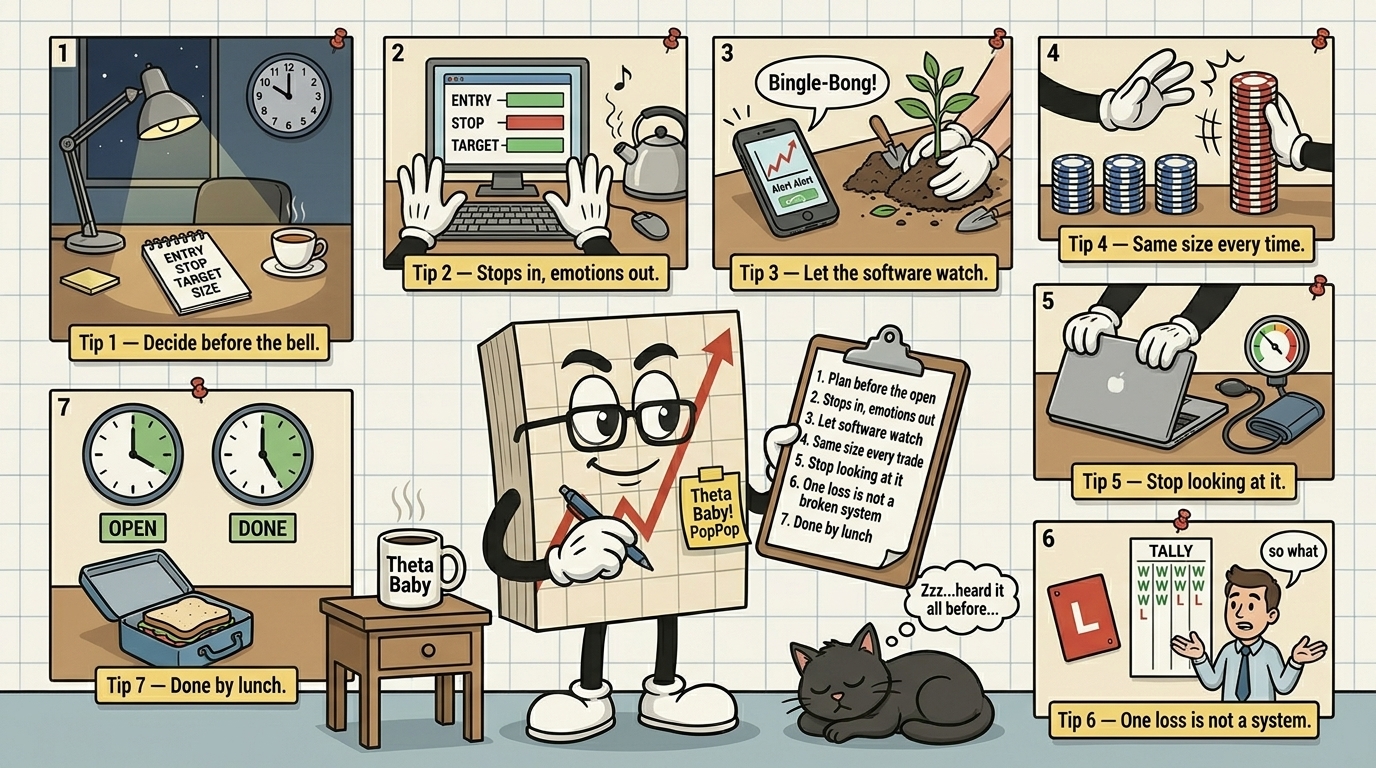
Get The Complete Premium Popper System – Automation Included
Your entry ticket to consistent SPX income. Inside: the exact setup, rules, and checklists I trade daily – for less than the cost of lunch. Easily actionable.
Get The Premium Popper System – Click Here
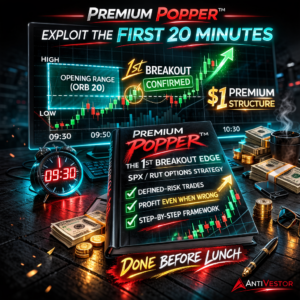
Tip 1: Make the decisions before the open
You are not making this up on the spot.
You know your strategy. You know your setup. You know what you’re looking for before the opening bell gongs, not scratching through chicken entrails at 09:31 est trying to divine what to do next.
The plan exists before, during, and after the trade. Every stage. What you’ll do if the setup triggers. What you’ll do if it doesn’t. What you’ll do if it triggers and then immediately moves against you. What you’ll do when it hits target. What you’ll do once the bracket has done its job and the trade is closed.
All of that is decided in advance. In the calm. With a cup of tea. The night before, or in the shower, or on the commute. Anywhere that isn’t the live market at 09:30 est with your heart rate climbing.
When the bell goes, you are not deciding. You are executing a plan that already exists. You are responding to a defined market movement that you were waiting for. You are not having a spasmodic knee-jerk reaction to an emotional response to a price fluctuation, which is, frankly, what most retail trading actually is.
Entry level. Stop level. Target level. Position size. Four numbers. Written down. Locked.
The trader who decides at the open is gambling. The trader who decided at 10pm last night while feeding the cat is trading. Same chart. Two completely different jobs.
Tip 2: Stops in, emotions out, then don’t fucking touch them
A bracket order is entry, stop, and target submitted as one instruction. The broker holds all three. The moment one fills, the others either activate or cancel automatically.
You submit it. You walk away. The trade lives or dies without you babysitting it.
Stops in. Emotions out. Then don’t touch them. Stop tinkering.
Between the stop being hit and the target being hit there is, statistically and practically and philosophically speaking, nothing for you to do. Pop the kettle on.
This matters more than any indicator, any chart pattern, any clever bit of market wisdom you’ve picked up from a podcast. Because the single largest source of trading losses for working professionals is not bad entries. It’s good entries that the trader fiddled with halfway through because they got nervous and had a meeting.
The stop gets pulled. The target gets moved. The “I’ll just watch it for one more minute” turns into a 90-minute meeting and a loss three times larger than the one you originally agreed to take.
Bracket orders remove the option to fiddle. The decision was made before the open (see Tip 1). The bracket enforces it. You are no longer trading the market. The bracket is trading the market. You are making a brew.
This is the entire point.
Tip 3: Let software do the watching
You don’t have time to watch a chart. The software does.
Set the alert. Wait for the bingle-bong. Execute. Close the broker.
That’s the whole loop. The alert tells you the setup has triggered. You take the trade. You go back to doing whatever it is you normally do. You don’t sit there staring at the screen “managing” the position, because there is nothing to manage. You already managed it when you set the bracket.
Let the software do the heavy lifting. That’s literally what it’s for. It’s not pretending to do anything else. It’s not trying to be your friend. It is sitting there, indifferent, waiting for a chart condition you defined hours ago, and the second that condition triggers, it pings you. That’s the entire job.
The fantasy of the day trader hunched over six monitors with one hand on the mouse is exactly that. A fantasy. It belongs in films about hedge funds and on Instagram reels by men who own three watches and zero real positions.
The reality of profitable mechanical trading is dull. Phone goes bingle-bong. You glance at the chart. You click two buttons. You go back to your spreadsheet. Six hours later you check the result.
If your trading process involves staring at price tick by tick, you don’t have a trading process. You have a screen addiction with a finance theme.
Tip 4: Trade the same size every time
Position size destroys more accounts than any other single variable. It’s not even close.
The fix is boring. Same size every trade. No “pressing” on a winning streak because you’ve got a feeling. No revenge sizing after a loss because the next one’s “definitely a winner.” No scaling up because you read a Reddit post about Kelly criterion at 2am.
A simple percentage of overall capital per trade works fine. Pick a number you can lose without it ruining your week. Trade that size on every single setup. Don’t deviate.
That’s it. That’s the whole rule.
Now, there is a level above this. There is a quant-style approach where you score every setup against your historical data, identify which configurations have higher expectancy, and size up on the strong ones. That’s what my software does for me now. Twenty-five-plus years of trade data, AI tools to mark up the best and worst setups on the chart, and a system that scores the setup and sizes the trade automatically.
But that took twenty-five years to build. You don’t have twenty-five years right now. You have a job and a coffee that’s going cold.
Until you’ve got the data, the tools, and the proof, you don’t size dynamically on a whim. You size flat. The flat-size approach served me perfectly well for the better part of a quarter of a century before I had the toys to do anything cleverer with it.
Stay in your lane until the lane gets wider.
Tip 5: Stop looking at the trade
Once the bracket order is in, looking at the chart changes nothing except your blood pressure.
The price doesn’t move faster because you’re watching. The stop doesn’t get any safer because you’re refreshing. The target doesn’t fill any sooner because you’ve alt-tabbed to TradingView for the fourteenth time this morning.
Close the broker. Go back to work.
The single biggest difference between profitable mechanical traders and unprofitable ones is not skill. It is the ability to leave a perfectly good trade alone. You set the bracket. You walked away. That’s the system. That is what the system is supposed to look like.
If you cannot close the broker after entering a trade, that is information about you, not about the trade.
The trade is fine. The trade has a stop and a target and is doing exactly what trades do. You are the unstable variable.
Close. The. Broker.
Then close the email client that’s pinging at you. Then make a coffee. Then do the thing your actual employer is paying you to do. The trade will resolve. It will resolve in your favour or against you, and either way, watching it doesn’t change the outcome by a single penny.
Tip 6: One bad trade is not a bad system
The system produces losses by design. That’s not a bug. That’s the maths.
A strategy with a 60% win rate loses 40% of the time. A strategy with a 70% win rate loses 30% of the time. Even the very best mechanical systems are wrong roughly one trade in three.
That means losing trades are not evidence the system is broken. Losing trades are evidence the system is doing what it’s supposed to do.
The mistake nearly every new trader makes is to look at a single loss and conclude that the strategy doesn’t work, the indicators are wrong, the market has “changed,” or that they need to find something better. Then they switch. Then the new thing has a loss. Then they switch again. Six months later they’ve traded eleven different systems, lost money on all of them, and learned exactly nothing.
The correct response to a loss is the next signal, executed identically. Same size. Same rules. Same bracket. No tweaks, no second-guessing, no “I’ll skip this one because the last one was a loser.”
Two or three losses in a row mean almost nothing. They’re a normal feature of any system that produces edge over a large sample. The system runs over hundreds of trades, not three. Stop drawing conclusions from a sample size that wouldn’t pass a primary-school maths test.
Tip 7: Anchor to the 9:30 EST open
The whole framework runs on the US cash open. That’s 14:30 UK time. 9:30 EST. 2:30pm if you’re somehow still reading clocks like a Victorian.
The first thirty minutes is the entire trading day. After that, you go back to your actual life.
This is not a constraint. This is the feature.
The opening range carries the highest-quality price action of the day. Real volume. Real participants. Real moves. The middle of the session is chop, lunch-hour drift, and algorithms shuffling positions around for reasons that have nothing to do with your edge. The close is a different beast entirely.
You don’t need any of that. You need thirty minutes of high-quality price action that fits between your stand-up and your first afternoon call.
The students who run this framework, the ones featured in the Student Edge wins compilations, are not sitting in front of screens all day. They’re plumbers, accountants, NHS consultants, teachers, software engineers. People with real jobs. People who trade the open, set the bracket, and get on with their day.
You are not behind because you only have thirty minutes. You are ahead because you only have thirty minutes. The traders who sit at the screen all day are not making more money. They are making more decisions, which is a completely different thing, and a substantially worse one.
Bonus Tip 8: For the love of God, do less stupid shit
This is the one that gets left out of every other listicle on the internet and frankly it might be the most important one of the lot.
Most losses are not caused by the market. The market is just sitting there doing its thing. Most losses are caused by the trader, sitting at home, doing something that anyone watching from outside the room would describe as “actively stupid.”
A non-exhaustive list of stupid shit, observed in the wild over thirty-one years:
Doubling down on a loser because “it has to come back.” It does not have to come back. The market is under no obligation to validate your feelings.
Adding to a winner that’s already at target because “it looks like it’s going further.” This is how you turn a clean win into a small loss in twelve minutes flat.
Trading a setup you’ve never tested because someone in a Discord server with the username Moonshot said it was “fire.”
Removing the stop loss because “I just need it to breathe a bit.” The stop is not strangling the trade. The stop is the only thing standing between you and your overdraft.
Increasing size after three winners because “I’ve cracked it.” You have not cracked it. You have rolled three coins. The fourth coin does not know about the first three.
Trading the news. The news is not a setup. The news is what happens to other people in suits while your bracket order is doing its actual job.
Going to “just check the chart” during a meeting and missing what your boss said about the restructure.
Telling your spouse about the trade. There is no version of this that ends well. The trade is your problem. Make a coffee. Move on.
Holding a seance with the ghost of a deceased margin account, ouija board out, candles lit, asking the spirit world whether to add to the loser. The spirit world, in my experience, has terrible risk management and is not regulated by the FCA.
If you simply did less of the above list, your equity curve would, statistically speaking, look like a much more handsome line on a graph. The market gives back roughly what you put in. Put in less stupidity and you get back less pain.
Mechanical trading is not about being clever. It is about consistently failing to be stupid in any of the seventy-three documented ways that stupidity tends to express itself in a brokerage account. That’s the whole game.
The seven tips, compressed into one line
Be mechanical. Let the software watch. Trust the process. Do less stupid shit.
That’s it. That’s the entire listicle in one breath.
If you want the long version, with the full framework, the rationale, and the bit about how to actually fit this around a real career, the Day Trading for Busy Professionals guide is where to go next.
If you want the cheapest, lowest-friction way to see how this actually looks day to day before you commit to anything, the Analysis Edge briefing lands in your inbox most mornings. Free. No pitch. Just the read.
And if you’ve read this far and you’re thinking “right, I get it, I just want the signal, the bracket, and the exit, with someone else doing the work” — that’s Premium Popper. The done-for-you version of everything above. The trade is called. You take it or you don’t. You’re back to work by 3pm.
Three options. Three commitment levels. Same framework underneath all three.
Pick the one that fits the time you actually have. Not the time you wish you had.
PopPop 🏴☠️
Happy trading,
Phil
Less Brain, More Gain
…and may your trades be smoother than a cashmere codpiece
p.s. There are 3 ways I can help you…
- Option 1: The SPX Income System Book (Just $12)
A complete guide to the system.
Written to be clear, concise, and immediately actionable.
>> Get the Book Here

- Option 2: Full Course + Software Access – 50% off for Regular Readers – Save $998.50
Includes the video walkthroughs, tools for TradeStation & TradingView, and everything I use daily. Plus 7 additional strategies
>> Get DIY Training & Software
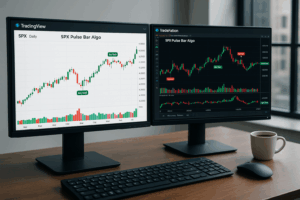
- Option 3: Join the Fast Forward Mentorship – 50% off for Regular Readers – Save $3,000
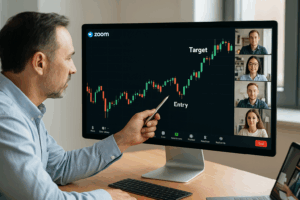
>> Join the Fast Forward Mentorship – trade live, twice a week, with me and the crew. PLUS Monthly on-demand 1-2-1’s
No fluff. Just profits, pulse bars, and patterns that actually work.
Nothing in this article is financial advice. Trading involves risk of loss. Past performance is not indicative of future results. This is published for educational purposes only.