Sixteen points came off September in a single morning, and the chairman has said the decision turns on inflation.
⚓ Weathervane
The tightening is arriving and nothing is transmitting it. The whole curve rose through July, the thirty-year to a nineteen-year high, and the S&P still closed the month up. What actually reprices now is attention rather than risk: premiums leave oil, volatility and equities the moment headlines stop arriving, whether or not anything on the ground has changed. Multiples answer to the news cycle, and the bill for that arrives in one session rather than gradually.
 Ahoy there, Trader! ⚓️
It’s Phil…
The banner rides unchanged, though Friday was the first session in five that argued with it. We will come back to that.
Should a jobs number move the September decision at all, when the chairman has said it turns on inflation?
That is the whole letter, and we are not certain of the answer.
The sequence is the strange part. On Tuesday a Treasury official said something with no data in it and September hike pricing fell ten points. On Wednesday the ADP release missed by 31,000 and the pricing moved by nothing. On Thursday an Iranian committee was reported to be reading an unvoted draft, and the two-year rose seven basis points. Three inputs, and the one carrying information placed last.
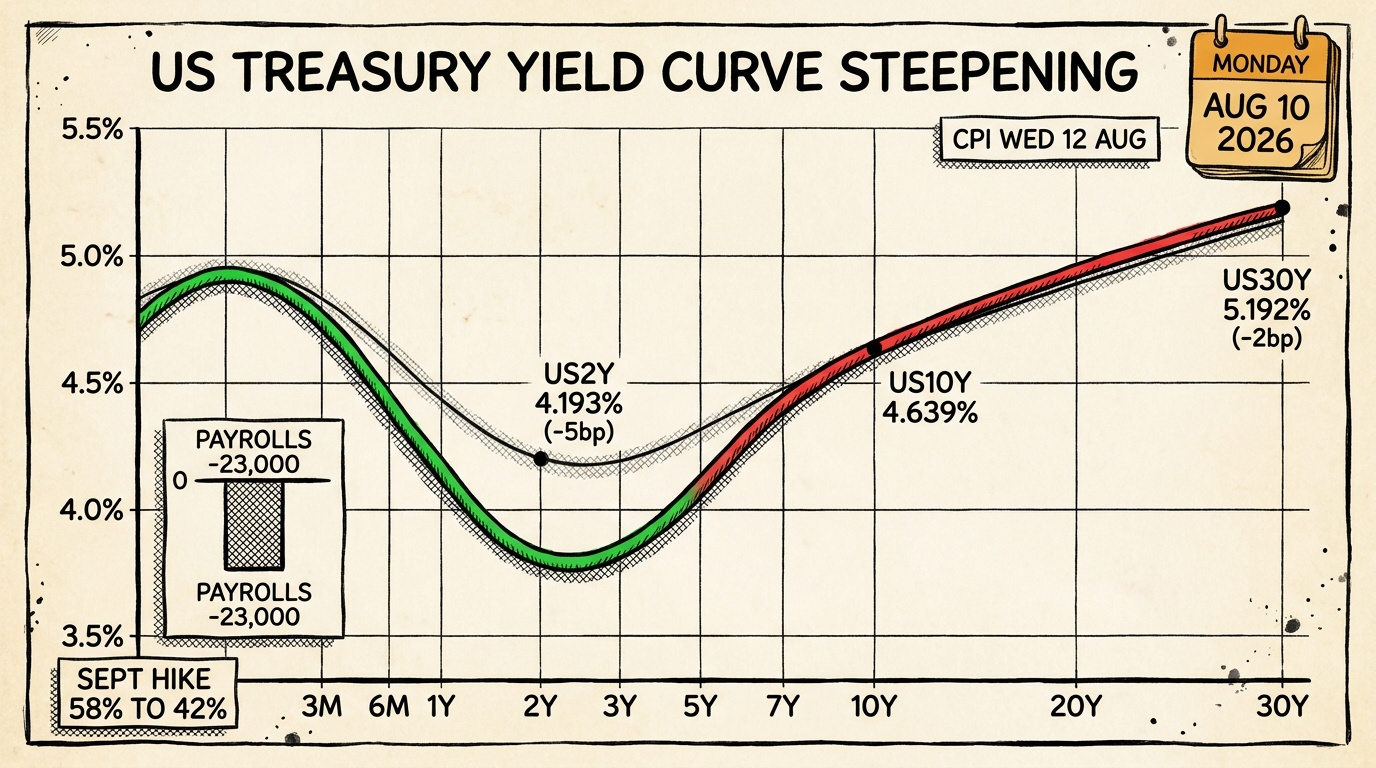
Then Friday. Payrolls came in at minus 23,000 against a forecast gain of 83,000, revisions removed a further 103,000 from May and June, participation slipped to 61.4%, and September hike pricing fell from roughly 58% to 42%. Sixteen points. More than the sentence, the silence and the draft put together.
We had spent the week arguing the front end had stopped listening to data. It was listening. It was simply waiting for something that disagreed with the level rather than something that confirmed it, and we did not consider that possibility once.
The common view is that this was a growth scare, and the textbook says a growth scare pulls the whole curve down together, since weaker output means lower rates at every maturity. The tape did something narrower. The two-year fell more than five basis points to 4.193%. The thirty-year gave up two, closing at 5.192%. The curve steepened. Duration declined to join in.
That gap is worth sitting with. A market frightened of recession buys the long bond. This one bought the short bond and left the long one alone, which reads less like fear of a downturn and more like one rate rise being removed from one meeting. The record equity close fits that reading. So does the small-cap outperformance, since small caps borrow.
And here is where we get stuck. The Financial Times reported last Thursday that the chairman intends to keep messaging lean and would raise in September if inflation readings run hot. Inflation. Not employment. If that is accurate, the market repriced a decision on Friday using the input the decision-maker has publicly set aside, whilst Brent climbed back above $84 over the weekend on Iranian conditions, which is the input he did name.
Wednesday’s CPI is where those two things meet. We do not know which one wins.
Phil’s Musing
The bit that nags at me is the thirty-year. If Friday were really about growth, duration would have moved and it barely did. So the market has taken out a hike without taking down the growth path, and that is a narrow, quite specific trade to be making off a number that also carried a hundred thousand of downward revisions. I am inclined to trust the curve shape over the headline here. It is telling us this was about one meeting, not about the economy.
Happy trading,
Phil
Less Brain, More Gain
…and may your trades be smoother than a cashmere codpiece
P.S. – Phils Footnote I got this wrong in public last week and would rather say so than bury it. I built a read on four sessions of the front end ignoring data, and four sessions is not a regime, it is a fortnight with opinions. What stays with me is that the data did not merely move it, it moved it further than everything else combined, so the mechanism was never absent. It was dormant, waiting for a print that contradicted where rates already sat. I am not sure whether that is a useful distinction or a nice sentence written to feel better about being wrong. Wednesday will tell us more than I will.
🗒️ Desk Notes | Monday, August 10, 2026
Raw briefing. Observations, not trades.
Session read (§8.4)
SESSION BRIDGE: prior session (Friday 7 August) full reaction, July payrolls printed minus 23,000 against a forecast gain of 83,000 at 08:30 ET, unemployment 4.1% from 4.2%, participation 61.4% from 61.5%, average hourly earnings plus two cents taking the annual pace to 3.2%, and May plus June revised down a combined 103,000; S&P 500 closed 7,757.64 (+0.62%), a record, Nasdaq Composite 26,690.62 (+1.3%), Dow 54,036.93 (+0.28%), Russell 2000 3,034.49 (+1.10%), VIX 14.89 (-1.65%); rates did the real work, 2yr to 4.193% (lowest since 17 July), 10yr 4.639%, 30yr 5.192%, CME September hike pricing from roughly 58% to 42%; weekend tail added Iran’s six conditions for Hormuz (Saturday), Araghchi ruling out direct US talks (Sunday), a claimed Houthi strike on Aramco’s Jazan refinery (Sunday) and the Feinberg weapons-production memo (reported Saturday); live premarket ES +0.16% / NQ +0.41%, YM -0.02%, RTY +0.01%, Brent $84.42 (+1.04%), WTI $78.83 (+0.83%), gold $4,408.70 (+0.20%), DXY 99.604 (-0.36%), BTC $65,157.68 (+0.48%); threshold: NONE on the equity test, stated with the same limitation carried on Friday, the prior session’s real reaction was in the front end and the §8.4.1 test does not measure it.
1. The mechanism read (full)
What moved. The four instruments read cleanly for once, and they read against us.
- Front end (2yr): 4.25% Thursday to 4.193% Friday, down more than five basis points, the lowest since 17 July. Driven directly and immediately by the 08:30 release.
- Long end (10yr / 30yr): 10yr 4.639%, 30yr 5.192%, the thirty-year giving up only two basis points against the two-year’s five-plus. The curve steepened rather than shifting down in parallel.
- Dollar (DXY): 99.965 Friday premarket to 99.604 this morning, down 0.36%. Confirming the dovish repricing rather than fighting it.
- Volatility (VIX): 14.89, down 1.65%, a seventh consecutive close under 18 and the lowest of the run. It declined to respond to a negative payrolls print, a Korean exchange halt earlier in the week, a 4% crude session and a full curve reversal.
What it implies. The front end has been the whole argument for eight sessions and the argument just changed sides. Across Tuesday to Thursday last week, a Treasury remark with no data content moved September pricing ten points, an ADP miss of 31,000 moved it nothing, and a parliamentary committee reading an unvoted draft moved the two-year seven basis points. Friday, a real employment release moved September pricing sixteen points, further than all three combined and in the direction the data actually pointed. The desk’s working read that the front end had stopped transmitting labour data is not merely unconfirmed, it is contradicted by the largest single move in the series.
The one artery. Sixteen points off September hike pricing, 58% to 42%. Everything else Friday was downstream of it. The record equity close, the small-cap outperformance at plus 1.10%, the dollar giving ground and the seventh sub-18 VIX print all read as one trade: a rate rise being taken out of the price. Note carefully what did not happen. The thirty-year barely moved. A genuine growth scare pulls the long end with it. This one did not, which places the move in the policy bucket rather than the recession bucket, and leaves the 30yr sitting at 5.192%, above the 5.15% level the duration respec measures.
The complication, held openly. Warsh’s position as reported by the FT on Thursday conditions a September rise on inflation readings, not employment readings. Friday’s sixteen points were priced off the employment leg. If that reporting is accurate, the market has just repriced a decision using an input the decision-maker has said is not the deciding one, and Wednesday’s CPI is where that gets tested rather than argued.
2. Forward catalyst slate
- Wednesday 12 August, 08:30 ET: July CPI. The single event of the week. Warsh’s stated condition, the desk’s new shot, and the September pricing all resolve against it.
- Thursday 13 August: July PPI. Second read on the same question. Services prices paid at 70.3 in the ISM print remains unreconciled with any cooling story.
- Friday 14 August: the Part 184 crude-versus-front-end window closes.
- Saturday 15 August: retail sales. Consumer resilience read after a negative payrolls month.
- This week: chip and AI earnings. Applied Materials (roughly 110% year to date, 10.39% implied move), Coherent (up 105%, widest implied swing of the week), CoreWeave, Cheniere Tuesday before the open on roughly $4.66bn of revenue. Eleven names above $10bn carry double-digit implied moves.
- Late August: the Feinberg 21-day deadline. Weapons makers’ acceleration plans are due to the Pentagon inside three weeks, feeding a fiscal 2028 budget request of roughly $1.5tn against about $900bn last year, with the current defence bill stalled in Congress.
- Monday 17 August: Alibaba earnings. Qwen3.8-Max open-weight thread.
- Monday 17 August: Part 180 crude window closes; the Weathervane’s next scheduled rewrite candidate.
3. Divergence flags
- The curve steepened on a weak print. 2yr down more than five, 30yr down two. Textbook growth scare pulls the whole curve. This one bought the front end and left duration alone. Either the market believes the weakness is policy-relevant but not growth-relevant, or the long end is pinned by something the front end is not seeing. Live.
- A record close on a jobs contraction with participation at a five-year low. Equities priced the Fed, not the economy. That is internally consistent and still worth flagging, because it means the index is now long an assumption about a person rather than about earnings.
- Real escalation is worth a quarter of a rumour. Six formal conditions from Iran’s national security council, a claimed strike on an operating Saudi refinery and a foreign minister ruling out talks bought Brent 1.04%. Last Thursday, a committee reported to be analysing an unvoted draft bought 4%. The anti-pricing thesis is now demonstrated in both directions inside four sessions.
- Defence demand signal versus defence equity signal. The Pentagon is demanding 21-day acceleration plans and a $1.5tn budget. The worst single name of last week was Honeywell Aerospace at minus 20% on a guidance cut, from that same sector. Order book and share price are pointing opposite ways.
- ETF inflows at a four-month high on falling turnover. $853.5m into spot bitcoin funds with volume down 9% to $8.19bn, and one manager taking more than 80% of it. Money arriving without changing hands is not the same as broad demand.
- Volatility has stopped responding to inputs. Seven consecutive sub-18 closes through a jobs contraction, a crude reversal and a curve round trip. The level is no longer the interesting part; the non-response is.
4. Carry-over note (§10.6)
Fires today. Not on the equity threshold, which reads NONE, but on the measured instrument. The noteworthy thing about Friday is not the record close, it is that the desk spent five sessions building a thesis that data no longer moves the front end and the data then moved it further than anything else this month. That is a carry-over about us, not about the tape, and it rides the tiers accordingly: a plain admission in the letter, a one-line HotTake in the Snippet, and the full dissection in Macro Edge, where the interesting question is not that we were wrong but why the front end waited for a print that contradicted the level rather than one that confirmed it.
5. Part C regime read
⚓ Weathervane: carried unchanged, and challenged for the first time. The banner claims attention rather than risk is the repriced variable. Friday priced information: a real release, the largest single move of the series. That is a direct challenge to the second clause. Monday then re-confirmed it in the other market, with six formal Iranian conditions and a burning refinery worth a quarter of what a rumoured document was worth on Thursday. First genuinely mixed mark. The banner is not rewritten on a mixed mark; next scheduled rewrite candidate remains Monday 17 August.
⚓ REGIME FLAG (duration, SOFT): window reset, cleanly and informatively. The respec awaiting Phil hardens on five sessions in which the 30yr holds above 5.15% and the S&P fails a new closing high. The index made a new closing high on Friday at 7,757.64, so the window that had reached session two is dead. The 30yr remains above the level at 5.192%. Log this as the respec working: it declined to fire in a week the index set a record, which is exactly what a well-specified condition should do. Recommendation unchanged and still with Phil.
⚓ REGIME FLAG (Korea, SOFT): session 2 of 5, zero qualifying sessions. Friday’s Nasdaq Composite was up 1.3%, so no qualifying session. Nothing to count in either direction.
⚓ REGIME FLAG (chipflation supply side, SOFT): carried, unchanged. SOXX gaining more than 7% on the week is a memory-adjacent equity move and is explicitly not counted here. The falsifiable version remains contract DRAM pricing for Q4 2026 and Q1 2027. Part 169 conflation lesson holds.
Vol regime: SPIKE-AND-REVERT, revert leg now seven sessions. 20.66, 17.08, 16.08, 16.04, 15.80, 15.14, 14.89. Monotonic. What keeps this open is unchanged from Friday and has strengthened: the index is not responding to visible inputs, and a negative payrolls print is now on that list.
New watch item: defence industrial base. Logged to Part A today. A 21-day production ultimatum, a $1.5tn budget ask against roughly $900bn, a stalled appropriation and a president publicly denying the shortage his own department is racing to fix. Not a regime flag. A thread with a testable claim in it.
Sensitivity read (§17.3): HIGH-TIGHT, hold at yellow. No change recommended. Honest accounting this run rather than a victory lap. The tight setting produced a clean MARKED-MISS on the Part 182 shot instead of a fudge, and refused to auto-fail the Part 184 shot on a technicality whilst stating its wound plainly. It also cost us: a looser reading would have called Part 182 “roughly right” and it was not roughly right, it was wrong by six points on a ten-point test. That is the setting doing its job in the direction that hurts, which is the only evidence that it works. The useful lever remains the duration respec, not the dial.
Public tell: NOT triggered.