The Treasury tripled its bid on Wednesday and the ten-year went the other way
⚓ Weathervane: the wind is still coming from the long end. The policy rate has been frozen at 3.50% to 3.75% since July whilst the term premium does the tightening, and the price of long money is set by deficits, issuance supply and a synchronised global duration bid rather than by the committee. The cruise ship is holding this heading, though this week raises a fair question about where the wind is blowing from.
 Ahoy there, Trader! ⚓️
It’s Phil…
Has the price of long money stopped being set by issuance and started being set by a barrel of oil?
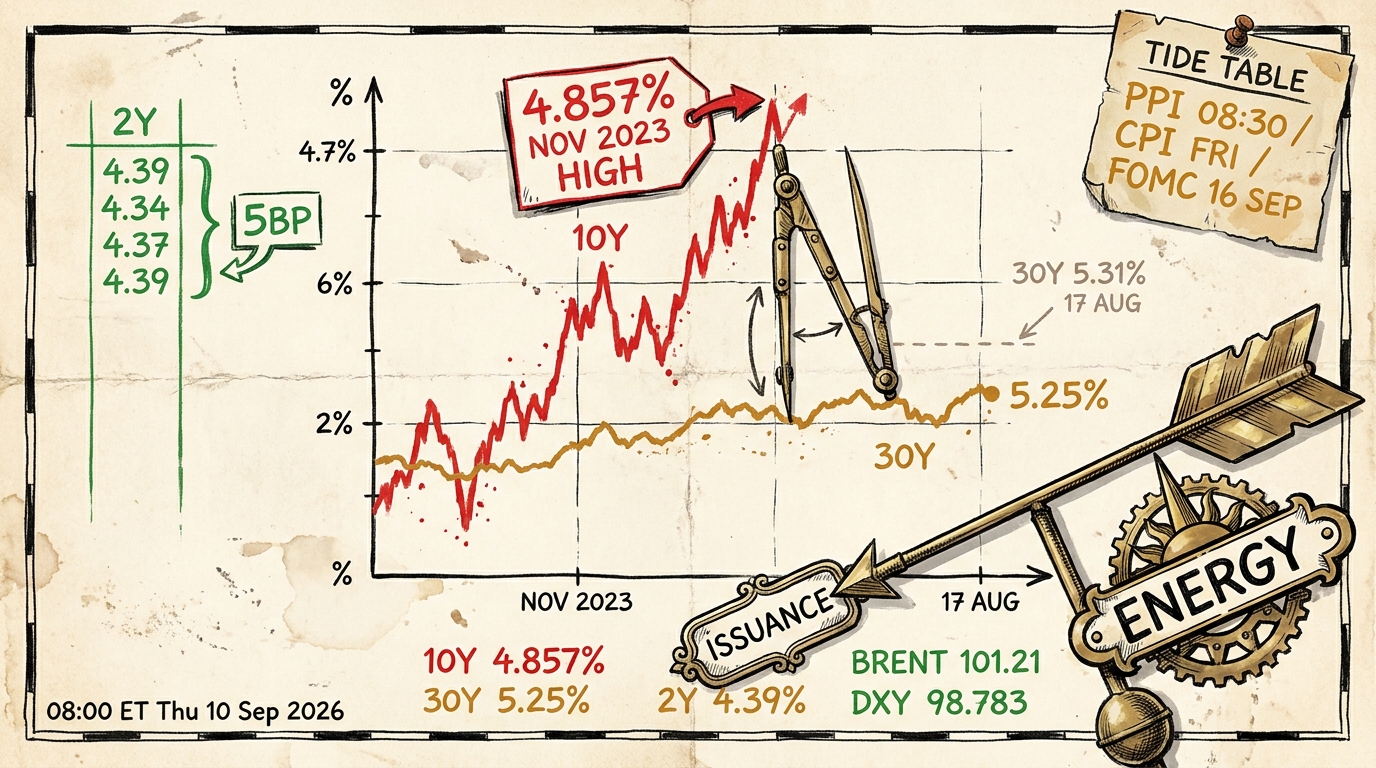
Here is what happened, stripped of commentary. On Wednesday the Treasury Secretary said the department would buy up to six billion dollars of longer-dated debt, three times the size of the previous operation and the second such expansion in a month. The ten-year note then reached 4.857%, its highest level since November 2023. Most desks read that as an intervention that failed. The common view on the street is simpler still: too much debt, not enough buyers, and a buyback too small to matter.
That reading is tidy and we are not sure it is right, because of what the rest of the curve did.
Walk the instruments in order. The thirty-year constant maturity closed around 5.25% on Monday, roughly six basis points below its 17 August high of 5.31%. So the long bond, the instrument most exposed to pure supply, did not make a new high at all. The ten-year did. The two-year has moved five basis points in total across the month’s published closes, whilst September rate-hike pricing rose from around 56% to above 60%. And the dollar sat near four-month lows on the same session the ten-year printed a three-year high.
Now the textbook. When a debt manager buys duration, duration yields fall, because supply available to the private market shrinks. That is the mechanism August’s operation was built on, and it half-worked: nine basis points of relief, four returned inside a session. It also says a supply problem should bite hardest at the longest maturity, and that a currency should firm when its bond yields rise.
The tape did neither. The pressure concentrated in the belly and the ten-year, the long bond stayed put, and the dollar softened. That combination is not what a supply squeeze looks like. It is what an inflation premium looks like, and Brent closed at $101.21 after five Iranian tankers were destroyed and a Saudi refinery was struck.
So the honest version is narrower than the headline. Issuance may still be setting the level of long money, which is what the Weathervane has been saying for weeks. But this week’s change came from energy, and six billion dollars of official demand could not stand in front of it. Those are different claims and we would rather hold both than collapse them into one.
What we cannot settle is which of the two is the slower-moving fact. Producer prices land this morning and consumer prices tomorrow. If the ten-year keeps making highs whilst the thirty-year sits still, the wind has changed direction without changing the heading, and that is a stranger thing than a plain bond-market revolt.
Phil’s Musing
I have been treating the long end as a supply story all summer and I think that was only ever half of it. What changed my mind this week is the thirty-year refusing to confirm. If this were really about deficits and issuance, the longest bond should be leading and it is not. My lean now is that we are watching an energy-driven inflation premium wearing a fiscal costume, which matters because the two things resolve completely differently. A supply problem gets solved by a debt manager eventually. An oil problem gets solved in the Gulf. I am not moving the heading on that yet, but I am watching the ten-year against the thirty-year rather than the thirty-year on its own.
Happy trading,
Phil
Less Brain, More Gain
…and may your trades be smoother than a cashmere codpiece
P.S. – Phils Footnote Wall Street often says you should never fight the Fed. Nobody warns you about fighting a barrel. I spent Wednesday afternoon assuming the buyback would do something, mostly because six billion dollars sounds like a serious number out loud, and it is not a serious number next to a four-dollar move in crude. That is a useful thing to have been wrong about in public, and it has changed which two lines I put on the same chart tomorrow morning.