The consumer had his worst month in over a year, and the bond market put its prices up
⚓ Weathervane
Information transmits into the price of money and stops there. Two scheduled surprises in three sessions moved the front end and then the long end in the directions the textbook names, and the equity multiple did not flinch at either one: a record close on the soft wholesale print, a record small-cap close on the worst consumer month in fifteen. The curve is doing the listening. Multiples are not, and the bill for that still arrives in one session rather than gradually.
Rewritten today, on its scheduled candidate date, after a fortnight rather than a session. The old banner said nothing was transmitting the tightening. Two sessions in three have now shown that rates transmit perfectly well. It was the equity half that was doing the ignoring all along, and the banner was blaming the wrong instrument.
 Ahoy there, Trader! ⚓️
It’s Phil…
The common view on Friday morning was the simple one, and it is the one most of us would reach for. A country that has stopped spending is a country that needs cheaper money. Weak demand cools prices, cooler prices bring the central bank closer, and the long bond rallies on the way. That is the sequence the surface expects, and it is not a foolish expectation. It is the one that has worked for most of the last thirty years.
So here is the question the tape leaves open:
If the American consumer just posted the worst month in fifteen, why did the price of long money go up?
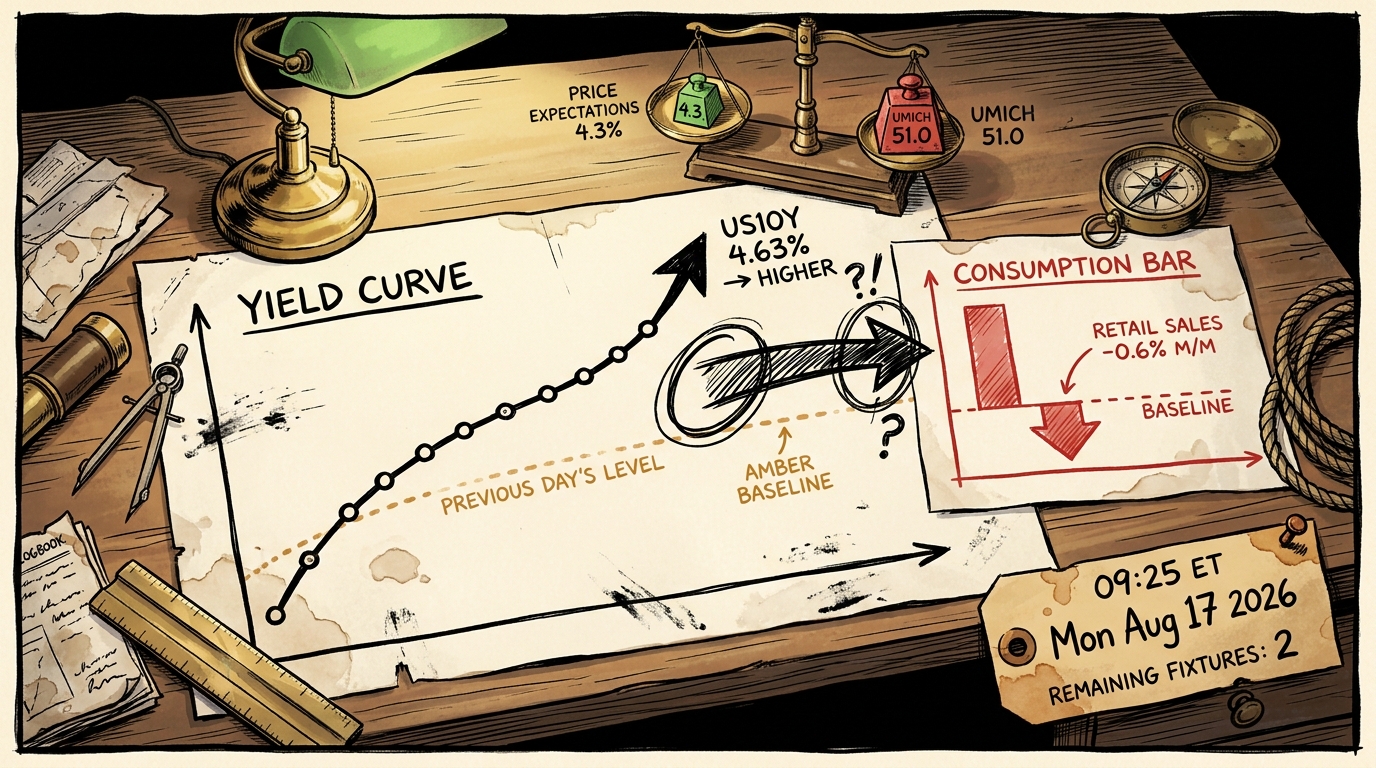
Because that is what happened. July retail sales fell 0.6% against a consensus looking for a small gain. The control group that feeds GDP came in at minus 0.4%, its weakest since the start of last year. Thursday’s official ten-year constant maturity had closed at 4.63%. Every reading available for Friday sits above it, somewhere between two and seven basis points higher. The front end did the same thing in miniature.
There is a second number in the same window that most desks skipped past. When Michigan asked households what they expect prices to do over the coming year, the answer came back at 4.3%, up from 4.2%, and a fifth consecutive month above four. So on the same morning, the same households reported the gloomiest outlook since May and raised what they expect to be charged.
Put those two side by side and the bond move stops looking eccentric. A market pricing a demand slump buys duration. A market pricing a demand slump with prices still rising underneath it does not, because the thing that erodes a thirty-year bond is not weak growth. It is inflation that arrives anyway. That distinction is the whole of it, and we would not have seen it from the retail sales line alone.
What we cannot settle is which way the causation runs, and we would be inventing certainty if we claimed otherwise. Perhaps the long end is reading the sentiment survey and pricing stagflation. Perhaps it is doing something far less interesting and simply absorbing supply, with a thirty-year auction earlier in the month having cleared at the highest yield since 2001. Those two explanations produce the same chart and very different futures.
The honest position is that one session is one session. The minutes land Wednesday and Walmart reports Thursday, and Walmart does not deal in survey responses.
Phil’s Musing
The bit that keeps nagging at me is the Russell. Small caps closed at a record on the day their own customers were confirmed to have stopped turning up, and I do not think that is a market disagreeing with the data. I think it is a market that has decided the data no longer sets the price. If that is right, then the interesting question stops being what the consumer does next and starts being how long a multiple can hold when the thing underneath it is shrinking. I would rather be early on that than clever about it.
Happy trading,
Phil
Less Brain, More Gain
…and may your trades be smoother than a cashmere codpiece
P.S. – Phils Footnote I will admit I read Friday’s retail sales number and assumed I knew what the bond market would do with it. I was wrong, and I was wrong for the reason I am usually wrong, which is that I looked at one number and stopped. The inflation expectations line was sitting right there in the same release window and I did not weigh it until I went back over the whole thing. That is the second time this month that the answer was in a part of the report nobody puts in the headline. I am starting to think that is where it usually lives.
🗂 Desk Notes – Part 190 | 17 Aug 2026
Published header: 🗂 Desk Notes – 17 Aug 2026
Raw briefing. Observations, not trades.
0. Close-to-open read (§8.4)
SESSION BRIDGE: prior session (Friday 14 Aug) full reaction: S&P 500 -0.17% to 7,785.76 with an intraday range of 7,776.31 to 7,810.01, Nasdaq Composite -0.28% to 26,729.16, Dow -0.20% to 53,732.41, Russell 2000 +0.51% to a record close of 3,068.42; no meaningful after-hours tail, the two catalysts both landed inside the cash session at 08:30 and 10:00 ET; live premarket ES +0.18%, NQ +0.60%, YM -0.09%, RTY -0.05%, VIX 14.25 at Friday’s close and -2.60% on the session; threshold: NONE on the §8.4.1 equity test, and this is the SIXTH CONSECUTIVE SESSION on which that test measures the wrong instrument. Friday carried two scheduled top-tier surprises and a record close in one index, and the equity percentage never left the normal envelope. The MIP 11.0 candidate to widen §8.4.1 with a commodity leg and a volatility leg now has 6 qualifying observations and should be treated as a defect rather than a preference.
Carry-over (§10.6): does not fire. No manual flag from Phil, no percentage trip. Friday’s data is not a backward glance in any case, it is this edition’s spine, so a carry-over beat would double-count the same material.
1. The mechanism read (full)
What moved.
- Retail sales (Fri 08:30 ET): July advance retail and food services sales $763.6bn, -0.6% m/m against a consensus near +0.1%. First monthly decline since October 2025, sharpest since May 2025. Ex autos and gasoline -0.2%. Control group -0.4%, the weakest since the start of 2025. Nonstore retailers -2.2%, motor vehicles -1.8%, gasoline stations -0.9%. Clothing +1.9%, health and personal care +0.7%, food services +0.5%. Published margin of sampling error plus or minus 0.4pp. June unrevised at +0.2%.
- Michigan sentiment (Fri 10:00 ET): preliminary August 51.0 from 55.2, an 8% fall, against 49.5 in June and a record low 44.8 in May. Year-ahead inflation expectations 4.3% from 4.2%, fifth consecutive month above 4% and against 3.4% before the Iran war. Expected business conditions -11% short run, -17% long run. Declines across the political spectrum, Republicans sharpest.
- The front end: official H.15 constant maturity 2-year closed Thursday 13 Aug at 4.15%. Friday readings cluster near 4.17%. The 14 August H.15 publishes today at 16:15 ET.
- The long end: official 10-year closed Thursday at 4.63%. Friday readings: 4.65% (Trading Economics), 4.68% (etfdb snapshot), 4.696% (16:27 ET quote). Three readings, a 2bp to 7bp spread, all above Thursday. Direction unanimous, magnitude disputed. 30-year 5.21% Thursday, quoted 5.255% this morning.
- The dollar: DXY 99.636 on the premarket screenshot, -0.31%. A separate reading at 99.387, -0.17%. Softer either way.
- Volatility: VIX closed 14.25, -2.60%, a 2026 low. Series: 14.89 (7 Aug), 15.45 (10), 15.30 (11), 14.54 (12), 14.65 (13), 14.25 (14).
- Equities: S&P -0.17%, Dow -0.20%, Nasdaq -0.28%, Russell 2000 +0.51% to a record 3,068.42. Weekly: S&P +0.4% (third straight), Nasdaq +0.1%, Dow -0.6%.
- Commodities: WTI Sep settled $82.40, +1.42%. Brent recovered above $88 from Thursday’s $87.07. Gold $4,437.30 Friday, $4,450.20 premarket. Silver +1.28%, copper +1.79% this morning.
- Crypto: BTC $63,544.26, +1.13%. ETH near $1,876. Spot BTC funds -$389.7m in the week of 10 August (Bloomberg, published 17 Aug), against +$853.5m the prior week. Fear and Greed 35.
What it implies.
The textbook chain runs: soft demand print, front end falls, long end falls harder, dollar softens, equities rally on the discount rate. Friday delivered the soft print, the softer dollar and a broadly flat equity tape, and then inverted the rates leg. Both the front end and the long end went up, and the long end went up more, on the day US consumption posted its first contraction in nine months.
That is not a growth scare being priced. A growth scare bids duration. This is duration being sold into weakening demand, with the survey that measures household price expectations printing 4.3% in the same hour. The bond market’s read on Friday was not “the Fed is further away”. It was “the Fed is further away and the money still costs more”, which is a term premium and inflation-expectations story rather than a policy-path story.
The equity leg is the second half. The S&P shed thirteen points. The index most structurally dependent on the American consumer, with no overseas revenue and no currency hedge, closed at an all-time high. If the consumer print were being taken as a demand signal, the Russell is the last place the money should have gone.
The one artery.
A genuine downside surprise in US consumption raised the price of long money instead of lowering it, and the equity multiple did not respond to either leg. Information is transmitting into rates and stopping there.
2. Forward catalyst slate
- Mon 17 Aug: Empire State Manufacturing (August) 08:30 ET. NAHB Housing Market Index (August) 10:00 ET. H.15 for 14 August publishes 16:15 ET and settles the Friday 10-year and 2-year dispute permanently. Hashdex DEFI final trading day.
- Tue 18 Aug: Housing starts and building permits, import and export price indices, industrial production and capacity utilisation. Earnings: Home Depot, Baidu, Toll Brothers, Keysight. Reddit enters the S&P 500 before the open, replacing AvalonBay Communities.
- Wed 19 Aug: FOMC minutes 14:00 ET. Earnings: Target, Lowe’s, TJX, Analog Devices, Estee Lauder, Progressive.
- Thu 20 Aug: Initial claims, Philadelphia Fed, Leading Indicators. Earnings: Walmart, Alibaba, Deere, NetEase, Ross Stores. Walmart is the second opinion on the 0.6%.
- Fri 21 Aug: S&P Global flash PMIs (August).
- Wed 26 Aug: Nvidia results. The test case for the Part 189 shot.
- Later August: Jackson Hole. Pentagon 21-day munitions production ultimatum resolves. Anthropic listing reported as an October candidate.
3. Divergence flags
- Rates versus demand. The 10-year rose on the worst consumption print in fifteen months. This is the day’s principal unreconciled fact and the spine of both the AVE and the Macro Edge.
- Small caps versus their own customers. The Russell 2000 took a record close on the session that confirmed US consumption contracting. Consumer-exposure logic points the opposite way. Note the reversal this morning: RTY -0.05% whilst NQ leads at +0.60%, so the leadership that produced Friday’s record is not being extended.
- Filed versus unfiled, third consecutive session. Applied Materials beat consensus EPS and closed -5.12%. Broadcom -5.94%. Against SanDisk +7.39%, AMD +6.50%, Seagate +5.65%, Nebius +8.88%. Nebius and CoreWeave both beat and rallied earlier in the week, which is adverse to the strong form of the Part 189 claim and is logged as such in the ledger.
- Volatility versus event density. VIX made a 2026 low on a session carrying two scheduled surprises. The compression has now survived an in-line CPI, an off-consensus PPI, an off-consensus retail sales print and a sentiment collapse.
- Sentiment versus price expectations. Households report the worst outlook since May and simultaneously raise what they expect to pay. Those two are not usually co-movers and the pairing is what makes the long-end move legible.
- Crypto flows versus crypto price. $853.5m in, then $389.7m out, then a 1.13% overnight gain with no catalyst. A $1.24bn round trip in a fortnight is not the behaviour of the patient allocator the category was sold on.
4. Regime and sensitivity (§17.3)
⚓ Weathervane: REWRITTEN today, on its scheduled candidate date. The previous banner said nothing was transmitting the tightening and that attention rather than risk was what repriced. Two sessions in three have now falsified the first clause: Thursday’s PPI surprise moved the front end cleanly and Friday’s consumption surprise moved the long end. What survived is the equity half. The new banner narrows the claim to what the evidence supports. Full text in ledger Part C.
⚓ REGIME FLAG (duration, SOFT): 1 of 5. Friday qualified on both legs. The 30-year sits above 5.15% and the S&P 500 failed to make a new closing high. The counter restarts from the reset logged on 13 August.
Sensitivity read: HIGH-TIGHT, hold at yellow. No change recommended, and today is the first edition where the setting visibly paid rather than cost. Two shots resolved on the exact permanently retrievable official series their falsifiers named, and the Part 188 blocking variable cleared from a public OHLC record after two editions of refusing to score on one endpoint. The discipline that looked expensive on Friday is what made all three resolvable today.
Desk Notes are observations only. No trades named, by design (§10.3).