Two soft prints, a curve that split in half, and 1 tenor that moved 0
⚓ Weathervane. The wind is coming from the long end. The policy rate has been frozen for most of the year whilst the term premium does the tightening, and the price of long money is set by deficits, issuance supply and a synchronised global duration bid rather than by the committee. Higher-for-longer stopped being a Fed decision and became a bond-market fact. The cruise ship is holding this heading.
 Ahoy there, Trader! ⚓️
It’s Phil…
If the front end believed Tuesday’s data and the long end ignored it, why did the equity market side with the long end?
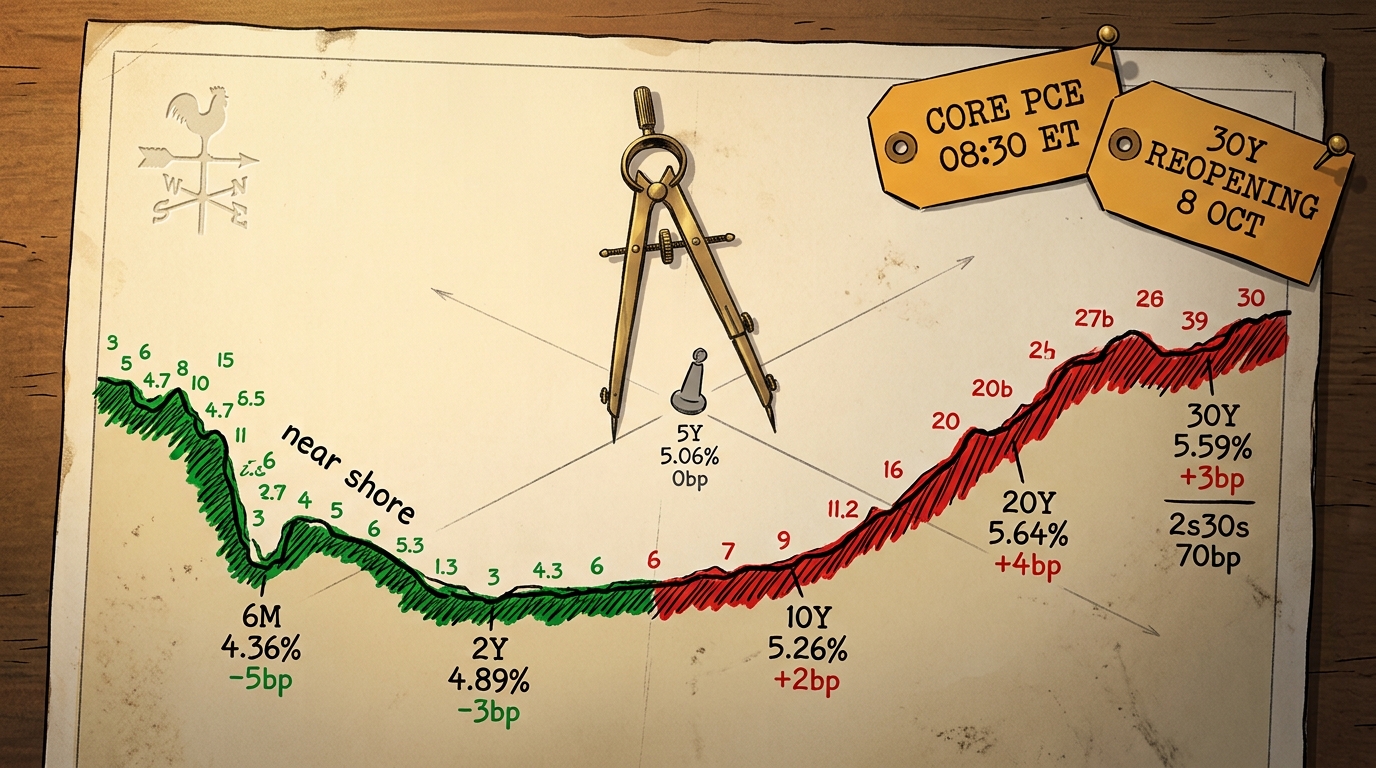
Two prints landed together at ten o’clock in New York: consumer confidence at 81.9 where 89.2 was expected, and job openings at 7.079 million on a third consecutive monthly decline. Softer consumer, looser labour market. Every tenor from the two-month out to the three-year richened, the six-month by five basis points, the two-year by three. That is the front end doing the job it exists for, which is to price what the committee does next.
The other half of the same instrument went the other way. The twenty-year cheapened four basis points to 5.64%, the thirty-year three, and two-to-thirty widened from sixty-four to seventy. The dollar firmed two tenths, three-quarters of it the euro cross. Between the two arguments the five-year closed 5.06% against a previous 5.06%, unchanged to the basis point.
Most desks will file that as a bear steepener and move on. The part worth sitting with is the tie-break, because equities cast a vote and it was not ambiguous. The headline index gave up under two tenths of a percent, which reads as nothing happening. Underneath, decliners beat advancers on the New York exchange 1,589 to 1,117, one hundred and twenty-three issues made new lows against twelve new highs, and the small-cap index closed 2,807.92, its lowest close of the quarter.
The textbook is not subtle about this. Softer data lowers the expected path of the policy rate, a lower path lowers the discount rate, and equities rally, small caps loudest, because they borrow short and float. It is the first thing anyone learns about how a soft print travels.
What happened instead is that the companies living on cheap funding sold off hardest on the day funding got cheaper at the front. Two readings stay open. Either the curve is saying growth softened rather than policy, so a lower path is compensation rather than a gift. Or the long end’s supply problem has simply become the bigger number, and the discount rate that matters to a small borrower now sits at twenty years instead of two.
We would rather leave that open than take the tidier half. What Tuesday settled is where the argument lives.
Phil’s Musing
The bit that keeps nagging is the zero. A market can hold two forecasts at once without noticing, and usually does. What it cannot do is hold them at the same tenor. The five-year is where the two stories had to meet and price each other, and what they agreed on was no change at all. That looks like consensus and it is the opposite of one. Volatility finished at 16.04, flat on the session, which says nobody involved thinks this needs resolving soon. I am less relaxed about it than the volatility index is.
Happy trading,
Phil
Less Brain, More Gain
…and may your trades be smoother than a cashmere codpiece
P.S. – Phils Footnote
I went hunting for the biggest number on the board and spent a good while on a stock that lost a quarter of its value before the bell. Then I noticed the one tenor that had not moved and realised I had been doing the thing I always warn other people about, which is mistaking size for information. The loud number was idiosyncratic. The quiet one was structural. I only found it because the curve happened to split so cleanly, and I would like a better method than luck for next time.
🗂 Desk Notes – Part 218 | 30 Sep 2026
Session read (§8.4)
SESSION BRIDGE: prior session (Tue) full reaction -0.16724% on cash SPX to 7,670.84 with December ES settling 7,732.00, breadth 0.703 and 123 NYSE new lows against 12 new highs; live premarket December ES +0.0905% / December NQ -0.1494%, VIX 16.04 official close 29 Sep -0.19%; threshold: none.
Threshold reasoning. The prior cash session moved 0.16724%, far inside the 1.0% normal envelope, so no editorial carry-over fires on the equity leg. The volatility leg needs plus or minus 8% and got 0.19%. The commodity leg needs plus or minus 4% on front-month crude and got 3.4773% on November WTI, which is the closest any leg came and still does not clear. The premarket is inside the band at 0.0905%, in fact below the 0.3% typical figure rather than above it. Threshold NONE. No carry-over note this edition, and §10.6 does not fire.
Close-to-open window. Cash close 16:00 ET Tuesday to the 06:30:00 to 06:34:59 UTC capture bar this morning. December ES 7,732.00 settlement, overnight low 7,738.00 in the session’s very first bar, overnight high 7,755.75 at 00:05 UTC, capture close 7,739.00. December ES did not trade below its own settlement at any point overnight. Capture taken 06:51:03 UTC and re-read 06:57:10 UTC; all four dated contracts byte-identical on open, high, low, close and volume across both reads, whilst the adjacent forming bar moved 2.00 index points between the same two reads. Fourth consecutive confirmation of the 15-minutes-past-close rule.
Premarket VIX is not available on this stack. CBOE:VIX at 5m terminates at the 29 September 20:15 UTC cash close on two reads nine minutes apart, taken deliberately past the 07:15 UTC global-hours threshold, and the route states it carries no pre or post-market bars. The bridge therefore carries the 29 September official close of 16.04 explicitly labelled as a prior-session figure. A dated CFE:VX contract is a different instrument on a different basis and was not substituted.
Contract roll. No roll warning. The September equity-index expiry was 18 September and December is front month by a volume ratio of 837 to 1 against March 2027, confirmed on Tuesday’s own volumes. November WTI remains front month by volume at 1.66 times December, derived from 313,854 lots against 189,182, and narrowed from 2.02 times on Monday. ICE Brent November 2026 stops trading TODAY, 30 September, with final settlement 1 October; Brent December is front month by 3.00 times.
The mechanism read
The full CMT curve, 29 September against 28 September, basis points.
| Tenor | 28 Sep | 29 Sep | Change |
|---|---|---|---|
| 1 Mo | 4.04 | 4.04 | 0 |
| 1.5 Mo | 4.14 | 4.14 | 0 |
| 2 Mo | 4.20 | 4.18 | -2 |
| 3 Mo | 4.28 | 4.25 | -3 |
| 4 Mo | 4.33 | 4.30 | -3 |
| 6 Mo | 4.41 | 4.36 | -5 |
| 1 Yr | 4.59 | 4.58 | -1 |
| 2 Yr | 4.92 | 4.89 | -3 |
| 3 Yr | 5.01 | 4.98 | -3 |
| 5 Yr | 5.06 | 5.06 | 0 |
| 7 Yr | 5.15 | 5.16 | +1 |
| 10 Yr | 5.24 | 5.26 | +2 |
| 20 Yr | 5.60 | 5.64 | +4 |
| 30 Yr | 5.56 | 5.59 | +3 |
2s10s 32 to 37. 2s30s 64 to 70. 20-year minus 30-year 4 to 5. The 20-year is strictly the highest published yield on the curve, by 5 basis points over the 30-year, with the 10-year the next nearest, 38 basis points below.
What it implies. This is a bear steepener with an outright front-end rally, and the 5-year is the exact pivot. Two soft 10:00 ET prints, consumer confidence at 81.9 against 89.2 and job openings at 7.079 million against 7.23 million on a third consecutive decline, were followed by a rally from the 2-month out to the 3-year. This is stated as sequence, not causation, and the reason is the same one that governs the speech below: only daily published closes are held, no intraday yield path was retrieved, and cross-sectional sign consistency is not a timing argument. What would settle it is an intraday 6-month and 2-year path placed against the 10:00 ET stamp. The long end went the other way on the same information. That is not a contradiction in the data, it is two different prices being set by two different mechanisms: the front end prices the committee’s next move and the long end prices term premium, issuance supply and a global duration bid.
The one artery. The curve, and specifically the 5-year at zero. It is the point where the two mechanisms met and cancelled to the basis point, which locates the hinge precisely. The 1-month and the 1.5-month also printed 0 and are not the same finding: nothing was pulling them in either direction. Equities sided with the long end: the Russell fell 0.35453% to the lowest close of the quarter, financials fell 0.3322%, the advance-decline ratio printed 0.703, and 123 NYSE issues made new lows against 12 new highs. A front-end rally that the equity market declines to take as good news is a market telling you which end of the curve it believes.
Confirmation and contradiction. The dollar confirmed the long end, adding 0.20% with roughly three-quarters of it the euro leg across a six-leg rebuild that sums to +0.1943 percentage points against an actual +0.1997, a residual of 2.7%. The yen was the only leg pulling the other way. Volatility validated nothing. At 16.04 against 16.07 the index barely moved, three hundredths of a point, on a session that steepened 2s30s by 6 basis points and produced the quarter’s lowest small-cap close. A 6 basis point steepening with a flat volatility index is repricing, not stress.
One attribution declined. The New York Fed president’s remarks are stamped 14:00 ET and carry both “one further upward adjustment of the federal funds target range may be appropriate late this year” and “there is no need for urgency”, read from primary text. Both halves are consistent with the split observed. But no intraday index or yield path was retrieved against that timestamp, so the causal sentence is not written. Per the standing wire-timing rule, a same-afternoon speech and a same-afternoon move are not a chain until the timestamps are placed.
Overnight Excitement (§8.5)
Does not fire, and the number it fails on is December ES at +0.0905% overnight, against a 0.3 to 0.6% normal-and-silent band and a 1.0% firing threshold. Nothing in commodities or crypto supplies a driver either: November WTI went from an 89.38 settlement to 89.39 at 02:00 ET, gold spot from 4,182.24 to 4,180.01, bitcoin and ether both softer by under 0.7%. The Reserve Bank of Australia hiked 25 basis points to 4.60% exactly in line with forecast. China’s official manufacturing PMI printed 50.1 against a 50.1 forecast and a 49.8 previous, and the private gauge beat at 52.1. Both liquid-constituent closure tests returned 30 September data, so Asia was open; those are closure demonstrations only and no non-US cash index level is publishable on this stack. The one live overnight catalyst is still ahead: German preliminary CPI at 12:00 UTC, consensus 3.2% against 2.9% previous.
Forward catalyst slate
Today, 30 September. Sixteen releases share the 08:30 ET timestamp: August core PCE, the Q2 GDP third estimate, advance August goods trade and inventories. Core PCE month-on-month is forecast 0.3% against 0.2% prior, and that field is one of the few on which both calendar routes agree. ADP at 08:15 ET, forecast disputed between routes and therefore not published as a figure. Chicago PMI 09:45 ET, forecast 51.2 against 47.1 prior, agreed. 17-week bill auction 11:30 ET, 75 billion dollars. Chicago Fed president 17:10 ET, confirmed at that bank’s own page.
Because sixteen reports print in the same second, any single-cause attribution of today’s move to core PCE alone is unsupportable. Note also that an August PCE printing on 30 September is a backlogged calendar, not the usual slot.
Thursday 1 October. Challenger job cuts, initial claims, final manufacturing PMI, ISM manufacturing at 10:00 ET with a previous of 54.6 agreed across routes, construction spending, 4-week and 8-week bill auctions, three Reserve Bank presidents and the New York Fed president again at 15:30 ET.
Friday 2 October. Non-farm payrolls at 08:30 ET, forecast 90,000 against 162,000 previous, unemployment 4.1%, average hourly earnings 0.3% month-on-month. All three fields agree across both calendar routes and are safe. Factory orders and vehicle sales after.
What is NOT this week, and it is commonly misplaced. No coupon auction falls between 29 September and 5 October. The first coupons are a 3-year on 6 October, a 10-year reopening on 7 October and a 30-year reopening on 8 October, verified against an exhaustive enumeration of the Treasury schedule with a date filter. Sizes are not yet announced on that route and are not asserted.
What is coiled. The 30-year reopening on 8 October sits directly against a 20-year-minus-30-year gap of 5 basis points, which is the open Part 211 claim. The payrolls print on 2 October sits inside the Part 215 breadth window. Both killers are named, plausible and inside their windows.
Divergence flags
- Utilities led the board at 1.172% on a session when the 20-year cheapened 4 basis points. A bond proxy outperforming into higher long yields did not reconcile on a rates mechanism. The competing explanation is data-centre power demand, and the attention data supports it: five power and energy-infrastructure names carry Zacks attention this edition whilst exactly one power name appears on any Stocktwits board. Flagged rather than resolved, because no instrument here separates the two.
- Gold spot rose 1.6227% whilst December gold rose 0.2711%, a divergence of 1.35 percentage points on one session. Both legs reproduce their prior anchors. No superlative is attached, because no dated window of spot-versus-futures gaps is held. ⚠️ The spot leg is single-sourced this run: Twelve Data is absent from the stack for a third consecutive edition and Kitco was not reached, so the substituted route carries the figure alone.
- The gold carry printed minus 2.54 on the basis the book has been using, against a held band of 18.72 to 52.94. Investigated rather than dropped. The mixed-basis definition differences a 13:30 ET settlement against a 17:00 ET spot rollover and therefore absorbs every late-session spot move; rebuilt on an aligned basis it reads 35.76, inside an aligned eight-session band of 25.43 to 39.49. The band is what was wrong, not the figure.
- Technology closed at minus 0.0154% whilst communication services closed at plus 0.2608%. A sector this close to zero is exactly where a name sample diverges from the cap-weighted truth in either direction. No “only large technology name green” construction is available today.
- The bitcoin flow row published 66.2 million with eight of twelve issuer cells carrying no value and still summed to its own stated total. The arithmetic cannot see a cell that is not there. The ether table, read the same way on the same morning, rendered every cell numeric on both reads, which is positive evidence that the ether rows are genuinely complete and the bitcoin row is not.
- The 06:33 UTC attention capture has the entire crypto majors complex off all three boards for a second session whilst four of five carry a high normalised message volume somewhere in their series. Rank and volume are different quantities, fifth consecutive capture supporting it.
- One calendar asserted six Board-governor appearances on 29 September that the Board’s own speeches page, read twice, does not carry, and a second calendar independently corroborated the Board page. Nothing was attributed to any of them.
Regime and sensitivity read (§17.3)
Running LOOSE, twenty-ninth consecutive edition, stated openly rather than presented as neutral. The diagnosis is unchanged and is specification rather than tuning: the candidate set is pointed at the wrong things.
Tuesday produced four regime-grade observations and the tripwire saw none of them. A front end rallying outright on data whilst the long end cheapened on the same data, which is the first clean instance of that ordering in the recorded run. A 5-year printing exactly zero as the pivot of a 6 basis point steepening. A utility sector leading the board into higher long yields. And a small-cap index closing the quarter at its floor on a session the headline index called a 0.17% day.
Recommendation order, unchanged in substance from the prior edition and re-ranked by what Tuesday showed:
- Two-sided volatility leg. Thirteen editions overdue. Monday vindicated it by a rise of 8.07%; Tuesday vindicated it by a flat 16.04 on a session with the quarter’s lowest small-cap close. A one-sided leg sees neither.
- Split the Weathervane turn condition into two separately-scored legs. Tuesday is the first session in the recorded run to fail BOTH limbs outright: the 2-year moved 3 basis points against a 10 basis point magnitude floor, and the 30-year moved 3 against a permitted 1.5. Friday cleared the ratio limb alone, Monday the magnitude limb alone, Tuesday neither. Simultaneity remains the binding constraint.
- Breadth-versus-index leg built on the new-high count rather than the advance-decline ratio. Tuesday is further evidence: the ratio travelled 0.3129 to 0.703 in one session, a move of 124.7%, whilst the new-high count went 10 to 12. The count is the stable signal.
- A leg on the front-end-versus-long-end ORDERING rather than on transmission magnitude. New this edition, and it is the honest replacement for the wording withdrawn yesterday. Tuesday’s information is not how much the front end moved, it is that the two ends moved in opposite directions on one data set. No current candidate can see that at all.
- Re-specify the policy-transmission thread, now challenged in eight distinct directions across eight consecutive editions.
Observations only. No trades are named anywhere in this file.