A very good day for the American economy, and the longest bond in the world still went up in yield
⚓ Weathervane. Information transmits into the price of money and stops there. Two scheduled surprises in three sessions moved the front end and then the long end in the directions the textbook names, and the equity multiple did not flinch at either one. The curve is doing the listening. Multiples are not, and the bill for that still arrives in one session rather than gradually. Carried unchanged from 17 August. Monday confirmed it rather than nudged it.
 Ahoy there, Trader! ⚓️
It’s Phil…
If neither a weak consumer nor a strong factory print can buy a long bond, what is actually setting the price of thirty-year money?
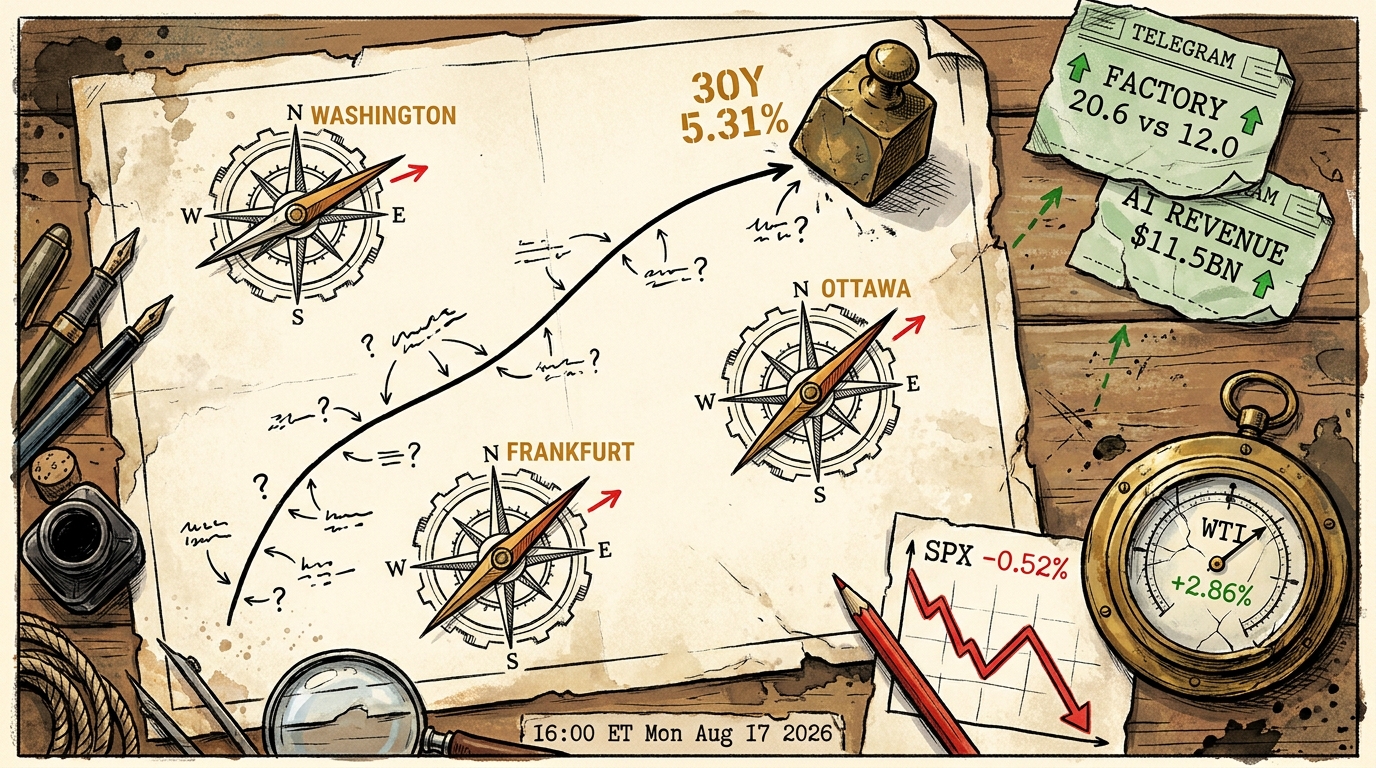
The common view going into Monday was simple enough, and most desks would have signed it: good news lifts shares, and the only real question is whether it lifts them enough to justify what you paid. Monday supplied the good news twice. The New York Fed’s August factory survey came in at 20.6 against a forecast of 12.0. Anthropic told prospective investors its quarterly revenue had gone from $787m a year ago to more than $11.5bn, with an operating profit attached this time.
The tape did something else. Semiconductors took the AI number and ran with it, Micron up 4.3%, SanDisk up 7.5%, Marvell up 6.4%. The S&P 500 closed 0.52% lower at 7,745.06 anyway, a second consecutive loss, and the Nasdaq 100 gave back an early gain to finish 0.2% down. The 30-year Treasury yield rose nearly six basis points to about 5.31%, the highest since 2007. The 10-year finished near 4.73%.
Here is the part we keep coming back to. Canadian 30-year yields hit their highest since 2010 on the same session, and German long rates went to 2011 levels. Three currency blocs, one direction, one day. Whatever explanation we reach for has to work in Ottawa and Frankfurt as well as Washington, which quietly rules out most of the American growth story we would otherwise use.
The textbook says a long yield is roughly a path of short rates plus a term premium: what the central bank is likely to do, plus what you charge for the risk of being wrong for thirty years. The path leg has been going the other way. September hike pricing has fallen through the fortnight, and the front end has not been leading these moves. So the movement has to be sitting in the second leg, which is where issuance, above-target inflation and simple appetite live. The crude move on Monday, WTI settling near $84.80 for a 2.86% gain after the ceasefire lapsed, refreshed the inflation half of that on the same afternoon.
What we cannot separate yet, and will not pretend to, is how much of Monday was foreigners repricing all long duration and how much was America’s own supply. The honest position is that the equity market has stopped taking instruction from the economy and started taking it from the auction, and we do not yet know who is running the auction.
Phil’s Musing
I keep expecting one of these good prints to work, and it keeps not working, which tells me the thing I should be watching is not the data at all. If the whole world’s long end moves together on a day America gets good news, then the marginal buyer of duration is the story and I have been reading the wrong page. Two flags on our own board are counting levels whilst the actual question is transmission.
Happy trading,
Phil
Less Brain, More Gain
…and may your trades be smoother than a cashmere codpiece
P.S. – Phils Footnote – I will admit something. Two months ago I would have looked at a factory survey beating by eight points and a private company going from $787m to $11.5bn and assumed a green day, no further thought required. Monday has taught me to check the long bond first and the news second, and I am not sure I like what that says about how this market is being run.
🗂 Desk Notes – 18 Aug 2026
Part 191. Raw briefing export. Observations, not trades.
0. Close-to-open read
SESSION BRIDGE: prior session (Monday 17 August) full reaction, S&P 500 -0.52% to 7,745.06 on the cash close with the overnight tail extending it, Friday close 7,785.76 to live ES 7,738.50 is -0.61% across the whole window; Nasdaq Composite -0.32% to 26,644.91, Dow -0.51% to 53,459.78, Russell 2000 -0.35% to 3,057.54; live premarket ES -0.39% / NQ -0.72%, VIX 15.18 +6.45%; threshold: none.
The equity test says none for the seventh consecutive session and for the seventh consecutive session it is measuring the wrong instrument. What actually moved on Monday was the 30-year, up nearly six basis points to about 5.31% and the highest since 2007, and crude, with WTI settling near $84.80 for a 2.86% gain. Neither is inside §8.4.1. The premarket at -0.39% on ES sits inside the normal 0.3% to 0.6% band; the VIX move at +6.45% does not, and there is no volatility leg in the threshold to catch it. The MIP 11.0 candidate to widen §8.4.1 with a commodity leg and a volatility leg now stands on seven qualifying observations.
No carry-over fires (§10.6). No manual flag from Phil, no percentage trip, and Monday’s long-end move is this edition’s spine rather than a backward glance.
1. The mechanism read (full)
What moved.
- Front end (2yr): not retrieved for 17 August at the time of writing. The official H.15 constant maturity for Monday publishes today at 16:15 ET. Thursday 13 August remains the last confirmed official reading at 4.15%. Treat the front end as unread today rather than inferred.
- Long end (10yr): approximately 4.73% Monday, up roughly 0.64% on the day on newswire quotes. (30yr): up nearly six basis points to about 5.31%, the highest since 2007, per Bloomberg.
- Dollar (DXY): closed near 99.58, down roughly 0.05%. The flat finish masks the shape: dollar sold through Asia and early London, then bid back from mid-morning London as the long end climbed and the tanker headline landed. Live 99.581.
- Volatility (VIX): 14.26 at Monday’s close, indicated 15.18 in the premarket, up 6.45%. That is the largest single move in the compression run and the first reading above 15 since 11 August.
- Crude: WTI settled near $84.80, +2.86%. Brent traded $91.27 overnight. Live WTI 84.37 on the 03:04 ET screen and 85.54 by the later European reading, so it is still climbing.
- Gold: closed near $4,421, +1.01%. Live 4,455.7, -0.40%.
- Equities: S&P 7,745.06 -0.52%, second consecutive decline. Nasdaq 100 erased an early gain to finish -0.2%.
What it implies.
The causal chain runs from the long end outward, and the direction of causation is unusually clean because the equity market had every excuse to go the other way. Two upside surprises landed before the sell-off: the New York Fed’s August factory survey at 20.6 against a 12.0 forecast, and Anthropic’s preliminary second-quarter revenue above $11.5bn against $787m a year earlier, with positive adjusted operating income. Both are unambiguously pro-risk. The semiconductor complex traded them (Micron +4.3%, Marvell +6.4%, Western Digital +6.0%, SanDisk +7.5%, Applied Materials +4.8%, KLA +2.4%) and the index still lost half a per cent.
The competing explanation is supply and term premium rather than growth. Canadian 30-year yields reached 2010 highs and German rates 2011 levels on the same session, so the bid disappeared from long duration across three currency blocs at once. A domestic growth story does not do that. Persistent above-target inflation, heavy long-dated issuance and the AI complex’s own $1.5trn of corporate bond supply this year are the candidate drivers, and the crude move gave the inflation leg a same-day refresh.
The one artery. The price of thirty-year money is now the independent variable and the equity multiple is the dependent one. Every other reading on Monday, including two genuinely good ones, was marked against 5.31%.
2. The forward catalyst slate
- Today, 18 August: housing starts, building permits and import prices at 08:30 ET; industrial production and capacity utilisation at 09:15; pending home sales at 10:00. Home Depot before the bell, Baidu after. API crude stocks 16:30. H.15 for 17 August publishes at 16:15 ET and settles the 2-year and 10-year readings this file is currently carrying on newswire quotes.
- Wednesday 19 August: FOMC minutes. Named in the Part 188 falsifier’s release list, so it is a candidate qualifying session for the range test.
- Thursday 20 August: weekly initial jobless claims. Named in both the Part 188 and Part 190 falsifiers. Alibaba earnings.
- Friday 21 August: S&P Global flash PMIs. Named in the Part 190 falsifier.
- This week: Walmart. The second opinion on Friday’s consumption miss.
- Next week: Jackson Hole. 26 August: Nvidia, the obvious test case for the Part 189 shot and inside its window.
- Late August: the Pentagon’s 21-day production ultimatum resolves. Anthropic’s reported September or October listing at a $2trn-plus valuation remains a draft S-1 in a quiet period.
3. Divergence flags
- Good data did not buy equities and bad data did not buy bonds. Friday’s retail sales miss left the long end higher. Monday’s factory beat left equities lower. The two observations point at the same conclusion from opposite directions and neither is explained by the growth channel.
- Semiconductors won the day and the index lost it. Six names up between 2.4% and 7.5%, Nasdaq 100 down 0.2%. That is a discount-rate outcome, not a demand outcome.
- Nvidia closed +0.02% on the single best read-through its customer base has produced. The stock the trade is named after did not participate in its own story.
- Bitcoin rose 2.28% with no crypto catalyst on a risk-off equity session, alongside gold at +1.01%. It sided with the hedges. The ETF flow data cuts the other way, with a third consecutive outflow day on 14 August.
- Volatility moved 6.45% in the premarket after closing at a 2026-low area. The compression that survived CPI, PPI, retail sales and a record close is being tested by a geopolitical headline rather than by data.
- The dollar could not hold a bid on rising US yields until the afternoon. Rate differentials widened in the dollar’s favour all day and it still finished a touch lower, which is a term-premium signature rather than a policy-expectation one.
4. Regime and the Weathervane (§17)
⚓ Weathervane status: carried unchanged, and yesterday’s session confirms it. The banner rewritten at Part 190 says information transmits into the price of money and stops there, with the curve doing the listening and multiples not. Monday is the cleanest confirmation available: two pro-risk surprises, a six-basis-point move in the long bond, and an equity market that took its instruction from the bond and ignored the news. No rewrite. Confirmed, not nudged.
⚓ REGIME FLAG (duration, SOFT): moves to 2 of 5. Monday qualifies on both legs. The 30-year at about 5.31% is above the 5.15% condition, and the S&P at 7,745.06 failed to make a new closing high. Counter was 1 of 5 after Friday.
⚓ REGIME FLAG (chipflation supply side, SOFT): carried, no new marks. Monday’s semiconductor rally is an equity event and is not counted. Sixth consecutive edition recording the temptation and refusing it.
Sensitivity read (§17.3): HIGH-TIGHT, hold at yellow. No change recommended. The duration flag is doing exactly what a tripwire should: it reset to zero on 13 August when the S&P made a record, and it has counted two clean sessions since without anyone arguing about interpretation. The level conditions that Part 190 flagged as mismatched with a transmission banner are still mismatched, and the recommendation to swap the three level conditions for a transmission condition still awaits Phil’s greenlight. Monday strengthens it again: the flag counted a level and the banner explained a mechanism, and both happened to point the same way, which is luck rather than design.
Public tell status: NOT triggered. “Hoist the mainsail” stays holstered.
5. Open live variables
- 2-year and 10-year constant maturity for 17 August. Newswire quotes only in this file. H.15 publishes 16:15 ET today.
- Brent’s Monday settle as a percentage. This file has WTI at +2.86% and Brent’s overnight level at $91.27, but not Brent’s official settle change. It matters for the Part 187 shot, which measures Brent and nothing else.
- The first-report timestamp on the Qeshm Island tanker detention. Fars is the source; the file cannot date the first report against 14:00 ET. See the ledger, Part B.