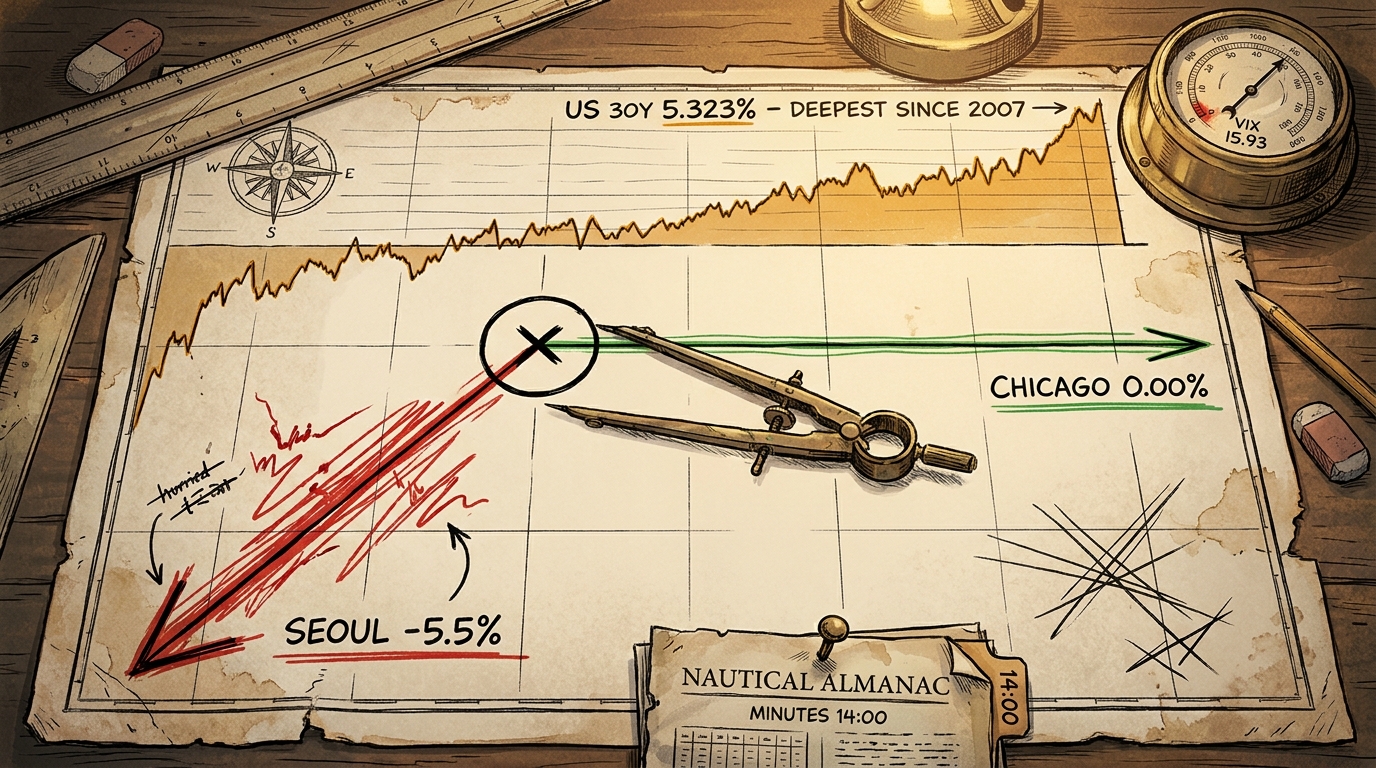
Two markets read the same long-end signal overnight and finished five and a half percentage points apart
⚓ Weathervane. The wind is coming from the long end. The policy rate has been frozen at 3.50% to 3.75% since July whilst the term premium does the tightening, and the price of long money is now set by deficits, issuance supply and a synchronised global duration bid rather than by the committee. Higher-for-longer has stopped being a Fed decision and become a bond-market fact. The cruise ship is holding this heading, and nothing on Tuesday turned it.
 Ahoy there, Trader! ⚓️
It’s Phil…
Most desks have today pencilled in as a Fed day. The 29 July minutes land at 14:00 ET, three officials dissented for a hike, and the convention is that we read the adjectives and adjust the September odds. Fair enough. But something happened overnight those minutes cannot address.
Korea lost 5.5% overnight and the S&P 500 future did not move. Which one of them is reading the long end correctly?
Start with what moved. On Tuesday the US 30-year touched 5.323%, its highest since 2007, then closed near 5.282%, two basis points lower. In the same window Japan’s 10-year reached a three-decade high, Germany’s 30-year its highest since 2011, France’s since 2008. Four sovereign long ends, one direction, one week. The front end did nothing: the 2-year eased to 4.175% and has been asleep since the July hold.
Sit with that. The Fed sets the short rate, it is frozen, and the price of long money climbs anyway: a July deficit near $432bn, roughly $1.7trn of corporate issuance chasing the same duration buyers, inflation that has declined to leave. None of it is a committee decision.
Now the part that caught us out. If the long end squeezes equities, Tuesday should have been a relief session, because the long end closed lower. The textbook expectation is simple: yields fall, the discount rate falls, the longest-duration equity rallies hardest. The opposite happened. Western Digital fell 7%, SanDisk 9%, Seagate more than 9%. Overnight it went global: Samsung and SK Hynix each over 7%, Kioxia 9%.
So the relationship failed, and the explanation is that it was never a daily one. A discount rate is not a headline you trade in the afternoon. It is a level you mark your model against, and that level has moved more than forty basis points since late June. Once a sector marks to the level rather than the print, two basis points of rally is not relief. It is noise inside a repricing that began weeks ago.
Which leaves the honest gap. The index is unchanged this morning, and that can mean two entirely different things. Either the market has correctly judged a concentrated unwind that five hundred names can absorb, or index-level calm is what concentration looks like from outside, right up until it is not. A VIX of 15.93 is the market taking the first view with real money, and we do not know which view is right. We do know the two positions are five and a half percentage points apart, and a gap that size closes one way or the other.
Phil’s Musing
The bit I keep turning over is that the committee has become a spectator at its own meeting. It sets a rate it has not changed since July whilst the deficit, the issuance calendar and a global duration bid do the actual tightening, at the long end, where nobody votes. If that is right, Warsh at Jackson Hole matters less than the market thinks and the refunding calendar matters more. Not ready to put that in the Weathervane. I do want to see whether the next long-end auction gets absorbed or gets a concession.
Happy trading,
Phil
Less Brain, More Gain
…and may your trades be smoother than a cashmere codpiece
P.S. – Phils Footnote The thing that bothered me most this week was not the 5.5%, it was the flat dollar underneath it. A 2% drawdown across Asia and no safe-haven bid at all. Every framework I was ever taught says there should have been one. Either this is not the risk event it looks like, or the same term-premium story lifting yields is quietly weighing on the currency too, which would be an uncomfortable combination. I have not settled it.
🗂 Desk Notes | 19 Aug 2026
Published as: 🗂 Desk Notes – 19 Aug 2026
Raw briefing. Observations, not trades.
Session read (§8.4)
SESSION BRIDGE: prior session (Tuesday 18 Aug) full reaction was SPX -0.69% to 7,691.76 on a third consecutive losing session, Nasdaq Composite -1.33% to 26,289.71, Dow -0.22% to 53,343.40, Russell 2000 -1.30% to 3,017.89, with no material after-hours tail in the index complex but a large continuation offshore overnight (MSCI Asia Pacific -2.0%, Korea -5.5%); live premarket ES 0.00% at 7,713.75 / NQ -0.07%, VIX +0.50% to 15.93; threshold: none.
Reading the window rather than the buckets: the prior session did not finish at the bell. It finished in Seoul and Tokyo eight hours later. The cash close understated the reaction by roughly the entire Asian leg, because the catalyst was not a US print, it was a global repricing of a single sector that trades round the clock across four currencies.
§8.4.1 status. Prior session -0.69%, inside the normal daily envelope. Premarket ES 0.00%, well inside the ~0.3% band. Mechanically no carry-over fires and none has been forced into the outputs. Recorded here rather than escalated: the threshold is specified on S&P futures and S&P futures did not move, which on a day like this is the information, not the absence of it. Flagging as a candidate specification gap for MIP 11.0, alongside the standing §8.4.1 volatility-leg question.
1. The mechanism read (full)
The front end (2yr): 4.175% Tuesday close, down under a basis point. Doing nothing, and has been doing nothing for weeks. The July FOMC held 3.50% to 3.75% by nine to three, and since then payrolls printed -23,000, core CPI 2.5% and retail sales -0.6%. September hike odds have fallen from roughly 57% on the day of the decision to about one in three (CME FedWatch, 17 Aug). The front end has priced the hike as postponed rather than cancelled, and futures continue to carry higher odds for October and December than for September.
The long end (30yr): 5.323% intraday Tuesday, closed near 5.282%, down two basis points. The intraday print is the highest since 2007. The close is not a new high. That gap is the day’s most important technical fact and it is where the Part 191 shot gets tested. Term-premium drivers cited across the sell side: a July deficit near $432bn, roughly $1.7trn of corporate issuance competing for the same duration bid, and inflation parked above target. The 10-year eased to 4.706%. Curve steepening continues to do the tightening the committee is not doing.
This is not a US story. Japan’s 10-year hit a three-decade high, Germany’s 30-year the highest since 2011, France’s 30-year the highest since 2008, all in the same window. A synchronised developed-market long-end move is a supply-and-term-premium event, not a central bank reaction function event. Anyone reading today’s minutes for the answer is reading the wrong instrument.
The dollar (DXY): 99.644, +0.06%. Inert. Below 100 and unbothered by a 2% Asian equity drawdown, which is itself notable. A genuine global risk event usually bids the dollar. It did not.
Volatility (VIX): 15.93, +0.50% premarket, ~15.85 Tuesday close. Grinding up off last week’s 2026 lows across three consecutive sessions (+4.28% Mon, +3.75% Tue morning, +0.50% premarket) without breaking anything. Index-level vol is pricing the S&P 500, and the S&P 500 is genuinely not moving.
The one artery. Duration has stopped being a rates story and become a valuation story, and it is being expressed through the single longest-duration equity complex on the board rather than through the index. Memory and storage names carry cash flows furthest out and the least pricing power to defend them, so a 40bp-plus move in the long bond since late June lands there first and hardest. Tuesday’s evidence is decisive on the mechanism: the 30-year closed lower and the sector still bled, which means the sector is not trading the daily rates print. It is trading the level, and the level has moved. The index looks calm because the repricing is concentrated in six names, not because it is small. Dispersion is the event. Direction is not.
2. Forward catalyst slate
- Today, 14:00 ET. July FOMC minutes. Backward-looking by three weeks and by three data prints. Watch for how far the hawkish dissent extended into the voting majority, which is the only genuinely new information a minutes release with recorded dissents can carry. The established pattern is a brief repricing on the initial read then a fade once the stale-information argument lands.
- Today, pre-bell. Target, Lowe’s, TJX. Wolfspeed reports after a 7.6% Tuesday decline.
- Thursday 20 Aug. Walmart fiscal Q2.
- Wed 26 Aug, 08:30 ET. July PCE, the Fed’s preferred gauge.
- Wed 26 Aug, after the close. Nvidia. The number circulating as the bar is $91bn. This lands roughly 36 hours after PCE and is the pre-registered killer on the Part 191 shot.
- 27 to 29 Aug. Jackson Hole. Warsh delivers his first keynote as chair on Friday morning 28 Aug. Official theme is payments. With written guidance withdrawn, a set-piece speech from this chair carries unusual weight.
- Fri 4 Sept. August payrolls, after a negative July print.
- 15 to 16 Sept. FOMC with a fresh Summary of Economic Projections, the first dot plot since June.
- 15 Sept. Senate cloture vote on the Clarity Act.
3. Divergence flags
- Korea -5.5% against ES 0.00%. The headline divergence and the edition’s spine. Two markets, one set of facts, five and a half percentage points apart. Either the American index has correctly judged the unwind as sector-contained, or it is late.
- The 30-year closed lower and chips fell harder. Rate relief arrived on Tuesday and the most rate-sensitive equity complex on the board declined it. This is the flag that matters most for the Part 191 thesis and it cuts against the simple version of it.
- DXY flat through a 2% Asian drawdown. No safe-haven dollar bid. Either the market does not regard this as a systemic event or the dollar is being held down by something else, most plausibly the same term-premium story that is lifting yields for bad reasons rather than good ones.
- VIX 15.93 into a global sector rout. Index vol is behaving. Single-name and sector vol clearly is not. The gap between them is the tradeable observation and it is widening, not narrowing.
- Solana ETF inflows at their strongest since May whilst bitcoin funds posted their heaviest weekly outflow in six weeks. An unusual internal split for an asset class that normally moves as one bloc.
- Gold -0.38% with crude +0.92% and the long end at a 19-year high. Gold is not behaving as an inflation hedge into a term-premium event. Worth watching whether that persists into PCE.
Part C – Regime tracking and the Weathervane (§17)
⚓ Weathervane (carried, not rewritten). The wind is coming from the long end. The policy rate has been frozen at 3.50% to 3.75% since July whilst the term premium does the tightening, and the price of long money is now set by deficits, issuance supply and a synchronised global duration bid rather than by the committee. Higher-for-longer has stopped being a Fed decision and become a bond-market fact. The cruise ship is holding this heading.
Reconstruction flag: the persistent ledger file was absent from the project at edition start, so this line is rebuilt from the last known regime read rather than carried verbatim. Verify against the 18 Aug ledger before publishing and correct if the wording has drifted.
Duration flag. Both legs of the tracked condition set held again on Tuesday: the 30-year sat above 5.15% throughout, and there was no new closing high (5.282% close against a 5.323% intraday print). Advances to 4 of 5 on the reconstructed condition set, subject to confirmation against the ledger file.
⚓ REGIME FLAG: not tripped. No tracked thread broke a multi-week pattern today. Two candidates are being watched and neither has crossed:
- Dispersion without index vol. A 5.5% single-session drop in a G20 benchmark and a 7%-plus move in two global chip bellwethers, against an unchanged S&P future and a VIX below 16, is an unusual pairing. If it recurs without the index absorbing any of it, the compression regime is not calm, it is concentrated, and those are different animals with different failure modes.
- The dollar’s non-response. A flat DXY through a 2% Asian drawdown breaks the reflex most desks still assume. One instance is noise. A second would be a genuine pattern break worth flagging properly.
Sensitivity read (§17.3). Running slightly LOOSE at present, not tight. The wire has now sat quiet through several sessions where the index-level instruments were inert but the underlying dispersion was substantial, and the tripwire is specified on index-level conditions that a concentrated regime will not trigger by construction. The honest position is that the current setting would miss exactly the kind of turn this market is most likely to produce. Recommend adding a dispersion or single-sector leg alongside the standing volatility-leg proposal for §8.4.1. Phil calls it.
Public tell. Holstered. “Hoist the mainsail” stays unsaid.