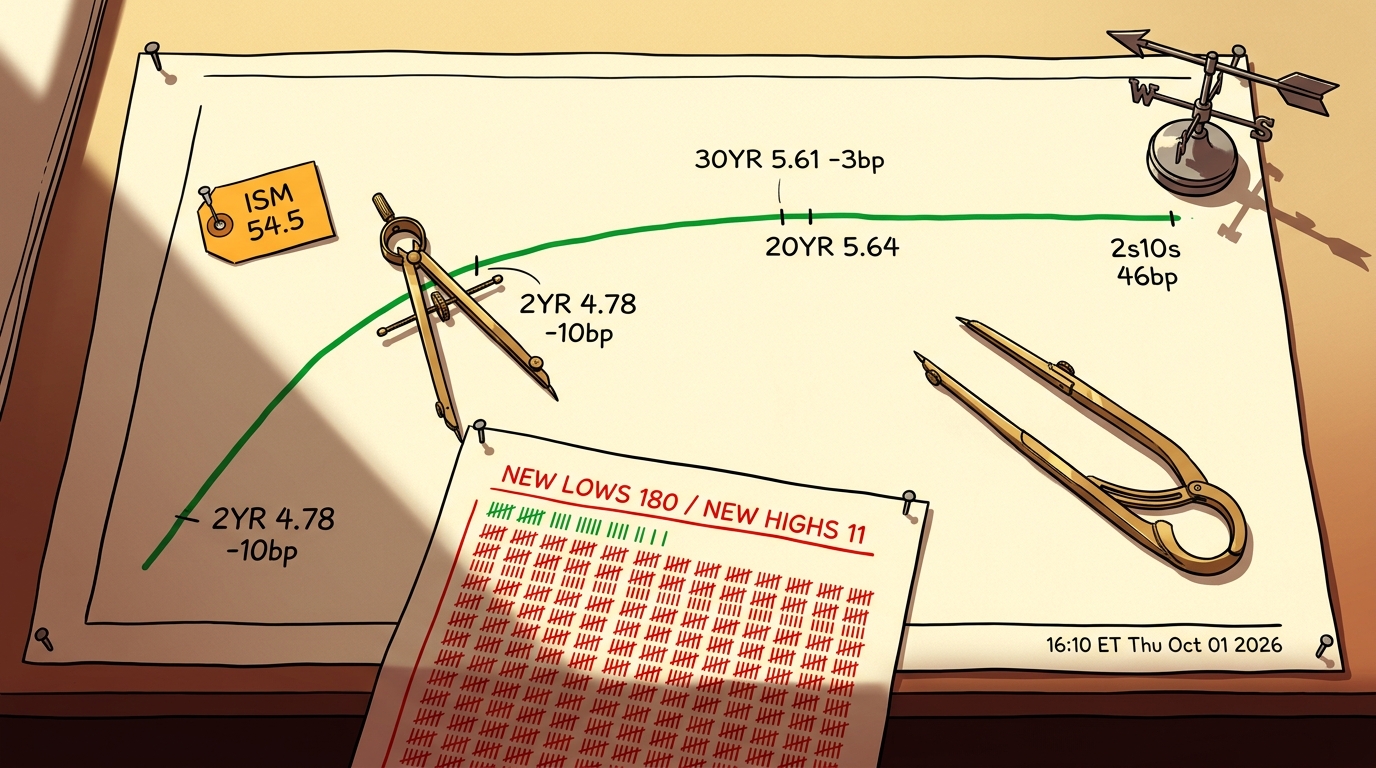
180 names hit a 1-year low on a day the index rose 0.19%
⚓ Weathervane. The wind is coming from the long end. The policy rate has been frozen for most of the year whilst the term premium does the tightening, and the price of long money is set by deficits, issuance supply and a synchronised global duration bid rather than by the committee. Higher-for-longer stopped being a Fed decision and became a bond-market fact. The cruise ship is holding this heading.
 Ahoy there, Trader! ⚓️
It’s Phil…
When the relief arrives at the front of the curve and not the back, who is it actually for?
Thursday looked, from the bridge, like an ordinary good day. A factory survey slipped a tenth to 54.5. The 2-year closed 10 basis points lower at 4.78%. The index rose 0.1949%. Most desks filed that under relief, and the surface reading is not wrong so much as incomplete.
Underneath it, the 30-year gave up 3 basis points and the 20-year, still the curve’s highest yield for a sixteenth session, gave 4. The gap between 2s and 10s widened to 46 basis points, the widest since 27 August. And 180 NYSE issues closed at fresh 52-week lows, the most of any session since 24 June, against eleven new highs.
Four markets were speaking at once and not saying the same thing. The front end heard soft data and priced a slower path. The long end heard the same data and barely moved, because what it prices is not next month’s meeting but the supply of long money. The dollar rose 0.573%, the wrong direction for a front-end rally, and about three quarters of that is the euro, not anything American.
The textbook here is unambiguous. Lower short rates are supposed to help equities, most of all the long-duration ones, whose value sits in cash flows arriving in the 2030s. Those cash flows are discounted at the long end. So if relief lands at two years and stops there, it has helped the part of the market that needed it least. A balance sheet refinancing next spring had a lovely Thursday. A company whose worth is a decade out got nothing.
That gap is where we suspect the 180 lives, and no more strongly than that. A cross-section is not a mechanism. Those names did not make new lows because the 30-year held; they made them on the same afternoon, and the honest word is coincident rather than caused.
What is worth sitting with is how completely the aggregate hid it. Advancers beat decliners 1,505 to 1,190. Five of eleven sector proxies rose, and two did the work: energy, as a supply thread ran, and technology on one result. Strip two narrow things out of a weighted average and it stops describing the thing it is named after.
Payrolls print this morning and the front end has already bought the deceleration. What we cannot answer is whether the back end joins in, or whether 180 becomes 200 and the index tells us again that everything is fine.
Phil’s Musing
The weighted average has been flattering us and I have been letting it. A tape where eleven companies out of the whole exchange made a new high is not a tape that is going up, whatever the headline says. I care less about where the 2-year goes this morning than about whether anything happens at thirty years, because that is the only number on the board that pays the companies most people actually own.
Happy trading,
Phil
Less Brain, More Gain
…and may your trades be smoother than a cashmere codpiece
P.S. – Phils Footnote I came into Thursday expecting the dollar to tell me something about US rates, and it told me about Europe instead. Three quarters of a 0.573% move sitting in one currency leg, on a day our own front end moved ten basis points. I had quietly assumed those two things were connected and they simply were not, and I would not have found that out if we had not pulled the move apart leg by leg. Worth remembering the next time I reach for the dollar as a confirmation of something domestic.
🗂 Desk Notes – Part 220 | 2 Oct 2026
Raw briefing. Observations, never trades.
Session read (§8.4)
SESSION BRIDGE: prior session (Thu) full reaction [SPX +0.1949% to 7,666.45 cash close, VIX 16.39 official close +0.05, 2-year CMT minus 10bp to 4.78%, plus the post-close tail: Nike minus 8.734% overnight on next-year guidance, tier 2]; live premarket ES +0.2913% / NQ +0.3511%, VIX 16.39 carried as a prior-session official close because no premarket volatility print exists on this stack; threshold: soft.
Why soft, and the reading is stated rather than assumed. Four legs were tested:
- Equity leg: silent. SPX +0.1949%, far inside the 1.0% normal envelope.
- Premarket leg: silent. All four December contracts between +0.2913% and +0.4351%, inside the 0.3% to 0.6% normal band. The closest to the 1.0% §8.5 trigger is December RTY at 0.5649 percentage points clear, so nothing is within re-crossing distance either. This is the explicit answer to the Part 219 finding that the drift gate measures distance travelled by a price and cannot see a figure crossing a specification threshold.
- Volatility leg: silent. VIX +0.31% against a ±8% floor.
- Commodity leg: FIRES, and the ambiguity is recorded. §8.4.1 specifies “a front-month crude move of ±4% or more” without naming the benchmark. WTI’s front month, November, moved +2.7096% and does not clear it. Brent’s front month, December, moved +4.366% and does. The reading taken is that Brent’s own front month satisfies the leg, so the threshold is soft and the §10.6 carry-over fires. Flagged for Phil as a wording question rather than resolved as a ruling.
Close-to-open window. Cash close 16:00 ET Thursday to the 07:30 UK capture is 10 hours 30 minutes. Capture bar window 06:30 to 06:34:59 UTC, read at +20 and +28 minutes, byte-identical on open, high, low, close and volume across all four contracts whilst the adjacent still-forming bar moved on all four, ES by 3.25 index points and 2,692 contracts and YM by 26 points. Sixth consecutive clean two-read lock, and the adjacent bar is the control that makes it evidence.
Contract roll: no warning. Not a roll window. The third Friday of September was the 18th and December’s is the 18th. Front months established from each session’s own volumes: equity index December on all four; WTI November at 311,065 lots against December’s 188,451; Brent December at 477,483 against January’s 274,328. The two crude products run opposite ways and the WTI finding is not carried across.
The mechanism read (full)
US Treasury CMT, Thursday 1 October 2026
| Tenor | 1 Oct | 30 Sep | Change (bp) |
|---|---|---|---|
| 1 month | 4.06 | 4.02 | +4 |
| 1.5 month | 4.10 | 4.13 | -3 |
| 2 month | 4.13 | 4.16 | -3 |
| 3 month | 4.17 | 4.20 | -3 |
| 4 month | 4.26 | 4.29 | -3 |
| 6 month | 4.27 | 4.33 | -6 |
| 1 year | 4.44 | 4.54 | -10 |
| 2 year | 4.78 | 4.88 | -10 |
| 3 year | 4.91 | 5.00 | -9 |
| 5 year | 5.01 | 5.09 | -8 |
| 7 year | 5.12 | 5.19 | -7 |
| 10 year | 5.24 | 5.29 | -5 |
| 20 year | 5.64 | 5.68 | -4 |
| 30 year | 5.61 | 5.64 | -3 |
2s10s 41 to 46. 2s30s 76 to 83. 20s30s minus 4 to minus 3. The 20-year is strictly the highest published yield on the curve for a 16th consecutive session, the run beginning 10 September. The 1-month is the only tenor higher on the day.
What moved. A clean bull steepening with monotonic rally magnitude from the 1-year outward. 2s10s at 46bp is the widest since 27 August, where it printed 47bp, on a window held back to 3 August. No superlative is claimed on 2s30s: August ran 88bp to 112bp.
What it implies, and the causal status of each clause is stated. The ISM print at 10:00 ET is causation: both the 2-year and the 10-year printed session highs inside that single five-minute bar on the intraday path, which is a pre-release level, a single-bar move at the release minute and a recovery. The three-and-a-half-hour grind lower that followed is inference, read as pre-payrolls positioning, and no single headline marks its start. The market traded the activity line of a contradictory survey, 54.5 against a prior 54.6, rather than its price line, 77.9 against 71.1.
The timestamps exonerate the Vice Chair, and this matters more than the rally. Both tenors printed session lows inside the single bar in which Jefferson began speaking at 13:30 ET, and then rose through the afternoon. The entire rally was complete before he opened his mouth. The obvious story, that a data-dependent speech from the Vice Chair rallied the front end 10 basis points, is wrong and the path disproves it. Nothing is attributed to him.
An ordering claim is available and it cuts against the obvious reading. The 2-year and the 10-year made their session highs in the same five-minute bar and their session lows in the same five-minute bar. At five-minute resolution there is no detectable lead or lag between the front end and the belly. The bull steepening is therefore a close-to-close artefact of differing overnight starting points, not an intraday lead. Anyone writing “the front end led the rally” would be wrong: it did not lead, it started from further away. The TradingView yield feed supplied the shape only; its basis-point magnitudes are not mixed with the CMT table above.
The one artery. The relief was delivered to the front of the curve and withheld from the back. Ten basis points at the 2-year against three at the 30-year, on a session whose spine was 180 new 52-week lows. The index was carried by energy, on a session a refined-product supply thread ran on the feed, and by technology on one name. The mechanism behind the energy leg is declined in both directions below and is not asserted here either. That is a description of Thursday’s cross-section, not a causal claim about the 180.
The dollar did not trade the US rates tape at all. DXY rose 0.573% to 102.042 whilst the front end rallied 10 basis points, which is backwards. The six-leg rebuild localises it: the euro leg supplied 0.4439 of a 0.5521 percentage-point sum against an actual 0.5726, a residual of 0.0205. That is 80.40% of the RECONSTRUCTION and 77.52% of the ACTUAL move, and the two must not be confused: the euro leg is roughly four fifths of the rebuild and about three quarters of the move itself. This was a euro-weakness event falling on the same day, not a dollar response to US rates, and the two are treated as independent. The ECB President is calendar-listed at 09:30 ET; no primary source was obtained and no link is asserted.
Overnight Excitement (§8.5)
Did not fire, and nothing was hunted to make it. All four December US equity futures came in between +0.2913% and +0.4351%, inside the normal band, with the closest contract 0.5649 percentage points clear of the 1.0% trigger. No foreign index close is offered as a trigger and no non-US cash index level is published. Direction with attribution only: Asian shares opened lower into the payrolls print, on syndicated reports, with European equities pressured by a French bond move. Mainland China is shut through the middle of next week, demonstrated on an exchange-native constituent and corroborated independently. Hong Kong reopened on 2 October after the National Day holiday, also demonstrated on a constituent. Underlying Tokyo inflation is reported higher, tier 3 relay. No figure is published: the relay_reason on that record bars it as a point figure and no primary or official route to Japanese CPI exists on this stack. No G10 policy decision landed in the window.
Forward catalyst slate
- Friday 2 October, 08:30 ET. September Employment Situation. Confirmed on schedule against the Bureau of Labor Statistics’ own October release schedule, which carries no lapse, postponement or revised-date notice. Prior payrolls 162,000. Unemployment forecast 4.1% and average hourly earnings 0.3% month on month, both agreeing across two routes. The payrolls forecast itself CONFLICTS between routes, 89,000 against 90,000, so no point forecast is publishable. 10:00 ET factory orders.
- Monday 5 October. ISM non-manufacturing at 10:00 ET. 13-week and 26-week bill auctions.
- Tuesday 6 October. 3-year note, 58 billion dollars. 6-week bill.
- Wednesday 7 October. 10-year reopening, published as a 9-Year 10-Month note, 39 billion dollars. A high-importance 14:00 ET rates event is calendar-listed and is most likely the September minutes; not verified against a primary source and not to be printed as such.
- Thursday 8 October. 30-year reopening, published as a 29-Year 10-Month bond, 22 billion dollars. Initial claims.
- Not this week, and commonly misplaced: there is no FOMC meeting until 28 October, and no CPI print in the slate above.
- What is coiled. The three coupons on 6, 7 and 8 October sit inside the Part 215 window and are its pre-registered killer. They also sit four, five and six sessions after the Part 211 window closes, which is the correction the Part 219 ledger made to the Part 218 entry.
Divergence flags
- The index and its own constituents. S&P 500 up 0.1949%, NYSE advancers 1,505 against decliners 1,190, up volume 55.4% against down volume 42.9%, and 180 new 52-week lows against 11 new highs. Every aggregate was positive and the tails made their worst low count in 70 sessions. The 180 is a divergence, not a driver, and no causal reading is attached to it.
- NYSE and Nasdaq advance-decline disagree in sign. NYSE 1.264706, Nasdaq 0.976391. Nasdaq up volume nevertheless beat down volume 1.078 to one.
- The dollar against the front end. Up 0.573% on a 10 basis point front-end rally, about three quarters of the move one currency leg.
- Copper against everything else. December copper minus 1.261% whilst November crude rose 2.7096%, December silver 1.0055%, gold spot 0.4939% and bitcoin 1.4792%. A supply-shock cross-section with the industrial-demand leg dissenting, not a reflation tape.
- The crude attribution runs backwards. The day high printed in the 17:00 UTC hour. The carrier-deployment reports reached the feed at 19:14 and 19:57 UTC, which is AT LEAST one hour fourteen and one hour fifty-seven minutes later and may be up to an hour more, because the high can have printed anywhere inside its bar. The decisive hour, a 1.55 dollar thrust on 20,324 lots in the 07:00 UTC bar, has no headline inside it at all, and the nearest feed item three minutes earlier was titled to the opposite effect. No attribution is carried in either direction.
- Accenture’s own session. Up 24.137% intraday, closed up 15.7768% at 7.62% of its range. McCormick fell 4.8707% on a quarter three independent routes called a beat. Nike printed its 255-session low before its results were public.
- The GAAP and adjusted bases on McCormick. Reported GAAP diluted earnings 0.36 against a consensus of 0.7558 that is an adjusted figure. Setting them side by side manufactures a 52% miss out of a basis mismatch. The published comparison is 0.36 against the prior-year GAAP 0.84.
- Attention against news, twice. Accenture posted the session’s largest advance and is absent from all three attention boards at depth 25 whilst carrying the highest canonical sentiment of any symbol pulled, 86, on an 8,916-watcher base. Nike fell 8.734% to a new low and is rank 1 on two boards. Good news does not buy board position on this stack; losses do.
- Constellation. Absent from all three boards and from both provider attention windows, with its recommendation cut from Outperform to Neutral, whilst its own dated chatter series rose to its highest reading of the week on the session it lost rank 7. Attention up, rank gone.
- The two power names that replaced it on the equities board both carry a Rank 4 Sell at their 52-week lows with every forward revision moving down, whilst the Rank 1 name in the same thread, with both attention windows positive and agreeing in sign, cannot reach any board.
- The 8-week bill. Cover 2.70 and indirect share 56.81%, both the lowest of the trailing seven 8-week auctions, on an offering 10 billion dollars larger than the prior one at 95 billion. No full size series is held, so no largest-in-the-series claim is made. Dealers took 36.13%. No tail is obtainable on any permitted route and none is published.
- Crypto flow composition. Net +102.7 million dollars of which one fund was 195.6 million, 190.5% of the net. The session before, one fund was 125.6 of a minus 148.7. Two consecutive sessions where a single issuer is the entire number, in opposite directions.
- The farside asymmetry diagnostic did not fire. Every cell on both products rendered numeric on this read, so the diagnostic is null and yields no positive evidence of completeness for either row. That is precisely the condition that obtained on 23 September, when a published +32.4 million completed at +346.9 million. Both 1 October rows are provisional and neither is marked.
- The truncation prediction failed. The earliest farside row was predicted at 15 September and came back at 14 September on both products, so the exact one-session-per-edition erosion has stalled for the first time in five observations.
- A Dallas Fed speaking engagement was reported after the cash close. No primary source was obtained on any permitted route, so under the registry’s hard rule nothing is attributed and no figure from it is carried anywhere in this edition. Recorded because it is the most market-relevant item on the feed between the US close and the European open, and because its absence from the copy is a decision rather than an oversight.
- The crypto feed legs reversed sign on both pairs simultaneously. A single feed drifting cannot do that, which retires the one-feed hypothesis and supports a boundary-timing characteristic.
Carry-over note (§10.6)
Fires on the commodity leg, on BRENT DECEMBER’s +4.366%. The noteworthy thing is not the move. It is that the reason everybody gave for it had not happened yet when it happened. The intraday path below is NYMEX WTI NOVEMBER’s, which is the contract this book holds at one-hour resolution: it made its low of 88.79 in the bar stamped 05:00 UTC, did its real work in the bar stamped 07:00 UTC, a 1.55 dollar thrust on 20,324 lots and the largest volume of the session to that point with no headline attached to it whatsoever, and printed its high of 93.68 in the bar stamped 17:00 UTC. The carrier-deployment story the wires hung the whole move on reached the feed at 19:14 and 19:57 UTC, which is at least one hour fourteen and one hour fifty-seven minutes after that bar closed and may be up to an hour longer again, since the high can have printed anywhere inside it. One syndicated account states the move happened “after reports” of the deployment, which inverts the order of its own two facts.
The antecedent that does have the clock on its side is the refined-product thread: shrinking gasoline and distillate supplies on the feed the previous morning, and an export-ban discussion thirty-six minutes before the session opened. This book publishes the sequence and declines the mechanism in both directions. That is the Part 215 lesson, and it is the second edition running on which it has protected the energy copy.
Regime and sensitivity read (§17.3)
Sensitivity: running LOOSE, thirty-first consecutive edition, stated openly rather than presented as neutral. The diagnosis is unchanged and remains specification rather than tuning.
The finding of the morning, and it is the most valuable thing in this section. The Weathervane’s turn condition requires two sessions in which a dated Federal Reserve communication moves the 2-year by 10 basis points or more whilst the 30-year moves by less than half. On Thursday both numeric limbs were satisfied for the first time in ten attempts. The 2-year moved exactly 10 basis points against a 10 basis point floor. The 30-year moved 3 against a permitted 5. And a dated Board-governor communication existed on the date.
A naive reading of the condition as written would therefore have FIRED it, and the regime call would have been false. The intraday path shows the rally was complete before the Vice Chair began speaking and that yields rose whilst he spoke. The attribution limb fails on the timestamps and the condition correctly does not fire, but it does not fail for any reason the condition’s own wording can see. Progress stays 0 of 2.
This is Lesson 59 paying for itself one edition after it was filed, and it converts the standing recommendation from a tidiness argument into a correctness one: the attribution limb must be tested against an intraday path, not against the existence of a communication on the calendar. Candidate 6, term premium without a policy move, has the identical defect in the opposite direction, since it is disqualified by the mere existence of a communication that demonstrably moved nothing.
Regime flag: not tripped.
- Dollar non-response. NOT SCORED, eighth consecutive edition. The dollar rose 0.573% on a session the front end rallied 10 basis points, which is the wrong sign for the candidate as understood, and about three quarters of the move was one currency leg. Candidate 1’s full condition text is still not carried in the live ledger, so there is nothing to score against. Eighth edition carrying this absence as a finding.
- Rates versus energy inertia. RETIRED at Part 208. Seventh consecutive session of new evidence: November crude rose 2.7096% whilst all fourteen tenors but one richened.
- Volatility suppression. RETIRED at Part 207. Replacement two-sided leg now FIFTEEN editions overdue. Vindicated a tenth consecutive time: VIX finished 16.39, up 0.05, having traded a 1.38-point intraday range, on a session that set the worst new-low count in 70 sessions. A one-sided leg built for suppression sees neither.
- Front end’s selective deafness. RETIRED at Part 207. Ninth consecutive vindication, and the sharpest yet: the front end was fully responsive to data and provably deaf to the only communication available to it.
- Official demand fails at the long end. Counter 3, UNCHANGED, dormant for a fourth session. The Part 209 ruling is now six editions from expensive and the deadline is Monday: does a routine scheduled auction count as an issuance-side operation for a candidate built around buyback interventions? Three coupons arrive on 6, 7 and 8 October. A ruling before Monday lets all three be scored; without one, none can be.
- Term premium without a policy move. Counter 0. Thursday carried a dated Board-governor communication, which disqualifies the session under the wording. See the finding above: the communication moved nothing, and the disqualifier is its existence rather than its effect.
Recommendation order, with the first entry promoted:
- Test the turn condition’s attribution limb against an intraday path rather than the calendar. Promoted to first on Thursday’s evidence, because both numeric limbs fired and only a path prevented a false regime call.
- Two-sided volatility leg. Fifteen editions overdue, vindicated a tenth time.
- Split the turn condition into two separately-scored legs. Ten attempts, and the tenth is the one that shows why the conjunction is the wrong shape.
- Breadth-versus-index leg built on the new-high and new-low COUNTS rather than the advance/decline ratio. Thursday is the strongest instance yet: the ratio read 1.264706, comfortably positive, on the session the low count hit 180.
- A leg on calendar-driven price formation. Carried unchanged from Part 219.