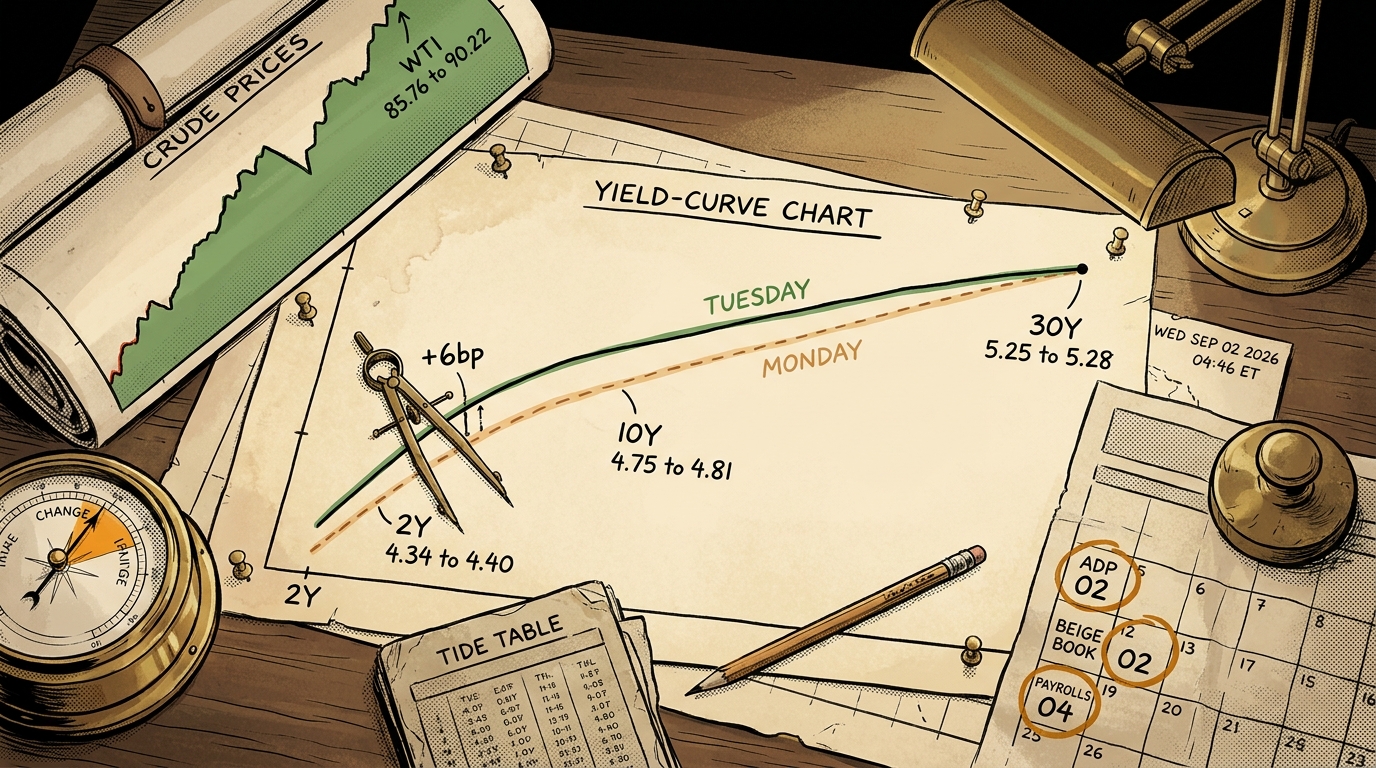
Monday it answered a five percent oil move with nothing. Tuesday it answered with six basis points.
⚓ Weathervane: The wind is coming from the long end. The policy rate has been frozen at 3.50% to 3.75% since July whilst the term premium does the tightening, and the price of long money is now set by deficits, issuance supply and a synchronised global duration bid rather than by the committee. Higher-for-longer has stopped being a Fed decision and become a bond-market fact. The cruise ship is holding this heading.
Tuesday nudged it and did not turn it. The banner’s mechanism is the long end leading and the front end abstaining. Tuesday inverted that: DGS2 rose 6bp and DGS30 rose only 3bp. One session is a speedboat. But it is the first session in this run where the wind came from the other end of the boat, and that is worth watching rather than filing.
 Ahoy there, Trader! ⚓️
It’s Phil…
Here is the question the tape handed us, and I want to be honest that I cannot settle it today.
The central question. Did the front end finally start pricing the oil, or did it just price Friday’s payrolls early?
Walking the dots
Start with what actually happened, because the numbers are not in doubt even where the meaning is.
Monday: WTI settled 85.76 dollars, up 2.83%, on a weekend that included a struck tanker and visible commodity traffic through the Strait falling to about five ships a day. The two-year Treasury moved zero basis points. None.
Tuesday: US forces struck Revolutionary Guard targets near the Strait after two supertankers were hit on the way out. WTI settled near 90.22, up about 5.2%, a six-week high. Brent finished near 95. The two-year closed 4.40%, up six. The ten-year added six to 4.81%. The thirty-year added three to 5.28%.
Equities took the consequence rather than the cause: S&P 500 off 0.71%, Nasdaq off 1.03%, chips at the front of the decline. Gold fell. The VIX rose 9.52% to 16.34 after ending August below 15.
So in two consecutive sessions, the same instrument answered the same kind of shock with zero and then with six.
Textbook versus reality
The textbook is unusually clear here, and unhelpful.
An energy supply shock is supposed to be long-end business. It raises expected inflation and the term premium, so the thirty-year should carry it. The front end should only move if the market thinks the central bank will respond to it, and central banks are conventionally taught to look through supply shocks because raising rates does not produce barrels.
Tuesday did the opposite. The front end moved twice what the long end did. On the textbook reading, that says the market no longer believes this Federal Reserve will look through energy, which after Jackson Hole is not absurd. The chairman said inflation remains too high and that the committee is not declaring victory. Fourteen basis points arrived on that speech. Zero arrived on a shooting war. Six arrived on the second day of the same war.
The alternative reading is duller and possibly correct. Six basis points on the session before a three-print week, with ADP, the Beige Book and payrolls stacked in front of it, is exactly what pre-data positioning looks like. Under that reading crude is coincident and the front end is watching the calendar, not the barrel.
I genuinely do not know which. What I can say is that they separate fast. If the oil reading is right, the next 3% crude settlement moves the two-year again regardless of what the data says. If the calendar reading is right, Friday’s payrolls will move it several times harder than any barrel has, and Monday’s zero was the honest signal rather than the anomaly.
Phil’s Musing
My lean is the calendar, not the barrel, and I hold it loosely. The tell for me is Monday. A struck tanker and traffic collapsing to five ships a day is a cleaner supply event than anything Tuesday added, and the front end sat through it without blinking. What changed between the two sessions was not the oil story, it was the distance to the payrolls print. If I am right, the six basis points is positioning and it unwinds or extends on Friday’s number rather than on the next headline out of the Gulf. If I am wrong, I will find out on the next 3% settlement day, and I would rather be told by the tape than argue with it.
Happy trading,
Phil
Less Brain, More Gain
…and may your trades be smoother than a cashmere codpiece
P.S. – Phils Footnote I have been doing this long enough to know the difference between a number that is loud and a number that is load-bearing, and I still got pulled towards the oil screen yesterday like everyone else. Five point two percent is a headline. Six basis points is a decision, and I only noticed it because the ledger made me go and look. That is the entire argument for keeping the ledger. The Beige Book lands at two this afternoon and I will be reading it for one thing only: whether anyone on the committee is describing energy as a cost problem or as an inflation problem. Those are different words and they are worth about forty basis points.