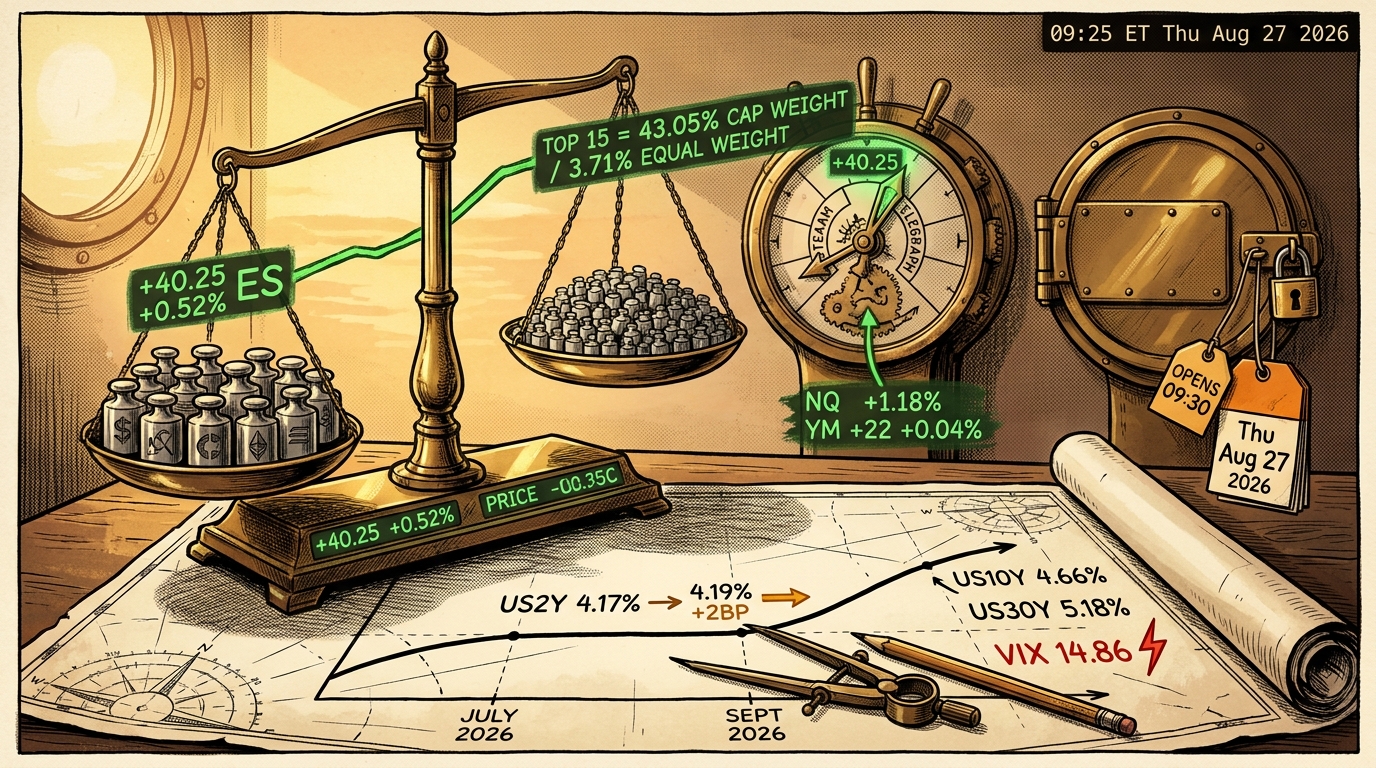
Forty points on the S&P contract, and no instrument awake that could check them
⚓ Weathervane: The wind is coming from the long end. The policy rate has been frozen at 3.50% to 3.75% since July whilst the term premium does the tightening, and the price of long money is now set by deficits, issuance supply and a synchronised global duration bid rather than by the committee. Higher-for-longer has stopped being a Fed decision and become a bond-market fact. The cruise ship is holding this heading.
 Ahoy there, Trader! ⚓️
It’s Phil…
Something happened at six o’clock last night that I am still chewing on.
Nvidia reported at 16:20 ET. Ninety-six point two two billion dollars of revenue, up 106%, against roughly ninety-two expected. A hundred and eight billion guided for next quarter against a hundred and four on the screens. Salesforce, CrowdStrike and Okta followed with beats inside the same window. The futures reopened and the S&P contract took on forty points.
So far, so ordinary.
Except I cannot tell you whether that was a rally, and I want to be precise about why, because my first instinct was wrong in an instructive way. I reached for the Russell 2000 as a control group, saw it lower, and nearly wrote that breadth was terrible. The Russell 2000 is a small-cap index. It does not contain Nvidia or Salesforce. An index that does not hold the stock that moved did not move, and that is a definition, not a finding.
What would settle it is the equal-weight S&P 500, the identical five hundred companies at 0.20% each. If that rose too, participation was broad. If it sat still, four names did the work.
It does not trade overnight.
Which brings me to the thing I cannot get past.
If nothing that trades overnight can tell us whether last night was breadth or arithmetic, what have we all been looking at since six o’clock?
Walking the dots. Every instrument that could corroborate a repricing declined to. The dollar added 0.23%. Gold slipped. Crude fell. The ten-year rose two basis points and the thirty-year one, on the day the Fed’s preferred inflation gauge printed. Volatility fell 2.37%. None of that proves the equity move was narrow. It means nothing outside equities thought it worth pricing.
Textbook versus reality. The textbook says a capitalisation-weighted index aggregates: it compresses the market’s judgement about five hundred businesses into one number that beats any of its parts, because errors cancel and signal survives.
The property is real, and it needs a condition rarely stated aloud. The weights must not be so concentrated that the index becomes a proxy for a handful of names. Fifteen holdings are 43.05% of the cap-weighted tracker. In the equal-weight version of the same companies, the top fifteen are 3.71%.
Here is the part that convinced me this is structural rather than a grumble about one night. On Monday the wire ran the other way. Semiconductors fell 2.33%. The cap-weighted S&P lost 0.26%. Equal weight closed higher, and decliners beat advancers only 1.21 to one, with sixteen new highs against seven new lows. An ordinary market underneath, reported as a down day.
Same mechanism, opposite sign, three sessions apart. Concentration is not a direction. It is a wire that runs both ways.
So the honest answer is that we have been watching four companies, expressed in index points, and calling it a market. Not because anyone is lying, but because the only instrument that could contradict us was shut. It opens at half past nine.
Phil’s Musing
The bit that nags me is the two basis points. If last night had been a genuine growth signal, the curve would have had something to say and it did not. So I do not think the economy got repriced. I think four order books did. I am not calling a top and I am not calling a bubble. I am saying that I have spent years reading an overnight index print as though it told me about the market, and this week has shown me it can be forty points up or a quarter point down for the same reason, and I would rather know which before I decide what sort of morning I am having.
Happy trading,
Phil
Less Brain, More Gain
…and may your trades be smoother than a cashmere codpiece
P.S. – Phils Footnote I nearly published a version of this letter that used the Russell 2000 as the control group. That would have been wrong, because the Russell holds none of the companies that moved. It is a tidy-looking mistake and I suspect a common one: the four contracts sit next to each other on the screen, and it is easy to read them as four views of one market rather than four different universes.