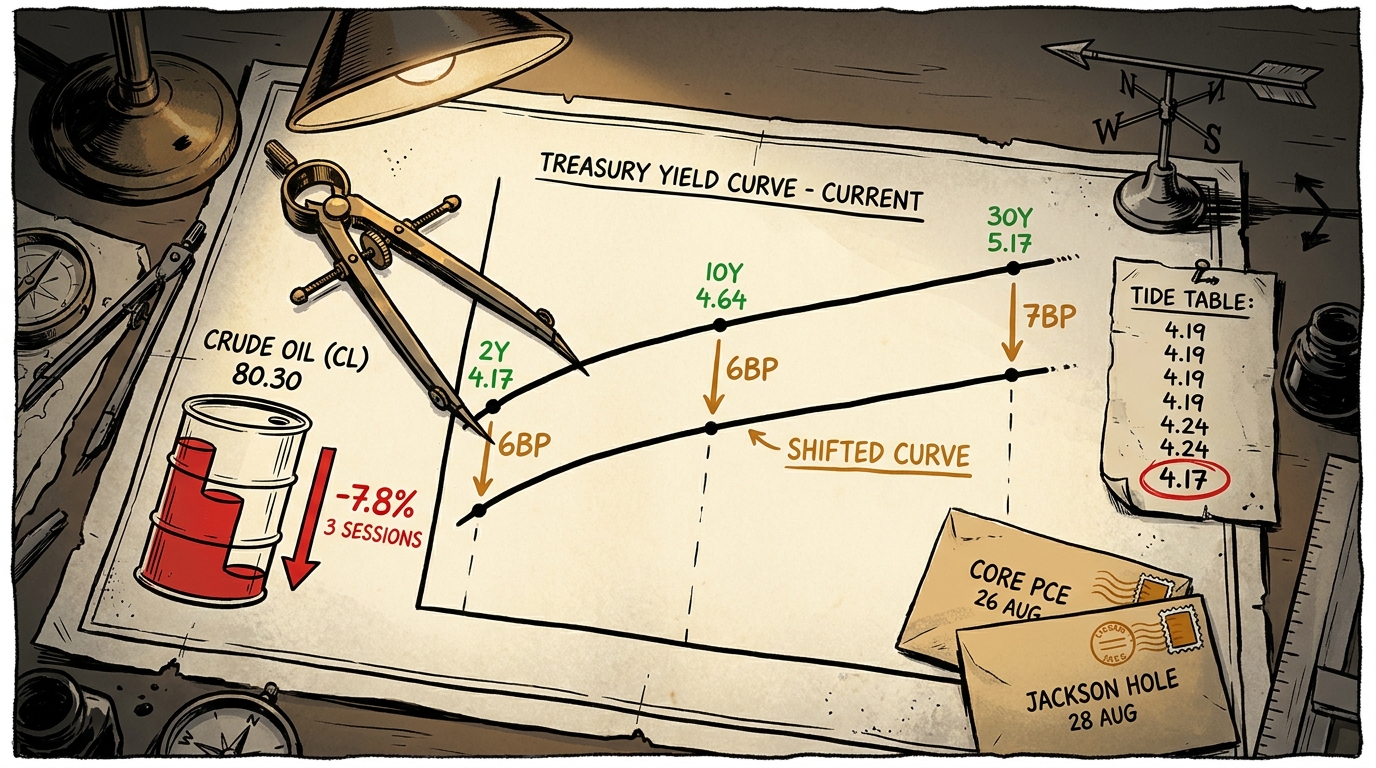
The whole curve moved on Tuesday and the Federal Reserve was not involved
⚓ Weathervane: The wind is coming from the long end. The policy rate has been frozen at 3.50% to 3.75% since July whilst the term premium does the tightening, and the price of long money is set by deficits, issuance supply and a synchronised global duration bid rather than by the committee. Higher-for-longer has stopped being a Fed decision and become a bond-market fact. The cruise ship is holding this heading, though today gave the wheel a nudge worth watching.
 Ahoy there, Trader! ⚓️
It’s Phil…
Let me put the puzzle plainly, because Tuesday finally made it sharp.
If the 2-year is taking its instructions from the price of crude rather than from the Fed, what is the front end actually pricing?
The two-year constant maturity closed at 4.17%, down seven basis points. The ten-year at 4.64%, down six. The thirty-year at 5.17%, down six. Three maturities, one direction, near-identical magnitude. A textbook parallel shift.
Now the awkward part. No Federal Reserve official spoke on Tuesday. No data printed. Nothing arrived from the committee or plausibly connected to it.
What moved was oil. West Texas Intermediate fell more than 3%, after 2.4% on Monday, and shed another 2.50% overnight to 80.30 dollars. That is 7.8% in three sessions, undoing thirteen gains in fourteen days, on Hormuz corridor talks and a sanctions package softer than the positioning.
So walk the dots. Cheaper energy lowers expected headline inflation. Lower expected inflation lowers the yield demanded at every maturity. Equities take the lower discount rate and rally, which they did, the S&P closing up 0.32%.
That chain is coherent. It is also not a monetary chain at any point.
Here is the textbook, and the gap. The two-year is meant to be the policy instrument, the maturity closest to the Fed’s reaction function; when it moves, the received reading is that the market changed its mind about the committee. A parallel shift is meant to be the rare case where a common factor hits all three, and that factor is usually inflation expectations or a policy surprise.
Tuesday was the rare case. The common factor was a shipping lane.
Which leaves two readings, and I do not think this is settled. Either the front end is working properly, correctly reading that cheaper oil eases the committee’s problem. Or it has stopped being a policy instrument and become an energy derivative in a Treasury wrapper, in which case anyone positioning it off Fed expectations is trading the wrong variable.
The first is orthodox. The second is a much bigger claim, and I would want three of these before believing it.
Two tests arrive immediately. Core PCE on Wednesday morning reads whether policy data still moves this thing. Warsh at Jackson Hole on Friday reads whether policy words still do. If the two-year shrugs at both and moves on the next oil headline, we have our answer, and it is the uncomfortable one.
Phil’s Musing
I have been wrong about this bond three times in three weeks, and each time because I assumed the Fed was the causal agent. Broken, then fixed, then through the floor. The pattern in the errors is more informative than any of the calls. If the energy reading is right, the thing to watch is not the committee, it is whether the long end keeps following crude through a real supply event. The buyback starts on 9 September. That is the test I would build around, and it is a slow-horizon question rather than a this-week one.
Happy trading,
Phil
Less Brain, More Gain
…and may your trades be smoother than a cashmere codpiece
P.S. – Phils Footnote I keep wanting the two-year to be about the Fed, because that is what I was taught it was for, and because a world where it is about tankers means rebuilding how I read the front end from scratch. Tuesday was the day the tape stopped being polite about it. I am not claiming the regime turned. I am claiming I noticed, and noticing early beats being certain late.