A memory maker with 7.67% of the market collected $487 billion on Monday. Let us work out what that price is really saying.
⚓ Weathervane. The Fed has turned hawkish for the cycle, and the customer-side leg of the AI capex bill has confirmed. Alphabet, Tesla and IBM signed the same invoice inside one hour on Wednesday the 22nd; the price arrived on Thursday at $797 billion. The equity thesis now has to carry both the tightening regime and the AI margin bill, and ad revenue can fund the second only where the top line outgrows the spending. Unchanged today, with a candidate third leg opening.
 Ahoy there, Trader! ⚓️
It’s Phil…
Something in this week’s tape refuses to sit still, and the honest thing is to lay the pieces out rather than pretend they fit.
Is the market now pricing the end of the memory shortage rather than the strength of the AI demand behind it?
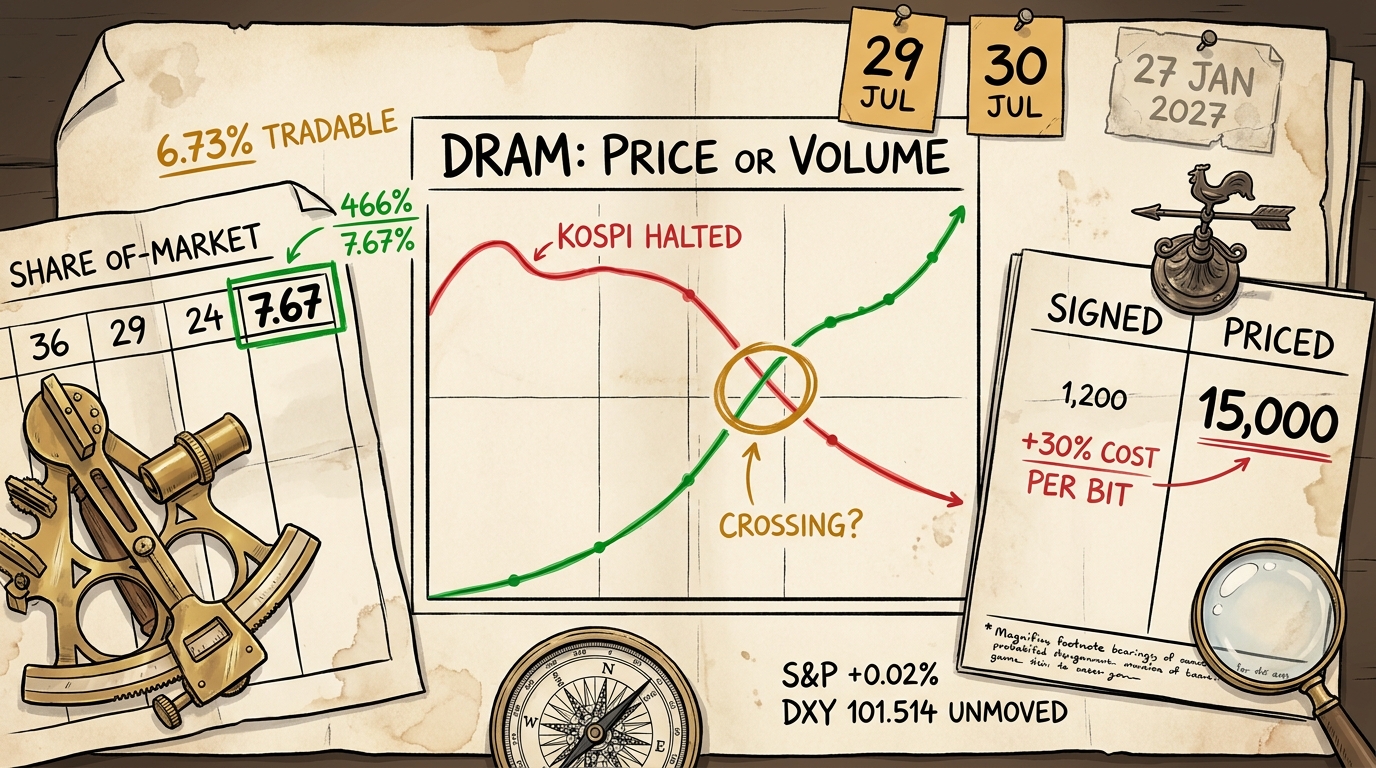
Here is what there is to work with. ChangXin Memory Technologies listed on Shanghai’s STAR Market on Monday and closed at 49 yuan against an 8.66 yuan offer price, up 466%, worth about 3.3 trillion yuan or $487 billion. That makes it the most valuable company on a mainland exchange, ahead of the largest bank in China. It holds 7.67% of the global DRAM market. Its DDR5 costs more than 30% per bit above Samsung, SK Hynix and Micron. There is no HBM project in its prospectus at all.
Three days earlier, Korea signed the largest set of AI commitments in its history. Late on Friday in San Francisco, Nvidia and SK Group signed letters of intent to a $500 billion-plus partnership covering a two-gigawatt AI factory and long-term HBM4 supply. Samsung signed a $200 billion memorandum with Broadcom. Seoul unveiled a $520 billion investment plan. By Monday Nvidia had fallen 4.99%, surrendered the world’s-most-valuable title to Apple, and SK Hynix had fallen 8.5%. By Tuesday lunchtime SK Hynix was down another 12.7%, Samsung 12%, the Kospi had fallen 10.5% to 6,051.19, and the exchange had stopped taking orders.
The macro instruments did almost nothing through any of it. The 10-year eased three basis points to 4.65%. The dollar index sat at 101.514, unmoved, having also declined to move on Monday’s oil collapse. Crude gave back another 0.87%. And the S&P, handed a paused war and an 8% drop in the barrel, closed Monday up 0.02%.
The surface reading is straightforward, and most desks would take it. Commitments of that size are a demand signal: the buyer commits, the supplier’s revenue visibility improves, both stocks firm. And a new entrant with 8% share, higher costs and nothing in the highest-margin product line is a rounding error against incumbents holding 89%.
The tape did the opposite of both, inside three sessions.
The pieces are all on the table, so the question is whether they make a picture we can read. Look a little deeper and the two oddities may not be two things at all. If memory pricing stays tight, $700 billion of intentions is a marvellous thing to have signed and CXMT really is a rounding error. If memory pricing rolls over, those same commitments become a liability for the buyer, the supplier’s margin is a peak, and the challenger’s arrival date matters far more than its current share. Monday looks like it took the second reading. The barrel and the bond market were not asked for an opinion.
What isn’t known is whether that was a judgement or a flow. Only 6.73% of CXMT’s shares were tradable, oversubscribed 212 times, in a market with obvious domestic incentives. The common reading is that $487 billion is a verdict on the DRAM industry. It might just as easily be a thin float behaving like a thin float, and telling those apart needs more clues than one session offers.
Which is why the thing to watch is a price, and not a share price. Contract DRAM pricing is the falsifiable version of all this, and SK Hynix guides on Wednesday morning. If it guides lower, Monday was information. If it holds, Monday was a party in a small room.
Phil’s Musing
The speedboat moved, ship has not turned. What makes this one harder to wave off than the usual wobble is that every scare since June has been about the cost of the AI buildout, and this is the first one about whether the thing being sold stays expensive. Not worth moving the banner on a 7% float. Worth hearing SK Hynix on Wednesday first.
Happy trading,
Phil
Less Brain, More Gain
…and may your trades be smoother than a cashmere codpiece
P.S. – Phil’s Footnote
I will admit the bit that surprised me. I assumed $700 billion of signatures was the biggest number on the page and would set the tone for a fortnight, and it did not survive three trading days. The market looked straight past all of it to a company with under 8% share and asked a question about 2028 instead. I keep having to relearn that size and significance are not the same measurement. It also helps to notice when the paperwork says letters of intent rather than contract.
🗂 Desk Notes | Tuesday, July 28, 2026
Raw briefing export. Observations, not trades.
Session read (§8.4)
SESSION BRIDGE: prior session (Monday) full reaction, opened +0.81% ES on the strike pause and crude -8%, closed +0.02% at SPX 7,413.18 having surrendered the entire gap, Dow +0.51%, Nasdaq 100 -0.3%, then Asia repriced overnight with Kospi -10.5% and a trading halt; live premarket ES -0.34% / NQ -1.10%, VIX +0.59% at 18.68; threshold: HARD.
Why HARD. Close-to-close on the prior session was inside the normal envelope at +0.02%, which on its own is silent. Three things override that. First, the intraday round trip is roughly 0.8% of surrendered gap, which is the reaction, not the print. Second, premarket NQ at -1.10% is well outside the ~0.6% abnormal band whilst YM sits at +0.01%, so the dispersion is the signal. Third, the overnight catalyst is discrete and severe: an exchange-level trading halt in Seoul. Phil also flagged the tape manually with a live watchlist capture. Carry-over fires (§10.6).
The carry-over itself. Monday was handed a war de-escalation and could not keep it. Thirteen nights of strikes paused, WTI -8%, Dow futures indicated +580, and the index closed up a fifth of a basis point. The gift was not refused, it was spent. Whatever consumed it was not the Fed and not the Gulf.
1. Mechanism read (full)
What moved.
- Front end (2yr): roughly 4.30%, easing with the oil giveback. July hike odds ~31.5% to 35%, down from 38% Friday. September ~82%, up from 52.4% on 16 July.
- Long end (10yr): 4.65% Monday close, -3bp, off Thursday’s 4.70% (highest since January 2025). 30yr touched 5.19% last week. Bloomberg US Aggregate -0.74% on the week; US Corporate -0.92%, worst investment-grade week since the spring inflation shock. Bonds extended gains overnight as Asia sold.
- Dollar (DXY): 101.514, +0.05%. Did not fall on Monday’s de-escalation. Did not bid on Tuesday’s global equity rout. Two opposite tests, no response either time.
- Volatility (VIX): 18.68, +0.59%, rising into an equity decline. No cash close below 17.50 materialised.
What it implies. The rates complex is behaving coherently and is not driving anything. Oil came off, the front end eased at the July horizon, the long end followed, and none of it reached equities, which handed back the entire benefit inside one session. The dollar’s double non-response is the cleanest evidence that this is not a macro risk event: a genuine global de-risk bids the dollar, and a genuine de-escalation sells it. Neither happened. VIX rising with the Nasdaq falling whilst the Dow holds flat confirms the same thing from the other side, that the fear is sector-located rather than index-wide.
The one artery. The tape is repricing who gets to charge for the AI shortage, and it has moved that question down the chain three times in six sessions. Week one it sat on the customer’s income statement (Alphabet, Tesla and IBM billed $797bn on Thursday 23rd). The weekend moved it to vendor credit (Nvidia proposing to guarantee $250bn of OpenAI’s borrowing). Monday moved it to supply-side pricing power, and that is the first version of the question the market can re-rate immediately, because it does not need an earnings date. CXMT’s debut is a bet that the memory shortage has a clock on it. Everything else today is downstream of that.
The one number. $487 billion. ChangXin Memory Technologies’ close-of-debut market capitalisation, awarded in a single session to a business holding 7.67% of global DRAM, carrying DDR5 costs more than 30% per bit above the incumbents, with no HBM project in its prospectus, and only 6.73% of its share capital tradable. Set against three days earlier, when Korea signed the largest set of AI commitments in its history: Nvidia and SK Group put letters of intent to a $500bn-plus partnership late Friday in San Francisco, Samsung signed a $200bn memorandum with Broadcom, and Seoul unveiled a $520bn investment plan. Nvidia fell 4.99% on Monday and lost the world’s-most-valuable-company title to Apple, whose distinguishing feature is that its capital spending has declined for three consecutive quarters.
2. Forward catalyst slate
- Today (Tue 28 Jul): FOMC day one. Conference Board consumer confidence. Roughly one third of the S&P 500 reports this week, the busiest stretch of the quarter.
- Wed 29 Jul: FOMC statement 14:00 ET, no updated projections and no dot plot. Warsh press conference 14:30. SK Hynix Q2 in Seoul, now a materially different call than it was on Friday. Microsoft and Meta post-close.
- Thu 30 Jul: Q2 GDP advance. PCE. Employment Cost Index. Apple and Amazon post-close. Apple’s print carries the first disclosed financial impact of the memory shortage that forced June price rises on Macs and iPads.
- Live claims about to be tested: the ad-revenue-funds-capex rule (Meta, Wednesday post-close, confirmed; consensus revenue $60.2bn, +27% YoY, decelerating from 33% in Q1, against 2026 capex guidance already raised to $125bn to $145bn); the capex-growth-versus-top-line-growth rule (same print); the crude de-pricing shot (session three of a ten-session window); the gold-over-the-hedges shot (gold now $4,047.20, three dollars under its own confirmation threshold, with Warsh 30 hours out).
- Coiled: CXMT’s lock-up expiry on 27 January 2027, when 93.27% of the shares meet the market. Not tradable news today, but it is the mechanical reason Monday’s price is a thin print, and it will be quoted back if the valuation holds.
3. Divergence flags
- YM +0.01% against NQ -1.10%. A 1.11-point spread between two US index futures on the same morning. Dispersion, not de-risking. Worth watching whether the Dow’s insulation survives the cash open or whether it is simply slower.
- Korea signed roughly $700bn of AI letters of intent on Friday and halted its exchange by Tuesday. SK Hynix, counterparty to the largest of them, fell 8.5% Monday and 12.7% Tuesday. Commitments of that scale failed to support their own signatories for three trading days. That is a pricing-power signal, not a demand signal, and it is the flag with the longest tail. Note the paperwork: letters of intent and a memorandum, not executed contracts.
- Gold fell 0.73% to $4,047.20 on a night Asia lost 3% and an exchange halted. The haven did not function. Either gold is trading the Fed exclusively, or the market genuinely does not read a chip rout as systemic. Both readings are live.
- The dollar did not move on either test. Flat through a de-escalation and flat through a global equity rout, 48 hours apart. A currency that ignores both sides of a two-way risk event is telling you the risk is not being priced as macro.
- Positioning is split down the middle. Deutsche Bank has discretionary investors at the 17th percentile, back to early-April lows, whilst systematic strategies sit at the 70th and have not adjusted. If volatility extends, the second group is the mechanical seller and the first has no room left to sell.
- Bitcoin under $63,800 with reduced put cover into the decision. Hedges removed the session before an unreadable press conference, with net 2026 fund flows at negative $4.76bn.
4. Part C regime read
⚓ Weathervane: UNCHANGED. Both existing legs survive today intact. The hawkish-for-the-cycle Fed leg is untouched, and the confirmed customer-side AI capex bill leg was arguably reinforced when the market handed the most-valuable crown to the one megacap that has been cutting capital spending. Per §17.2 the banner is not rewritten on one session, and the scheduled rewrite candidate remains tomorrow’s double event.
What today adds is a candidate third leg, not a rewrite. The banner currently describes a cost problem: the AI buildout is expensive and somebody has to carry the bill. CXMT introduces a revenue problem on the other side of the same trade: the shortage that made the buildout profitable for the suppliers may have a competitor with a timetable. Those are different claims and the second one has only one session behind it.
⚓ REGIME FLAG: SOFT flag raised, chipflation supply side. The chipflation thread has held one pattern for weeks, that scarcity equals pricing power equals vendor margin. Monday is the first credible challenge to it, and the challenge arrived with an exchange-level trading halt attached, which is a genuine multi-week pattern break in the Asian complex rather than an odd day. It is raised soft, not declared, because a first-day IPO print in a 6.73% float is the least reliable price in the market and CXMT’s own economics (costs 30% above the incumbents, no HBM, 7.67% share) do not yet justify the re-rating. The falsifiable version is contract DRAM pricing, not the share price.
Sensitivity read (§17.3): HIGH-TIGHT, and today argues for holding rather than loosening. The setting exists precisely to stop a curious-newbie over-read, and yesterday it caught one correctly on oil. Today it should not suppress a genuine candidate. Recommendation: hold at yellow, carry the soft flag into Wednesday, and reassess against three things on the same evening, the Warsh presser, the SK Hynix Q2 call, and Meta’s capex guide. If SK Hynix guides DRAM pricing lower on Wednesday morning, the soft flag hardens.
Public tell: NOT triggered. “Hoist the mainsail, the macro winds have changed” stays holstered. One session and one IPO do not turn a cruise ship.