Three officials voted to hike, September pricing fell, and the thirty-year broke a nineteen-year high. All on the same afternoon.
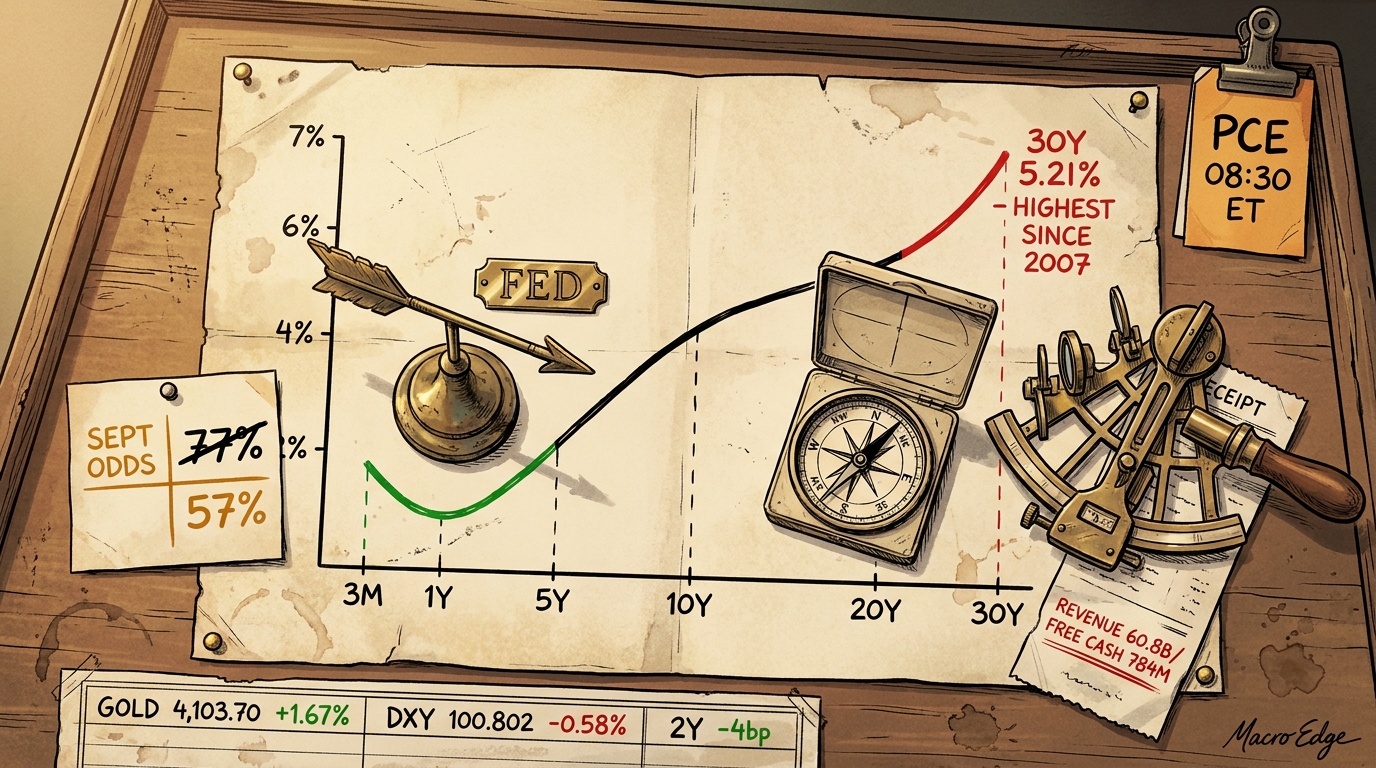
⚓ Weathervane. The tightening is no longer coming from the Fed, it is coming from the bond market. Three officials voted to hike, September pricing fell anyway, and the thirty-year went to a nineteen-year high. Meanwhile the AI capex bill has moved off the income statement and onto the cash flow statement, where Alphabet printed minus $5.9 billion and Meta printed $784 million. Equity multiples now answer to term premium and cash conversion rather than to guidance.
Rewritten today, for the first time in a fortnight. Direction unchanged. Both legs replaced with sharper versions, because both got tested this week and one of them failed.
 Ahoy there, Trader! ⚓️
It’s Phil…
On the surface Wednesday was the most hawkish thing this committee has done in a decade. Three officials broke ranks and voted to raise rates, the largest same-direction rebellion since September 2016, and the chairman promised the committee would not hesitate to act. The common assumption from there is straightforward, and most desks would take it: hawkish committee, higher front-end yields, a firmer dollar, gold under pressure.
None of that is what happened.
If three officials voting to hike is hawkish, why did the two-year fall and the thirty-year break a nineteen-year high on the same afternoon?
Take the instruments one at a time. The two-year yield, which exists to price what the Fed does next, fell four basis points. Odds of a September hike touched 77% immediately after the statement and finished nearer 57%. The stretch of curve that tracks the Fed most closely concluded the Fed would do less, not more.
Now the far end. The thirty-year added twelve basis points to 5.21%, last seen in 2007. The ten-year added seven to 4.67%. Gold rose 1.67% to $4,103.70 and the dollar index slipped 0.58% through 101. Each of those moves is the textbook response to a central bank losing its argument with inflation, not winning it.
The instruments are all reading at once, so the useful question is whether they are reading the same weather. One way the pieces fit is that the market has stopped negotiating over twenty-five basis points and started charging for the thirty years behind them. BNP Paribas read the long-end move as the market telling the chairman he should have acted already. Warsh may even have invited it: he said he considers it healthy for the bond market to move on economic data rather than Fed guidance, and within the hour it obliged him.
There is a second reading, which is why none of this is settled. Long-dated yields move on supply and month-end positioning as well as conviction, and the afternoon of an FOMC decision is where that noise lives. Separating a credibility repricing from an auction takes more than one session.
Which leads to the oddest number of the night. Microsoft reported revenue of $90.01 billion against $87.62 billion expected, Azure growth accelerating to 43%, capital spending held flat. That is the clean AI demand print the market spent a month asking for, and it took the shares 8% higher after hours. S&P 500 futures this morning are up 0.20%. Fifteen points.
Meta, reporting the same evening, grew revenue 28% to $60.80 billion and turned it into $784 million of free cash flow after $31.08 billion of quarterly spending. Alphabet’s went to minus $5.9 billion last week, its first quarterly outflow since 2004.
Perhaps those numbers belong to the same story as the thirty-year rather than a separate one. The rate used to discount future cash went up, and the cash being discounted went down, inside the same eighteen hours. Good news has to fight uphill against that pairing, however clean the news is.
Core PCE prints at 08:30 ET, with consensus at 3.3%. It is the first piece of evidence capable of telling the two readings apart.
Phil’s Musing
Two things surprised me here. A committee voting to tighten somehow left the long end more worried about inflation, not less. And Microsoft printed the exact number everybody said they wanted, and bought fifteen index points with it. If today’s PCE confirms, the thing I need to learn properly is term premium, because that is plainly where the argument has moved.
Happy trading,
Phil
Less Brain, More Gain
…and may your trades be smoother than a cashmere codpiece
P.S. – Phils Footnote I have spent most of this month treating the two-year as the only yield that mattered in this cycle, because that is where every repricing since June has started. On Wednesday it was the least informative number on the screen. I would rather write that down than quietly shift my attention to the long bond and pretend it was there all along.
🗂 Desk Notes | Thursday, July 30, 2026
Raw briefing export. Observations, not trades.
Session read (§8.4)
SESSION BRIDGE: prior session (Wednesday Jul 29) full reaction, FOMC held 3.50% to 3.75% at 14:00 ET with three dissents for 25bp (Hammack, Kashkari, Logan), Warsh presser 14:30, stocks turned green during the presser then closed at the lows, Dow -2.19% to 51,594.14 (worst since April 2025), SPX -1.52% to 7,316.15, Nasdaq Composite -1.74% to 24,442.94, RUT -1.61% to 2,906.31, 30yr +12bp to 5.21% (highest since 2007), 10yr +7bp to 4.67%, 2yr -4bp, Brent +7.9% to $90.74, plus an after-hours tail carrying Microsoft +8% (revenue $90.01bn, Azure +43%, capex flat) and Meta -5% (revenue $60.80bn +28%, EPS $6.18 miss, free cash flow $784m); live premarket ES +0.20% / NQ +0.34%, VIX -4.46% to 19.73; threshold: HARD (the -1.52% index print sits inside the 1.3% to 2% soft band, but the catalyst clause is unambiguous with a Fed decision, a three-dissent split, a presser and two megacap prints inside eight hours, and Phil flagged the tape manually).
Carry-over (§10.6), fires today. The noteworthy thing is not that stocks fell. It is that they went up during the press conference and then closed at the lows. The room heard “we will not hesitate to act” as reassurance for roughly twenty minutes, then read the bond screen and repriced. The equity tape was the last venue in the building to work out what had happened. That carries as a snarky nod in AVE, a one-liner in the Snippet, and the actual dissection in Macro Edge.
1. The mechanism read (full)
What moved.
- 2yr: down 4bp. The maturity most sensitive to the policy path eased on the most hawkish committee split in a decade.
- 10yr: up 7bp to 4.67%.
- 30yr: up 12bp to 5.21%, the highest since 2007, a nineteen-year high. Extended lower in price overnight, with Asian bonds following.
- DXY: 100.802, down 0.58%, through 101 for the first time this run (101.393 Wednesday premarket, 101.514 Tuesday).
- VIX: 19.73, down 4.46%, having spiked through 20 on Wednesday. Above 18 for a sustained run.
- Gold: $4,103.70, up 1.67%, the top of its range and clear of $4,050.
- Crude: WTI $85.48, up 1.21%, after Wednesday’s 6.6% to $84.46. Brent settled $90.74, up 7.9%.
What it implies. This was not a policy-path repricing, it was a credibility repricing, and the two are mechanically distinct. A hawkish hold should lift the front end (more tightening sooner) and flatten or invert the back (tighter policy suppresses long-run inflation). Wednesday delivered the mirror image: the front end eased, September pricing fell from 77% straight after the statement to about 57% by the close, and the long end broke a nineteen-year high. The market took less near-term tightening and demanded more compensation for the next three decades. BNP’s Calvin Tse read the long-end move as a message to the chair that he should already have acted; that is the correct mechanical reading. Warsh’s own framing accelerated it: he said explicitly that he considers it healthy for the bond market to move on data rather than on Fed guidance, and the bond market took him at his word within the hour.
The one artery: the long end has taken over the job the front end was doing. Three separate venues priced the same thing inside eighteen hours. (1) Treasuries: 30yr to 5.21% while the 2yr fell. (2) FX and metals: dollar through 101 and gold at $4,103.70, both the opposite of the textbook response to a hawkish central bank. (3) Corporate credit: Nvidia five-year CDS posted a record one-day jump Monday of roughly 14bp to about 82bp and are up near 90% year to date, having only begun trading actively in November. Every venue that lends long repriced at once. The confirming evidence is Microsoft: it printed the cleanest AI demand number of the cycle, Azure accelerating to 43%, revenue $90.01bn against $87.62bn, capex held flat, and it bought fifteen S&P futures points. When the best available news is worth fifteen points, the news was never the binding constraint. The constraint is the discount rate and the cash flow it is applied to.
The second pillar, and why it belongs to the same artery. Meta grew revenue 28% to $60.80bn, beat, and converted it into $784m of free cash flow after $31.08bn of quarterly capital spending. Alphabet’s free cash flow last week swung to minus $5.9bn, its first quarterly outflow since 2004. FactSet’s 23 July work had five hyperscalers at more than $690bn of FY26 capex, over 80% year-on-year growth, with free cash flow for most approaching zero or turning negative. That forecast is now printing. The AI bill has moved from the income statement, where growth can absorb it, to the cash flow statement, where it cannot be presented away. Microsoft held capex flat and was paid 8%. Meta raised its capex floor $5bn and was fined more than 5%. Same arms race, same evening, opposite verdicts, and the differentiating variable was cash conversion rather than the ad line.
2. Forward catalyst slate
- Today 08:30 ET, the dense one. Q2 GDP advance, June personal income and spending with the PCE price index, weekly jobless claims, Q2 employment cost index. Dow Jones consensus has headline PCE at 3.7% annual and core at 3.3%. This is the first hard inflation read since the committee split three ways over it, and there is no dot plot standing behind the decision to soften a surprise.
- Today, post-close. Apple and Amazon. Options priced a 4% move on Apple’s weekly 340 straddle and 7.5% on Amazon’s weekly 230 straddle as of Wednesday. Apple carries the index into this print having taken the most-valuable-company title on declining capital spending; Amazon is the last of the four hyperscaler capex confessions.
- Today, post-close, crypto. Strategy (consensus $3.07 non-GAAP EPS on $124.48m revenue, 843,775 coins at an average $75,476) and Coinbase.
- Friday Jul 31. University of Michigan final July sentiment. Month end, so watch for rebalancing flow into a tape where duration has just repriced.
- Coiled, undated. Contract DRAM pricing for Q4 2026 and Q1 2027, which is the falsifiable version of the chipflation thread rather than the share price. Whether September pricing re-converges toward the 80% it held for a week, or the ~57% it closed at. Any further US strikes on Iran, with Brent’s $95 level the marker the ledger nominated.
3. Divergence flags
- 2yr down 4bp against 30yr up 12bp, on a three-dissent hawkish hold. The single cleanest divergence of the month. The front end and the long end read the same statement in opposite directions.
- Microsoft +8% after hours converting into ES +0.20%. The best cloud print of the cycle bought fifteen index points. Either the after-hours move is wrong or the index is capped by something the print does not address.
- Gold +1.67% whilst September hike odds FELL from 77% to ~57%. Gold rose as the near-term rate path softened. That is gold trading long-run inflation and term premium, not the front end, which is a different mechanism from the one the ledger logged on 27 July.
- DXY -0.58% through 101 on the most hawkish committee split since 2016. Textbook says hawkish equals stronger dollar. It did the reverse.
- VIX -4.46% to 19.73 into a nineteen-year yield high. Equity vol relaxed on the morning after duration broke. Equity vol and rates vol are not looking at the same thing.
- Equity vol easing whilst credit vol does not. Nvidia five-year CDS up about 90% year to date against SOXX up about 61% year to date. Credit and equity are pricing different distributions on the same balance sheets.
- Meta revenue +28% with free cash flow of $784m. Top-line acceleration and cash conversion of roughly 1.3% of revenue in the same release.
- Semiconductors down a fifth straight session on a day the largest cloud buyer accelerated. Micron -9.9%, Applied Materials -8.4%, AMD -5.5%, Nvidia -3.5% against Azure +43%. Demand up, suppliers down.
4. Part C regime tracking (§17)
⚓ Weathervane: REWRITTEN this edition. The rewrite was pre-committed in the Part 177 ledger for today, conditional on having the Warsh presser, the Meta capex line and the Microsoft cloud line in hand. All three are in hand. Direction is unchanged; both legs are replaced with more precise and more falsifiable versions. Leg one moves from “the Fed has turned hawkish for the cycle” to “the tightening is being administered by the long end, not the Fed”, which is what the 2yr/30yr split actually says. Leg two moves from “ad revenue can fund the bill where the top line outgrows the spending” to “cash conversion funds the bill, and revenue growth does not”, because Meta had the ad line, grew it 28%, and was sold anyway. The old leg two is falsified by its own test case.
⚓ REGIME FLAG (SOFT, NEW): the transmission channel has moved from the front end to the long end. For sixteen catalysts the Warsh thread has been a front-end story: the 2yr breach, September pricing travelling from 52% to 82%, the committee contesting it, the blackout locking it. Wednesday the leadership moved to the 30-year and the front end went the other way. That is a multi-week pattern break rather than one odd session, and it is corroborated cross-asset by gold and the dollar on the same afternoon. Raised soft, not declared, for one reason: a single FOMC session with a heavy supply calendar behind it can produce a long-end move that unwinds within a week, and the honest alternative explanation is auction mechanics plus month-end positioning rather than a credibility repricing. Hardening condition: core PCE prints at or above 3.3% today AND the 30yr holds above 5.15% through Friday’s close AND September pricing stays below 75%. If all three hold, this is the strongest regime candidate the ledger has carried.
⚓ REGIME FLAG (SOFT, CARRIED): chipflation supply side. Unchanged and not hardened. The falsifiable version is still contract DRAM pricing for Q4 2026 and Q1 2027, and SK Hynix reported prices rising more slowly rather than falling. Decelerating growth is not a decline. The second vector, domestic Chinese immersion DUV lithography, also unchanged and still awaiting customer validation evidence.
Vol regime: BROKEN designation holds. VIX spiked through 20 on Wednesday and sits at 19.73. The notable feature remains the level rather than the change.
Hormuz: cycle 20, escalation properly priced. Brent regained $90 on live fire and a fresh wave of strikes followed overnight. The anti-pricing thesis is now confirmed in both directions inside five sessions and the thread is behaving exactly as logged. No new flag.
Corporate bitcoin treasury: unchanged. Sale count HOLDS at TWO. Strategy reports tonight roughly $9.7bn underwater on its stated average cost.
Sensitivity read (§17.3): HIGH-TIGHT, hold at yellow, with one caveat stated plainly. The tight setting has been right twice this week: it stopped the chipflation flag hardening on a headline that superficially looked like confirmation, and it is stopping today’s duration flag being declared on a single FOMC session. But the trade-off is now real and worth naming rather than burying. If today’s core PCE confirms and the 30yr holds, the tight setting will have cost roughly two sessions of lead time on what would be the most consequential regime change the ledger has tracked. That is the price of the setting, not an argument against it. Recommendation: hold at yellow through today’s print, then reassess Friday with PCE, the 30yr level and September pricing together.
Public tell status: NOT triggered. “Hoist the mainsail, the macro winds have changed” stays holstered. A nineteen-year high on one afternoon is a speedboat wake until the print behind it confirms.