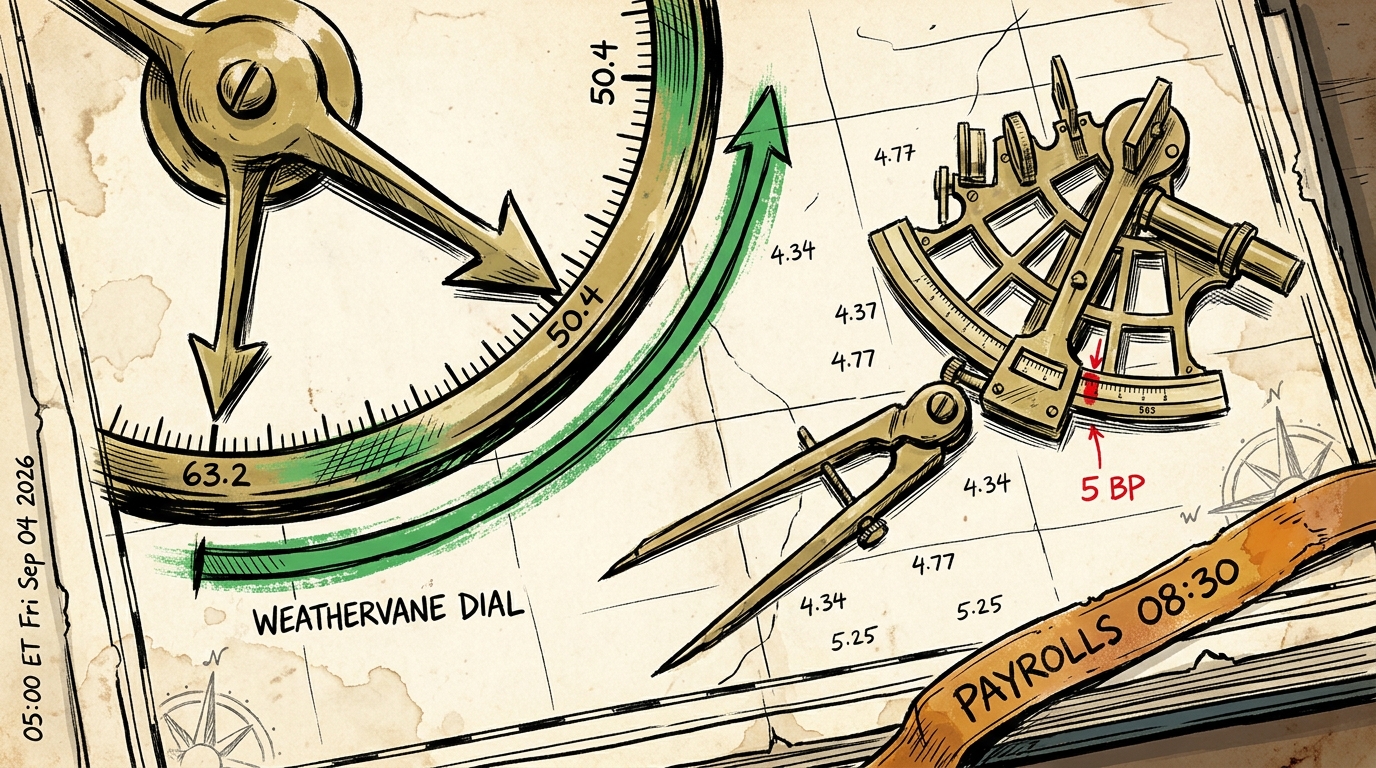
Two instruments heard the same interview and disagreed about what it meant
⚓ Weathervane – The wind still comes from the long end. The policy rate has not moved since July whilst the term premium does the tightening, and long money is priced by issuance, deficits and a global duration bid rather than by the committee. Thursday nudged that. For the second time in four sessions the front end moved more than the long end, and a named Federal Reserve voice caused it. Two nudges are not a turn. The banner rides unchanged.
 Ahoy there, Trader! ⚓️
It’s Phil…
The question we are stuck on
Why did knocking September’s hike odds back to a coin flip move the two-year only five basis points?
The version most desks ran with
The surface reading of Thursday is clean. A Federal Reserve governor said he was inclined to hold if disinflation continues. September hike odds fell from 63.2% to 50.4%. Equities had their best day in a month. The Fed blinked, the cycle is done, buy things.
We understand why the common man stopped there. It is a big, quotable number and the equity response fitted it exactly.
What the tape actually did
The two-year Treasury constant maturity closed at 4.34%, five basis points lower. That is the entire bond-market reaction to the supposed end of a tightening cycle.
Then comes the arithmetic. Shifting one meeting’s odds of a 25 basis point increase by 12.8 points moves the expected policy rate after that meeting by about three basis points. The two-year is near enough an average of the expected overnight rate over two years. So of Thursday’s five, three are simply September being shuffled. Two basis points carry everything the market changed its mind about for the remaining twenty-three months.
The textbook against the tape
The textbook says that when a central bank abandons a tightening path, the front end leads hard. Ten basis points, fifteen, twenty. What arrived would pass for noise on a quiet Tuesday.
Two readings, and I am not confident which is right. The first is that the meeting probability overreacts to any Federal Reserve voice with a microphone, whilst the two-year tells the sober truth that little changed. The second is that both are correct and never in conflict, because a hike pushed later is not a hike cancelled.
Two numbers contradict each other only if they measure the same thing over the same horizon. A single-meeting probability and a two-year yield plainly do not.
What breaks the tie
From tomorrow the Federal Reserve enters blackout. No more governors giving interviews. PPI lands on the 10th, CPI on the 11th, and Waller named CPI as the input deciding his own vote. For one week the front end has nothing to hear except data.
If it moves then, the path was live all along and Thursday was a bad microphone. If it sits still through a hot inflation print too, a less comfortable possibility earns a look. The two-year may have quietly stopped responding to this Federal Reserve at all.
Phil’s Musing
The small number is the expensive one. Twelve point eight points of meeting odds cost nobody anything to quote. Five basis points of two-year is real money on a real view. If I had to lean, I would lean with the money and against the headline, knowing that leaves me slow if payrolls blows it open at half past eight.
Happy trading,
Phil
Less Brain, More Gain
…and may your trades be smoother than a cashmere codpiece
P.S. – Phils Footnote I got this wrong in my own head on Thursday. I saw 63.2 fall to 50.4, assumed the front end would follow hard, and was halfway to a story about the cycle turning before I looked at the close. Five basis points. Doing the three-basis-point sum afterwards was humbling, because the number sat there the whole time and I read the exciting instrument instead of the accurate one.