Two markets read the same Wednesday. One shrugged, one shut itself down.
⚓ Weathervane. The tightening is arriving and nothing is transmitting it. The whole curve rose through July, the thirty-year to a nineteen-year high, and the S&P still closed the month up. What actually reprices now is attention rather than risk: premiums leave oil, volatility and equities the moment headlines stop arriving, whether or not anything on the ground has changed. Multiples answer to the news cycle, and the bill for that arrives in one session rather than gradually.
 Ahoy there, Trader! ⚓️
It’s Phil…
If one session can print a record and trip a circuit breaker on the same information, which of the two is doing the pricing?
The pieces are all on the table, so the question is whether they make a picture we can read.
Here is what Wednesday contained. ADP said private employers added 44,000 jobs in July against an expected 65,000, after 95,000 in June. A real miss on a real measurement. The ten-year eased to about 4.6%, a third session down from an 18-month high. The dollar slipped to 99.690. Gold futures added roughly 3.67% to settle near $4,305.20. Every one of those is the textbook response to a softer labour market.
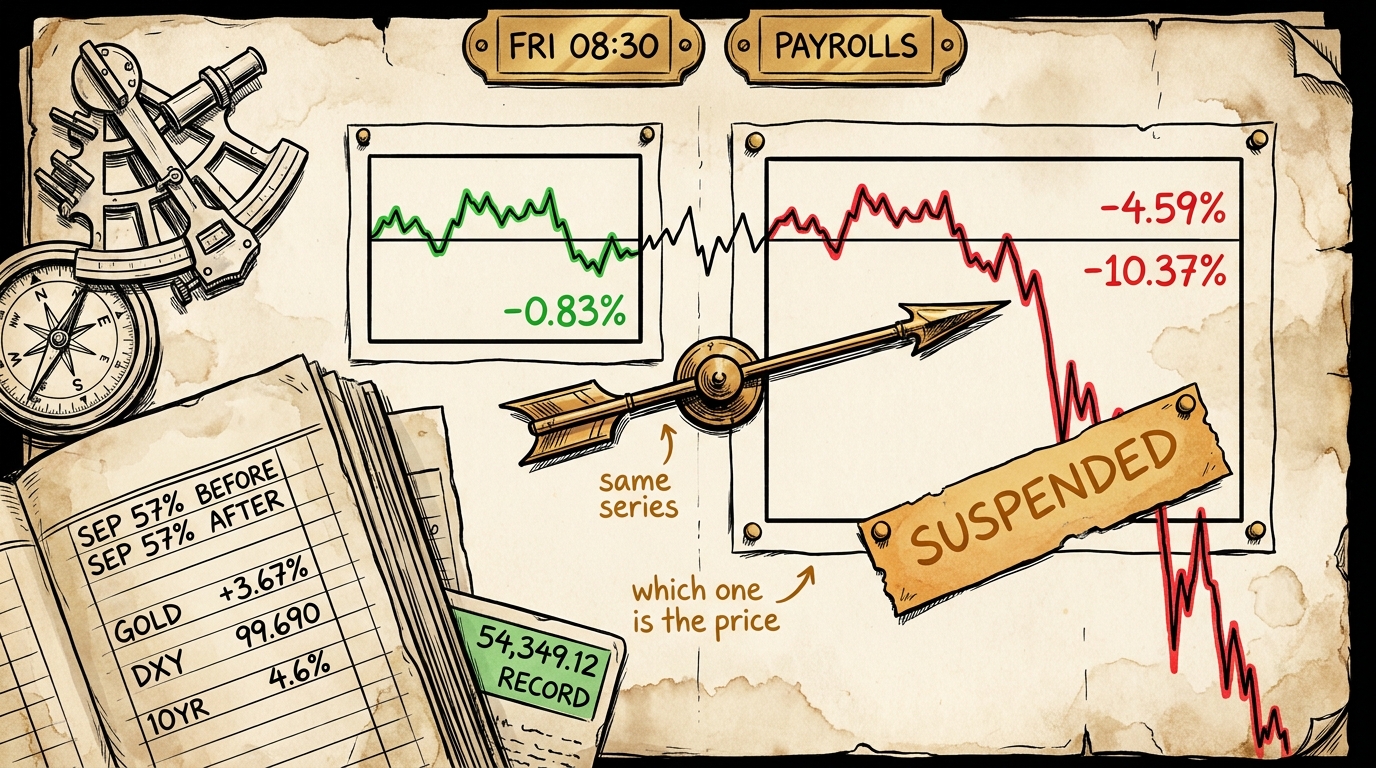
Then the odd part. The market’s actual pricing of the September Fed decision sat at roughly 57% before the release and roughly 57% after it. The surface reading is straightforward, and most desks would take it: soft data, dovish tape, nothing to see. Look a little deeper and it is stranger than that. The instruments that merely reflect the policy path all moved. The instrument that is the policy path did not move at all. And only the day before, a single unsigned sentence from the Treasury Secretary had moved that same number ten points.
The equity market did the identical thing in a different costume. The Nasdaq Composite fell 0.83%. New York treated that as a rounding error, rotated the money into healthcare and industrials, and printed a record Dow close of 54,349.12. Thirteen hours later Seoul read the same 0.83% and the Kospi closed down 4.59%, tripping the sidecar that suspends programme selling. SK Hynix lost 10.37%.
So the textbook expectation, twice over, is that the designated instrument carries the news and the proxies follow. The tape did the reverse. The proxies convulsed and the designated instrument absorbed. Gold moved 3.67% about a Fed decision that Fed pricing would not move on. Korea moved 4.59% about a chip session America priced at 0.83%.
There are two ways that gap closes, and they are not equivalent. Either the proxy is overreacting and hands the move back, which is the comfortable version, or the headline instrument is under-reacting and catches up later, which is not. One session cannot tell you which. The thing to watch is not the level of any of these prices but whether the gap between them narrows from the top or from the bottom.
July payrolls print Friday at 08:30. That is a real number, arriving into a front end that has just spent a session proving it does not move for real numbers.
Phil’s Musing
My lean, held loosely: the Korean move is the honest one and New York is the market doing the flattering arithmetic. A 4% float and a 900 million share unlock is what a market looks like when it has to price something properly. I would rather watch what breaks first than guess which of the two blinks.
Happy trading,
Phil
Less Brain, More Gain
…and may your trades be smoother than a cashmere codpiece
P.S. – Phils Footnote I went into Wednesday assuming a soft jobs number would show up in Fed pricing, because that is what I thought Fed pricing was for. It did not, and I do not fully understand why yet. My first instinct was that the market simply did not believe ADP, which is fair enough. But then gold moved 3.67% on it, and gold does not usually trade things nobody believes. So either the front end knows something the rest of the complex does not, or it has stopped being the place where this argument gets settled. I do not know which, and I would rather say so than tidy it up.
🗂 Desk Notes | Thursday, August 6, 2026
Raw briefing export. Observations, not trades.
Session read (§8.4)
SESSION BRIDGE: prior session (Wednesday 5 August) full reaction, Dow +0.49% to a record 54,349.12 on a fifth straight gain, S&P 500 -0.17% to 7,723.55 snapping a four-day run after setting a fresh high inside the first hour, Nasdaq Composite -0.83%, Russell 2000 -0.59%, with the overnight tail carrying the actual event as the Kospi closed -4.59% at 6,295.44 having fallen as much as 5% intraday and triggered its sidecar, Nikkei -0.93%, Hang Seng -1.8%; live premarket ES +0.11% / NQ -0.29%, VIX +0.38% at 15.86; threshold: SOFT.
Threshold note. On the cash number alone this reads none: an S&P move of -0.17% sits deep inside the normal envelope and would ordinarily leave the bridge silent. The trigger is the tail, not the bell. §8.4 requires the prior session be read as its full reaction including the overnight window, and that window contained an exchange-level trading intervention in a G20 market. A circuit breaker is a catalyst by definition, so the carry-over fires on the tail. Premarket at +0.11% ES sits inside the normal 0.3% band and is not itself abnormal, which is part of the point.
1. Mechanism read (full)
What moved.
- Front end: Tuesday’s constant maturity 2yr was 4.21%. Wednesday’s 2yr and 30yr constant maturity prints do not publish until Thursday 16:15 ET and are therefore not marked today. Same discipline applied on Parts 181 and 182.
- Long end: 10yr eased to about 4.6%, a third consecutive session lower, off an 18-month high of 4.75% set last week. Tuesday’s 10yr was 4.63%.
- Dollar: DXY 99.690, a third session lower and a second under the hundred handle. Wednesday’s close was 99.882.
- Vol: VIX closed 15.80, now 15.86. Fifth consecutive print below 18 and the lowest of the run (20.66 on 29 Jul, 17.08 on 30 Jul, 16.08 on 3 Aug, 16.04 on 4 Aug, 15.80 now).
- Gold: futures settled near $4,305.20, up about 3.67% on the session, now $4,313.40. Context that matters for proportion: this is well below the April peak near $4,722 and far below the January record above $5,300. A large move, not a new high.
- Crude: Brent $79.24. Traded $78.77 to $80.54 on Wednesday, the top of that range on the Houthi strike. WTI $75.40.
Data.
- ADP July private payrolls +44,000 against a 65,000 consensus, after +95,000 in June.
- ISM services 54.1 from 54.0. New orders 57.2 from 55.1. Supplier deliveries 52.8 from 54.4. Prices paid 70.3 from 67.7, which is the number in that release that is not cooling.
- S&P July services PMI 54.6 from 51.2; composite 54.5 from 51.9.
- EIA crude stocks +2.5m barrels to 407m against an expected 1.5m draw.
What it implies. The labour print was soft and the long end, the dollar and gold all traded it. September hike pricing did not: roughly 57% before the release and roughly 57% after, having already fallen from about 67% on Tuesday on a Treasury remark. So the instruments that are proxies for the policy path repriced, and the instrument that is the policy path did not. That is the second consecutive session in which the designated pricing mechanism sat still whilst its proxies moved, and the two sessions had opposite causes: Tuesday a remark with no data content moved the path ten points and Wednesday a data release with no rhetorical content moved it nothing.
Note the ISM tension held lightly. Prices paid at 70.3 is not consistent with a cooling-inflation read, and it went almost entirely uncommented on. If the front end is unresponsive to labour data, that could be an attention story or it could be a rates market that has quietly decided services inflation caps how dovish it is allowed to get. Telling those apart needs more than one session.
The one artery. The same information is being priced at wildly different magnitudes depending on which venue is doing the pricing, and the venue that is supposed to carry the signal is the one sitting still. It showed up twice on Wednesday in unrelated asset classes. In rates, a real labour miss moved gold 3.67% and September pricing zero. In equities, a 0.83% Nasdaq decline moved New York almost nothing, printed a Dow record next door, and then arrived in Seoul as a 4.59% fall and an exchange-level halt with SK Hynix down 10.37%. Two instances, one shape: the headline instrument absorbs, the proxy convulses.
Carry-over (§10.6), fires. The noteworthy thing is not that Korea fell. It is that Korea had to be stopped. An exchange intervened in its own market over a session that Wall Street described as mixed. The gap between those two descriptions of the same information is the day’s actual content, and it is worth a backward glance in all three tiers.
2. Forward catalyst slate
- Today, Thursday 6 August. SpaceX first lock-up tranche expires: up to 911.5 million shares, roughly $116bn at recent prices, become eligible against a public float of about 4% to 5% of roughly 13 billion shares. Musk’s approximately 6.4bn shares stay locked to 12 June 2027. Full 180-day block expires 8 December. Stock already down about 43% from its peak and trading near its $135 IPO price. Largest single insider release on record by notional.
- Today, 08:30 ET. Weekly jobless claims; Q2 productivity and unit labour costs. Unit labour costs is the one to read against the ISM prices-paid print.
- Friday 7 August, 08:30 ET. July non-farm payrolls. The week’s decisive print, the terminal date of the Part 179 Amazon shot, and the second leg of the Part 182 shot’s falsifier.
- Hormuz, live and undated. Axios reports a 60-day interim US, Iran and Oman agreement to reopen the strait without tolls, inbound through Iranian territorial waters and outbound through Omani waters coordinated with Tehran. Washington was aiming to announce as early as Wednesday. Trump said more would be known within 48 hours. A formal announcement inside this window resolves the Part 180 shot directly.
- Houthi maritime embargo on Saudi ports and vessels, declared alongside the strike on the tanker Wafa off Yanbu. Second theatre, separate from Hormuz, and currently uncounted in the Hormuz cycle.
- 17 August. Alibaba earnings, carried from the China open-weight thread.
3. Divergence flags
- VIX at 15.80 into a foreign circuit breaker. A volatility index printing its lowest level of the run on the eve of an exchange-level halt in a major market. Either the halt is genuinely local and irrelevant to US risk, or US vol is not pricing the transmission channel. Both readings are available; the second is the one that would matter.
- Gold +3.67% on a peace-deal session. Textbook says an imminent de-escalation and a three-week low in crude reduce the crisis premium in gold. Gold added 3.67%. The available explanation is that gold traded the softer dollar and the cooler labour print rather than the war, which would mean gold is currently a rates instrument wearing a geopolitical costume. Worth watching whether it holds that character if the Hormuz deal is actually signed.
- September pricing unresponsive to labour data two sessions after being highly responsive to a remark. Logged as the Part 182 shot’s first mark. The divergence is between the front end and every other instrument that claims to track it.
- Kosdaq +0.26% whilst the Kospi fell 4.59%. The small-cap index went the other way on the day the large-cap index halted. That is a concentration signal, not a market-wide risk signal, and it argues the Korean move is a memory-complex event rather than a Korea event.
- Bitcoin flat through both narratives. BTC +0.26% across a record Dow close and a Korean halt. The ETF flow picture also flipped: bitcoin funds have now logged zero net outflow days in August whilst ether products shed $30.4m over seven days, exactly reversing last week’s rotation.
- The index split has not become a factor. The Dow made a record whilst the Nasdaq fell 0.83%. That is the earnings-composition thread finally propagating from single names to indices, which the 5 August entry noted had not yet happened. One session is not a factor. Two would be.
4. Part C regime tracking (mirrors the ledger)
- ⚓ Weathervane: carried unchanged, third consecutive confirmation. The banner claims attention rather than risk is what reprices. Wednesday ran the test in the cleanest possible form: information with no rhetoric attached moved the policy path nothing, one session after rhetoric with no information attached moved it ten points. Next rewrite candidate remains not before Monday 17 August unless the Regime Flag hardens.
- ⚓ REGIME FLAG (Korea / memory-complex transmission, NEW, SOFT). Raised today. Fourth outsized move in this thread’s window and the second requiring an exchange intervention: 5.13% down on 3 August, roughly 4% up on 4 August, 4.59% down today with the sidecar tripped. A market that needs its own circuit breakers twice in four sessions has broken the pattern it held. Honest caveat stated rather than buried: this may be measuring volatility rather than regime, and a concentrated index doing concentrated things is not by itself a macro signal. Candidate for a special report only if a US instrument starts carrying the same amplitude.
- ⚓ REGIME FLAG (duration, SOFT): carried, not marked today. Wednesday’s 30yr constant maturity is unpublished until 16:15 ET. The 10yr eased for a third session, which is the wrong direction for the flag. The respec recommendation logged 3 August still stands and still awaits Phil: replace the three level conditions with one transmission condition, a five-session window in which the 30yr holds above 5.15% and the S&P fails to make a new closing high.
- ⚓ REGIME FLAG (chipflation supply side, SOFT): carried, unchanged. Falsifiable version remains contract DRAM pricing for Q4 2026 and Q1 2027. Today’s Korean move is a price event in memory equities, not a memory price, and does not count as evidence here. Noting the Part 169 conflation error deliberately.
- Vol regime: SPIKE-AND-REVERT, revert leg extended to five sessions. 15.80 is the lowest print of the run. Closer to restored compression than to broken. Classification still waits for payrolls, now one session away.
- Sensitivity read (§17.3): HIGH-TIGHT, hold at yellow. Sixth consecutive occasion the tight setting has been vindicated. Today the setting is doing visible work in the other direction too: it is why the Korea flag goes up as soft rather than hard, and why the caveat above is stated rather than hedged. No change recommended. The useful lever remains the duration condition respec.
- Public tell: NOT triggered. “Hoist the mainsail, the macro winds have changed” stays holstered.
Desk Notes are observations, not positions. No trade is named here by design (§10.3).