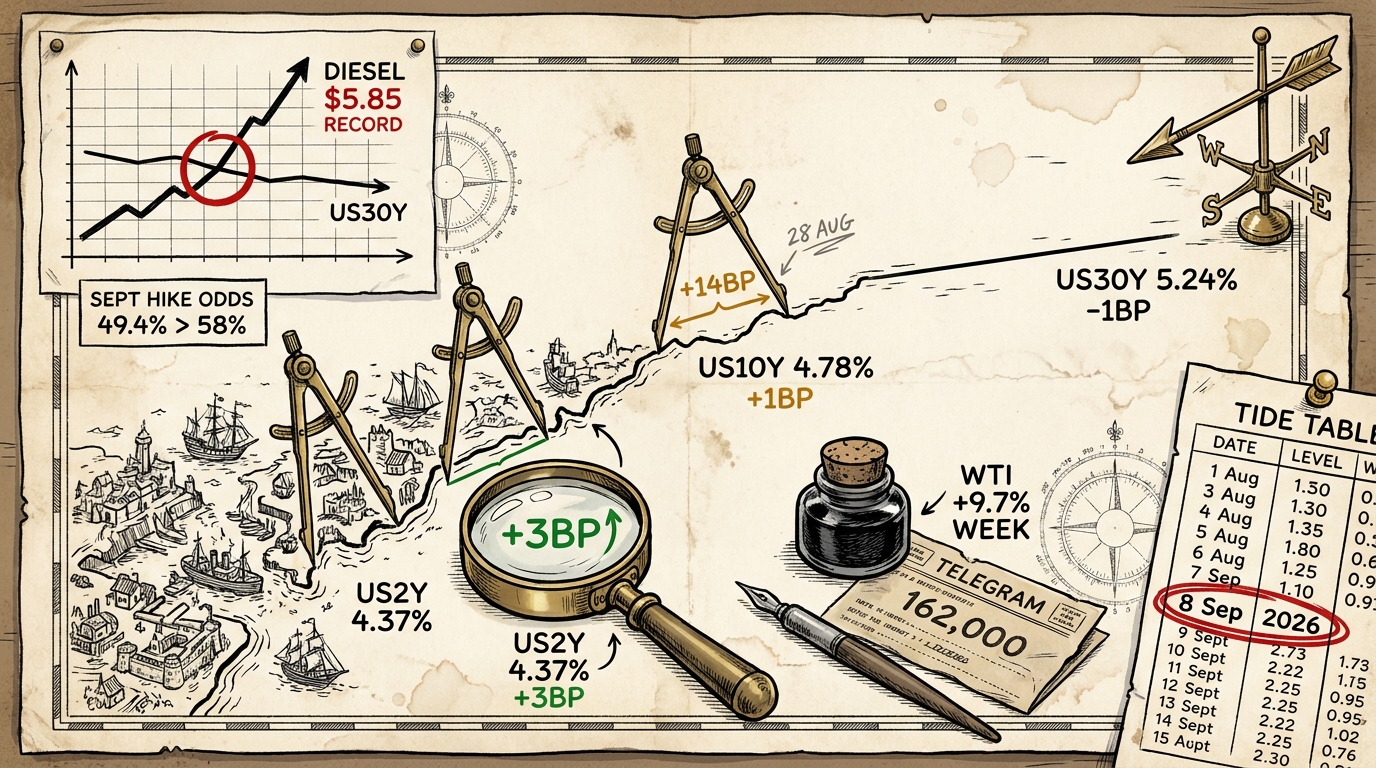
What a two-year Treasury actually prices, and why Friday might not have been the repricing everyone called it.
⚓ Weathervane. The wind is still coming from the long end. The policy rate has sat at 3.50% to 3.75% since July whilst the term premium does the tightening, and the price of long money is being set by deficits, issuance supply and a global duration bid rather than by the committee. Friday nudged this and did not turn it. The heading stands.
 Ahoy there, Trader! ⚓️
It’s Phil…
Should eight and a half points of hike probability be worth only three basis points on the two-year?
Most desks read Friday the obvious way, and it is worth saying that the obvious way is usually right. August payrolls came in at 162,000 against roughly 53,000 expected. Unemployment held at 4.1%. June and July were revised up by a combined 55,000, which turned July from a month the economy was reported to have lost jobs into a month it gained them. The probability of a rate rise at next week’s meeting went from 49.4% to 58%. The word most of the coverage reached for was monster.
Here is what the Treasury’s own constant maturity series recorded that afternoon. The two-year closed at 4.37%, up three basis points. The ten-year closed at 4.78%, up one. The thirty-year closed at 5.24%, down one.
The surface reading is that the bond market shrugged, and there is a genuinely damning comparison available if you want it. On 28 August that same two-year series moved fourteen basis points, from 4.20% to 4.34%, because the Fed chair gave a keynote. Fourteen for a man speaking. Three for 162,000 people finding work.
That comparison is satisfying and it might be wrong, which is the part worth sitting with. A single-meeting probability and a two-year yield are not the same instrument measured at different volumes. They are different instruments over different horizons. Pulling one 25bp move forward by a few months, whilst adding nothing to where rates end up two years out, genuinely is worth only a handful of basis points on a two-year note. On that arithmetic the curve did not shrug at all. It did the sum correctly, and the error belongs to every headline that called Friday a repricing of the path.
The textbook expectation is that a labour surprise of this size lifts the whole front end, because strong employment is a growth signal and a growth signal is an inflation signal. What the tape delivered instead was three basis points at the front and minus one at the back. That combination is not a growth repricing in any form. It describes a market that thinks one meeting has become live whilst the destination is unchanged, or has quietly moved slightly lower.
The commodity complication makes it stranger rather than clearer. The most visible price rise anywhere in the economy last week was diesel, which set a record at $5.85 a gallon nationally and $7.70 in California as the wars in Ukraine and Iran removed refining capacity. Crude rose 9.7% on the week. The thirty-year yield fell on the day the diesel record printed. Whatever the long end is pricing, it is not this.
The thing that would separate the two readings is a dated Federal Reserve communication landing on a comparable surprise. The blackout has been in force since 5 September, so we will not get one before the decision on 16 September. Both readings survive the week intact, which is honest and mildly infuriating.
Phil’s Musing
The lean I hold is that the front end is not asleep, it is just answering a narrower question than the headlines assume. A two-year yield prices two years. A meeting probability prices one Wednesday. We keep asking one to confirm the other and then treating the mismatch as a scandal. What I would want before calling anything a regime change is the long end. Diesel at a record and the thirty-year falling is the anomaly that actually matters here, and it points back at the Weathervane rather than away from it.
Happy trading,
Phil
Less Brain, More Gain
…and may your trades be smoother than a cashmere codpiece
P.S. – Phils Footnote I spent Friday morning fully prepared to write that the Fed had been forced, because the wire quote in front of me said the two-year had risen more than four basis points and I took that at face value. Then I pulled Treasury’s own series and found three, and worked out that the wire figure was an intraday high rather than a close. I had a paragraph built before I checked the number it stood on. Wall Street often says the bond market is the smart money in the room. Possibly. It is definitely the quiet one, and quiet is much harder to read than loud.