The Nasdaq 100 lost 6.4% and the VIX hit 28.2 on Thursday; December Nasdaq futures were 0.95% higher at 08:15 UTC
 Ahoy there, Trader! ⚓️
It’s Phil…
On Wednesday the market celebrated the midterms. On Thursday it read the small print.
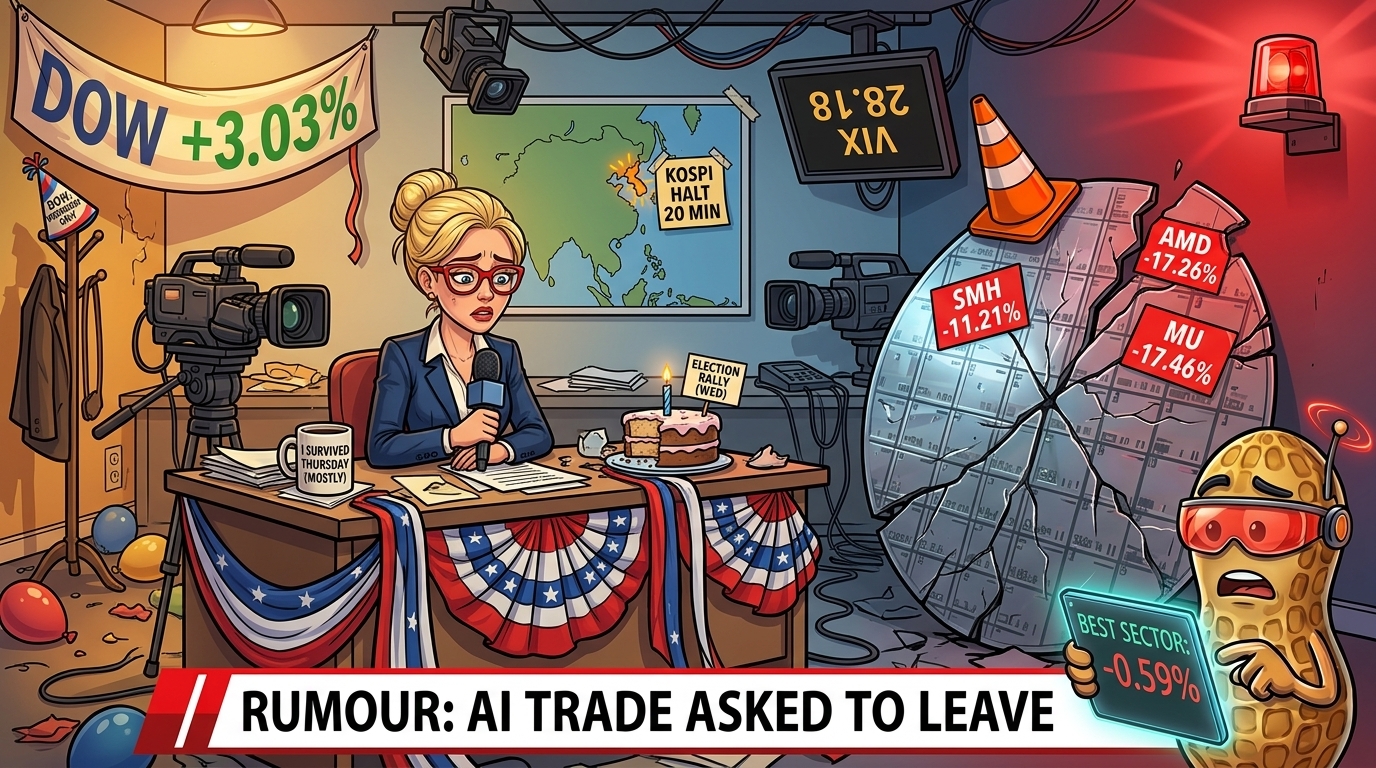
The chip fund SMH fell 11.21%. Its cousin SOXX fell 12.15%. AMD fell 17.26%, Micron 17.46%, Sandisk 22.26%, Nvidia 9.26%. The technology sector proxy lost 8.00% in a session. These are not the moves of a sector having a bad day. They are the moves of a sector being asked to leave.
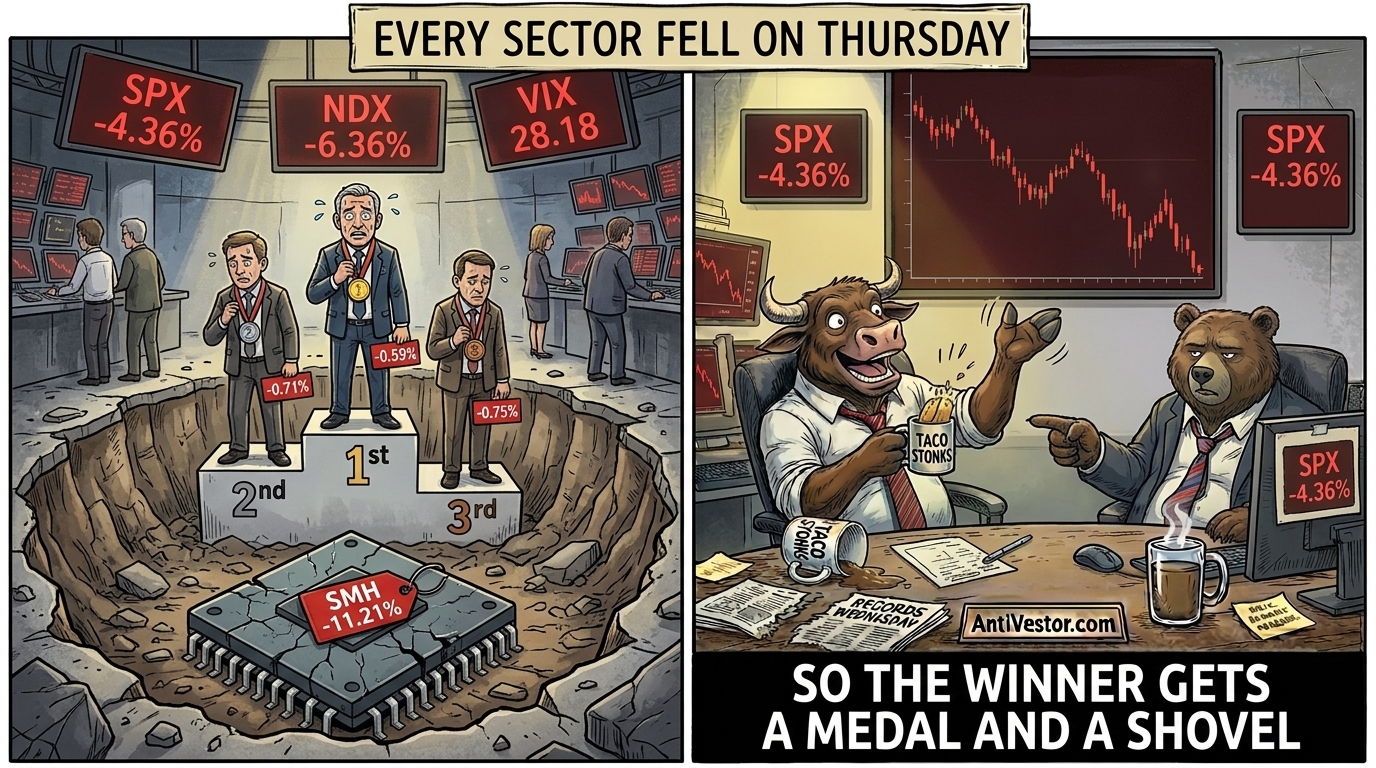
Then everybody else. The Nasdaq 100 fell 6.36% to 26,629.81, a loss of 1,807.36 points. The S&P 500 fell 4.36% to 7,353.73. The Dow fell 3.44% to 51,523.06, which puts it about 264 points below where it closed on election day. Wednesday’s 3.03% rally lasted one session and then asked for a refund. No SPDR sector fund closed higher. The best of them was communication services, down 0.59%, which on Thursday counted as a lap of honour. On the NYSE, 2,276 issues fell and 393 rose.
So the one number that mattered today is SMH down 11.21%, because the indices moved in its direction at a fraction of its size.
Now the why, and the clock. The S&P 500 opened 0.13% lower. The opening gap carried 3.0% of its fall; the other 97.0% arrived during the session. For the Nasdaq 100 it was 19.9% at the open and 80.1% after. By the close the desks had three explanations, and they are worth hearing, labelled as explanations: a Democratic Congress makes the data-centre buildout slower and dearer; hedge funds de-grossing their most crowded winners while retail sold; and plain doubt about the return on all that AI spending. The quotes came late, the earliest at 19:03 UTC. The news behind the data-centre reading did not: UBS’s estimate of data-centre capacity at risk ran on Reuters at 11:21 UTC, three hours before the bell, and the chips sold it at once, with SOXX opening 4.70% lower. The rest of the market had the same news for hours and did nothing with it until 14:30 UTC. What changed at the open was not the news. It was the clock. So the news can explain the chips. It cannot explain why the index waited, and this book names nothing as the cause of the 4.36%.
Thursday’s edition set two tests on Thursday’s cash close. Qualcomm, below 173.19: it closed at 156.75, down 9.49%. AppLovin, above 271.75: it closed at 356.10, up 31.04%. Two hits. The book’s record on named causes now stands at 15 hits and 7 misses. And a correction: Thursday’s edition said Mississippi’s Democrat led by 65 votes. No count we can find carries that figure. Thursday’s counts put the lead at between 1,138 and 1,818.
The VIX rose 69.66% to 28.18 and closed above its three-month cousin, VIX3M, at 25.55. The 2-year yield fell 12bp. High yield fell 0.31%. Hold those three numbers side by side and the question writes itself.
Payrolls print at 13:30 UTC, before the opening bell, which is when the chips find out whether the economy is coming to the rescue or joining the queue.
The One That Mattered
SMH lost 11.21% and dragged the Nasdaq 100 down 6.36% with it. The volatility index went to 28.18 and turned its curve upside down. And the 2-year yield fell 12bp, which is either a growth worry or money hiding at the short end. Credit, meanwhile, barely moved. Those cannot both be the whole story. When chips fall 11.2% and the 2-year yield falls 12bp on the same day, is the market pricing an AI problem or a growth problem? We have not settled it here. We took it apart in today’s Macro Edge.
Hot News: The AI Rout Goes Global, and Congress Gets Its Totals
The Chip Sell-Off Reached Asia Overnight. The House Count Reached 253. What is new since Thursday morning, and what is still not known
The AI and tech rout escalated from a sector story into the market story. Asia sold chips too: Japan’s Nikkei fell sharply at Friday’s open and Korea’s Kospi fell far enough to trip a 20-minute trading halt, on AP’s report, with SK Hynix, Samsung and TSMC among the casualties; Taiwan closed lower. Micron reportedly paused a Taiwan plant over a labour dispute, and Anthropic’s planned listing is reportedly under investor scrutiny. The data-centre reading is the one the wires are running with; whether any actual restriction follows is not known, and nothing in Congress changes before January. Nvidia reports on 17 November, which is when this argument gets a number of its own.
On the midterms, Democrats hold at least 54 Senate seats; AP counts 253 Democratic House seats and CBS projects 251 to 268. Hakeem Jeffries is running for Speaker unopposed. Mississippi’s Senate race is uncalled, with the Democratic lead between 1,138 and 1,818 votes depending on whose count you read. Alaska cannot run its ranked-choice count until about 18 November. President Trump blamed the “Dumocrats” for the fall in 401(k)s, which is a novel use of a midterm result.
On Iran, the New York Times reported Iran weighing concrete Qatari proposals. Nobody has accepted anything, no talks date is set, and President Trump says he will decide soon whether to go further. A tanker was hit north of Qatar on Thursday. Separately, January Brent rose 3.88%; this book holds no stamp tying the two.
Our Top Trader Uses This 9:50 AM Secret to Target $500 Per Day Regardless Of Which Direction The Market Moves https://antivestor.com/ppp-webinar
Special Report: Thursday, Minute by Minute
The Chips Read the News at Breakfast. Everyone Else Waited for the Bell. A summary of Thursday’s special report, now scored against the close
Thursday got its own report while it was still happening, and the close has now marked it. Three findings stand. The order: the chips sold before the open, SOXX down 4.70% at its first print, and the rest of the market sold after it, with December S&P futures closing lower in 16 of the 17 five-minute bars between the open and the morning low. No crash candle, no headline spike. A queue. The news was early: the data-centre warnings, Qualcomm’s forecast and Micron’s Taiwan pause were all public before the bell. And the fear stayed in stocks: the VIX curve inverted while bond volatility and high yield barely flinched.
The report set three tests at lunchtime. The close failed two of them: there was no half-recovery, and the VIX curve finished inverted at 1.10. It passed the third: high yield stayed within 1% of Wednesday’s close.
The full clock, what the market blamed and what this book declined to blame, is in the deep dive: https://antivestor.com/news-edge-05-nov-2026
Overnight Excitement
December Nasdaq Futures Swung Both Ways by Up to 1.5%. Dow Futures Were Lower at Both Reads. The section fires on the futures and leads on the range: 1.44% below settlement at the low, 1.52% above at the high
December Nasdaq 100 futures spent the night trading a range of 2.96 percentage points around Thursday’s 26,752 settlement: 1.44% below it at the low, 1.52% above it at the high. At the 07:45 UTC capture they were 1.05% higher at 27,032.25, and at the 08:15 UTC bar 0.95% higher at 27,005.75.
The Dow went the other way. December Dow futures were 1.03% lower at the capture and 0.91% lower at 08:15 UTC. December S&P futures were up 0.04% at the capture and up 0.09% at 08:15 UTC, which is the arithmetic of a tech bounce sitting on top of a Dow that is still lower.
Asia sold chips too: Korea halted trading, Japan fell sharply, Taiwan closed lower, on AP’s and Reuters’ reports. After the US close, Cloudflare rose 16.51% in extended trading after its 21:15 UTC release, and Airbnb 11.0% after 21:03 UTC, whilst Atlassian fell 17.62% and Axon 11.94%. Those are causes for those shares. This book holds no stamp that explains the index split, so it names none.
December WTI was 90.33 at the 08:15 UTC bar and spot gold 4,065.99.
Stock Market Edge
Chips Fell 11%, the Index Fell 4%, and the Winner Fell 0.6% December Nasdaq 100 futures 0.95% higher, December Dow futures 0.91% lower at the 08:15 UTC bar
Premarket snapshot:
At the 07:45 to 07:50 UTC capture, December S&P 500 futures stood at 7,386, 0.04% above Thursday’s 7,383 settlement. December Nasdaq 100 futures were 1.05% higher at 27,032.25 against 26,752. December Dow futures were 1.03% lower at 51,085 and December Russell 2000 futures 0.24% lower at 2,728.7. At the 08:15 UTC bar the four contracts read 7,389.75, 27,005.75, 51,143 and 2,732.5. The VIX has no global-hours print; it closed Thursday at 28.18. The Nasdaq contract has had a lie-down and feels better. The Dow contract has not been told.
Sector rotation:
Technology fell 8.00%, industrials 4.12%, consumer discretionary 3.83%, energy 2.98%, materials 2.91% and financials 2.87%. Health care lost 2.5% and real estate 1.82%. Staples fell 0.75%, utilities 0.71% and communication services 0.59%. The spread from best to worst was 7.41 points. Inside the chips, memory, storage and optical names took the worst of it: Sandisk down 22.26%, Lumentum 18.68%, Micron 17.46%, Western Digital 17.35%. Intel fell 10.33%. Bloom Energy fell 16.41%. The chips fell out of bed and the power names came down the stairs after them.
Earnings or guidance:
Qualcomm fell 9.49% to 156.75 on its outlook and AppLovin rose 31.04% to 356.10 on its quarter, the biggest riser this book checked. After Thursday’s close, Cloudflare rose 16.51% and JFrog 20.61% in extended trading; Airbnb added 11.0%. Atlassian fell 17.62%, Five9 16.14%, Axon 11.94%, Affirm 10.55% and Lyft 9.19%. DraftKings fell sharply after cutting its outlook; the size is not settled between sources, so it is not printed. Moderna, Humana and Enbridge report before today’s open.
Cross-asset nuance:
The 2-year yield fell 12bp to 4.46% and the 10-year 6bp to 4.84%; the 30-year fell 3bp to 5.25% and 2s10s widened to 38bp. The 20-year held the top of the curve at 5.27%. The VIX rose 69.66% to 28.18 against VIX3M at 25.55, a ratio of 1.10. Bond volatility, the MOVE index, rose 4.3%. High yield fell 0.31%, LQD rose 0.15% and TLT 0.21%. The dollar index added 0.07%. December WTI settled at 90.52, up 2.72%, and January Brent at 98.29. Spot gold rose 0.65% to 4,087.36. The Bank of England raised Bank Rate to 4.00%. Equities panicked, bonds rallied and credit shrugged, three markets reading one Thursday.
Crypto Market Edge
Bitcoin Remembered It Trades With the Nasdaq Ether fell 7.7%; liquidations passed $1bn; the flow tables stayed shut
Price snapshot:
Bitcoin stood at 76,010.12 on the Friday 00:00 UTC mark, down 5.46%, and at 75,599.89 at the 08:15 UTC bar. Ether stood at 2,235.77, down 7.67%, and at 2,228.03 at the same bar. Coinbase and the composite feed agreed within 0.1%.
Flows and positioning:
Farside’s bitcoin page errored three times, a fourth session without a table; its ether page loads but stops at 23 October. This book publishes no flow figure for the week. The Block counted more than $1bn of crypto liquidations as bitcoin gave back its post-election gain.
Leadership and rotation:
Ether fell further than bitcoin, on a day it had beaten bitcoin upwards the session before. On Stocktwits’ crypto-only board at 07:30 UTC, depth 25, 24 of the 25 names were lower. The crowd turned up. It just turned up in red.
Catalysts and roadmap:
Anchorage has applied for CFTC swap-dealer registration. Payrolls at 13:30 UTC, Michigan sentiment at 15:00 UTC and Governor Bowman at 17:15 UTC.
TL;DR
- SMH fell 11.21% and SOXX 12.15% on Thursday as the AI trade broke; AMD lost 17.26% and Micron 17.46%, and no sector fund closed higher.
- The S&P 500 fell 4.36% and the Nasdaq 100 6.36%; the Dow closed below its pre-election level, one session after a 3.03% rally.
- The data-centre news was public by 11:21 UTC and the chips sold it before the bell; 97.0% of the S&P 500’s fall still came after the open.
- The VIX hit 28.18 and closed above VIX3M while the 2-year yield fell 12bp and high yield slipped only 0.31%: equities panicked, credit did not.
- December Nasdaq futures were 0.95% higher and Dow futures 0.91% lower at 08:15 UTC, after Asia sold chips overnight; payrolls print at 13:30 UTC.
Fun Fact
The Semiconductor Index Began at 200 It was launched in December 1993
The PHLX Semiconductor Index, the benchmark for the chip trade, was launched in December 1993 with a base value of 200. It has since learned to move more than that in a week.
Meme of the Day:
Happy trading,
Phil
Less Brain, More Gain
…and may your trades be smoother than a cashmere codpiece
p.s. There are 3 ways I can help you…
- Option 1: Collect Morning Income
A complete guide to the Premium Popper system.
Written to be clear, concise, and immediately actionable.
>> Learn More Here
- Option 2: Collect Weekly Income
A complete guide to the Tag ‘n Turn system.
>> Learn More Here
- Option 3: Join the Fast Forward Mentorship
>> Join the Fast Forward Mentorship – trade live, twice a week, with me and the crew.
PLUS Monthly on-demand 1-2-1’s
No fluff. Just profits, Tag ‘n Turn Pulse bars, Poppers, and Patterns that actually work.