Why “wait for all three timeframes to align” is the slowest, most expensive entry signal in trading. And what to do instead.
 Ahoy there, Trader! ⚓️
It’s Phil…
There’s a piece of advice in trading education that gets repeated so often it’s basically scripture.
Look at three timeframes. Daily, 4-hour, 60-minute. Wait until they all show the same thing. Then take the trade.
It’s in books. It’s in courses. It’s all over YouTube. It’s in the bonus chapter of one of the most-recommended trading psychology titles ever written, authored by someone who, with respect, was a therapist to traders rather than a trader himself.
And it’s wrong.
Or, to be more precise: it works, just not in time to be useful.
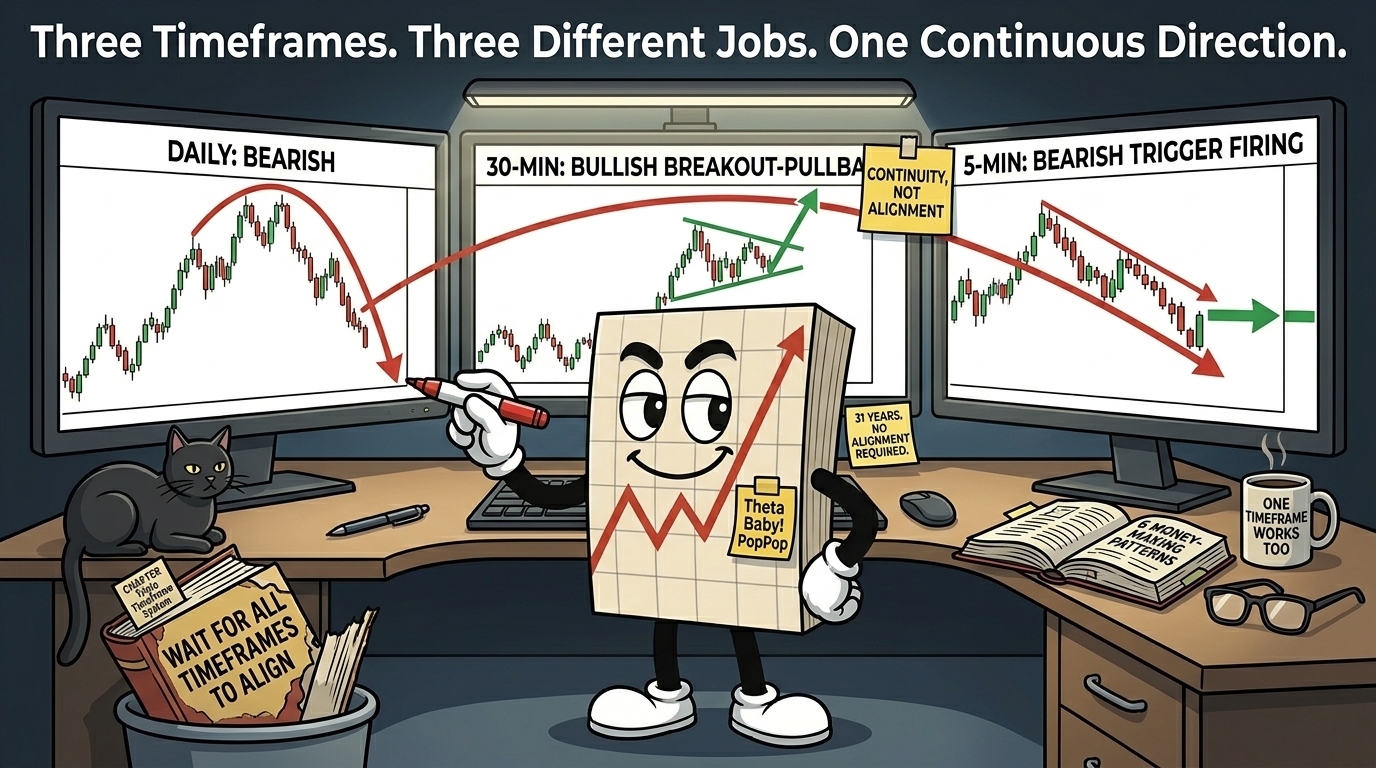
Get The Complete Premium Popper System – Automation Included
Your entry ticket to consistent SPX income. Inside: the exact setup, rules, and checklists I trade daily – for less than the cost of lunch. Easily actionable.
Get The Premium Popper System – Click Here

The Problem With Waiting For Alignment
Here’s what actually happens when you wait for three timeframes to all show the same direction.
You start with the daily. That’s your big picture, your candidate trend. Bullish, let’s say. So far, so sensible.
Then you want the 60-minute to agree. Then the 5-minute. Three bullish charts. Permission granted, take the trade.
Sounds disciplined. It isn’t. It’s a delay mechanism dressed up as patience.
For all three timeframes to show the same direction at the same time, the move has to be old enough and strong enough that even the noisiest, lowest timeframe has run out of counter-moves. That doesn’t happen at the start of trends. That happens in the middle. Often near the end. By the time your lower timeframes have stopped throwing pullbacks and counter-rallies, the move has been running for hours. Sometimes days.
You waited for unanimous agreement. You paid the price of admission for that agreement. The price was the meat of the move.
And here’s what most people miss: this problem is fractal.
Whatever combination of timeframes you pick, weekly / daily / 60-min, or daily / 60-min / 15-min, or 4-hour / 30-min / 5-min, the same dynamic plays out. There is always conflict between timeframes. Clean three-timeframe alignment is rare. When it does occur, it tends to mark exhaustion rather than opportunity.
You’re not going to fix this by switching to a different combo. The problem isn’t your timeframes. It’s the mental model.
I’ve got a 31-year trading career behind me and I can tell you that “wait for all three to align” has cost more opportunity losses than almost any other piece of well-meaning advice in this industry. The reason it’s well-meaning is because it sounds like prudence. It sounds like patience. It sounds like the disciplined thing to do.
It’s actually the opposite. It’s a permission slip your charts will only hand you when the move has already happened.
And don’t think the modern alternatives fix this either. The whole liquidity-sweep, fair-value-gap, break-of-structure circus, pushed loudest by a YouTube personality whose legal track record is now more interesting than his trading record, runs on the exact same broken premise dressed up in fancier jargon. Different vocabulary. Same trap. With the added insult of being so unnecessarily complicated that beginners spend more time decoding the language than reading the chart.
What Actually Works: Continuity, Not Alignment
The fix is one word. Continuity.
You don’t need three timeframes to show the same pattern. You need three timeframes to show continuity of direction with your big picture thesis.
That’s a very different thing.
When all three timeframes show the same pattern, the move is over. When all three timeframes show continuity with your big picture, the move is just getting started, and you’ve got a layered set of opportunities to enter.
The way to think about it is that each timeframe has a different job. Not the same job repeated three times. Three different jobs.
The Three Jobs
Forget “confirm, confirm, confirm.” Use thesis, refine, trigger.
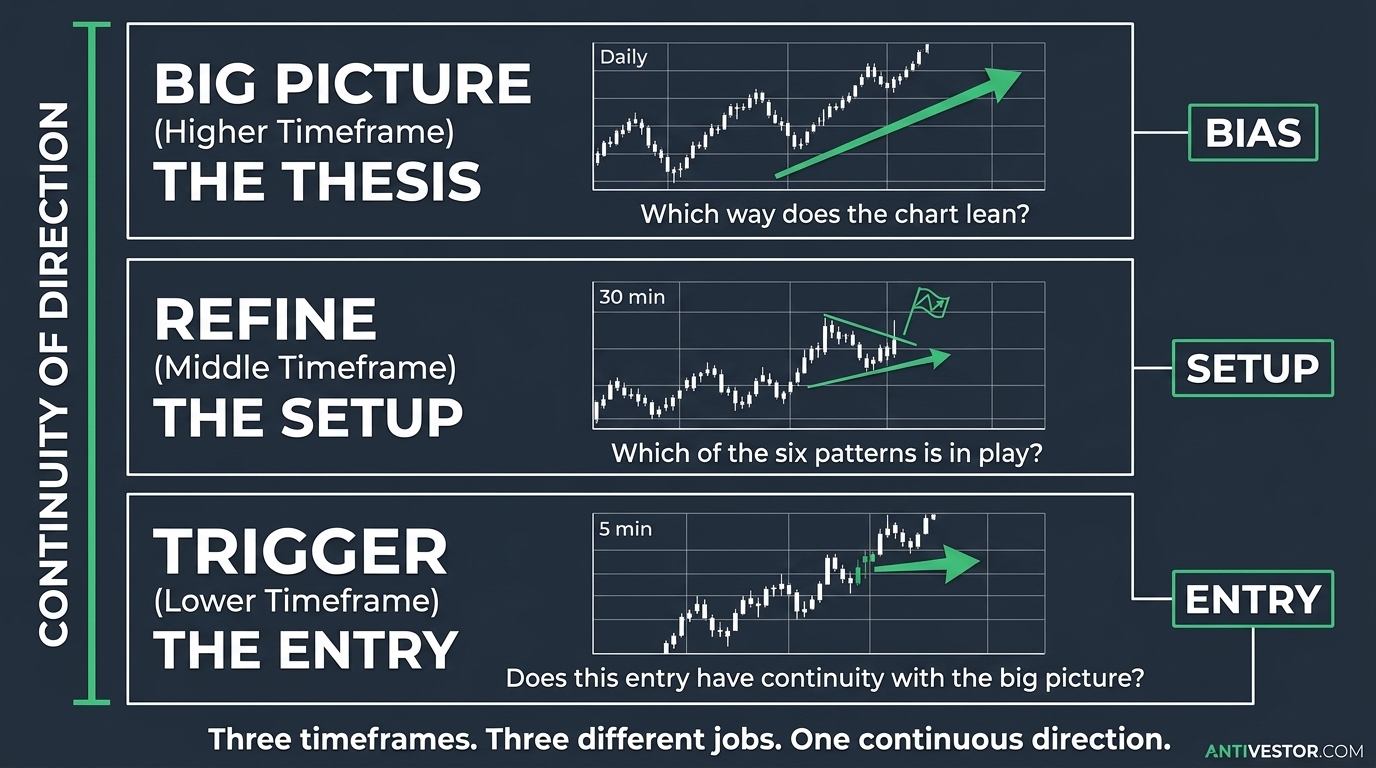
Big Picture (Higher Timeframe) — The Thesis
This is your directional anchor. On the daily chart, where is the market? Trending up? Trending down? Sideways inside a range? Sat at an inflection point?
You’re not looking for a setup here. You’re answering one question: where are we now, and which way does the chart lean?
This is your bias. Bullish, bearish, or neutral. That’s it. The big picture doesn’t tell you where to enter. It tells you which direction your entries should lean.
Refine (Middle Timeframe) — The Setup
On the 4-hr, or 60-minute, or whatever sits a step below your big picture, you’re looking for the actual setup. The breakout. The pullback. The break-back-in. The pattern that fits the big-picture bias.
This is the timeframe where the trade idea takes shape.
Trigger (Lower Timeframe) — The Entry
The 5-minute is where the trade actually fires. The trigger.
Here’s the part most multi-timeframe teaching gets wrong: the trigger doesn’t need to look like the setup. It doesn’t need to look like the big picture. It just needs to be a valid entry that has continuity with the bias above it.
A bit of honesty here. I think a third timeframe is overkill. Two-timeframe analysis works perfectly well. Big picture plus setup. That’s enough for the vast majority of trades. The trigger timeframe is a refinement, not a requirement. But if you’re going to do three, this is how you do it.
Why Conflict Between Timeframes Is Normal, And Useful
Here’s the part that breaks most people, and the part that makes triple time frame analysis profitable when others find it impossible.
Your timeframes are going to disagree with each other. That’s fine.
Imagine this scenario.
Your daily chart is in a downtrend or topping out. Big picture: bearish.
You drop down to the 30-minute. The 30-minute is currently in a small range that’s just broken higher and is pulling back. By the rules of the setup, that’s a bullish breakout-pullback.
Big picture bearish. 30-minute bullish setup.
That’s “conflict,” in the language of orthodox multi-timeframe teaching. You’re supposed to wait. You’re supposed to skip the trade.
Now drop to the 5-minute. The 5-minute is rolling over. Lower highs, lower lows, looks like it wants to break the morning’s range to the downside.
So now you have:
- Daily: bearish
- 30-minute: bullish setup, not yet confirmed
- 5-minute: bearish setup, about to trigger
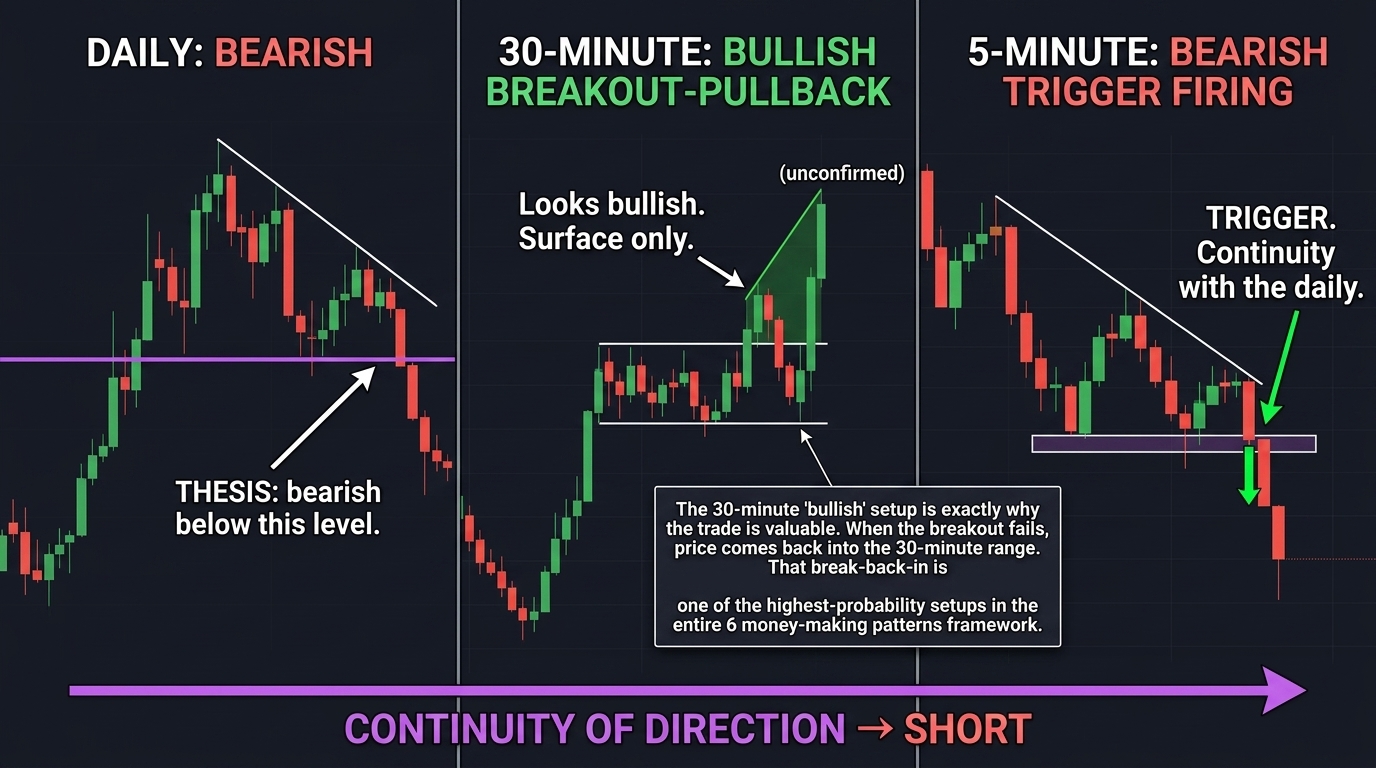
Three “different” readings. One coherent trade.
Take the 5-minute short. It has continuity with the daily. The fact that the 30-minute looks bullish on the surface is precisely why the trade is valuable. If that 30-minute breakout fails, which is what your big picture is telling you it will do, price comes back into the 30-minute range. That break-back-in is one of the highest-probability setups in the entire 6 money-making patterns framework.
You’ve taken the 5-minute trigger ahead of the 30-minute setup confirming. Both trades are continuous with the big picture. Neither requires the other to fire.
That’s triple time frame analysis. Three different timeframes, three different jobs, one continuous direction.
The Mental Model Shift
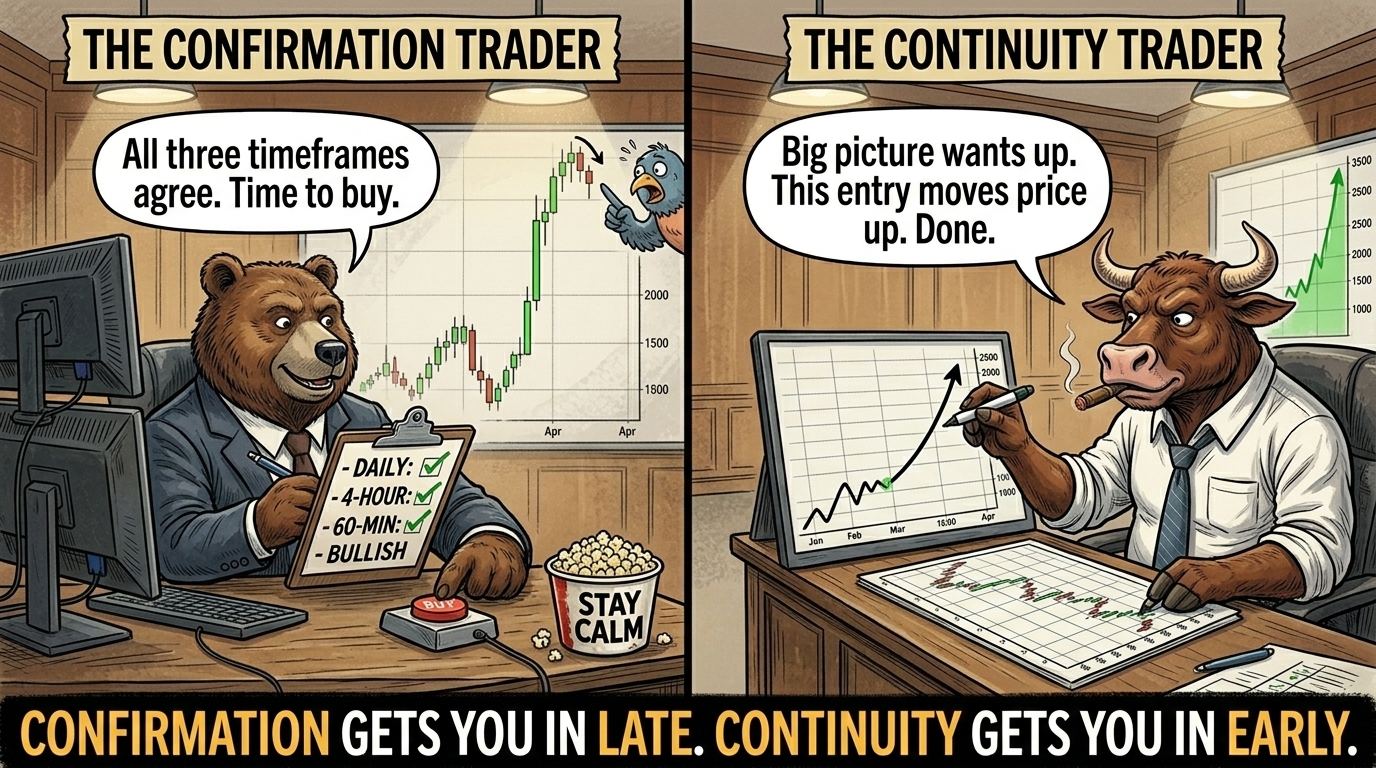
Most traders are taught to look for confirmation. Triple time frame done properly is about looking for continuity.
Confirmation asks: do these timeframes all agree?
Continuity asks: does this entry move price in the direction the big picture wants it to go?
The first question only gets a “yes” when you’re late.
The second question can get a “yes” while you’re still early.
That’s the difference. That’s the entire game.
How To Apply This Tomorrow
If you’ve been wrestling with multi-timeframe analysis, try this for a week.
1. Start with the daily. Write down a one-line big-picture bias. Bullish, bearish, or neutral inside a range. One line. That’s your thesis.
2. Drop to your setup timeframe. Find a setup that fits one of the six money-making patterns. Don’t worry whether the setup looks bullish or bearish on its own. Just identify which of the six patterns is in play.
3. Drop to your trigger timeframe, or use the setup timeframe as your trigger if you’re keeping it to two. Look for an entry that moves price in the direction of your big picture bias.
If the entry has continuity with the big picture, take it. If the setup timeframe disagrees with the big picture on the surface, that’s not a problem. It’s often the entire reason the trade is there.
You’re not looking for permission. You’re looking for direction.
The Bottom Line
Triple time frame analysis isn’t broken. The way it gets taught is broken.
Stop waiting for three timeframes to all show the same thing. By the time they do, the trade is gone. Start looking for continuity of direction across timeframes that each have a different job.
Big picture. Refine. Trigger.
Bias. Setup. Entry.
The conflict between timeframes is where the entries live.
If you want to see this applied to live markets every session, the daily Analysis Edge briefing walks through exactly how I read the big picture on SPX and Russell, identify the setup on the 30-minute, and trigger entries on the 5-minute. [LINK]
Happy trading,
Phil
Less Brain, More Gain
…and may your trades be smoother than a cashmere codpiece
p.s. There are 3 ways I can help you…
- Option 1: The SPX Income System Book (Just $12)
A complete guide to the system.
Written to be clear, concise, and immediately actionable.
>> Get the Book Here

- Option 2: Full Course + Software Access – 50% off for Regular Readers – Save $998.50
Includes the video walkthroughs, tools for TradeStation & TradingView, and everything I use daily. Plus 7 additional strategies
>> Get DIY Training & Software

- Option 3: Join the Fast Forward Mentorship – 50% off for Regular Readers – Save $3,000
>> Join the Fast Forward Mentorship – trade live, twice a week, with me and the crew. PLUS Monthly on-demand 1-2-1’s
No fluff. Just profits, pulse bars, and patterns that actually work.