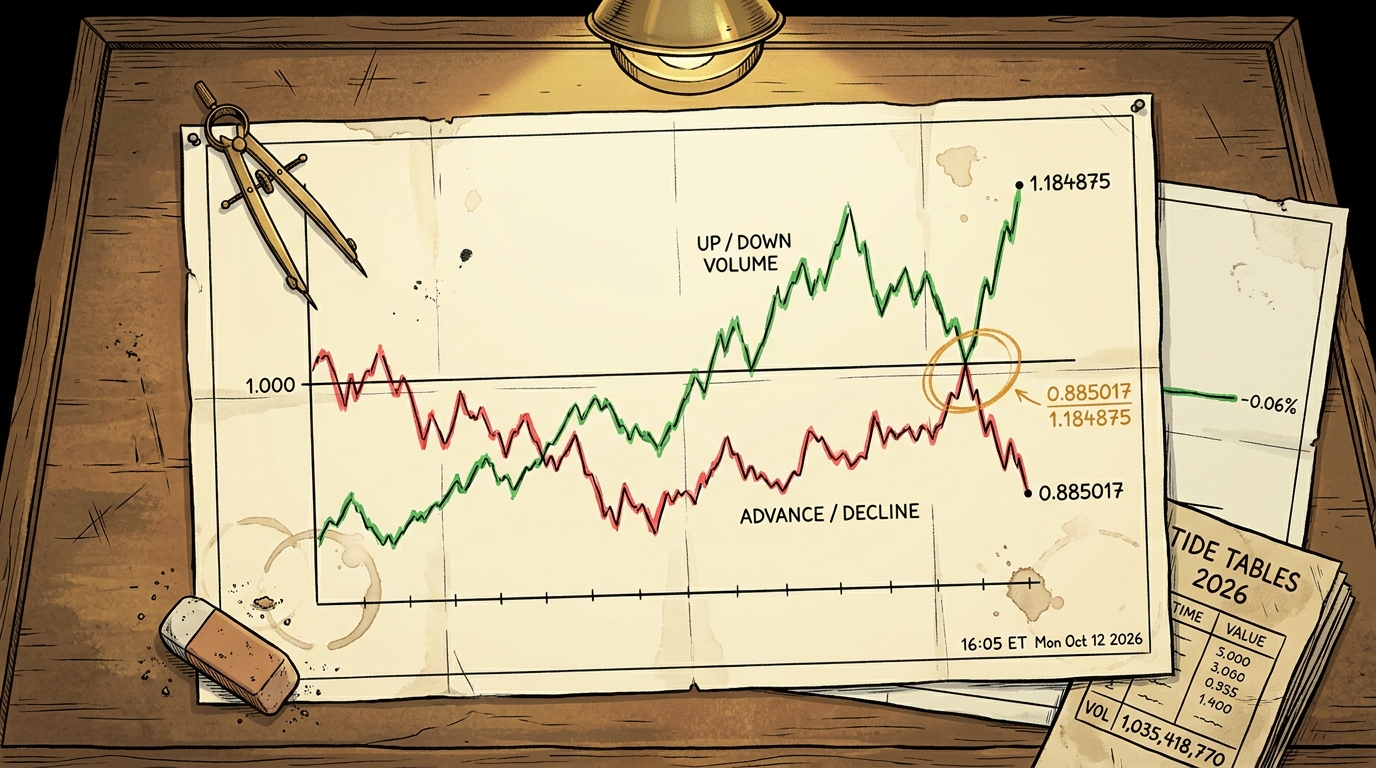
NYSE up volume beat down volume 1.18 to 1 on a session when advancing issues lost 0.89 to 1
⚓ Weathervane. The wind is coming from the long end. The policy rate has been frozen for most of the year whilst the term premium does the tightening, and the price of long money is set by deficits, issuance supply and a synchronised global duration bid rather than by the committee. Higher-for-longer stopped being a Fed decision and became a bond-market fact. The cruise ship is holding this heading.
 Ahoy there, Trader! ⚓️
It’s Phil…
Why did more volume go into the stocks that rose on a session when more stocks fell?
Monday was a holiday with the bond market shut and the stock market open, so the numbers will not reconcile on the surface. The S&P 500 moved 0.055047%. The Dow rose 195.60 points. The Nasdaq-100 fell 0.707347%. Eight of eleven sector proxies closed higher. And 4,409 issues fell against 3,202 that rose, on the lightest NYSE volume of the eighteen sessions we hold.
Most desks will reconcile that with one word: weight. Technology fell 1.217426%, last of eleven, and technology is heavy, so a cap-weighted index can fall whilst most of its constituents rise. Correct, and not the interesting part.
The interesting part is the second pair of lines. On the NYSE, advancing issues lost to decliners 0.885017 to 1 whilst up volume beat down volume 1.184875 to 1. On the Nasdaq those same two measures agreed with each other, 0.649630 and 0.685669, both negative.
Breadth and volume are meant to be two instruments measuring one thing, participation. When the advance-decline line falls, up volume is supposed to fall with it, because the stocks going down are where the selling is. A session where the two cross is one where participation and money have come apart.
What that mechanically requires is that the shares changing hands concentrated into a small number of large, rising names whilst the long tail drifted lower on very little. That is not selling. Selling needs volume on the downside, and the downside did not get it. It is money arriving with a short shopping list.
Whether that is positioning or conviction we cannot say, and the honest reason is that a thin tape flatters any reading. But it has a settling condition and it arrives today. If the same divergence appears on a full-volume session with four bank prints in it, concentration is the regime rather than the calendar. If it closes, Monday was a day off with a decimal point.
One thing Monday did settle. The cruise ship’s own subject matter was shut: no curve published, no 2-year, no 30-year, nothing to measure a term premium against. A thesis about the price of long money is unfalsifiable on a session when long money has no price.
Phil’s Musing
The bit I find hardest to let go of is how close Monday came to being reported as calm. One line, 0.06%, and almost every summary written that evening would have been technically true and completely wrong. The volume was the tell, and the volume is never in the summary.
Happy trading,
Phil
Less Brain, More Gain
…and may your trades be smoother than a cashmere codpiece
P.S. – Phils Footnote I had assumed a session this quiet could not contain a disagreement worth a letter, and I was wrong before I had finished looking. What embarrasses me is the order: I checked the index, the sectors and the breadth before the volume, and the volume was where the argument was.
🗂 Desk Notes – Part 227 | 13 Oct 2026
Observations, not trades.
Session read (§8.4)
SESSION BRIDGE: prior session (Mon 12 Oct, Columbus Day, equities OPEN / bond market CLOSED) full reaction S&P 500 -0.055047% to 7,807.24, Dow +0.378667%, Nasdaq Composite -0.439474%, Nasdaq-100 -0.707347%, Russell 2000 -0.445379%, breadth NEGATIVE on both exchanges, NYSE total volume 1,035,418,770 the lowest of 18 retrieved sessions; live premarket ES -0.124077% / NQ -0.730624%, VIX 15.21 (prior-session official cash close, carried, there is no premarket VIX on this stack); threshold: none.
Threshold reasoning, stated because the call is not obvious this edition. The §8.4.1 bands are specced on S&P futures. December ES at 0.124077% lower is inside the roughly 0.3% typical premarket band and the prior cash session at 0.055047% is nowhere near the 1.0% soft trigger, so the carry-over does not fire and the bridge is silent. The volatility leg does not fire either: the VIX moved 0.37 points and 2.493261%, against a ±8% requirement. The commodity leg does not fire: November WTI moved 2.0577%, against ±4%.
🔴 But the dispersion across the four contracts is itself abnormal and is recorded rather than ignored. December NQ at 0.730624% lower sits outside the roughly 0.6% normal premarket range whilst December ES sits inside the typical 0.3%, and YM and RTY are both positive. No catalyst is named for it, so per §8.4.1 the soft trigger is not fired on the NQ leg alone. The honest description is a sign split, not a move.
Close-to-open window. Monday’s cash close 20:00 UTC to the 06:30 UTC capture bar is 10 hours 30 minutes. No bar is stamped between 20:55 and 22:00 UTC, which is the CME maintenance break, and that gap was used as the deterministic session boundary rather than the daily-bar stamp.
🔴 Contract-roll warning (§2.5). NYMEX:CLX2026, November WTI, last trades about 20 October, six sessions from today. It is still the genuine front month by volume, 209,765 against December’s 153,418, a ratio of 1.3673, so nothing changes yet. Any window opened on WTI from here will span the expiry and would require splicing contracts, which this book does not publish. The quarterly equity roll is not due: the December contracts are current and the next quarterly roll is the third Friday of December.
Mechanism read (full)
There is no mechanism read on rates for the prior session, because the prior session had no rates. The bond market was fully closed on the SIFMA Columbus Day recommendation. Treasury published no 12 October CMT row; the latest curve is Friday 9 October. The absence was confirmed on four structurally different routes, which is worth recording as positive evidence rather than a gap: no 10/12 row in the CMT file, H.15’s latest column is 8 October, no auction record anywhere dated 2026-10-12, and the Monday daily bar is absent from both TVC:US02Y and TVC:US10Y. A 12 October Treasury-yield figure on this stack would be fabricated.
The curve as it stands into today, Friday 9 October, all fourteen tenors read on two agreeing cache-busted fetches with the header asserted before parsing:
| Tenor | 9 Oct | 8 Oct | Change |
|---|---|---|---|
| 1 Mo | 4.13 | 4.14 | -1 bp |
| 1.5 Mo | 4.13 | 4.14 | -1 bp |
| 2 Mo | 4.13 | 4.13 | 0 |
| 3 Mo | 4.25 | 4.23 | +2 bp |
| 4 Mo | 4.29 | 4.29 | 0 |
| 6 Mo | 4.32 | 4.30 | +2 bp |
| 1 Yr | 4.47 | 4.44 | +3 bp |
| 2 Yr | 4.80 | 4.75 | +5 bp |
| 3 Yr | 4.89 | 4.85 | +4 bp |
| 5 Yr | 5.02 | 4.99 | +3 bp |
| 7 Yr | 5.13 | 5.11 | +2 bp |
| 10 Yr | 5.24 | 5.22 | +2 bp |
| 20 Yr | 5.65 | 5.64 | +1 bp |
| 30 Yr | 5.60 | 5.60 | 0 |
2s10s 44 bp from 47, 2s30s 80 from 85, 20s30s -5 from -4. H.15 matched cell for cell on 55 overlapping cells with zero discrepancies and carries no 9 October column, so no H.15-versus-CMT discrepancy is assertable this edition.
🟢 The 20-year streak is UNCHANGED at 22, not extended to 23, and the distinction matters. The 20-year is the strict maximum of all fourteen tenors on 22 consecutive published sessions from 10 September through 9 October inclusive, breaking on 9 September where it tied the 30-year at 5.28. 9 October is the 22nd session of that run, not the 23rd. Because Monday published nothing, the count neither advanced nor broke. Phrase it as unchanged.
The equity mechanism, and it is a one-statistic mechanism. On the NYSE, advance/decline was 0.885017, negative, whilst up volume over down volume was 1.184875, positive. Nasdaq showed no such split: 0.649630 and 0.685669, both negative and mutually consistent. Fewer NYSE issues rose and the issues that rose absorbed more of the day’s shares. That single divergence reconciles, without any further assumption, the Dow at 0.378667% higher, the Russell 2000 at 0.445379% lower, negative breadth on both exchanges, and an S&P 500 that moved 0.055047%. It locates the concentration specifically in NYSE large capitalisations, which is precisely where today’s bank prints land.
The one artery: cap-weighted concentration on the lightest volume of the retrieved window. Technology, the heaviest sector, fell 1.217426% and finished last of eleven proxies by 0.703469 percentage points whilst eight of the eleven rose. The index fell because of weight, not because of participation. This is a composition effect and should never be written as a risk-off session.
Causation, stated plainly and with its limits. Thin holiday volume plus one heavy sector falling is sufficient to produce Monday’s whole index picture. It is not sufficient to explain why technology fell, and no timestamped driver for that was retrieved. The AI and semiconductor complex sold as a bloc: Micron 3.883382% lower, Intel 3.199618%, Oracle 2.835926%, AMD 2.279230%, Broadcom 1.883609%, Nvidia 1.290998%. The AI-adjacent power names went with them, NuScale 6.944444% lower, Bloom 6.495544%, Fluence 4.845222%, Vistra 2.074560%, Constellation 1.402355%, whilst the utilities proxy still closed 0.531273% higher – so this was merchant and AI-adjacent power being sold, not regulated utilities, and the sector proxy hides that distinction entirely.
The dollar. Up 0.3176 percentage points on the six-leg rebuild against a published 0.3326, a residual of -0.0150 percentage points, with the index at 102.572. The euro leg alone is 68.8% of the rebuild, so Monday’s dollar is a euro story. The Swiss franc was the largest single-leg mover at 0.62% and contributed 7.1%; do not confuse leg magnitude with index contribution.
Overnight Excitement (§8.5)
🔴 DOES NOT FIRE. Eighth consecutive edition. The largest overnight excursion on any of the four dated contracts is December NQ at 0.949892% lower, set in the hour beginning 02:45 UTC, short of the 1.0% trigger by 0.050108 percentage points. It was stress-tested against all three available close legs and fails on every one: 0.949892% against the daily-bar settlement proxy, 0.941877% against the settlement-window bar, 0.883329% against the electronic close. The most adverse leg available still leaves it short. Do not round this up. December ES made 0.279969% lower, December YM 0.491268% higher, December RTY 0.391153% higher, all inside or below the normal band.
Captured anyway, per §8.5’s every-edition requirement, as colour and not as a trigger. Asia traded broadly lower: Japan, Korea, Hong Kong, Shanghai and Taiwan all down on two independently dated syndicated reports. No level is published for any non-US index and none is publishable: no tier-1 route exists on this stack. Direction with attribution only. Europe’s 13 October direction was not obtained and is reported as a gap rather than inferred; three candidate sources were respectively four months stale, dateline-conflicted, and one day stale with no dateline field at all.
🟢 Japan was shut on Monday and is trading today, demonstrated two independent ways. A successful TSE:7203 pull returns every October trade date with 12 October absent and 13 October present on 25,048,800 shares, which is a closure demonstrated rather than a failed pull. A syndicated 12 October wrap says the same and attributes light regional volumes to it. China was open on both days on the parallel SSE:600519 test. So Monday’s Asian session was missing its largest market, which is consistent with the thin crude and metals sessions measured.
Forward catalyst slate
- Today, 13 Oct. Three bills price: 13-week and 26-week at 11:30 ET, 6-week at 13:00 ET. No 08:30 ET release exists today at all – ADP weekly employment change is at 08:15, and must not be folded into an 08:30 cluster that does not exist. NFIB small business optimism 06:00, existing home sales 10:00. Four of the six largest lenders report: JPMorgan, Goldman Sachs, Citigroup, Wells Fargo, all two-route corroborated, report times not established on either route.
- Tomorrow, 14 Oct. September consumer prices, 08:30 ET, confirmed on three routes including the Bureau of Labor Statistics schedule, which carries no delay or revision notice. Beige Book 14:00. Bank of America and Morgan Stanley report. 17-week bill 11:30.
- Thursday, 15 Oct. 🔴 The heaviest timestamp of the week: 22 rows all stamped 08:30 ET, enumerated rather than asserted – September producer prices and its sub-series, retail sales and its sub-series, initial and continuing claims and the four-week average, the Philadelphia Fed manufacturing index plus five sub-indices, and the Empire State index. Separate and deliberately not folded in: 10:00 inventories, 11:00 GDPNow, 11:30 bill auctions, 12:00 the energy block, 16:30 the balance sheet.
- Friday, 16 Oct. Import and export prices 08:30. Industrial production and capacity utilisation at 09:15, not 08:30. TIC flows 16:00.
- Coiled. FOMC 27 to 28 October, two days, no projection round.
- 🔴 What is NOT this week, because it is commonly misplaced: there is no Treasury coupon auction on today’s schedule, only bills. And the Monthly Budget Statement’s date is disputed between the two calendar routes, one placing it today at 14:00 and the other on Friday 16 October as tentative, with the forecasts carrying opposite signs. Publish neither.
Divergence flags
- 🔴 The sector block is single-route and explicitly unreconciled. The cap-weighted
SP:S5*route is dead; all eleven figures are SPDR ETF proxies at tier 2. The Trading Economics wrap, the only route that has ever reconciled the block independently, returned index-level figures and qualitative sector commentary only. Its wording did corroborate the ranking directionally: technology leading the declines with energy, communication services and staples outperforming, which is the exact top three in a different order. Zero numeric reconciliation. - 🔴 The 8-up/3-down sector count hangs on one cent. Materials rose 0.020231%, 49.43 to 49.44. The next value down, industrials at 0.059084% lower, is negative. Fragile.
- 🔴 A retail-sourced contradiction of this book’s own telecom figures, resolved in this book’s favour. One retail account posted Verizon at 8.75% lower and AT&T at 9.81% lower for 9 October, which would put two of the three below 10%. This book’s bar-computed figures are 10.140237% and 10.816244%, and they reproduce the prior edition exactly from the closes 46.35 to 41.65 and 24.87 to 22.18. The retail figures reconcile to no pair of closes held here. Ours stand.
- 🔴
mcp-tv-get-ohlcvrate-limited six times, exact symptomError POSTing to endpoint: Too Many Requests, andmcp-tv-get-news-storyonce. The registry records both routes as surviving four-agent concurrency. That claim is downgraded as of today. Every instance recovered on retry with no data lost; the mitigation that worked was two parallel calls maximum spaced 40 to 75 seconds, with a deliberate quiet window before the premarket capture. A third agent running the same discipline took zero 429s across thirteen calls. - 🔴 The aligned gold carry breached its band and the breach is an artefact of the band, not a signal. 12 October computes 20.02 against a band of 25.43 to 39.49, the sixth breach in eight October sessions. The band’s floor of 25.43 was set on 23 September at 97 days to expiry;
COMEX:GCZ2026is now at 78 days. Rescaling that floor by the tenor ratio 78 over 97 gives 20.45, and the observed 20.02 sits 0.43 below it. On the tenor-normalised measure there is no breach at all: 2.246% annualised sits inside the September range of 2.204% to 3.461%. A dollar band on a fixed-expiry basis is non-stationary and is guaranteed to breach downward with time alone. No superlative is published on the dollar carry, because tenor shrinks monotonically across the window and the eighteen values are therefore eighteen different quantities. - ⚠️ A book-maintenance discrepancy on that same series. 30 September computes 35.35 against a held 35.25, a delta of 0.10, with eight of the nine other held values reproducing to the cent including both mandated back-solve anchors. Recommend the ledger correct 30 September to 35.35. Separately, the stated band mean of 32.97 is not the mean of the nine listed values, which is 33.22, so the band statistics derive from a wider sample than the nine printed.
- 🔴 The farside asymmetry diagnostic returned NULL. All four cache-busted reads rendered every daily cell numeric on both products, all rows reconciling, twelve and eleven issuer columns enumerated. That is precisely the condition that obtained on 23 September, when a published figure completed five days later with a 314.5 million dollar revision. The one instrument on this stack that can distinguish a genuine zero from a rendering artefact is therefore unavailable, and the 6 October ether row stays PROVISIONAL for a fourth edition.
- 🔴 Farside truncation has advanced to an earliest row of 24 September, one session on from last edition. The 23 September bitcoin row has now fallen off the live table entirely. The ether run-start anchor of 28 September at a positive 17.1 million is two rows from the edge and drops off in roughly three sessions. It is frozen into this edition’s lock for that reason.
- 🔴 Four Fed speaker rows on today’s calendars, not one corroborated by its own bank. Collins at 16:00 ET is corroborated by nothing on the Boston Fed’s own page for a second consecutive edition; Barkin at 13:00 appears nowhere in Richmond’s October listing; Waller at 03:45 is absent from the Board’s 2026 speeches page on both cache-busted reads. Nothing is attributed. Both calendars again label Reserve Bank presidents “FOMC Member”, which reads as Board governor.
- 🔴 A material correction to a quotation this book has been carrying. The held Waller line, “I anticipate additional hikes to support a timelier return of inflation to our 2 percent goal”, drops its conditional antecedent. The primary text reads: “If the economic data continue to come in as expected, I anticipate additional hikes to support a timelier return of inflation to our 2 percent goal.” He adds that there is “some flexibility about when those hikes will occur”. The truncation converts a data-dependent expectation into an unconditional commitment and must not be published again in the held form. A separate trap in the same speech: its “three 25 basis point hikes” line is an explicitly illustrative communications hypothetical, not a policy view, and must not be lifted as one.
- 🔴 Zacks staleness has recurred: escalate from MONITORED to ACTIVE.
last_trade_datereads 2026-10-09 on a 13 October capture, a one-session lag across a full Monday equity session. Consequence: a Zacks last close of 1029 on Micron against a Stocktwits reference close of 989.04. No Zacks price may be published as current, and every Zacks figure this edition is stamped 9 October. - 🔴 Two attention providers give opposite answers on the week’s causal name. SpaceX is absent from all three Stocktwits boards at depth 25 and from the equities board at depth 50, whilst sitting at Zacks 7-day attention rank 8 on growth of 0.8072. Same on Nvidia, absent from the equities board at depth 50 against Zacks 7-day rank 3, and on Verizon, absent from all three boards against Zacks 3-day accelerating-attention rank 1 on growth of 0.8933. Neither provider is chosen.
- 🔴 The Zacks 3-day and 7-day attention lists share zero names at depth 10 for a second consecutive edition. Depth 10 is the route maximum, not a choice. That is a replicated finding: the accelerating-attention route and the highest-attention route are describing two different populations.
- 🔴 The equities and all-asset boards were byte-identical at depth 25, 25 of 25 names and ranks, against 19 of 25 ranks shifted at the last capture, and the all-asset board carried no crypto name at depth 25. Board-scope discipline stays mandatory, for the opposite reason to usual: the risk this edition is an editor pulling only the all-asset board and concluding crypto attention had vanished.
- 🔴 Rank and volume are now demonstrated as different quantities in both directions at one capture. T-Mobile is off all three boards at depth 25 and off the equities board at depth 50 whilst reading 86 EXTREMELY_HIGH on 1D normalised message volume. NuScale is equities rank 3, the third-loudest name on the board, whilst reading 39 LOW. Neither may be written as an attention collapse or an attention spike respectively.
- 🔴 Five new ticker collisions, one severe for this week specifically.
CBRSat equities rank 36 is Cerebras Systems, whilst CBRS in spectrum writing means the Citizens Broadband Radio Service band – in an edition whose live story is a spectrum deal, that is a sentence waiting to invert. AlsoKORU(Korea Bull 3x, a Korean-session move levered three times),XE(X-Energy),VG(Venture Global),STX(Seagate, not a space name). Plus two non-ticker traps: a Stocktwits user named “SuperMicro” who is not the company, and retail using$WFfor Wells Fargo, which isWFC. - 🔧
GLD.XandGLDwere both live at one capture, 9 cents apart, the tokenised tracker at crypto rank 5 on 459 watchers against the real exchange-traded fund at equities rank 49 on 96,695. The token’s title has changed and now reads “GoldCoin”, a third way it misleads. Record by deeplink only. One macro post used$GLD.Xas its gold reference. - 🔴
FERVreturned a 404 for a fourth consecutive edition, exact symptomSymbol not found. That is a route failure, not an absence from a board, and no prior reading is restated as current. - 🔧 The NYSE volume-integrity residual reads 1.689428%, up from 1.5037%. Tracked series 0.99%, 2.045%, 1.5037%, 1.689428%. Within range; no integrity concern; keep tracking.
- 🔧 Three disagreeing “prior closes” per futures contract, reproduced on two contracts this edition rather than one. December ES: daily-bar 7,858.00, settlement-window bar 7,856.50, electronic close 7,857.00. December NQ: 30,898.25, 30,895.75, 30,877.50. The daily bar matches neither intraday leg on either contract. No CME route confirms it, so every figure names its leg and the daily close is labelled a settlement proxy throughout.
- 🟢 The premarket two-read protocol is confirmed a twelfth consecutive time with a clean control. All four December contracts byte-identical on open, high, low, close and volume at 06:50:54Z and 06:58:20Z. The control mutated on all four between reads and a new bar was created between them, which are two distinct observations and both confirm a live feed. Control mutations reached 2.75 index points on the ES close and 10.5 on NQ, which vindicates the 20-minute maturity wait again.
- 🔴 One retail account is not a crowd, three times over. Ten of ten sampled top posts on Strategy came from just two accounts, one of them named “MSTR PUMPER”, so any Strategy sentiment read this edition is a read on two people. The entire AI-credit frame on the memory fund stream is one account. And a single account posted securities-class-action notices on three separate tickers, which would read as a litigation theme and is one feed.
Carry-over note (§10.6)
Does not fire. §8.4.1 did not trip on any leg and no catalyst has been flagged. Monday was a composition effect on holiday volume, which is not a noteworthy reaction, it is an absence of one. The noteworthy item is forward rather than backward: the first genuine data event of the week has not happened yet.
Regime and sensitivity read (§17.3)
Sensitivity is running LOOSE, thirty-eighth consecutive edition, stated openly rather than presented as neutral. The diagnosis is unchanged and remains specification rather than tuning: a candidate set producing no fires across thirty-eight editions is pointed at the wrong things, and adjusting sensitivity will not fix a candidate set aimed elsewhere.
Monday produced one regime-grade observation and the tripwire saw none of it, which is now the ordinary outcome rather than a surprise. The observation: an NYSE session in which advance/decline and up/down volume finished on opposite sides of parity whilst the Nasdaq showed no such split, on the lightest volume of the retrieved window. None of the six candidates is pointed at a volume-versus-breadth divergence, and none is pointed at a composition effect. That is the shape of the gap: the candidate set is built around rate transmission and dollar response, and the last four editions’ best observations have been about market internals.
🔴 Candidate 1, dollar non-response: NOT SCORED, fifteenth consecutive edition. The full condition text is still not carried in the live ledger, so there is nothing to score against. The dollar rose 0.3176 percentage points on a session the curve did not trade at all, which is not even addressable. 🔴 Candidate 5, official demand fails at the long end: the Part 209 ruling is now EIGHT DAYS past its Monday deadline and four auctions have gone unscored. Three bills price today and will make five. This remains the single most time-critical item in the file. Forward evidence rather than retrospective: the 13-week bill repricing today carries a 5 October bid-to-cover of 2.51, the lowest of ten consecutive 13-week auctions from 3 August against a 3.08 maximum on 24 August, and a 44.21% primary-dealer share that is the high of a seven-auction share series with indirects at 48.64%, their low. Dealers absorbed what indirect bidders declined. The 26-week is recovering off a September low rather than back to its late-August level: 2.79 against 2.62 on 21 September and 3.05 on 24 August, with a dealer share of 26.22%, the lowest of its own seven-auction series. The 6-week is flat to softening, 2.78 after 3.16 on 15 September and three consecutive declines from it. 🔧 Candidates 2, 3, 4 remain retired and all three were vindicated again, which is the fourteenth, seventeenth and sixteenth consecutive time respectively. The replacement two-sided volatility leg is twenty-two editions overdue. 🔧 Candidate 6 carries no numeric threshold in the live file, so the missing-condition-text problem still affects two of six candidates.
Weathervane turn condition: progress 0 of 2, and this edition it is INAPPLICABLE on two independent grounds, which is a sixth distinct way the condition has managed to be uninformative. First, no qualifying dated Federal Reserve communication landed: the only 12 October engagement was a Reserve Bank president’s keynote with no primary text retrieved, and all four of today’s calendar rows are uncorroborated by their own banks. Second, there is no DGS2 or DGS30 reading for the prior session at all, because the bond market was shut. A condition that requires measuring a rate move on a day the rate does not publish cannot be scored. Spuriously satisfied at 220, trivially unsatisfied at 221, inapplicable at 222, unscoreable at 223, engaged and failed at 224 and 225, inapplicable on timing at 226, inapplicable on both limbs at 227. Splitting it into two separately scored legs remains the strongest standing recommendation in the file.
Drift gate (§11.9.1), both limbs
Limb one, price drift. Six keys re-quoted against the lock immediately before delivery, nothing over the 2% threshold. The only one that can move is bitcoin: locked at 83,724.51 on the 07:00 UTC mark, re-quoted at 83,942.61 on the completed 07:45 UTC bar, a drift of +0.26%. The spine itself cannot drift, being Monday’s cash close. The breadth ratios, the up-down volume ratio and the VIX close are all settled figures and returned identical.
Limb two, threshold distance. Applied per the Part 219 proposal, because the ordinary gate measures distance travelled by a price and cannot see a figure crossing a specification threshold. 🔴 The relevant figure is December NQ’s overnight excursion at 0.949892%, which sits 0.050108 percentage points from the §8.5 trigger. A move of five hundredths of a percentage point in the wrong direction would fire an entire section. It is the closest this pipeline has come to the 1.0% boundary, and it is why the NQ reading was stress-tested against all three close legs rather than one. Re-checked before delivery and the threshold distance has widened rather than closed: December NQ was trading 30,733 on the completed 07:50 UTC bar, 0.534820% below Monday’s settlement proxy, so the contract now sits above its overnight low and a completed excursion cannot deepen retrospectively. Still short, still not fired.