The 2-year moved 5, the 30-year moved 0, and the shape between them is the useful part
⚓ Weathervane. The wind is coming from the long end. The policy rate has been frozen for most of the year whilst the term premium does the tightening, and the price of long money is set by deficits, issuance supply and a synchronised global duration bid rather than by the committee. Higher-for-longer stopped being a Fed decision and became a bond-market fact. The cruise ship is holding this heading.
 Ahoy there, Trader! ⚓️
It’s Phil…
Why did soft consumer data make the front end more expensive?
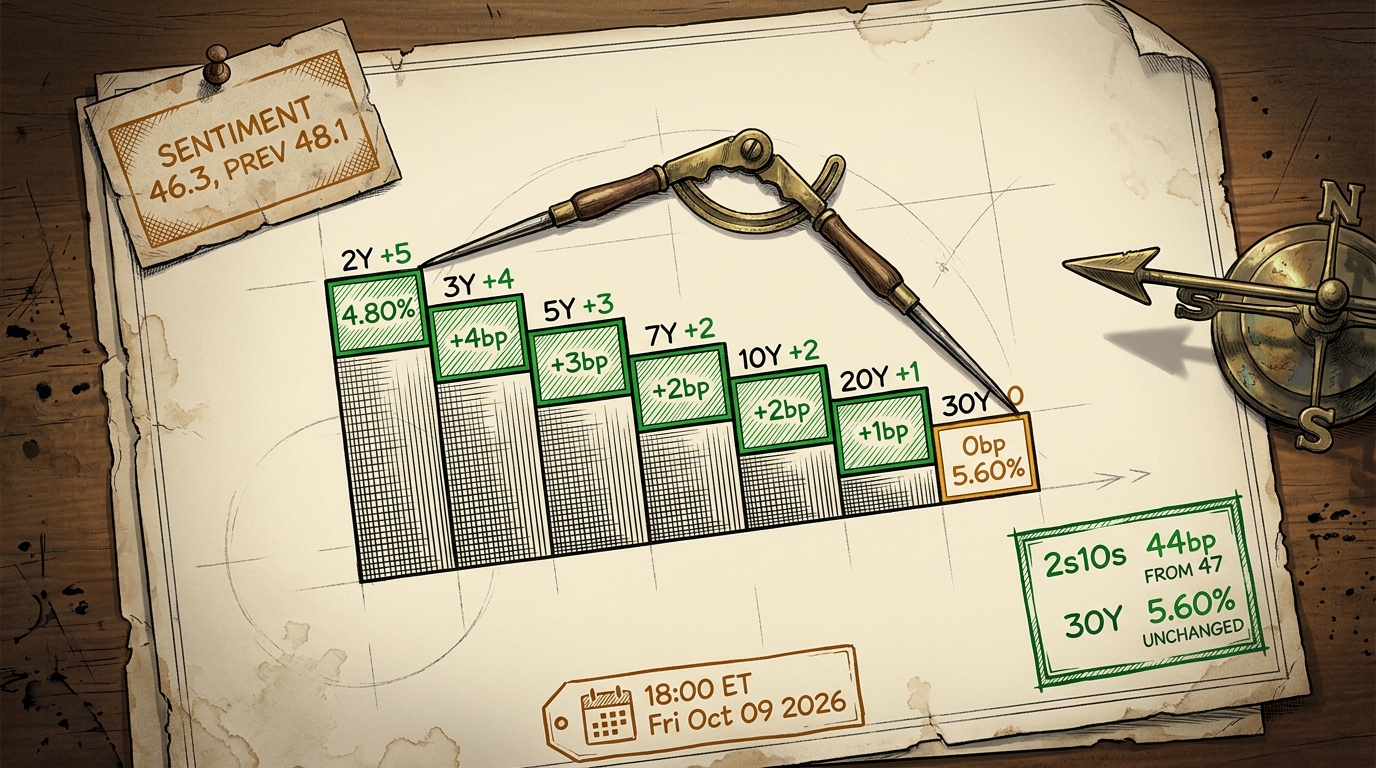
Friday gave us one scheduled American number and it was a bad one. Preliminary October consumer sentiment printed 46.3 against 48.1, a fall of 1.8 points. Most desks would tell you what happens next, and most desks would be describing the opposite of what happened. The 2-year closed 4.80%, up 5 basis points. Money got dearer at precisely the maturity where a worried consumer is supposed to make it cheaper.
The rest of the tape sided with the market rather than the public. The S&P 500 added 0.594692%, nine of eleven sector proxies rose, 4,339 stocks advanced against 3,217, and volatility settled at 14.84. The dollar firmed to 102.232. Gold, silver and copper all rose. None of that looks like a flight from risk, which is the first reason to doubt reading the 2-year as fear.
The textbook expectation is specific enough to test. A sharply gloomier consumer implies softer demand, softer demand implies softer inflation, and the front of the curve should rally with yields falling. A lower 2-year would have surprised nobody. We got five basis points higher.
So we are left with the shape, and that is where this stops being a puzzle. Out from the 2-year the move decays with suspicious tidiness: 5 basis points, then 4, 3, 2, 2, 1, then nothing at thirty years. 2s10s flattened to 44 from 47 and the 30-year closed exactly where it began, 5.60%.
That decay is the half of the answer we can stand behind. A term-premium repricing, the deficits and issuance and duration demand our Weathervane has described for months, does not arrange itself as a descending staircase from the policy end. It lands at the back. This landed at the front and faded outward, which is the signature of expectations about the committee rather than of the price of long money. The speedboat moved. The cruise ship never changed its wake.
What we cannot say is that the print caused it. We hold one daily close per tenor and no intraday path, so this is a sequence and not a mechanism, and the evening’s Reserve Bank speech landed after the close it would need to move. We now know which end repriced without knowing why it chose that direction.
Phil’s Musing
What I keep returning to is that a 1.8-point fall in how people feel bought not one basis point of relief at the maturity that would deliver it. Either the front end has decided the consumer’s mood is no longer information, or it is pricing something nobody has published yet. Wednesday settles more of this than Friday did: if this reading holds, September CPI should move the 2-year further than the 30-year again. If the 30-year leads instead, the staircase was noise and I have the wrong end of the boat.
Happy trading,
Phil
Less Brain, More Gain
…and may your trades be smoother than a cashmere codpiece
P.S. – Phils Footnote An honest correction against myself. I went into this morning assuming today’s American data had been shunted to Tuesday because of the holiday, and said so in writing before checking. It had not. The labour statisticians had nothing scheduled for either day, so there was nothing of theirs to defer; what actually moved to the 13th was the Fed’s own H.15, the commercial paper release and H.10. A tidy assumption about a holiday is still an assumption, and I managed to carry mine three steps further than I should have before a schedule page disagreed with me.
🗂 Desk Notes – Part 226 | 12 Oct 2026
Raw briefing. Observations only. No trades named anywhere in this file.
Session read (§8.4)
SESSION BRIDGE: prior session (Friday) full reaction [S&P 500 +0.594692% to 7,811.54 cash close, Dow +0.826267%, Nasdaq Composite +0.635558%, Russell 2000 +0.460018%, advancers ahead on both exchanges at 1,488/1,197 and 2,851/2,020, VIX 14.84 down 3.698897%, and the 2-year CMT 5bp higher at 4.80%]; live premarket ES +0.244919% / NQ +0.228232%, VIX 14.84 prior-session official close; threshold: none.
Threshold reasoning, stated rather than asserted. December ES moved +0.556533% on Friday against its own prior settlement, which sits inside the normal envelope below 1.0%, so no carry-over fires and the bridge stays silent. The premarket capture at +0.244919% is inside the roughly 0.3% typical band. The volatility leg needs ±8% and got 3.698897%. The commodity leg needs ±4% on front-month crude and got +0.393486% on November WTI. Four legs, four misses, threshold NONE.
Close-to-open window. Friday’s 20:55 UTC electronic close to Monday’s 06:30 UTC capture bar is 57 hours 35 minutes, spanning a weekend. The capture was taken at 06:50:11Z and again at 06:57:26Z, 15m11s and 22m26s after the bar closed, and all four December contracts returned byte-identical open, high, low, close and volume on both reads. The adjacent forming bar moved on ES, NQ and YM and was created between reads on RTY, which is the control and is why this is evidence rather than assertion. Eleventh consecutive clean two-read lock.
Three distinct “Friday closes” exist per contract and they disagree. December ES daily-bar close 7,859.75, the 19:55 to 20:00 UTC settlement-window bar 7,861.00, the 20:55 UTC electronic close 7,866.00. The daily bar matches neither intraday bar exactly, which is consistent with TradingView carrying the official CME settlement, but no CME route confirms it, so every figure in this edition names its leg and the daily close is labelled a settlement proxy.
Contract-roll note (§2.5). Today is not a quarterly roll window. But November WTI last trades about 20 October, inside a fortnight, and Friday’s WTI volume ratio rose to 1.3564 from 1.2216 whilst both legs fell by roughly a third. A ratio rising on a one-third fall in both legs reads as a thin pre-holiday session rather than conviction, and November remains the genuine front month nowhere near parity. Brent’s front month is December and ran the opposite way, 1.4984 from 1.5232. Neither finding is carried across to the other product.
Mechanism read (full)
The one artery is the front end, and it moved the wrong way for its own data.
The session’s only scheduled US macro release was preliminary October Michigan consumer sentiment at 46.3 against a previous 48.1, a fall of 1.8 points. The textbook response at the front of the curve is a rally and lower yields. The 2-year closed 5 basis points higher at 4.80%.
| Tenor | 8 Oct | 9 Oct | Change |
|---|---|---|---|
| 1 Mo | 4.14 | 4.13 | -1bp |
| 1.5 Mo | 4.14 | 4.13 | -1bp |
| 2 Mo | 4.13 | 4.13 | 0bp |
| 3 Mo | 4.23 | 4.25 | +2bp |
| 4 Mo | 4.29 | 4.29 | 0bp |
| 6 Mo | 4.30 | 4.32 | +2bp |
| 1 Yr | 4.44 | 4.47 | +3bp |
| 2 Yr | 4.75 | 4.80 | +5bp |
| 3 Yr | 4.85 | 4.89 | +4bp |
| 5 Yr | 4.99 | 5.02 | +3bp |
| 7 Yr | 5.11 | 5.13 | +2bp |
| 10 Yr | 5.22 | 5.24 | +2bp |
| 20 Yr | 5.64 | 5.65 | +1bp |
| 30 Yr | 5.60 | 5.60 | 0bp |
A timing note, because the reader sees two clocks. CMT figures are stamped 18:00 ET because that is when Treasury publishes them. The observation itself is the roughly 15:30 ET close, which is why a 16:00 ET engagement post-dates it.
The shape is the finding, and it is a hump rather than a slide. The bill sector went the other way, the 1-month and 1.5-month each a basis point lower, so the maximum sits at the 2-year rather than at the front. From the 2-year outward the move decays 5, 4, 3, 2, 2, 1, 0. 2s10s flattened to 44bp from 47, 2s30s to 80 from 85, and 20s30s widened its inversion to -5 from -4. The 20-year remains the strict maximum of all fourteen tenors at 5.65%, and this edition holds the dated series for it: 22 consecutive published sessions as the strict maximum back to 10 September, the streak breaking on 9 September when it tied the 30-year rather than exceeding it.
What is NOT claimed. This book holds one daily close per tenor and no intraday path, so nothing here says the sentiment print caused the 2-year’s 5 basis points. The sequence is published and the mechanism is refused. A speech by the Boston Fed president at the University of Michigan is listed on that bank’s own page for 9 October at 16:00 ET, which post-dates the curve close it would have to move, and no primary text exists yet, so nothing is attributed to it in either direction.
Cross-asset. The dollar index firmed 0.115557% to 102.232; the six-leg rebuild returned +0.116242% for a residual of +0.000685 of a percentage point, which is inside the tolerance this method has established. No superlative is claimed on that residual: this book does not hold every prior edition’s figure, and a superlative over the pipeline’s own history needs the pipeline’s own history. The euro leg was 51.28% of the rebuild, and the rebuild is named as the base. Metals rose uniformly in direction and not in magnitude: December gold +1.4265%, spot +1.5272%, December silver +2.7329%, December copper +1.8802%. Bitcoin +1.0478% and ether +0.4952%, so Friday was not the crypto drawdown; the 7th and 8th were.
Overnight Excitement (§8.5)
Did not fire, seventh consecutive edition. The largest overnight excursion on any December contract was NQ at +0.580223% above its own Friday close, which clears the 0.3% silent floor, misses the 0.6% band by 0.019777 percentage points and sits 0.419777 percentage points below the 1.0% trigger. All four contracts set their overnight low in the 22:00 UTC session-open bar, which is a clean printable fact and is the only thing the night did worth recording.
Closures demonstrated rather than inferred. Japan is closed: the TSE:7203 pull succeeded and returned 1, 2, 5, 6, 7, 8 and 9 October with 12 October absent, which is a closure demonstrated. Shanghai is open: SSE:600519 returned a 12 October bar. Neither constituent is read as index direction; both are closure tests and nothing more. No non-US cash index level is published anywhere in this edition, because no tier-1 route to one exists on this stack.
Forward catalyst slate
- Tuesday 13 October: three bills, 6-week, 26-week and 13-week, all moved off Monday because the bond market is shut today. Confirmed on the tier-1 Treasury route, total count 3, nothing on the 12th. Read against its own run rather than any headline, the 13-week is the one to watch: its 5 October bid-to-cover of 2.51 is the lowest of ten consecutive 13-week auctions from 3 August, against a 3.08 maximum on 24 August, and its 44.21% dealer share was the high of its three-auction share series. The Fed’s own H.15, commercial paper and H.10 releases also shift to the 13th.
- Tuesday 13 October, before the open: JPMorgan, Johnson and Johnson, Citigroup, Wells Fargo, Goldman Sachs, UnitedHealth, Domino’s and Albertsons, corroborated on two routes.
- Wednesday 14 October 08:30 ET: September CPI, confirmed on three routes. Also Real Earnings, and the Beige Book at 14:00.
- Thursday 15 October 08:30 ET: September PPI, confirmed on three routes. Taiwan Semiconductor reports.
- Monday 12 October 12:50 ET: the Cleveland Fed president keynotes the NABE annual meeting. The bank’s own page gives 12:50; one calendar said 12:10 and the bank wins. No text exists yet.
- FOMC 27 to 28 October, two days, confirmed on two routes, and the Fed’s own calendar lists no projection round. That is stated as the calendar’s silence rather than as a positive claim.
- What is NOT this week: nothing from the labour statisticians. They had no release scheduled for the 12th or the 13th, so nothing is deferred from that slate, which corrects a premise this run carried into its own briefs.
Divergence flags
- 🔴 A research return asserted a superlative its own series refutes, and the §2.6 validator caught it before drafting. The claim offered was that 14.84 is the lowest VIX close since 18 September. 22 September printed 14.21. The licensed form is “lowest since 22 September” and that is what is published. The refuting value was inside the same returned window.
- 🔴 Two retail posts assert two different superlatives about two different companies, and the pair was nearly published as a contradiction. One called Friday T-Mobile’s worst session on record; the other called Friday AT&T’s worst day since 2000. They do not conflict, because they are about different issuers, and the first draft of AVE said they could not both be true. Corrected. This book holds two of T-Mobile’s closing prices, so neither claim is checkable here and no ranking is published. The field that would settle the T-Mobile claim is a dated series of its daily returns from the 2013 listing.
- 🔴 A Benzinga headline put the T-Mobile fall at 12% against a measured 13.268344%, and a retail stream put AT&T’s volume at 140 million against a measured 150,534,918. Both secondary figures are wrong, both are locked as tier-3 relays recording the disagreement, and neither is published as the figure.
- 🔴 The percentage form of the T-Mobile decomposition is refused because it does not sum. The gap on the prior close is -9.223046% and the session on the open is -4.456305%, which total -13.679351% against a true -13.268344%. The two legs sit on different bases. Published in points instead, where they do sum on one basis: 15.80 plus 6.93 equals 22.73 exactly, and the gap is 69.511659% of the point move.
- 🔴 No contribution or weighting claim is made anywhere. Communication services fell 1.507986% and three carriers fell 10% or more, and this stack holds no index weighting data, so the sector figure is not attributed to the carriers in magnitude.
- 🔴 The aligned gold carry remains unusable and was not computed, not characterised and above all not re-based. Raw inputs are locked separately and labelled as carry inputs only: December settlement 4,216.3 and the
FX:XAUUSD1h bar stamped 17:00 UTC with a close of 4,195.32. No value, band or breach appears in any reader-facing letter. - 🔧 Yahoo staleness was per-symbol again.
^RUTtopped out at 8 October whilst^GSPC,^IXICand^DJIwere current in the same minute. Every row Yahoo did return matched the primary to the cent. The Russell and the Nasdaq-100 closes are single-route this edition and that is stated. - 🔧 The breadth volume-integrity residual narrowed again. Tracked series 0.99%, 2.045%, 1.5037%, now 1.007178%. Unchanged-issue counts remain unretrievable, so no claim about a share “of the exchange” is made and the denominators are issues that moved: NYSE 2,685, Nasdaq 4,871, combined 7,556.
- 🔧 The missing-trending-block shape failed in both directions this capture and the standing route rule needs downgrading. One symbol returned no trending block whilst sitting on two boards, and four returned a present block whilst absent from all three. It is not corroborative in either direction; the board array at a stated scope and depth is the only safe evidence of an absence.
- 🔧 Three new ticker collisions for the standing list.
DRAMis the Roundhill memory exchange-traded fund and not a memory manufacturer, which inverts the exposure in a story driven by Chinese capacity.SLV.Xis a tokenised silver tracker live at the same capture as the realSLV, which was equities rank 7.RAMis a second memory fund, asserted in a stream and not independently verified. - 🟢
get_zacks_metricsstaleness did not recur. All three names returned a 9 October last trade date, which is the correct prior session, against a one-session systematic lag last edition. One name’s Zacks close matched a board reference close exactly. Every Zacks figure is still stamped 9 October rather than “current”. - 🟢 The Zacks two-route rank split did not recur, three of three names agreeing across routes.
- 🔴 The canonical-versus-legacy sentiment reversal ran 6 of 15 non-degenerate rows and all six ran the same way, canonical bearish against a legacy bullish majority, zero the other way. And the stronger form: the legacy series printed a bullish majority on 15 of 15 rows and no bearish majority anywhere, so it is structurally incapable of disconfirming a bullish read. Canonical published alone.
- 🔴 The Progressive date conflicts across two routes and is not published. One route puts it Monday 12 October and another Wednesday 14 October. A third was paywalled and published for the prior week, so it could not adjudicate. This is the second consecutive edition in which a Progressive forward date has failed to corroborate.
- 🔧 A defunct listing reached a calendar. One route carries First Republic Bank as a 16 October reporter. It is not published.
Regime and sensitivity read (§17.3)
Sensitivity is running LOOSE, thirty-seventh consecutive edition, and that is stated openly rather than presented as neutral. The diagnosis is unchanged and remains specification rather than tuning. A candidate set that has produced no fires across thirty-seven editions is pointed at the wrong things, and adjusting sensitivity will not fix that.
The Weathervane turn condition is INAPPLICABLE this session rather than failed, and the distinction matters. The condition needs a dated Federal Reserve communication to move the 2-year by 10 basis points or more whilst the 30-year moves by less than half. The only dated engagement, a Reserve Bank president’s remarks at the University of Michigan, landed at 16:00 ET, after the curve close it would have to move, and has no primary text. So the first limb cannot engage at all. Note for the record that the second limb is satisfied on the arithmetic, the 30-year’s 0 being less than half the 2-year’s 5, but it is vacuous without the first limb, because there is no qualifying communication for it to be measured against. So the session scores nothing rather than half. Progress 0 of 2. Sixteenth consecutive non-advance, and the fourth distinct way this condition has failed to inform. Splitting it into two separately scored legs remains the strongest standing recommendation in the ledger.
Friday produced two regime-grade observations and the tripwire saw neither: a monotonic front-led curve move decaying 5, 4, 3, 2, 2, 1, 0 on a soft consumer print, which is the clean shape the “policy tightening that does not transmit” thread has been waiting fifteen editions for; and a sector repricing of over 10% in three large-capitalisation names that completed in an opening auction, with the attention boards registering none of it.
Candidate notes, briefly. Dollar non-response is unscored for a fourteenth consecutive edition because candidate 1’s full condition text is still not carried in the live file. Rates-versus-energy inertia, retired at Part 208, collects a thirteenth session of fresh evidence. Volatility suppression, retired at Part 207, is vindicated a sixteenth time: the VIX fell 0.57 points to its lowest close since 22 September on a session with 122 new lows across the two exchanges. The front end’s selective deafness, retired at Part 207, takes a fifteenth vindication and the sharpest version yet, because this time it disagreed with the data in the opposite direction. Official demand at the long end stays at counter 3, and the Part 209 ruling is now a full week past its Monday deadline.
Carry-over note (§10.6)
Does not fire. No §8.4.1 threshold tripped and no catalyst was flagged manually. Friday’s reaction sits inside the normal envelope on all four legs.
Drift gate (§11.9.1), both limbs
To be run immediately before delivery and recorded here with its result. Second limb, the threshold-distance check: the figure to watch is NQ’s overnight excursion at +0.580223%, which sits 0.419777 percentage points below the §8.5 trigger and 0.019777 below the 0.6% band boundary. A move of two hundredths of a percentage point changes which band this session is described as sitting in, which is the narrowest threshold margin this gate has recorded. The spine is a settled Friday cash close and cannot drift; the live crypto and futures keys can.