A wholesale price of zero bought an all-time high, and the companies that reported paid for it.
⚓ Weathervane. The tightening is arriving and nothing is transmitting it. The whole curve rose through July, the thirty-year to a nineteen-year high, and the S&P still closed the month up. What actually reprices now is attention rather than risk: premiums leave oil, volatility and equities the moment headlines stop arriving, whether or not anything on the ground has changed. (Carried unchanged. Thursday split the verdict on it, which is a reason to leave it alone rather than a reason to rewrite it.)
 Ahoy there, Trader! ⚓️
It’s Phil…
When the index sets a record and the companies that reported are the ones being sold, is that a market broadening out or a market changing hands?
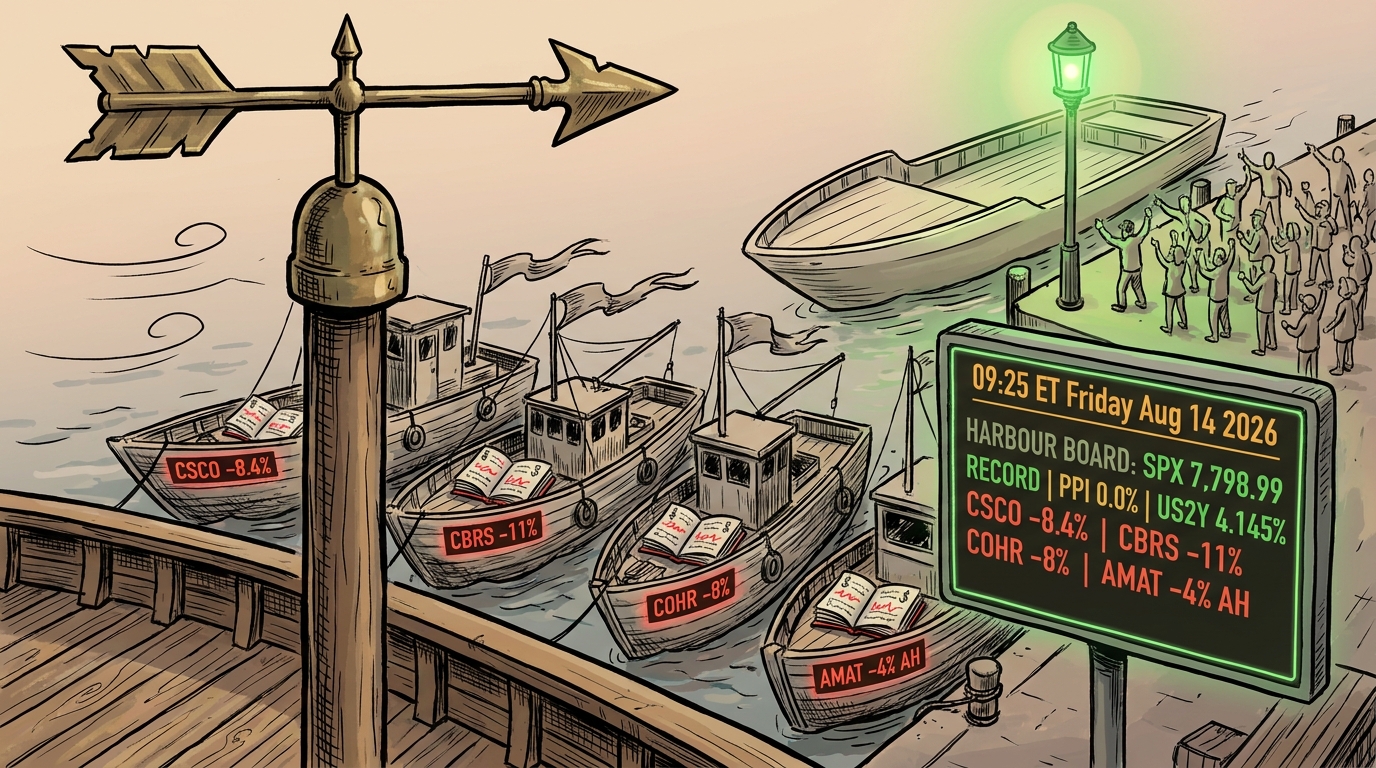
Thursday reads as two different days depending on which end you pick it up. Wholesale prices for July came in at 0.0% against a 0.2% forecast. The 2-year fell more than five basis points to 4.145%. September hike pricing dropped to roughly 34% from about 55% a week earlier. The S&P 500 closed at a record 7,798.99, its first finish ever above 7,800, and the Russell 2000 set a record too. Breadth ran 1.8 to one, 28 new highs against one new low.
Every sentence there describes a market broadening out, exactly as the textbook orders. Soft inflation eases the front end, easing lifts multiples, and the lift reaches the smaller, rate-sensitive names that had been left behind.
Now the other end. Cisco reported the largest revenue quarter in its history, $17.3bn, up 18%, past consensus, and fell 8.4%. Cerebras grew revenue 74%, raised full-year guidance, and fell 11%. Coherent fell 8%. After the close, Applied Materials guided October revenue near $10.3bn against a $9.62bn consensus, a $680m beat on the hardest line to massage, and slipped about 4%.
So where did the easing go. To SanDisk, up 13.7% on an investor-day presentation. To Micron, up 4.2%, and SK Hynix ADRs, up 7.31%. To Netflix, up more than 5% because a well-known investor disclosed a stake. To Workday, on a take-private rumour. Not one of those is a filing.
This is the part I keep turning over. The textbook explains why a soft print lifts the market and says nothing about which half of a sector receives the money. On Thursday it moved with real consistency away from the companies that had just shown verified numbers.
The benign reading deserves stating properly. Memory pricing sits on contracts visible quarters ahead, whilst networking and AI compute revenue is lumpy and hangs on capex decisions a customer can revise in one sentence on a call. A market re-sorting toward the predictable end of the same cycle is behaving sensibly.
The less comfortable reading arrived the same day, when six investors told the Financial Times they model an October listing above $2trn for a company in a quiet period that has published nothing. A market paying a premium for the absence of audited numbers is not pricing growth, it is pricing optionality about growth. That is a light thing to carry into an autumn with an FOMC on 16 September and a real set of accounts landing in October.
I do not know which reading is right, and I would distrust anyone claiming one Thursday settles it. The test costs nothing to run. Next time this index makes a record, look at whether the companies that reported into it went up with it.
Phil’s Musing
This looks like a rotation rather than a top. Breadth of 1.8 to one and a small-cap record do not read as distribution, and I am wary of the seasonal argument that will get run at me for six weeks. What I am watching is narrower: whether the next batch of results gets bought. If audited numbers keep being sold whilst private marks keep being raised, that gap closes on a filing date, not in a particular month.
Happy trading,
Phil
Less Brain, More Gain
…and may your trades be smoother than a cashmere codpiece
P.S. – Phils Footnote This week taught me that “the market went up” and “the market believed you” are two different sentences. Thursday was the clearest gap I have seen: an index at an all-time high with four sets of real accounts marked down inside it. I have started reading the reaction to earnings more carefully than the earnings.
🗂 Desk Notes | Friday, August 14, 2026
Raw briefing export. Observations, not trades. Feeds Analysis Edge and seeds today’s Macro Edge.
Session read (§8.4)
SESSION BRIDGE: prior session (Thursday 13 August) full reaction, S&P 500 +0.65% to a record close of 7,798.99 after an intraday all-time high of 7,816.70 and a 17.71 point fade into the bell, Nasdaq Composite +0.81% to 26,803.03, Dow +0.13% to 53,839.99, Russell 2000 to a record 3,067 intraday and a +0.24% close at 3,052.85; overnight tail, Applied Materials beat on EPS and guided October revenue near $10.3bn against a $9.62bn consensus and fell about 3.9% after the close, so the equity tail was NEGATIVE against a positive cash session; live premarket ES +0.02% / NQ +0.07%, YM -0.14%, RTY -0.14%, VIX 14.65 +0.07%, CL +1.81%, GC -0.46%, DXY -0.04%; threshold: NONE on the §8.4.1 equity test, carry-over fires on Phil’s manual flag.
Fifth consecutive session in which the §8.4.1 equity threshold measures the wrong instrument. The prior session was +0.65%, well inside the normal envelope, and the premarket is +0.02%, which is quieter than typical. The only overnight mover outside any reasonable band is crude at +1.81%. The standing MIP 11.0 candidate to widen §8.4.1 with a commodity leg and a volatility leg is now on its fifth qualifying observation and should be treated as a defect rather than a wish.
The mechanism read (full)
The four instruments.
- Front end. 2-year fell more than 5bp to 4.145% on the PPI print. CME FedWatch September hike pricing near 34%, against roughly 55% a week earlier and roughly 49.9% at Tuesday’s close.
- Long end. 10-year fell more than 4bp to 4.645%. 30-year fell more than 3bp to 5.214%. The official 2s10s constant maturity spread printed 0.48 on 13 August against roughly 0.47 on 12 August.
- Dollar. DXY sits at 99.949 this morning, down 0.04%, having been 99.985 in Thursday’s premarket. Across two consecutive downside inflation surprises the dollar index has moved less than a tenth of a point.
- Volatility. VIX 14.65, roughly a tenth above Wednesday’s 14.54, still the lowest zone of the run, printed through a genuine data surprise rather than into one.
What it implies. The front end led and the equity market followed, which is the textbook transmission and is the first clean example of it in this file for a fortnight. A zero wholesale print is a genuine surprise, it repriced September, and the index took the record. That part is mechanically ordinary.
The one artery. The easing was real and the equity market chose where to spend it. It went to memory and storage (SanDisk +13.7%, Micron +4.2%, SK Hynix ADRs +7.31%), to a Netflix stake, and to a Workday take-private rumour. It did not go to any of the four companies that reported audited numbers into that same session. Cisco -8.4% on record revenue of $17.3bn, Cerebras -11% on 74% growth and a guidance raise, Coherent -8%, Applied Materials about -4% after hours on a $680m guidance beat. The artery is not risk-on or risk-off. It is a re-sort inside the AI complex, from names selling capacity narratives toward names selling components with contract pricing, executed under cover of a macro rally.
The curve note, fifth session. The whole curve fell but the front fell furthest and the spread still widened by a basis point. The long end continues to decline to follow the front end proportionally. This is the same observation logged on each of the four prior sessions and it has now survived two downside inflation surprises in a row.
Carry-over (§10.6) – fires on Phil’s manual flag
Phil flagged the all-time highs and asked whether they are sustained or a trap, with a September and October window in mind. The §8.4.1 thresholds did not trip; the manual flag forces the note.
What the tape actually supports. Thursday’s record was broad on the surface. Breadth 1.8 to one, 28 new highs against a single new low, small caps at a record of their own and up more than 23% on the year. Broad participation is the opposite of the classic distribution pattern, and it is the single strongest argument against the trap reading.
What cuts the other way, and it is specific rather than atmospheric. Every company that published audited results into that record was sold, three of them hard. A market that rewards rumour, investor-day slides and a private valuation model whilst marking down every set of filed accounts is expressing a preference about verification, not about growth. The Anthropic report is the cleanest example: six investors modelling a $2trn October listing on a company in a quiet period, on the same session four listed AI companies with real numbers were marked down.
On the seasonal window, stated as a base rate rather than a signal. September carries the weakest average monthly return in the S&P 500’s long history. That is a real statistical regularity and a poor timing instrument, and it is not evidence about this September. The dated items that would actually make the window operative are the 16 September FOMC into September hike pricing near 34%, the 19 August FOMC minutes, the Nvidia report in the last week of August, and an Anthropic listing in October that would put a public price on the private AI mark for the first time. Those are catalysts on a calendar. The season is not.
Forward catalyst slate
- Today, 08:30 ET. July retail sales, consensus clustered between 0.1% and 0.3%, prior 0.2%. Core ex-autos consensus 0.2% against a prior -0.2%. Import prices same slot.
- Today, 09:15 ET. Industrial production and capacity utilisation.
- Today, 10:00 ET. Michigan preliminary August sentiment, consensus around 54 against 55.2 prior. One-year inflation expectations were 4.2%, five-to-ten year 3.3%. In a week where both inflation prints came in soft, the expectations lines are the ones with something left to say.
- Today. SEC meeting on crypto investment-contract rules.
- Monday 17 August. Alibaba earnings. Weathervane rewrite candidate date.
- Tuesday 18 August. Housing starts, building permits, industrial production. Home Depot, Baidu, Toll Brothers. Part 181 window closes.
- Wednesday 19 August. FOMC minutes. Analog Devices, TJX, Lowe’s, Target, Estee Lauder.
- Late August. Nvidia. Pentagon 21-day production ultimatum resolves. Hashdex liquidation completed 17 August.
- October. Anthropic listing window, per the FT report.
Divergence flags
- Record index, sold reporters. Four audited results into an all-time high, all lower. This is the day’s primary flag and the whole edition is built on it.
- Memory up, equipment down. SanDisk +13.7%, Micron +4.2%, SK Hynix +7.31% on the same session Applied Materials guided $680m above consensus and fell. The market is separating the memory cycle from the tools that build it, which is not obviously coherent.
- Bitcoin against equity risk appetite, second week. Equities at an all-time high, BTC at $62,693.57 and down 1.15%, trends negative on every horizon. The IGV to bitcoin ratio made new highs this week. The correlation people still quote is not in the data.
- Crude, numbers versus sentences. Down 2.2% Thursday on OPEC’s fourth consecutive demand downgrade and the IEA cut. Up 1.81% overnight on a statement that the blockade could continue indefinitely. Nothing physical changed in either direction.
- A supply deficit forecast and a three-year inventory build in the same week. The IEA sees a 1.8m bpd shortfall this quarter. The EIA reported a 17.4m barrel build. Unreconciled since Wednesday.
- Dollar inert through two dovish surprises. DXY has travelled less than a tenth of a point across CPI and PPI. Either the front-end move is not believed or it was already positioned.
Part C: regime status
⚓ Weathervane: carried unchanged, next rewrite candidate Monday 17 August. Thursday cuts both ways against the banner and that is why it is not being rewritten. It CHALLENGES the equity clause, because a genuine statistical surprise transmitted straight into price, which is information repricing rather than attention repricing. It CONFIRMS the commodity clause, because crude fell on counted barrels and rose on a sentence within eighteen hours. A banner that gets a split verdict on a single session is a banner that should sit still.
⚓ REGIME FLAG (duration, SOFT): RESET TO 0 OF 5. The respec requires a five-session window in which the 30-year holds above 5.15% and the S&P fails to make a new closing high. Thursday made a new closing high. Under the flag’s own stated terms the window resets. The counter goes from 3 back to 0 and the reset is logged rather than argued with.
⚓ REGIME FLAG (chipflation supply side, SOFT): carried, no new marks. Applied Materials reported and is still an equity event, not contract DRAM pricing. Fourth consecutive edition recording the temptation and refusing it. The memory equity moves on Thursday are also not evidence here.
⚓ VOL REGIME: cross-asset compression, unchanged. VIX 14.65 through a genuine data surprise. The compression has now survived CPI, PPI and a record close.
Sensitivity read (§17.3): HIGH-TIGHT, hold at yellow. Today the setting costs us the duration counter we had built to 3 of 5, refuses to bank the Part 184 crude and rates shot on newswire figures with the official series publishing within hours, and refuses to score the Part 188 range test without both chart values. Three refusals, one of which surrenders three sessions of accumulated evidence. No change recommended.
⚓ LIVE VARIABLE FOR PHIL, second consecutive edition and now blocking. The S&P 500 intraday high and low for Wednesday 12 August and Thursday 13 August. The Part 188 falsifier cannot be scored without both, and Thursday is its first qualifying session.