Crude fell 3.59% in an hour, equities round-tripped, and the 20-year closed at 5.53% anyway
⚓ Weathervane. The wind is coming from the long end. The policy rate has been frozen for most of the year whilst the term premium does the tightening, and the price of long money is set by deficits, issuance supply and a synchronised global duration bid rather than by the committee. Higher-for-longer stopped being a Fed decision and became a bond-market fact. The cruise ship is holding this heading.
 Ahoy there, Trader! ⚓️
It’s Phil…
If the peace headline was worth 3.59% of crude in an hour, why was it worth nothing at all to the long end?
The tidy version of Thursday is that nothing happened. The S&P 500 closed 7,704.13, down 1.90 points. That flatness is an average of two quite different afternoons.
The session opened at 7,666.99, half a percent lower, with crude running on a reported strike on Saudi sites and the long end sold. By half past ten the index was at 7,662.57, and from there it recovered without a catalyst anybody has produced, before the news existed.
It happened at 12:16 New York time. Reuters reported that US and Iranian negotiators were exploring a phased deal to reopen the Strait of Hormuz in exchange for lifting the American blockade. Nothing was agreed, and the reporting called the talks preliminary, with significant differences over terms and sequencing.
The barrel answered inside the hour. November crude fell from 96.78 to 93.31, down 3.59%, on 61,316 lots, two and a half to three times the surrounding volume. The index, already most of the way back, topped at 7,719.01 fourteen minutes later. Only one of the two is a reaction to the wire.
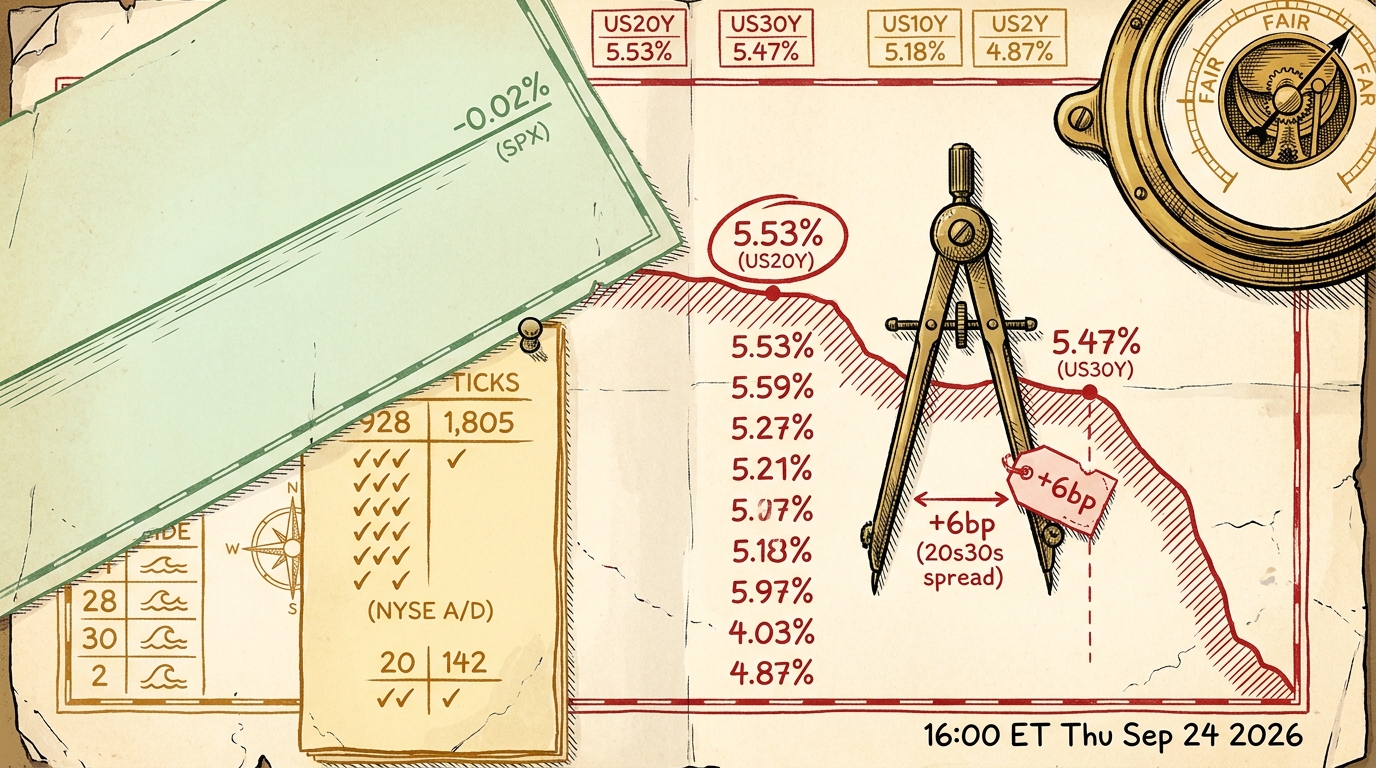
The textbook says an oil shock lifts the long end through inflation expectations and term premium, and that removing it should release the yield. Half of that happened. The barrel came down. The Treasury curve, marked at half past three, two and a half hours after crude printed its low, closed with the ten-year at 5.18% and the twenty-year at 5.53%, both the highest of the month.
Three readings fit and we cannot separate them on a daily close. The bond market did not believe the report. Or the long end stopped being an oil story some time ago, its bid coming from deficits and issuance. Or, least flattering to this letter, it did respond and the response was too small to survive a mark taken hours later.
There is a fourth complication. A seven-year auction cleared at one o’clock, between the crude break and the mark, and it was soft: cover and indirect share both below their trailing-six ranges. That is sufficient reason for a long end to sit where it did, inside the same window. Without an intraday yield series, which this book lacks, we cannot tell the auction from the refusal.
Phil’s Musing
What I keep returning to is that one wire report was worth 3.59% of crude inside an hour and nothing whatsoever to the twenty-year, and the twenty-year had two and a half hours longer to think about it. I have been treating the long end as the thing oil pushes around. Thursday says the causation may be thinner than I assumed, or the bond market simply refused a headline the barrel accepted. Either way the useful dashboard is the twenty-year and the breadth tally, and the index is decoration.
Happy trading,
Phil
Less Brain, More Gain
…and may your trades be smoother than a cashmere codpiece
P.S. – Phils Footnote I assumed for most of this year that a flat index meant a quiet day, and I have been using it as a first filter every morning, which is a habit rather than a method. Thursday cost me that assumption twice over. The close was 1.90 points and the path was a 0.74% round trip with a war headline in the middle of it, and the tell was that new lows beat new highs seven to one underneath a number that rounded to nothing. On my old filter I would have skipped the session entirely and missed both. The open, the low, the high and the close have gone onto the morning list beside breadth, because a close on its own turns out to be an average of a story rather than the story.
🗂 Desk Notes – Part 215 | 25 Sep 2026
Raw briefing. Observations, not trades.
Session read (§8.4)
SESSION BRIDGE: prior session (Thu) full reaction, S&P 500 cash opened -0.51% at 7,666.99, bottomed 7,662.57 at 10:30 ET, recovered unaided from there, topped 7,719.01 fourteen minutes after the 12:16 ET Hormuz wire and closed -0.02% at 7,704.13, a 0.74% round trip, with December ES settling -0.07% at 7,767.00 and Costco reporting after the bell; live premarket ES +0.11% / NQ +0.39% captured 06:15 UTC, VIX +3.23% on Thursday’s official close of 15.67; threshold: none on the close-to-close bands, and see the gap note below.
🔴 THRESHOLD GAP, AND IT IS A SPEC PROPOSAL RATHER THAN AN OBSERVATION. §8.4.1 IS SPECIFIED ENTIRELY ON CLOSE-TO-CLOSE CHANGE, SO A SESSION THAT GAPPED DOWN 0.51%, FELL TO -0.56%, REVERSED ON A WAR HEADLINE AND CLOSED -0.02% SCORES none, IDENTICALLY TO A SESSION ON WHICH NOTHING HAPPENED. The band cannot see a 0.74% round trip because it never looks at the path. The AP’s own wrap called it “a suddenly shaky Wall Street” that “ended the day roughly back where they started after whipping through a couple reversals”, which is the opposite characterisation to the one the threshold machinery produces.
Proposed §8.4.1 addition, an intraday leg: a cash-session high-to-low range of 0.75% or more fires the soft trigger regardless of the close, and the catalyst is named. Thursday would have missed it by a single basis point at 0.74%, which is the right kind of near miss for a first calibration. The figure wants Phil’s ruling; the existence of the gap does not.
Threshold reasoning, on the bands as currently written. Prior-session December ES change -0.0708%, well inside the normal envelope and nowhere near the 1.0% investigate band. Premarket ES +0.1094% against Thursday’s settlement, below the ~0.3% typical band. Volatility leg not tripped: VIX +3.228%, against a ±8% trigger. Commodity leg not tripped: front-month WTI November +2.658%, against a ±4% trigger, and Brent November +3.415% is not the specced leg. No manual flag. Carry-over note does not fire (§10.6).
Close-to-open window. Thursday cash close 16:00 ET to Friday capture 06:15 UTC is roughly 10 hours 15 minutes. Costco’s fourth quarter landed inside it, at 16:15 ET, and the after-hours reaction was +0.27% on a regular-session close of 896.48. The overnight low on December ES was 7,748.50 and came before the capture; syndicated copy at 03:35 UTC had futures lower on a 10-year approaching 5.2%, and by 05:54 UTC had them flat. Do not pair an early-overnight headline with the 06:15 capture. They describe different hours.
Contract roll (§2.5). No action. The quarterly roll was the third Friday, 18 September, and is complete: ES, NQ, YM and RTY are all on December 2026. WTI front month is November, confirmed by volume at 392,362 lots against December’s 204,312. ⚠️ Brent is the other way round: December out-traded November on both 23 and 24 September, 494,692 against 379,941. The Brent roll is under way and the WTI finding must not be carried across.
Mechanism read (§8)
What moved. A bear steepening, led by the far end.
| Tenor | 23 Sep | 24 Sep | Change |
|---|---|---|---|
| 2-year | 4.85 | 4.87 | +2bp |
| 3-year | 4.97 | 4.99 | +2bp |
| 5-year | 4.99 | 5.03 | +4bp |
| 7-year | 5.05 | 5.10 | +5bp |
| 10-year | 5.11 | 5.18 | +7bp |
| 20-year | 5.45 | 5.53 | +8bp |
| 30-year | 5.40 | 5.47 | +7bp |
Spreads: 2s10s 26 to 31, widening 5bp. 2s30s 55 to 60, widening 5bp. 20s30s 5 to 6, widening 1bp and the widest gap of the month. 5s30s 41 to 44.
Cross-asset: dollar index 101.249, up 0.134%, with EUR/USD at 1.13811 barely moved and USD/JPY at 158.85957 up 0.324%. The dollar’s move was yen-led and narrow, qualitatively different from 23 September, when the euro fell 0.57% and the index rose 0.57% together. VIX 15.67, up 3.228%. Gold spot 4,275.28 down 0.273% against December futures 4,298.00 down 0.472%; carry 22.72, inside the held 18.72 to 47.65 band, with all four prior anchors reproduced to the cent.
🔴 THE SESSION HAD A CATALYST AND A PATH, AND THE CATALYST EXPLAINS LESS THAN IT FIRST APPEARS. At 12:16 ET Reuters reported that US and Iranian negotiators were exploring a phased deal to reopen the Strait of Hormuz in exchange for lifting the US economic blockade. Nothing is agreed and the reporting calls the talks preliminary, with significant differences over terms and sequencing.
The reaction, measured from exchange data rather than inferred. November WTI went from 96.78 to 93.31 inside the 12:00 ET hour, -3.59%, on 61,316 lots against roughly 20,000 to 26,000 in the hours either side, so two and a half to three times. That is a clean causal read: the high is stamped 12:00, the wire lands 12:16, the low prints by 13:00.
🔴 THE EQUITY LEG IS NOT A CLEAN CAUSAL READ AND THE FIRST DRAFT CLAIMED IT WAS. The S&P 500 bottomed at 7,662.57 in the 10:30 hour, one hour and forty-six minutes BEFORE the wire existed, and recovered from there unaided. It topped at 7,719.01 at 12:30, fourteen minutes after the report. Most of the 0.74% round trip had already happened. No causal attribution is published for equities and the timing is stated instead.
🟡 AND THE CURVE’S NON-RESPONSE CANNOT BE SEPARATED FROM ITS OWN CALENDAR. CMT is marked 15:30 ET, two and a half hours after crude printed its low, and closed with the 10-year 5.18% and the 20-year 5.53%, both the month’s highest. But this book holds no intraday yield series, so “refused the news” and “did not fully reverse earlier selling” are observationally identical on a daily close. 🔴 And the 7-year auction cleared at 13:00 ET, INSIDE that window, soft on cover and indirect share. That is a sufficient bearish-for-duration input on its own. The published copy states the ambiguity rather than resolving it.
What it implies. This was a term-premium repricing, not a policy repricing. Three Reserve Bank presidents leaned hawkish inside the session and the two-year moved two basis points. The inputs that moved the curve were a reported strike on Saudi sites, which put Brent November up 3.415% to 106.60, jobless claims at 197,000 against a 201,000 forecast, and new home sales at 684,000 against 615,000, the most rate-sensitive part of the real economy accelerating into the highest ten-year close of the month.
The one artery. The long end. Twenty-year 5.53%, the month’s highest close, 153bp above the top of the funds target and six basis points above the thirty-year.
Equity transmission, and the part that needed checking. Rate-sensitive equity was sold: First Solar 172.16 from 191.97, down 10.3193% on 2.79 times its prior five-session average volume; materials 1.1933%, utilities 0.9811%, staples 0.8856%, real estate 0.4541%. NYSE advancers 928 against 1,805 decliners, an A/D ratio of 0.514 against a 33-session median of 0.786 and mean of 0.905. New lows 142 against 20 new highs, the highest new-low count in five sessions.
🔴 Lesson 42 applied, and the easy explanation fails. The index did not rise, so no megacap-rescue framing is available. Of thirteen large constituents checked, six rose and seven fell, and the largest decline was Oracle at -3.473% on 1.88 times average volume. Large and small finished 8 basis points apart, SPX -0.0247% against RUT -0.1087%, so this was not a size rotation either. The index-versus-breadth gap is a universe difference plus a sector story: the S&P 500 holds 500 large operating companies whilst the NYSE tally counts every issue on the exchange, and communication services at +1.2704%, essentially Meta at +4.501% and Alphabet at +1.341%, was enough to carry a cap-weighted index back to flat.
Overnight Excitement (§8.5)
Does not fire, and the night was genuinely quiet. December ES +0.1094%, NQ +0.3908%, YM +0.1218%, RTY +0.2205% overnight to the 06:15 UTC capture. All four sit below the 1.0% trigger and the largest is inside the 0.3% to 0.6% normal band. No non-US central bank decision landed except the SNB holding at 0.0% on 24 September. Tokyo is open on 25 September, demonstrated by a successful constituent pull returning bars, the three-session closure having ended. Germany’s October GfK consumer confidence printed -30.6 against a -27.4 forecast at 06:00 UTC, a clear miss and the only high-importance non-US print into the session. China is closed for Mid-Autumn Festival. No foreign index level is published; no tier-1 route to any non-US cash index exists on this stack.
🔧 The crude leg has continued overnight and it is the live variable of the morning. November WTI traded a 92.14 low at 08:00 UTC and sits 92.91, which is 4.00% below Thursday’s 96.78 intraday peak. Brent November is 105.42 live. On the cross-validator series, not CMT and not published as a point figure against it, the 10-year has eased roughly three basis points overnight, so the bond market may be starting to take the trade it refused on Thursday. The CMT print at 15:30 ET today is the thing to watch.
Forward catalyst slate
Today, Friday 25 September. Core durable goods orders 08:30 ET, forecast 0.6% against 0.4% prior; headline durable goods, forecast -0.3% against 1.1% prior. Revised University of Michigan consumer sentiment 10:00 ET, forecast 47.4 against 47.8. Revised inflation expectations 10:00 ET, prior 4.6%. Williams 05:15 ET, Schmid 09:20 ET, Hammack 14:00 ET on the Cleveland Fed’s inflation conference policy panel.
🔴 What is NOT today, and it is commonly misplaced: core personal consumption expenditures. Core PCE m/m is Wednesday 30 September at 08:30 ET, prior 0.2%, alongside final GDP, personal income and personal spending. Any copy trailing “PCE tomorrow” is wrong.
Next week. Monday 28 September: 13-week bill 95 billion, 26-week bill 82 billion. Tuesday 29 September: CB consumer confidence, JOLTS job openings, 52-week bill 54 billion, 6-week bill 85 billion; Carnival and CarMax report. Wednesday 30 September: core PCE, final GDP, ADP, Chicago PMI; Micron reports. Thursday 1 October: ISM manufacturing, prior 54.6, with ISM prices prior 71.1; jobless claims; Accenture reports with a call at 08:00 ET, and Nike. Friday 2 October: non-farm payrolls, prior 162,000, and the unemployment rate, prior 4.1%.
No coupon auction falls next week. The end-of-month coupon block is finished: the 2-year on 22 September, the 5-year and the 2-year floating-rate note on 23 September, the 7-year on 24 September. The mid-month refunding tenors went on 17 September. The routine 17-week and 4-week bills are announced on Tuesday and are therefore simply not in the table yet; their absence is announcement timing, not a missing event.
Claims about to be tested. The Part 207 window closes today, with one session to run and a 20bp cushion. The Part 208 window closes Monday 28 September. The Part 209 comparison is struck on Tuesday 29 September. Part 210 and Part 211 both close on Friday 2 October.
Divergence flags
- 🔴 The Farside 24 September bitcoin row cannot be adjudicated and is recorded PROVISIONAL. Total +190.7 million with six of twelve issuers carrying no value. Two independent reads of the same page disagreed on whether those cells are printed zeroes or blanks, and direct retrieval to farside.co.uk is refused at the egress proxy, so the raw HTML that would settle it is unavailable. The pipeline currently has no reliable route to distinguish a blank from a zero on the single most dangerous table in the book. This is worth a route decision. The 24 September ether row does not exist at all, which is the strongest evidence the provider’s 24 September update is incomplete across products.
- 🔴 Costco: three figures on three different bases, and welding any two of them would be a Lesson 36 error. The company’s release gives 6.75 dollars a share reported; Zacks gives 6.60, which is the ex-item figure; the release separately calls out a non-recurring 0.15 per-share benefit from tariff refunds net of partial reinvestment in member value. The 184 million dollars quantified on the call is the gross refund received, not the per-share benefit grossed up: against 444,364 thousand diluted shares, 0.15 a share is roughly 67 million. The published copy carries the per-share figure only and does not attach the 184 million to it. Consensus itself differs by provider, so no consensus point figure is published and no beat size is quoted anywhere.
- 🔴 Darden’s reaction was misstated by two wires. RTTNews carried “down 5%”, 24/7 Wall St carried “falls 6%”; exchange OHLCV gives -3.018%, with a session low of only -3.50%. A -6% close sits below the session’s own low and is arithmetically impossible. Sixth consecutive instance of secondary wraps misstating a reaction, after Expedia at Part 213.
- First Solar’s close, small and worth stating. Exchange OHLCV gives 172.16 and -10.3193% from 191.97; Zacks gives 171.86 and -10.48% from 191.91. Both are internally consistent; they are two slightly different closing prints. The exchange print is used throughout.
- 🔴 The EDGAR submissions feed omitted the 21 September Strategy 8-K again, for a second consecutive edition. Full-text search carried it and the accession index confirmed it. The feed has now produced a false positive at Part 213 and a false negative at Parts 214 and 215. Recommendation: treat the submissions feed as a non-source for Strategy presence or absence and rely on full-text search plus the opened accession only.
- Nothing is attributed to Barkin on 24 September. ForexFactory listed him at 08:30 ET; the Richmond Fed’s own 2026 archive shows nothing that day and its most recent entry is 22 September. The Reserve Bank’s own page wins, exactly as with Goolsbee at Part 214. His live quote remains the 22 September “Why Hike?” remarks and should be dated as such if used.
- 🔴 A carried expectation in this book was wrong and is corrected here. The Part 214 ledger recorded “BoJ core CPI Friday, forecast 1.5% against 1.6%”. Two independent calendar routes show no Japanese CPI release of any kind on 25 September; the only Japanese event is a 3-month bill auction. August national core printed 1.7% on 17 September and the September Tokyo CPI is 1 October. No such print is published.
- 🔴 A research finding was refuted at lock build and is recorded so it is not repeated. It was reported that “the two weakest breadth readings of the 33-session run fell back to back”. False. An independent pull of the full dated series puts 24 September’s 0.514 tenth weakest of 33. The 23 September reading of 0.251 retains the minimum on its own.
- 🔧 Treasury CMT served a stale response on its first call for a fifth consecutive session, and the failure shape has changed. Prior sessions returned top-of-file January rows. This session it returned a one-session-stale top row dated 23 September, which is more dangerous because it looks plausible. A cache-bust returned 24 September and a third independent fetch reproduced it character for character. Three open shots run on this series through this single route.
- 🟢 The held 32-session breadth base rate reproduced exactly on an independent pull, which is an integrity result rather than a divergence: median 0.811, mean 0.917, minimum 0.251, maximum 1.814, zero sessions above 2.0 and six below 0.5, all matching the figures carried into this edition. The same pull independently reproduced the 23 September 547 against 2,181.
- Yahoo’s S&P 500 history was NOT stale this run, against a standing one-to-two-session caveat, and matched exchange data to the cent on 24 September. Its table skips 22 September entirely. The caveat should be softened to “intermittently stale, verify the top row” rather than assumed.
- 🟡 Brent’s 24 September settlement is disputed by TWO wires, not three, and the correction is worth more than the finding. The tier-1 dated-contract route gives
ICEEUR:BRNX2026at 106.60, +3.415%. Reuters via syndication reports 107.18, up 4.0%, and a Dow Jones headline carried Brent “above $107”. 🔴 An earlier draft of this entry counted The National as a third wire above our route. It is not, and the error was a settlement-versus-intraday conflation committed inside the log whose job is to catch exactly that. The National’s “$108 the previous session” is an intraday HIGH, which says nothing about a settle; and its own stated change implies a Thursday reference of 105.7 / (1 – 0.0088) = 106.64, which corroborates this book’s 106.60 and contradicts 107.18. 🟢 On Friday’s live level the routes agree to within five cents of our range, The National at 105.7 against our 105.42 to 105.65. So the divergence is narrow, two-sourced, and located at the settlement mark. On 107.18 the Part 208 killer would read 1.57 dollars out, 1.44%, and 8% to 10% of the band, against the 2.15 dollars, 1.98% and 11% to 14% published. The exchange route is tier 1 and is used, per §12.3, but the divergence is recorded rather than smoothed and the wire figure sits in the lock as a labelled tier-3 relay so the discrepancy stays auditable. Worth a registry note: this is the first material ICE-versus-wire settlement conflict recorded on Brent. - Oracle’s reaction was misstated by wires in the same shape as Darden’s. Secondary wraps carried “sinks 5%” and “sinks 7%” against an exchange print of -3.473%. Flagged for symmetry with divergence 3; the exchange print is used throughout.
- 🔧 A third Hormuz shipping source has appeared and it is roughly consistent with one of the two blocked trackers. The National, citing preliminary Kpler data, gives 13 crossings at Hormuz and 27 at Bab Al Mandeb on Thursday, against
straits.live‘s “10 vessels” for Wednesday. The provider and the preliminary qualifier belong in any registry entry. The standing rule holds and no transit figure is published, but for the first time two independent sources sit in the same order of magnitude, which is the beginning of a route out of the factor-of-ten disagreement. Worth a registry candidate rather than a ruling. - 🔴 A date error was caught in an editorial read and is recorded because it nearly reached the page. The first lady rang the New York Stock Exchange opening bell on Wednesday 23 September, for the Imperia women’s leadership initiative, not on Thursday 24 September. Wednesday is the -0.75% session with the 547-against-2,181 breadth; Thursday is the round trip. The two sessions had been merged into one narrative and the bell was about to be attached to the wrong day. Nothing is published about it.
Carry-over note (§10.6)
Does not fire. No threshold tripped and no catalyst was flagged. The session’s interesting feature was the absence of a reaction in the front end rather than the presence of one anywhere, which is an observation for the mechanism read and not a carry-over.
Regime and sensitivity read (§17.3)
Running LOOSE, twenty-sixth consecutive edition, and the bias is stated openly rather than presented as neutral. The diagnosis is unchanged and hardens again: the candidate set is mis-specified rather than mis-tuned.
Thursday produced four regime-grade observations and the tripwire saw none. A wire report moved crude 3.59% in an hour and moved the 20-year not at all, at a settlement two and a half hours later. A far-end-led repricing on an oil shock whilst three dated hawkish communications sat in the same session and moved the front end two basis points. A 10.3% single-session fall in the most capital-intensive corner of the equity market on a day the index moved 1.90 points. And a seven-year auction whose cover and indirect share both printed below their own trailing-six range whilst dealers were not made to absorb it.
Recommendation order, unchanged from Part 214 except where noted:
- Two-sided volatility leg. Ten editions overdue. Vindicated a fifth time: VIX moved 3.228% on a session with the second sub-median breadth reading in a row and registered nothing, because the leg is one-sided and the threshold is 8%.
- Un-retire the front-end selective-deafness leg. Fourth consecutive vindication, and the sharpest yet: three Reserve Bank presidents in one session, two basis points.
- Breadth-versus-index leg. Both blockers cleared. A shot is filed against this series at Part 215, which does not replace the regime leg and does not satisfy it.
- Re-specify the policy-transmission thread, now challenged in five distinct directions across five consecutive editions.
- Split rates-versus-energy leg, which has a second session of new evidence: energy green again whilst the tracked monetisation name added only 0.6617% against a 2.658% front-month crude move. See the ledger’s Lesson 45 on why that name has too little sensitivity to score the thesis either way.