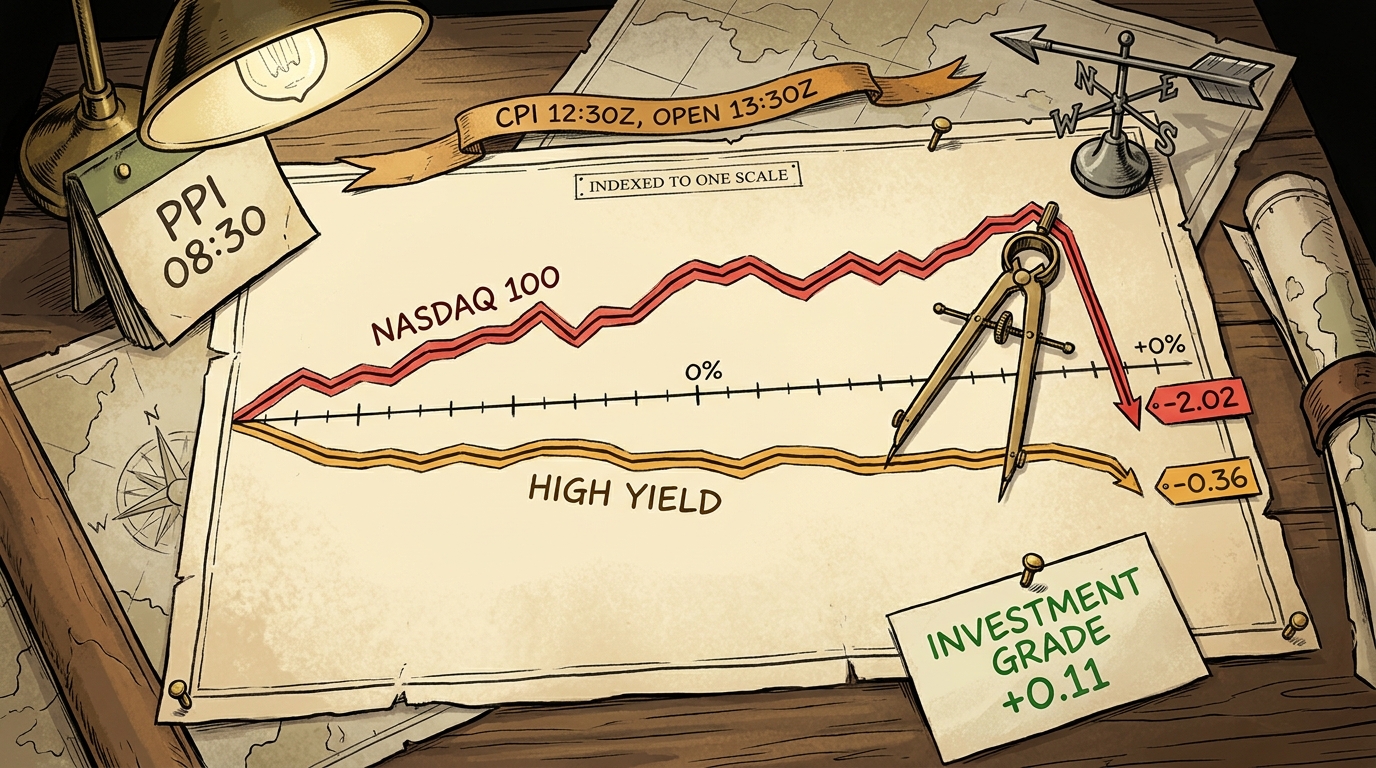
Investment grade rose 0.11%, high yield fell 0.36%, and the equity in the theme lost 15.46%
⚓ Weathervane. The wind is coming from the long end. The policy rate has been frozen for most of the year whilst the term premium does the tightening, and the price of long money is set by deficits, issuance supply and a synchronised global duration bid rather than by the committee. Higher-for-longer stopped being a Fed decision and became a bond-market fact. The cruise ship is holding this heading.
 Ahoy there, Trader! ⚓️
It’s Phil…
If the AI trade was unwinding on leverage, why did high-yield credit barely move?
The Nasdaq-100 fell 2.023799%, the largest of the 29 daily moves we hold, against a next-worst of 1.394%. The semiconductor proxy fell 4.500827% and CoreWeave closed 15.460738% lower, having traded 1.458849 times its whole previous session inside the first hour.
The inflation print will get the credit, and the clock will not let it. September consumer prices landed 12:30 UTC, an hour before the open. That bought the gap of 253.4563 points, 40.968262% of the day. The other 365.2087 points, 59.031738%, arrived after the bell. A tenth of a point does not sell gold, and gold spot fell 1.327303% with December silver down 6.128517%.
So the shape is not an inflation shock’s. It looks like one crowded theme reduced whilst duration and defensives rose: the thirty-year richened 4 basis points, health care gained 2.534481% and staples 2.221166%. In fairness, the front end cheapened, the one-year by 5 basis points, and the relay put October tightening odds at 29.9% from 23.0%. The print mattered. It did not matter 2%.
The textbook expectation is testable. If a capital-intensive trade is unwinding because its financing is in question, the low-quality tier moves hardest and high-grade paper sells with it. One limb held and one did not: high yield fell 0.363212% whilst investment grade rose 0.107265%. The ordering is right. The size is not: a third of one per cent out of credit, against 15.460738% out of the equity in the same theme.
Three limits, stated not buried. The long Treasury proxy rose 0.663519% whilst investment grade managed 0.107265%, a gap of 0.556254 points, and we hold no duration for either, so none of that becomes a spread. A broad high yield fund is not this theme’s own borrowing, which we cannot see. And 0.363212% is 43.557076% of high yield’s own eight-session range, the close sitting 0.078176% above its low, so “barely moved” is absolute, not relative.
Which leaves the ordering open, and here is the trap in our own case. Credit should reprice first where financing binds. But much of its price discovery is slow, because fund flows and dealer inventory take days, so one flat session proves little. What settles it is a number and a date. If high yield falls more than 0.8% by Tuesday’s close whilst investment grade falls with it, Wednesday was the first day of a financing problem. If it is within 0.3% of 76.81, it was a crowded trade getting smaller. We mark it either way.
Phil’s Musing
I spent yesterday in the wrong market, hunting an inflation trade in the long bond and finding a bid. The thing I keep relearning is that credit decides whether an equity move is a story or a statistic, and I check it last.
Happy trading,
Phil
Less Brain, More Gain
…and may your trades be smoother than a cashmere codpiece
P.S. – Phils Footnote I had assumed a 15% fall in a capital-intensive name would show up somewhere in the debt, and at this magnitude it did not. What I keep wanting to do with that absence is read it as proof, and it is not proof, it is one session of one broad fund. An opinion about growth and a fear about solvency look identical in the equity for a day or two. I had them filed under the same heading until this morning, which is the part that bothers me.
🗂 Desk Notes – Part 229 | 15 Oct 2026
Observations only. Nothing here names a trade.
Session read (§8.4)
SESSION BRIDGE: prior session (Wed) full reaction December ES 7,855.75 to 7,770.25, -1.088374%, December NQ 30,791.50 to 30,182.75, -1.977007%; live premarket ES -0.398957% / NQ -1.135582% / YM +0.107987% / RTY +0.236794%, VIX prior-session cash close 16.87 carried as a prior-session figure; threshold: soft.
Why soft rather than none or hard, and it fires on three separate legs. The prior-session December ES reaction of -1.088374% sits inside the 1.0% to under 2.0% investigate band. The volatility leg fires independently: VIX closed 16.87 against 15.27, a single-session move of +10.478061%, comfortably past the ±8% threshold. And the premarket NQ at -1.135582% sits outside the ~0.6% normal band on its own leg. Three legs, one direction. Note the wording change from this edition’s first cut: the soft trigger no longer rests on “a clear named catalyst”, because the catalyst does not carry the move. See the mechanism read.
Capture discipline. The capture bar is the 5-minute bar running 06:30:00Z to 06:34:59Z, which is the fixed 07:30 UK mark. It was read at 07:25:06Z and again at approximately 07:27Z, both well past bar maturity. ES and NQ returned byte-identical open, high, low, close and volume on both reads, whilst the adjacent still-forming 07:20 bar mutated on both contracts between the reads, ES close 7,742.00 to 7,744.00 with volume 371 to 1,580, NQ close 29,817.75 to 29,834.00 with volume 49 to 783. That forming bar is the control and it is what makes the result evidence rather than assertion.
🔴 ROUTE FINDING, AND IT IS THIS RUN’S OWN FAILURE RATHER THAN A FEED’S: the two-read protocol was run on TWO of the four contracts, not four. YM and RTY were read once. The capture figures for those two are therefore single-read and are labelled as such. The reason is wall-clock pressure, not a retrieval problem. This breaks a thirteen-edition run of four-contract confirmation and it should not recur.
Prior-session cash, for the record. S&P 500 7,718.94, -1.108328%. Nasdaq Composite 26,692.8684, -1.880255%. Nasdaq-100 29,950.8159, -2.023799%. The Composite and the 100 are 14.35 basis points apart and are never written as “the Nasdaq”. Dow 51,621.48, -0.094097%. Russell 2000 2,729.531152, -1.93426%.
🔴 No premarket VIX exists on this stack. CBOE:VIX 5-minute data terminates at the cash close and does not resume; this is a recorded permanent absence rather than a retrieval failure. The bridge carries the prior session’s official cash close, labelled.
Mechanism read (full)
🔴 THIS SECTION WAS RE-CUT AFTER DELIVERY AND THE RE-CUT IS THE MATERIAL EVENT OF THIS EDITION. The first cut crowned the CPI as the cause of a 2.023799% Nasdaq-100 day. The timestamps do not support it and the cross-asset evidence runs against it. What follows replaces that read. The correction is recorded in the ledger’s standing-record section and in the diff log, not buried here.
What the clock actually permits
September CPI released 08:30 ET, 12:30 UTC, read off the BLS primary and independently confirmed on the BLS October schedule. Headline 3.7% year on year against a 3.6% consensus; core 2.6% against 2.5%; monthly headline 0.6% from a 0.4% prior; core monthly 0.3%. All four actuals agree exactly across the BLS primary and ForexFactory. The consensus and prior fields are tier 2. The cash open is stamped 13:30 UTC, an hour later.
| Leg | Points | Share of the move | What is timestamped against it |
|---|---|---|---|
| Opening gap, 13 Oct close 30,569.4809 to 14 Oct open 30,316.0246 | -253.4563 | 40.968262% | The CPI, one hour prior |
| Intraday, open 30,316.0246 to close 29,950.8159 | -365.2087 | 59.031738% | Nothing in this book |
| Full session | -618.665 | 100% |
The two legs sum exactly. The gap is -0.829115% on the prior close and the intraday leg is -1.204672% of the open. The session low of 29,861.0614 was set in the 18:30 UTC hour, six hours after the print. 🔴 A tenth of a percentage point on the headline and a tenth on the core bought the gap and nothing else that this desk can demonstrate. The majority of the fall has no named trigger and is published as such.
The cross-asset evidence against an inflation read
Three independent checks, and all three point the same way:
- The inflation hedges were sold, not bought. Gold spot -1.327303%, December gold futures -1.661316%, December silver -6.128517%. An inflation shock does not do that to silver.
- Long money got cheaper. The thirty-year richened 4 basis points to 5.52% and the twenty-year 3 to 5.57%. The long Treasury proxy rose 0.663519% on 1.727743 times its usual volume.
- The damage was one theme, not the index. Nasdaq-100 -2.023799% against a Dow -0.094097%, a spread of 1.929702 percentage points. Three of eleven sector proxies rose: health care +2.534481%, staples +2.221166%, energy +0.639881%, against information technology -2.980436%, on a 5.514917 point best-to-worst spread.
The shape, offered as a reading and not as a finding, is one crowded leveraged theme reduced whilst duration and defensives rose. What IS a finding is the negative: it is not an inflation shock.
The concentration, measured
| Figure | Window context | |
|---|---|---|
| Nasdaq-100 | -2.023799% | Largest daily fall of the 29 computable returns in the 30 sessions held. Next largest -1.393664%, 8 October |
| Semiconductor proxy | -4.500827%, 519.42 from 543.90 | Second-largest of the same window: only -5.629233% on 14 September is worse, and the third-largest is -3.352665%, so the rank is bounded on both sides |
| Semiconductor proxy volume | 10,900,469 | 1.577487x the 30-session mean |
| CoreWeave | -15.460738%, close 65.78, low 64.42 | Gapped -7.794628% to an open of 71.745 |
| CoreWeave first hour | 3,999,467 shares | 1.458849x its ENTIRE prior session of 2,741,522; full day 3.894134x |
| Dell | -11.27% on 2dp closes | Locked at -11.273993% from unrounded levels; published outward at 2dp |
| AMD | -5.73% on 2dp closes | Locked at -5.732202% from unrounded levels; published outward at 2dp |
The semiconductor proxy decomposes too and it also sums: open 531.88 against a 543.90 prior close is a gap of -12.02, the intraday leg is -12.46, and the two make the full -24.48.
🔧 ROUTE FINDING, SEMICONDUCTOR COVERAGE. AMEX:SMH returned invalid symbol and NASDAQ:SMH returned a 429 on the same block. Neither was retried, per the batch-size discipline. The semiconductor leg is therefore carried by SOXX plus the already-locked XLK, which is sufficient for direction and magnitude but means no second independent semiconductor proxy confirmed this session. The correct exchange prefix for SMH should be established out of band and written into the registry.
The credit-ordering diagnostic, and this is the spine
The textbook expectation is precise enough to test. If a capital-intensive theme is unwinding because its financing is in question, the lowest-quality tier moves hardest and high-grade paper sells with it because the whole discount rate has moved. 🔴 THE TIMING LIMB IS NOT A TEST AND THE FIRST CUT TREATED IT AS ONE. Credit reprices early where financing is the binding constraint, but a large part of credit price discovery is SLOW, because fund flows and dealer inventory take days. One flat session is therefore weak evidence in either direction, and any sentence implying that credit “was asked to confirm and declined” is overreach. The outward files now carry this concession explicitly, because it is the concession a hostile reader would make first.
| 13 Oct | 14 Oct | Change | |
|---|---|---|---|
| High yield proxy | 77.09 | 76.81 | -0.363212% |
| Investment grade proxy | 102.55 | 102.66 | +0.107265% |
| Long Treasury proxy | 78.37 | 78.89 | +0.663519% |
🔴 ONE LIMB HELD AND ONE FAILED, AND THE FIRST CUT OF THIS SECTION GOT THAT WRONG. The quality-ordering limb HELD: high yield fell and investment grade rose, which is the right direction of travel. The high-grade limb FAILED: investment grade did not sell. The ordering-in-time limb is UNTESTABLE on a single session. The published claim is therefore about MAGNITUDE, not about direction: -0.363212% of credit against -15.460738% of the equity in the same theme. The spine of this edition is hyg_pct_20261014 at -0.363212%: the one-number spine is the number that moved far too little, which is not the same as a number that did not move.
🔴 THREE LIMITS ON THAT SPINE, ALL THREE PUBLISHED OUTWARD RATHER THAN HELD HERE.
- NO DURATION IS HELD FOR ANY OF THE THREE PROXIES, SO NOTHING HERE CONVERTS INTO A SPREAD. The long Treasury proxy rose 0.663519% whilst the investment-grade proxy managed 0.107265%, a gap of -0.556254 percentage points (
lqd_minus_tlt_pp_20261014). On a spread basis that underperformance would read as WIDENING rather than as a rally, and the 7y to 30y all richened 2 to 4bp, so the rate leg was a tailwind the IG proxy largely failed to collect. This desk cannot make the adjustment and must not imply the sign either way. Calling investment grade a rally is wrong. Calling it a widening is equally unsupported. 🔧 Three duration figures would close this and they are the highest-value addition the registry could make: effective duration for HYG, LQD and TLT. - A BROAD HIGH-YIELD FUND IS NOT THIS THEME’S OWN FINANCING. The lock holds one broad high-yield ETF price and no sector composition, no issuer overlap, no instrument of the named single stock and no datacentre credit exposure. The identification of that fund with “the AI trade’s financing” is the most demolishable claim available and it is NOT made. What is published is narrower: the broad low-grade corporate credit market did not reprice at a magnitude matching the equity.
- THE RANGE COUNTERWEIGHT IS PUBLISHED AGAINST OUR OWN ARGUMENT. -0.363212% is 43.557076% of the whole eight-session 76.75 to 77.39 range, which is 0.833876% wide, and the close sits only 0.078176% above that range’s low. “Barely moved” is an absolute statement and not a relative one, and the outward files say so.
🔴 WHAT IS REFUSED, AND IT IS REFUSED EXPLICITLY. This book has no primary route to a corporate bond price, no credit default swap series, no repo or funding series and no positioning data. The ETF proxies are tier 2 and they are equity-market instruments that track credit, not credit itself. The published claim is therefore the signature only: a leveraged equity theme repriced without the broad credit market repricing at a matching magnitude. 🔴 NO MECHANISM IS ASSERTED AS ESTABLISHED. One candidate reading is carried, labelled as a reading, in these words: one crowded theme reduced whilst duration and defensives rose. Positioning and funding are both live and this desk cannot separate them. 🔧 The outward files were swept for mechanism verbs after the verification pass. “Liquidation”, “margin call”, “people who needed to be out”, “proceeds parked in” and “money walked down the corridor” were all removed: each asserted a flow route from a price observation. Co-movement language replaced them. This is a recurring defect class and belongs in the drafting checklist, not in a verification catch.
The settling test is stated in the outward files so that it can be marked, and it was RE-SPECIFIED after the verification pass. 🔴 The first form was “still inside its eight-session range by the weekend”, and that test was broken: the close sits 0.078176% above the range low, so a rounding-scale fall would have broken the range downward whilst breaking it upward needed 0.75511%. A test that resolves on noise in one direction only is worse than no test, and it was marked in the ledger as falsifiable, which made it worse still. The replacement is symmetric and dated: high yield falling more than 0.8% by Tuesday 20 October’s close, with investment grade falling alongside it, is the financing read; high yield within 0.3% of 76.81 at that close is the positioning read. Either outcome is markable.
The CMT curve, 14 October against 13 October
| Tenor | 13 Oct | 14 Oct | Change, bp |
|---|---|---|---|
| 1 Mo | 4.10 | 4.11 | +1 |
| 1.5 Mo | 4.15 | 4.15 | 0 |
| 2 Mo | 4.15 | 4.15 | 0 |
| 3 Mo | 4.26 | 4.28 | +2 |
| 4 Mo | 4.32 | 4.36 | +4 |
| 6 Mo | 4.34 | 4.37 | +3 |
| 1 Yr | 4.48 | 4.53 | +5 |
| 2 Yr | 4.79 | 4.82 | +3 |
| 3 Yr | 4.90 | 4.92 | +2 |
| 5 Yr | 5.00 | 5.00 | 0 |
| 7 Yr | 5.11 | 5.09 | -2 |
| 10 Yr | 5.21 | 5.19 | -2 |
| 20 Yr | 5.60 | 5.57 | -3 |
| 30 Yr | 5.56 | 5.52 | -4 |
Spreads: 2s10s 37 from 42, flatter by 5. 2s30s 70 from 77, flatter by 7. 20s30s -5 from -4, inversion deepened by 1.
The twist is real and it is now a supporting observation rather than the artery. Every tenor from three months to three years cheapened and every tenor from seven years out richened, and three of the fourteen tenors printed 0bp: the 1.5-month, the 2-month and the 5-year. 🔧 “Two of them inside six weeks” was published in the first cut and is wrong: the 1.5-month bill sits AT six weeks and the 2-month at about 8.7 weeks. Corrected outward to “two of them at the short end”. The tier-3 relay moved the same way: October tightening odds 23.0% to 29.9%, the December single-hike mode thinning 69.0% to 62.0%, the probability of at least one further increase by December falling 88.5% to 85.8%, and the two-or-more tail fattening 19.5% to 23.8%. The path got sooner rather than longer. No cut is priced at either meeting. 🔧 This is consistent with the equity read and does not establish it. A near-term policy repricing of this size does not produce a 15.460738% single name.
🔴 No single-name attribution to any index move is made anywhere in this edition. The Dow divisor does not exist on this stack. Moves are published as a sequence.
🔴 No causal chain is asserted beyond the gap. The CPI’s 12:30 UTC release demonstrably precedes the 13:30 UTC open and that buys the gap. The intraday 59.031738% is published as an unexplained majority. The ASML read-across, the TSMC read-across and the single-stock earnings reactions are published as sequence only.
Breadth, in full
| NYSE | Nasdaq | Combined | |
|---|---|---|---|
| Advancing issues | 669 | 1,104 | 1,773 |
| Declining issues | 2,056 | 3,813 | 5,869 |
| Advance/decline ratio | 0.325389 | 0.289536 | 0.302096 |
| Up volume, SHARES | 510,288,707 | 2,406,891,950 | |
| Down volume, SHARES | 912,057,739 | 6,426,294,700 | |
| Up/down volume ratio | 0.559492 | 0.374538 | |
| New highs | 43 | 15 | 58 |
| New lows | 119 | 206 | 325 |
| New high/low net | -76 | -191 | -267 |
Volume breadth counts SHARES, not money. Dollar volume is not retrievable on this stack and no sentence in this edition describes volume as money. Unchanged counts remain unretrievable, so denominators are issues that moved: 2,725 NYSE, 4,917 Nasdaq, 7,642 combined.
🔧 Breadth this wide is the one genuine tension with a single-theme read and it is flagged rather than explained away. 5,869 decliners is not one theme. The reconciliation offered, and it is a reconciliation rather than a proof, is that the magnitude sat in one theme whilst the participation was broad: the Dow fell 0.094097% and three sector proxies rose, so breadth went against a market whose capitalisation barely moved. No figure here establishes that and it is not written as established.
🔴 THE VOLUME-INTEGRITY CHECK FAILED IN A NEW WAY AND IT IS FLAGGED RATHER THAN FIXED. On 14 October NYSE up volume plus down volume EXCEEDS total volume by 12,175,116 shares, a residual of -0.863378%. Every session in the tracked series has been positive: 0.99%, 2.045%, 1.5037%, 1.689428%, 1.296365%. 🔧 Those five prior residuals and the gold carry band 25.43 to 39.49 below are CARRIED INTERNAL DIAGNOSTICS, not lock figures, and none of them appears in any outward file. This is an unrecorded failure mode. The directional ratio of 0.559492 is still usable; the levels carry an unexplained overlap of roughly 0.86% and the standard “falls just short of total volume” framing is NOT published for this session. Nasdaq’s residual cannot be computed at all, there being no working Nasdaq total-volume symbol.
🟢 The breadth route was independently validated to six decimal places. This run’s computed 12 October NYSE ratios reproduce the carried 0.885017 and 1.184875 exactly, and 13 October reproduces 1.197218 and 0.963212 exactly. The residuals 1.689428% and 1.296365% also reproduce exactly. The registry route is sound.
Cross-asset
Dollar index 102.528 from 102.215, firmer by 0.306217%, +0.313 index points. 🔧 The six-leg rebuild was NOT run this edition for want of wall clock, so the published index figure is the only dollar number and no leg decomposition is offered. Gold spot 4,105.09, -1.327303%; December futures 4,107.90, -1.661316%. December silver 55.877, -6.128517%. VIX 16.87, +10.478061%, intraday 14.98 to 17.45.
🔴 THE ALIGNED GOLD CARRY BREACHED ITS BAND AND THE BREACH SURVIVED A DEFINITION CHECK. On the pinned definition, the December settlement of 4,107.90 less the FX:XAUUSD 1h bar stamped 17:00 UTC close of 4,084.28 gives 23.62, against a held band of 25.43 to 39.49. It breaches the low by 1.81. The definition was investigated before the breach was accepted: the timezone is correct, the bar correctly straddles the 13:30 ET settlement, and a stricter 5-minute cross-check at the settlement moment gives 19.90, which is further below the band rather than nearer it. Mechanically the carry compressed because December futures fell harder than spot. No superlative on the breach is available: the held series is nine observations from 18 to 30 September with nothing held for 1 to 13 October, so there is no continuous window measuring this quantity.
Energy, every contract month named
November WTI settled 95.09 from 94.14, high 96.06, low 93.97, volume 201,189. December WTI 93.90 from 93.17, volume 190,307. December Brent 106.06 from 105.69. January Brent 103.40 from 102.91.
Front months established from each product’s own volumes: WTI is NOVEMBER at a ratio of 1.057181, Brent is DECEMBER. The WTI finding is not carried across.
Spreads, each a same-date difference of two named settlements: WTI November minus December +1.19 from +0.97, widened. Brent December minus January +2.66 from +2.78, narrowed. December Brent minus November WTI +10.97 from +11.55, narrowed 0.58. The decomposition sums on a single date basis: +0.37 on the Brent leg less +0.95 on the WTI leg equals -0.58. The two curves moved in opposite directions on the same session.
🔴 CLX2026 last trades about 20 October, three sessions out, so NO multi-session WTI front-month superlative is publishable without splicing an expired contract. December 2026 Brent last trades 30 October on the contract rule.
Crypto
Bitcoin 81,606.65, -1.758%, high 84,053.01, low 81,377.53; two feeds agreed to 0.04946%, which is wider than the 0.011% to 0.038% agreement recorded in the source registry, on a second consecutive session, and is flagged rather than merged. 🔧 Those registry observations are not lock figures and the band is therefore not published in any outward file. Ether 2,419.42, -3.024%, high 2,527.26, low 2,403.10.
Flows: bitcoin -261.4 million dollars, FBTC -152.7 against IBIT -110.9 and BITB +2.2, nine of twelve issuers flat, row reconciles to its own stated total. Ether -129.5 million, ETHA -109.8 or 84.787645% of the total. Both rows complete, every cell numeric on two cache-busted reads, both marked. The asymmetry diagnostic returned NULL and yields no independent evidence of completeness, so completeness rests on the row-total reconciliation alone.
🟢 The 6 October BITCOIN row is RESOLVED after five editions provisional and reconciles at an inflow of +118.8 million dollars; the 6 October ether row is also complete at -201.9 million. 🔴 Earliest visible row is 28 September on both products, against a predicted 26 September. The prediction form was wrong, not the rule: 26 and 27 September are a weekend, and 25 September to 28 September is exactly one trading session. The standing prediction should be restated in TRADING sessions. Next edition expects 29 September.
Overnight Excitement (§8.5)
🔴 IT FIRES, for the first time since Part 219, and it fires on the primary trigger. December NQ at the capture is -1.135582% on Wednesday’s settlement proxy, clearing the 1.0% trigger by 0.135582 percentage points. It does not reach 1.5%, so it does not lead the section, and it is not a spine candidate.
The dispersion is the finding rather than the level, and it corroborates the re-cut. December RTY is +0.236794% against NQ’s -1.135582%, a spread of 1.372376 percentage points before the US open. December ES -0.398957%, December YM +0.107987%. Three of the four contracts are inside or near the normal band and one is well outside it, which is a sector event wearing an index costume. A second session of the same shape is evidence about the theme rather than about the index.
Colour, and it runs the wrong way. Taiwan Semiconductor reported in Asian hours, with Dow Jones feed stamps from 05:32Z to 06:29Z: a 66.4% gross margin and revenue growth guidance raised to roughly 44%. Both are tier-2 aggregator material and no fiscal-period label from it is published, and the revenue and capital expenditure guide ranges are NOT locked and are therefore not published anywhere. The semiconductor-heavy index is nonetheless the one being sold. 🔧 That is the strongest piece of evidence AGAINST a fundamentals read: the sector’s largest supplier raised guidance overnight and the sector’s contract is lower regardless. It does not establish positioning, which would need positioning data this book does not hold. Asia and Europe opened lower on syndicated reports; no non-US cash index level is published, there being no tier-1 route to one on this stack.
Also overnight, and an event rather than a measurement: Reuters via a live feed reports Washington is considering easing sanctions on shadow-fleet tankers to cut freight rates. This runs opposite to the 8 October sanctioning of seventeen such vessels and is flagged as a direction conflict in the policy narrative, not a figure conflict.
Forward catalyst slate
- Today, 15 October: September PPI at 08:30 ET, confirmed on the BLS primary. ForexFactory also groups Core PPI, retail sales, core retail sales, the Philadelphia Fed and Empire State surveys and unemployment claims under an 08:30 heading, 🔴 but its per-row time cells are blank on those rows and the time was inferred from a group heading, so “seven releases at one timestamp” is NOT asserted. Only PPI is tier-1 timestamped. Auctions: 8-week and 4-week bills only.
- 16 October: import and export price indexes, 08:30 ET, BLS primary. No auction at all.
- 19 October: 13-week and 26-week bills. The Part 221 shot’s final session.
- 20 October: 6-week bill.
CLX2026last trades about here. - 🔴 21 October: a Bond, 19-Year 10-Month, a 20-year reopening, landing squarely on the tenor that is currently the strict curve maximum. 22 October: a 5-Year Note. Both unannounced with null offering amounts, so no size is publishable for either. No auction 23 October.
- 27 to 28 October: FOMC, two days, no projection round.
🔴 A CORRECTION TO A CARRIED LEDGER LINE, AND IT MATTERS BY SIX DAYS. Part 228 recorded “bills only for the rest of this week, no coupon supply into CPI or PPI”. That is confirmed for this week and must not be extended: coupons land 21 and 22 October. A drafter reading it as “no coupon supply ahead” would be wrong.
Divergence flags
- 🔴 THE EDITION’S SPINE. The equity in a leveraged theme fell 15.460738% and the broad low-grade credit market moved 0.363212%, with investment grade UP 0.107265%. The direction of travel between the two credit tiers was the textbook one; the magnitude against the equity was not, and no duration is held with which to convert either into a spread.
- 🔴 59.031738% of the Nasdaq-100 fall arrived with the only timestamped catalyst already an hour old, and nothing in this book is stamped against it.
- 🔴 The inflation hedges were sold on a hot inflation print. Gold spot -1.327303%, December silver -6.128517%.
- 🔴 The sector’s largest supplier raised revenue growth guidance overnight and the sector’s contract is lower regardless, for a second consecutive session of the same shape.
- 🔴 Breadth of 5,869 decliners against a 0.094097% Dow and three rising sector proxies. Participation broad, magnitude narrow, and the two are not reconciled by any figure held here.
- 🔴 The headline index and its own internals. 325 new lows and a VIX up 10.478061% beside a Dow that did not move.
- 🔴 The front end and the back end on one print. 1-year +5bp against 30-year -4bp. Nineteenth instalment of the transmission thread.
- 🔴 The relay’s path got sooner, not longer. October odds up 6.9 points whilst the probability of at least one hike by December fell 2.7 points.
- 🔴 Five of six reporters beat and all three whose closes are held fell, 4.1% to 4.8%. A results-insensitive tape.
- 🔴 The two crude curves moved in opposite directions on the same session, WTI’s front spread widening and Brent’s narrowing.
- 🔴 The volume-integrity residual went negative for the first time in the tracked series.
- 🔴 The aligned gold carry breached its band and the breach survived a definition check.
- 🔧 Two feeds on bitcoin agreed 1.3 to 4.5 times more loosely than their established tolerance, in the same direction, on a second consecutive session.
- 🔴 Three Reserve Bank calendar rows remain uncorroborated after two sessions, Barkin, Collins and Goolsbee, and nothing is attributed from any of them.
- 🔧
TVC:RUTintraday highs and lows carry a prior-close plus-0.0001 artefact and are not published. The Russell closes are sound and match syndication exactly. - 🔧 A next-morning Trading Economics wrap was level-corrupt on all three indices whilst its point changes were right, and it mislabelled the session’s weekday. Rejected as a numeric source.
Carry-over note (§10.6)
It fires, on the soft trigger, and the noteworthy thing is an absence rather than a decline. The largest single-day Nasdaq-100 fall in six weeks, the second-largest semiconductor session of the same window and a 15.460738% fall in a capital-intensive name, and the broad market for low-grade corporate credit closed a third of one per cent lower, which is 43.557076% of its own eight-session range. Investment grade closed higher, and this desk holds no duration with which to say what that means.
The carried question is a dated test rather than a view, in the re-specified symmetric form above: more than 0.8% out of high yield by Tuesday 20 October’s close with investment grade falling alongside is the financing read, and high yield within 0.3% of 76.81 at that close is the positioning read. Both outcomes are markable, the threshold is numeric and the date is fixed. The five-year at 5.00% unchanged remains the curve’s pivot and is now carried as a supporting observation rather than as the artery.
Regime and sensitivity read (§17.3)
Sensitivity is running LOOSE, fortieth consecutive edition, stated openly rather than presented as neutral. The diagnosis remains specification rather than tuning.
And this edition sharpens it in a sixth consecutive way, now with a seventh gap added by the re-cut. None of the six candidates is pointed at a curve twist, at equity duration dispersion, or at a volume-against-breadth divergence. 🔴 And none is pointed at a CREDIT-VERSUS-EQUITY ordering test, which is this edition’s spine. A candidate of the form “equity theme falls more than 2% whilst its high-yield proxy moves less than half a per cent and investment grade rises” would have fired yesterday and fires nothing today, because it does not exist. That is proposed as a seventh candidate with a numeric threshold already attached, which is more than two of the existing six carry.
Candidate 3’s replacement two-sided volatility leg is now twenty-four editions overdue and a +10.478061% VIX session on 325 new lows would have fired nothing. Candidate 6, term premium without a policy move, is finally applicable twice over and still carries no numeric threshold in the live file, so it cannot be scored. Candidate 1’s full condition text is still absent. Two of six candidates cannot be scored at all for want of their own condition text, and that has now cost scoring opportunities in three consecutive editions.
The Weathervane’s turn condition is NOT advanced: nineteenth consecutive non-advance. It needs a dated Fed communication moving DGS2 by 10bp or more whilst DGS30 moves by less than half. This edition fails on the communication limb rather than the magnitude limb: DGS2 moved 3bp and DGS30 moved 4bp the other way, and the mover was a data release rather than a communication. An eighth distinct way the condition has managed to be uninformative. 🔧 Noted for the record: the session ran OPPOSITE to the standing heading on its own terms, the long end richening whilst the front end did the tightening. The Weathervane is a regime statement and is carried unchanged by design, but a reader meeting it directly above this session’s data will feel the friction, and that friction is now in its ninth edition.
Specification lesson, this edition (§18)
🔴 A CORRECT SPINE CAN BE PROPPED BY AN UNMEASURED CAUSE, AND THE GATES WILL NOT CATCH IT. This edition’s first cut passed 119 of 119 gates, a clean validator, a clean audit and a clean drift check whilst asserting that a 0.1 percentage point inflation surprise produced a 2.023799% index fall, a 10.478061% volatility move and a 15.460738% single-name decline. Every figure in it was locked and sourced. The defect was the join between them. The gates test figures, windows, forms and structure; nothing tests whether the asserted cause is large enough, or early enough, to carry the asserted effect.
The proposal is a sizing-and-timing gate on any causal join, in two limbs: an asserted cause must be timestamped before the majority of the move it is credited with, and where the move decomposes into timestamped legs, the published share must be stated. This edition would have failed the first limb at 59.031738% and now states the second limb in a table. 🔧 This is the fifth consecutive edition whose lesson is about joins between verified figures rather than about the figures. The verification agent reads the drafts; nothing reads the argument.
Drift gate (§11.9.1)
Run immediately before delivery against a fresh quote set on the spine-adjacent live keys. Both limbs reported: price distance, and distance to a specification threshold, per the Part 219 proposal. Result recorded in the chat wrap-up.