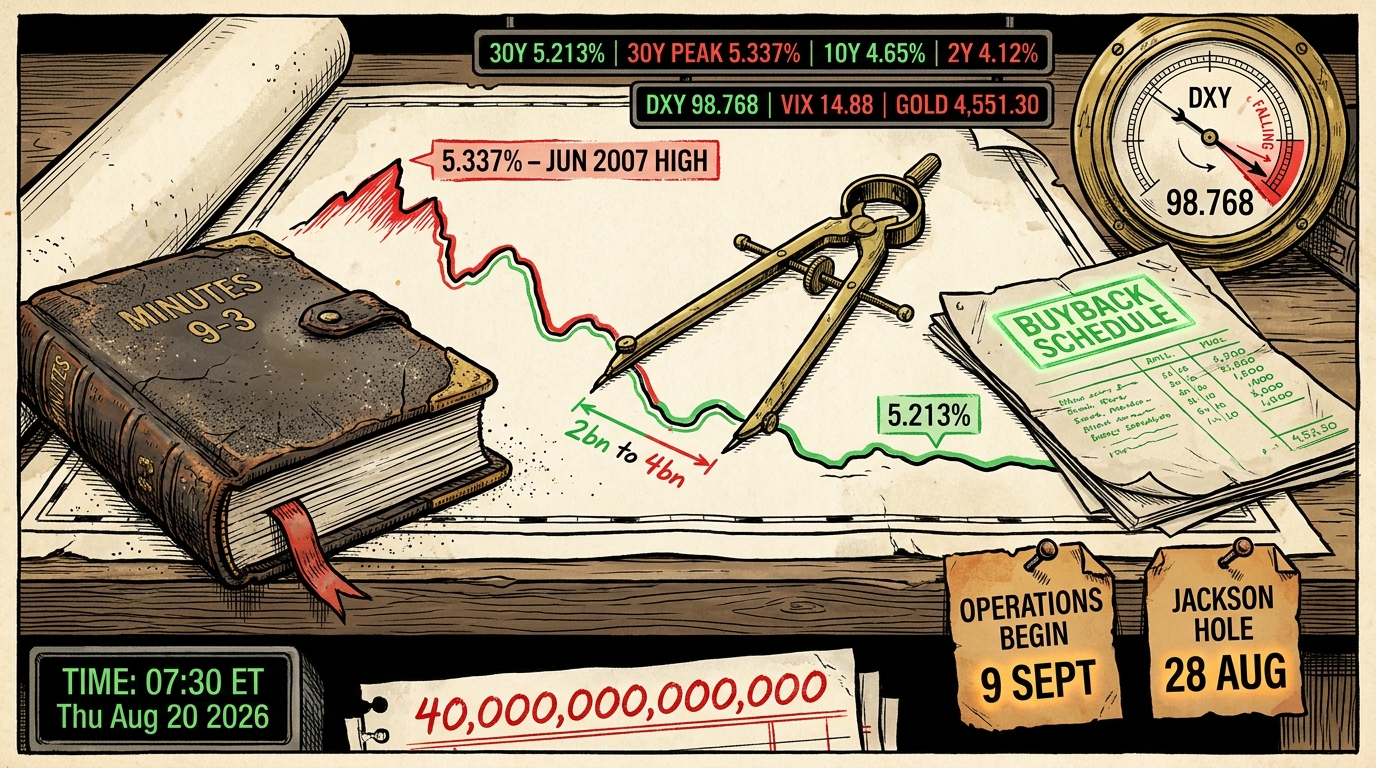
The Fed argued for tighter money and the long end took its orders from somebody else entirely
⚓ Weathervane. The wind is still coming from the long end. The policy rate has been frozen at 3.50% to 3.75% since July whilst the term premium does the tightening, and the price of long money is set by deficits, issuance supply and a synchronised global duration bid rather than by the committee. The cruise ship is holding this heading.
 Ahoy there, Trader! ⚓️
It’s Phil…
The common assumption is that the Federal Reserve sets the price of money and everything else is downstream. Wednesday tested that, and the result is odd enough to sit with.
If a 2bn dollar tweak to a buyback operation moves the long end further than the Fed’s own minutes, who is actually setting the price of long money?
Take the sequence as it happened. On Monday the 30-year yield touched 5.337%, its highest since June 2007. That level had already survived payrolls at minus 23,000, a soft July CPI and retail sales at minus 0.6%. Three pieces of evidence that the economy is cooling, and the long end ignored all of them.
On Wednesday afternoon the Treasury said that from 9 September its liquidity buyback operations in the 10-year to 20-year and 20-year to 30-year sectors would go from 2bn dollars each to 4bn dollars each. The 30-year fell 7.2bp to 5.213%, the 10-year eased to about 4.65%, and the dollar slid to a three-month low at 98.768.
An hour later the Fed published the July minutes. Held by 9 votes to 3. Several participants wanted an immediate 25bp increase. Many judged further tightening likely necessary. The 2-year, the instrument that exists to price exactly that, sat near 4.12% and did not budge.
The textbook has the central bank setting the short rate, expectations setting the long rate, and the fiscal authority as a price taker who turns up at auctions and pays what he is charged. What happened is that the price taker changed a size field and the curve moved, whilst the price setter published its reasoning and nothing moved at all.
Part of this is simple staleness. The July meeting is three weeks and three soft prints old, so the minutes arrived already spent.
The harder half is that federal debt passed 40tn dollars the same afternoon, and the doubled operations do not begin for three weeks and have not bought a single bond. The long end repriced on a promise of future purchases funded by future issuance, which is an odd thing for a market worried about issuance to celebrate. If that reading holds, the calm under a VIX of 14.88 rests on an announcement rather than a purchase, and the first real test is Jackson Hole on 28 August.
We may need to wait for the 9 September operations before this settles.
Phil’s Musing
The sequencing is what I keep circling back to. Debt through 40 trillion and a doubled buyback in the same afternoon, and the market read the second and ignored the first. The constraint being priced right now is liquidity in the long end, not solvency, and those are very different worries living in the same instrument. I am content holding the Weathervane where it is. The thing worth watching before doing anything more is whether the 30-year holds under 5.30% through the next auction cycle with no operation having actually run.
Happy trading,
Phil
Less Brain, More Gain
…and may your trades be smoother than a cashmere codpiece
P.S. – Phils Footnote I have spent years assuming that if I want to know where rates are going, I read the Fed. On Wednesday I read the Fed carefully, understood it, and would have been positioned exactly wrong. The thing that mattered came from a different building in language so dull I nearly skipped it. Read the boring one first, apparently.