Twelve basis points of argument at thirty years, and not one at two
⚓ Weathervane. The wind is coming from the long end. The policy rate has been frozen at 3.50% to 3.75% since July whilst the term premium does the tightening, and the price of long money is set by deficits, issuance supply and a synchronised global duration bid rather than by the committee. Higher-for-longer has stopped being a Fed decision and become a bond-market fact. The cruise ship is holding this heading, and this week it held it through a direct attempt to turn the wheel.
 Ahoy there, Trader! ⚓️
It’s Phil…
When the front end refuses to move for four straight sessions, is the Fed being ignored, or is nobody left to price it?
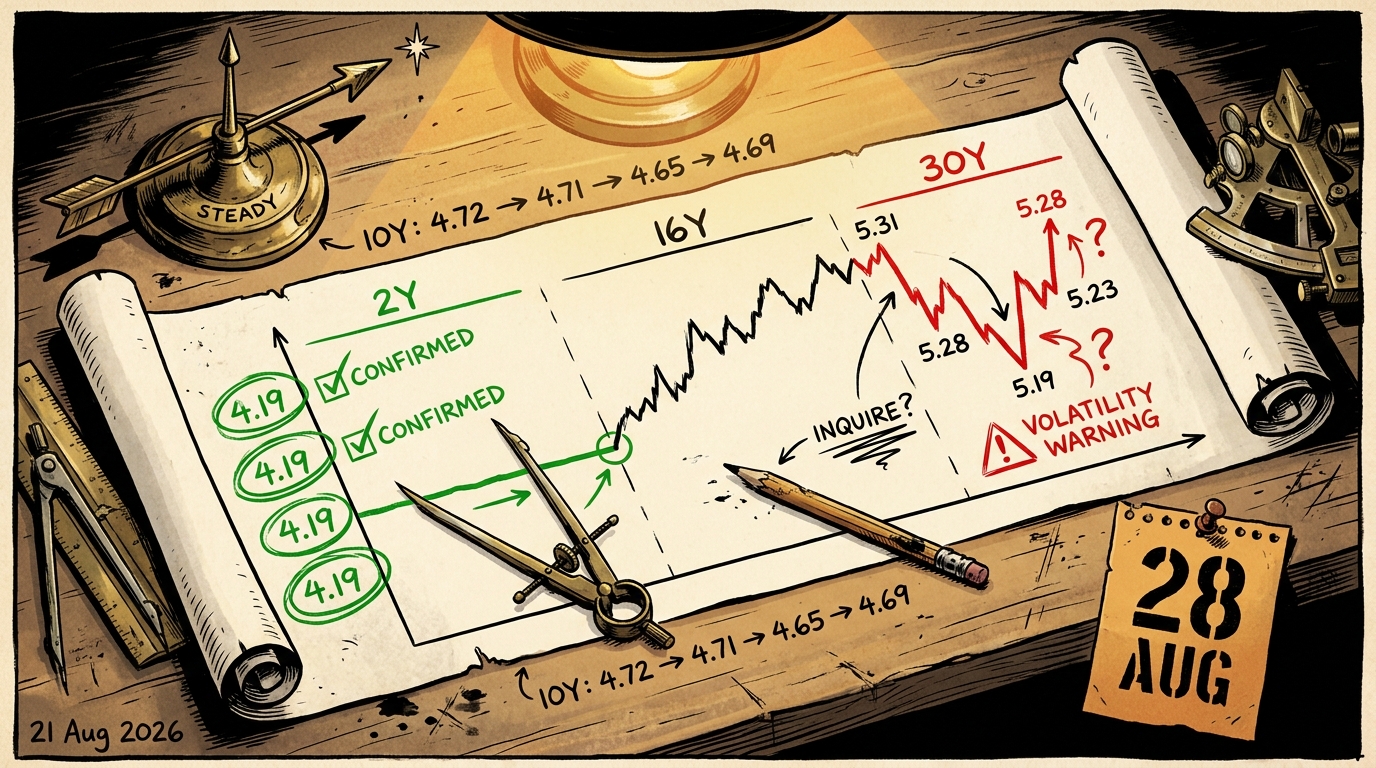
Here is what we are working from. The US Treasury daily par yield curve puts the 2-year constant maturity at 4.19% on 17 August, and at 4.19% on the 18th, the 19th and the 20th. Four identical closes. Across the same four sessions the 30-year printed 5.31, 5.28, 5.19 and 5.23: a 19-year high followed by a 12 basis point round trip.
Those four sessions were not quiet. They contained hawkish July FOMC minutes in which several participants favoured an immediate increase, a mid-quarter and off-schedule decision by the Treasury to at least double its long-dated buyback operations, and that intervention giving back 44% of its effect within a day. The Dow lost roughly 700 points on Thursday. Crude reached a one-month high, gold took 4,638 dollars, and bitcoin added around 20% whilst spot funds absorbed 800 million dollars.
Everything moved. The one thing built to move on exactly this kind of news did not.
The common assumption, and most desks would take it, is a fully priced hold. The committee is on pause, the market believes it, and a settled view produces a settled price. That is tidy and it may well be right.
What gives us pause is the shape of it. A settled view usually still breathes. It wobbles a basis point on a hawkish paragraph, then comes back. Four identical prints through a document in which officials discussed hiking is not a market that concluded something calmly. It is a market that did not respond at all, which is a different phenomenon.
The textbook says a surprise sovereign intervention in the long end should transmit. Cap the far end of the curve and you have eased financial conditions, which raises the odds the central bank must lean the other way, which moves the front end. The front end did not receive the message. Meanwhile bitcoin and gold, which have no view on the reaction function at all, received it enthusiastically.
That gap is the thing. If transmission has been rerouted through term premium and hard assets, the front end is not wrong, it is simply no longer where the question is being asked. And an instrument that has stopped being asked questions eventually stops being able to answer them.
We might need to wait for more clues. Warsh speaks at Jackson Hole a week today, which is the cleanest available test: if the 2-year does not move on that either, the silence is structural rather than seasonal.
Phil’s Musing
The four identical prints are the part I keep turning over. I have spent years treating the 2-year as the honest instrument, the one that tells you what people actually believe rather than what they say on television, and it has gone quiet through minutes in which officials discussed hiking. My lean is that the audience has left rather than that the belief is unanimous, and if that is right the thing to watch into September is not what the committee says but who is left in the room to price it.
Happy trading,
Phil
Less Brain, More Gain
…and may your trades be smoother than a cashmere codpiece
P.S. – Phils Footnote I will admit something. I looked at that column of 4.19s three times because I assumed I had copied the same row down by mistake. I had not. My honest first reaction was not “interesting signal”, it was “surely that is a data error”, and I would rather say so than pretend I had it filed under something clever.
🗂 Desk Notes – Part 194 | 21 Aug 2026
Published beneath the Macro Edge essay as the “show the working” appendix. Observations, not trades.
Session read
SESSION BRIDGE: prior session (Thursday 20 Aug) full reaction: S&P 500 -0.87% to 7,641.16, Nasdaq Composite -1.00% to 26,067.17, Russell 2000 -1.34% to 2,992.43, Dow roughly -700 points or -1.31%, VIX +7.52% to 16.01, 30-year CMT +4bp to 5.23%, 10-year +4bp to 4.69%, 2-year unchanged at 4.19%, WTI +2.7% to about 86.80 dollars, bitcoin +4.43% intraday and continuing overnight; live premarket ES +0.29% / NQ +0.45%, VIX -1.37%; threshold: soft, and it fires because the catalyst is unambiguous.
Threshold working. The S&P move sits below the 1% normal envelope, but the Dow at -1.31% lands inside the 1.3% to 2% investigate band and VIX added 7.52%. Under §8.4.1 a soft trigger fires only where a clear catalyst exists. It does: the Treasury buyback reversal is named, dated and mechanical. Carry-over fires.
Premarket at +0.29% on ES is inside the normal 0.3% to 0.6% band and is not flagged as abnormal in its own right. Read it as a stabilisation, not a recovery: it recoups under a third of Thursday’s cash loss.
Catalyst timing guard. No late catalyst on Thursday. The buyback reversal was a continuous all-session repricing rather than an afternoon shock, so the cash close is a fair representation of the full reaction. The overnight tail belongs almost entirely to crypto, which continued advancing whilst equity futures went sideways.
The mechanism read (full)
What moved.
Front end. The 2-year constant maturity closed at 4.19% on 17, 18, 19 and 20 August. Four consecutive identical prints, source US Treasury daily par yield curve. Across that window the 30-year printed 5.31, 5.28, 5.19, 5.23 and the 10-year printed 4.72, 4.71, 4.65, 4.69.
Long end. Wednesday’s Treasury announcement, mid-quarter and off schedule, at least doubles per-operation buyback size for the 10-to-20-year and 20-to-30-year sectors from 2 billion dollars to 4 billion, effective 9 September through 4 November. The 30-year fell 9bp on the day. Thursday returned 4bp. Roughly 44% of the relief reversed before a single operation runs.
Dollar. DXY at 98.841, up 0.07%, having registered 98.8 on Wednesday. Effectively inert across a 12bp round trip in the long bond and a new high in gold.
Volatility. VIX 16.01 Thursday, up 7.52% from 14.89. Premarket 15.80. Three sessions of compression giving way, then partially reasserting.
What it implies.
The causal chain on Thursday runs long end first, equities second. Walmart at -6.8% and crude at a one-month high are real and they contributed, but neither writes 30-year bond prices, and the yield reversal was underway across the curve’s long half in instruments Walmart does not touch. The equity move is downstream.
The genuinely unusual observation is the absence at the front. A 19-year high, hawkish July minutes, a surprise sovereign intervention and its failure inside 24 hours produced zero basis points of movement in the instrument that exists to price the policy response. Two readings are available and the data does not yet separate them: either the market has fully priced a hold and there is nothing left to express, or the front end has stopped being the venue where the argument happens and the repricing has migrated entirely into term premium and hard assets.
The one artery.
The 2-year at 4.19%, four times. Everything on the board moved except the instrument whose job is movement. That is the edition, and it is what the AVE crowns and Macro Edge takes apart.
Forward catalyst slate
- Friday 21 Aug. No major scheduled earnings or data. A thin tape into a weekend after a week of large moves is its own risk, particularly with crypto extended.
- Tuesday 25 Aug. August Consumer Confidence, July new home sales. Earnings from Intuit, Zoom, Dick’s Sporting Goods, Bank of Montreal.
- Wednesday 26 Aug. July PCE and core PCE, personal income and spending, second-quarter GDP second estimate, July durable orders. Nvidia reports after the close at roughly 5 trillion dollars of market value against a circulating bar of 91 billion dollars in revenue.
- Friday 28 Aug. Warsh keynote at Jackson Hole. The pre-registered killer for the Part 193 shot and the new Part 194 shot alike.
- Wednesday 9 Sept. The expanded buyback programme actually begins. Everything priced this week is priced on an announcement, not an operation.
- Standing observation. The programme runs to 4 November, which is the day after the 3 November midterm election. Worth noting without ascribing intent.
Divergence flags
- Same catalyst, opposite verdicts, 24 hours apart. Equities and the long bond marked the Treasury buyback expansion as a failure on Thursday. Spot bitcoin funds took 606 million dollars on the same session, up from 517.19 million the day before, explicitly attributed by market participants to the same announcement. Two markets, one press release, two conclusions. This is the cleanest divergence on the board and it is unresolved.
- The front end’s silence. Twelve basis points of round trip at 30 years, zero at 2 years, across four sessions containing a 19-year high and hawkish minutes. Flagged as the primary anomaly.
- The dollar’s second non-response. DXY effectively flat through a 4bp long-end backup whilst gold reached 4,638.20 dollars, up 1.46% and back above its 200-day average. The 20 August notes recommended standing this candidate down after one anomalous session. That recommendation now looks premature: this is a second instance, and the pairing of an inert dollar with a new high in gold is the hard-asset bid rather than normal transmission. Recommend the candidate is re-opened rather than stood down. Reversal of our own prior recommendation, noted deliberately.
- Walmart’s shape. Beat on profit, missed on comparable sales. The margin held and the volume did not. A consumer-weakness signal that does not show up in an earnings-beat headline, and it sits oddly beside initial claims falling to 206,000 from a revised 212,000.
- Crude versus inventories. WTI at a one-month high on a sanctions announcement in a week US crude inventories rose 4.4 million barrels. The premium is being paid for language, not for barrels.
⚓ Weathervane and regime status
Weathervane, carried unchanged. The wind is coming from the long end. The policy rate has been frozen at 3.50% to 3.75% since July whilst the term premium does the tightening, and the price of long money is set by deficits, issuance supply and a synchronised global duration bid rather than by the committee. Higher-for-longer has stopped being a Fed decision and become a bond-market fact.
The refinement question from 20 Aug now has an answer. Phil was asked to call whether naming the debt manager as an active participant was a refinement or a rewrite. Thursday answers it: the debt manager is an active participant and is not a price setter. It moved the level deliberately and the market returned 44% of the move inside a session, before the programme runs. That is a refinement of the existing heading, not a change of heading. Recommend the Weathervane rides unchanged and the refinement is folded in at MIP 11.0 rather than rewritten mid-week. Phil retains the call.
⚓ REGIME FLAG: not tripped. The dispersion candidate advanced again, in a new form. Previous instances were geographic (Korea against the S&P). Thursday’s is cross-asset: bitcoin +7.67% against a Dow down roughly 700 points, on the same catalyst. Fourth consecutive session of the pattern. It has not tripped because the tripwire is specified on index-level S&P conditions and cannot see it.
Sensitivity read (§17.3): running LOOSE. Fourth edition carrying this. The condition set missed a 5.5% Korean drawdown, a 6.19% Korean recovery, and now a 20% three-session move in bitcoin against a 1.3% Dow decline. A tripwire that cannot see any of those is not calibrated for what this market is doing. Standing recommendation, unchanged and now four editions old: add a dispersion leg to §8.4.1 firing when a G20 equity benchmark moves 4% or more in a single session in either direction whilst S&P futures move less than 0.5%. Suggest extending it to a cross-asset leg on the same logic. Phil calls it.
Public tell. HOLSTERED. “Hoist the mainsail, the macro winds have changed” stays unsaid.
Carry-over note (§10.6) – fires this edition
The noteworthy thing is not that Thursday was down. It is that Wednesday’s rescue had a 24-hour shelf life and the instrument that should have arbitrated the argument did not turn up. The tiers take it at increasing depth: AVE lands it as the deflating verdict on four identical prints, the Snippet takes the one-liner about a warranty shorter than a supermarket sandwich, and Macro Edge does the actual dissection of what an inert front end means.