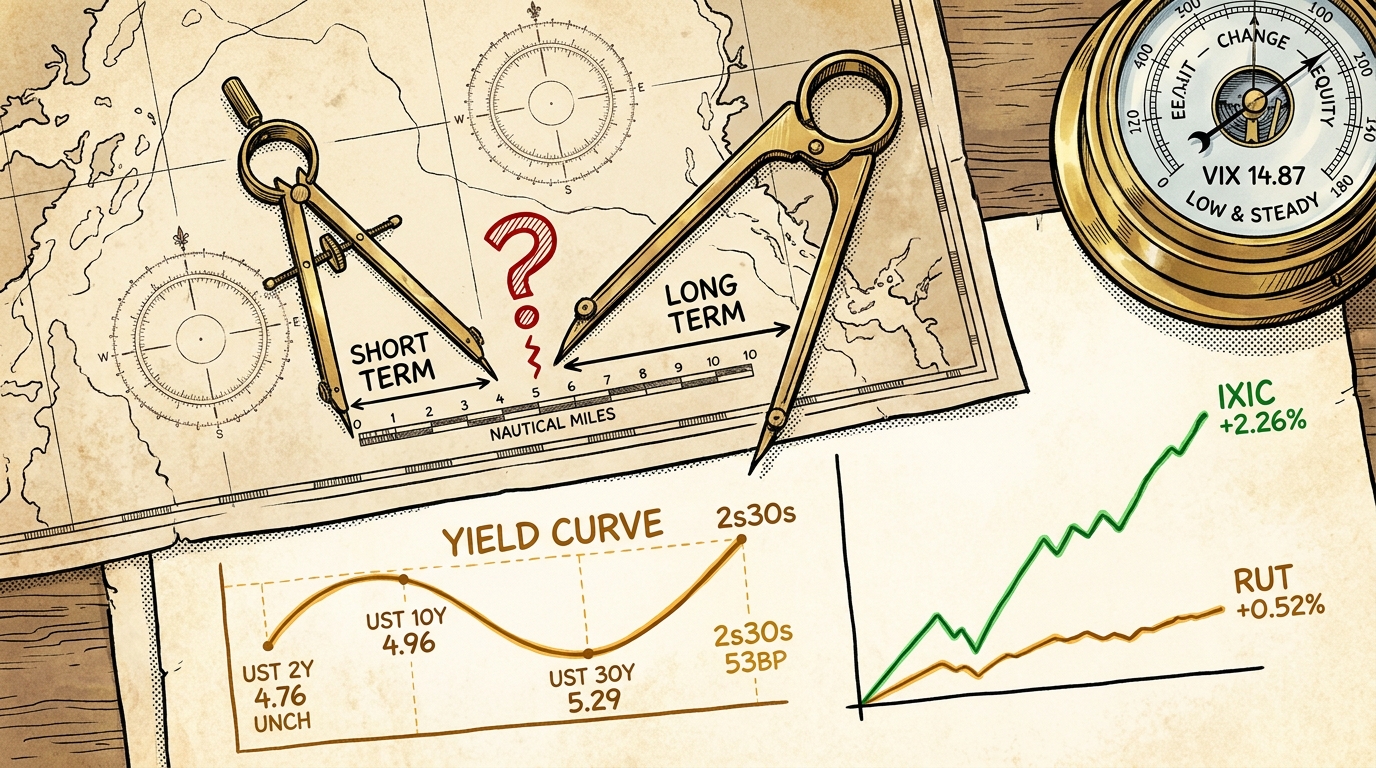
One cohort borrows. The other does not. Only one of them moved.
⚓ Weathervane. The wind is coming from the long end. The policy rate has been frozen for most of the year whilst the term premium does the tightening, and the price of long money is set by deficits, issuance supply and a synchronised global duration bid rather than by the committee. Higher-for-longer has stopped being a Fed decision and become a bond-market fact. The cruise ship is holding this heading, though Monday is the first session in some weeks that argued against it: a policy voice moved the whole curve and compressed the term premium rather than widening it. One session does not turn a ship, and we are logging it rather than steering on it.
 Ahoy there, Trader! ⚓️
It’s Phil…
The Russell managed 0.52% on the day the Nasdaq managed 2.26%, so which of the two is telling us what money actually costs now?
Start with the bond market, because it moved first and on something specific. The Chicago Fed president spoke in London and said plainly that the route back to target would be painful, that pushing inflation down quickly means pushing employment below target, and that the further increase pencilled in for late 2026 would likely not be enough if the inflation proves demand-driven.
The curve’s response is worth sitting with. Bills and the one-year rose. The five through thirty-year all fell, each by three to five basis points. The two-year, oddly, did not move at all, holding 4.76%. The market bought the argument at both ends at once: more tightening soon, less growth later. 2s30s compressed to 53 basis points, the tightest of the 14 to 21 September window. The dollar agreed, firming to 100.43. Most desks would call that a coherent hawkish session, and we think they would be right.
Then look at what equities did with it. If money is dearer for longer and growth slower as a result, the textbook says the assets that suffer most are those whose value sits furthest out in the future, and that small caps, borrowing at floating rates and refinancing constantly, ought to be sensitive too.
What happened was the inverse. The longest-duration equities in the index led, three technology names supplying most of the advance, whilst the Russell 2000, the cohort with the actual debt, managed 0.52% on four-fifths of its normal volume.
One caution, because it bears on the weight this carries: advance-decline data could not be retrieved on three routes, so the dispersion above is a proxy for breadth, not a measurement. Two readings, and we cannot yet separate them. Either the market has concluded that a handful of balance sheets are now indifferent to the cost of capital, which is a claim about concentration rather than a view on rates. Or the equity market was not listening, which the volatility market rather supports: implied volatility closed at 14.87, with only two September sessions lower, on a day a policymaker said the forecast path may be insufficient.
The uncomfortable part is that both readings produce the same price action today and entirely different consequences tomorrow. The first survives Wednesday’s purchasing managers’ surveys. The second does not.
Phil’s Musing
The concentration argument is the one I keep coming back to, and I do not love where it leads. If four companies really can ignore the cost of money, then the index has stopped being a barometer of the economy and become a barometer of four capital structures. That is not a rates story at all. It is a market-structure story wearing a rates costume, and it would mean the signal I have been reading off the S&P for twenty years is measuring something narrower every year.
Happy trading,
Phil
Less Brain, More Gain
…and may your trades be smoother than a cashmere codpiece
P.S. – Phils Footnote I assumed, when I saw the headline number on Monday, that this was a trade-detente rally ahead of Thursday. I was wrong, and the thing that corrected me was not analysis but arithmetic: a genuine detente trade lifts small caps and industrials, and those two barely moved. I had reached for the narrative that was already in the air rather than the one in the table. Worth remembering that the tape usually arbitrates these things faster than commentary does, if you let it.