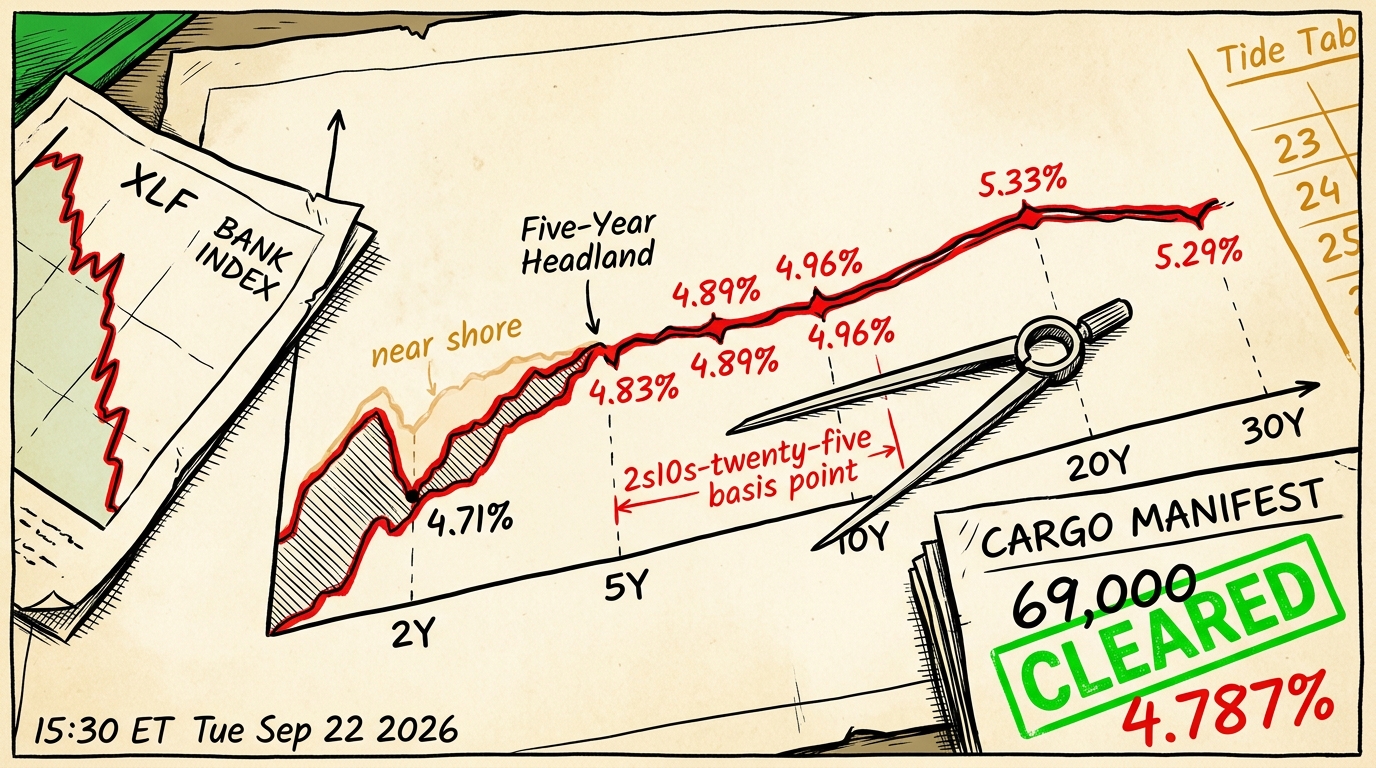
A $69bn auction, a five basis point steepening, and the heaviest sector loss on the board
⚓ Weathervane. The wind is coming from the long end. The policy rate has been frozen for most of the year whilst the term premium does the tightening, and the price of long money is set by deficits, issuance supply and a synchronised global duration bid rather than by the committee. Higher-for-longer stopped being a Fed decision and became a bond-market fact. The cruise ship is holding this heading.
 Ahoy there, Trader! ⚓️
It’s Phil…
The curve steepened five basis points and the banks were sold hardest of all, so which of the two has read the front end correctly?
Take the part most desks noted and moved past. Treasury brought $69bn of two-year notes on Tuesday and sold them at a high yield of 4.787%. The same auction cleared at 4.204% a month ago. Cover came in at 2.63, inside its recent run, and primary dealers went home with 13.19%, their largest share of the last six. Then the two-year yield fell five basis points to 4.71%, and every tenor from five years out printed Monday’s number a second time. The whole day’s curve movement happened inside two years, and all of it was a rally.
Now the expectation. A steeper curve is the thing bank chief executives have asked for on every earnings call for two years. Banks fund short and lend long; widen the gap and net interest margin widens with it. Tuesday delivered that widening and financials closed 1.97% lower, heaviest of the eleven sectors, on more than double Monday’s volume. JPMorgan opened at 352.00 and closed at 340.00, which is not a gap on news. It is a full session of selling.
The gap between those two things is worth sitting with, because the readings of it point opposite ways.
The first says the shape is right and the cause is wrong. A curve that steepens because the front end falls is a different animal from one that steepens because the long end rises. The first prices a policy path that stops sooner. Bank assets reprice off the front end quickly whilst deposit costs come down slowly, so a front-end rally ends the margin story rather than starting it. On that reading the banks read Tuesday correctly and the bond market simply bought a good price.
The second says the reverse. The front end took heavy supply at a much dearer yield on ordinary demand, then rallied regardless, which is a market with a settled view of where the rate lands. If that view is right, the tightening is nearer finished than the equity market believes, and the sector selling itself is the one in error.
One session cannot separate them, and the five basis points are the same to both. What we can say is which has more often been right this year when the two disagreed, and it is not the one that trades in shares.
Phil’s Musing
What holds my attention is that the long end did nothing whatsoever. Sixty-nine billion of supply, a Fed president with a speech titled “Why Hike?”, and five tenors printed the previous session’s numbers exactly. A long end that will not react to supply or to communication is not waiting for information. It thinks it already has the answer. That tilts me towards the bond market and away from the banks, whilst admitting the banks sit closer to their own revenue line than I do.
Happy trading,
Phil
Less Brain, More Gain
…and may your trades be smoother than a cashmere codpiece
P.S. – Phils Footnote Two numbers this book has been carrying turned out not to be what it thought. Brent November for 21 September was held at 101.49 and the exchange gives 100.34. December gold for the same session was held at 4,408.90 and COMEX gives 4,383.90. In both cases the sessions either side agree to the cent, which is the tell: these were single captures taken at a moment rather than settlements. The gold one is the more embarrassing, because the carry it implied was 66 dollars against the 41 this book had itself described a week earlier, and nobody noticed the arithmetic disagreeing with the prose. A carry sanity-check now sits on the morning list beside the contract-month one.