Seoul booked the best quarter in its history and lost eleven per cent. The number that did it was a gain.
⚓ Weathervane: The Fed has turned hawkish for the cycle, and the customer-side leg of the AI capex bill has confirmed. Alphabet, Tesla and IBM signed the same invoice inside one hour on Wednesday the 22nd; the price arrived on Thursday at $797 billion. The equity thesis now has to carry both the tightening regime and the AI margin bill, and ad revenue can fund the second only where the top line outgrows the spending.
 Ahoy there, Trader! ⚓️
It’s Phil…
Something strange happened in Seoul at dawn, and the surface reading is tidy enough that most desks will take it and move on.
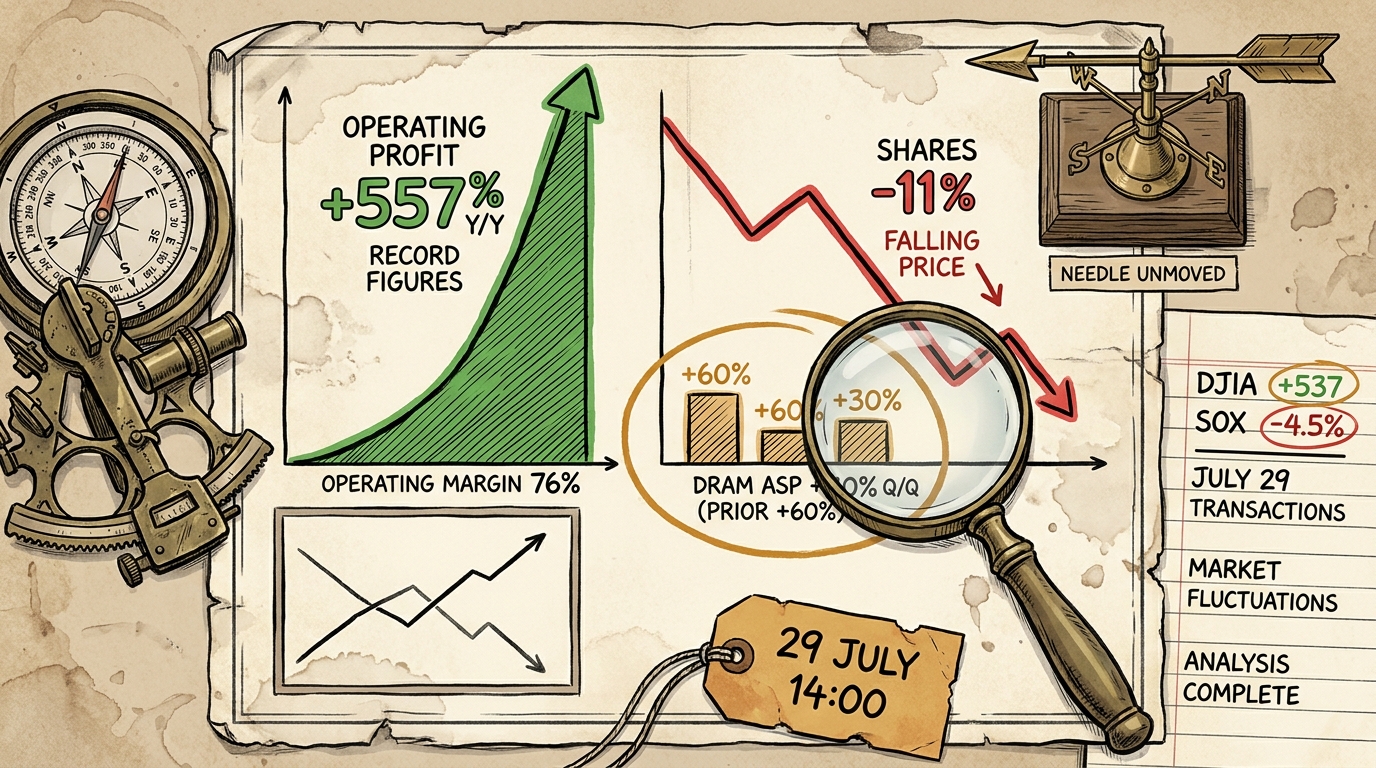
SK Hynix reported the best quarter in its corporate history. Operating profit of 60.54 trillion won, up 557% on the year. A 76% operating margin, the fifth consecutive record quarter, and first-half revenue through 100 trillion won for the first time. Revenue landed near 79.32 trillion won against a consensus closer to 84 trillion. The shares fell more than 11%.
The common assumption is that this is simply a miss. Company undershoots the number, company gets sold, on we go.
What is a record worth when the price that made it is slowing down?
Let us lay this week’s pieces side by side and see whether they make a picture.
The first piece is the pricing line buried in the release. DRAM average selling prices rose about 30% in the quarter. In the previous quarter they rose 60%. NAND rose 50% to 60%, against 70%. Every one of those numbers is a price increase.
The second piece is Tuesday’s American session. The Dow gained 537 points, six names supplying roughly 460 of them. Sherwin-Williams rose 8.3% and its chief executive said the quarter reflected pricing actions taken to offset raw material inflation. The Philadelphia Semiconductor Index fell 4.5% the same afternoon.
The third piece is Monday. A Shanghai state-backed group began mass-producing the immersion DUV lithography machines that were supposed to be beyond it. ASML lost 8.5% in Amsterdam.
The textbook is unambiguous about what should follow. Record margins and expanding AI demand ought to support a share price, and a modest miss on a fifth straight record is noise. The tape did the opposite. It sold the record and bought the paint.
One way the pieces fit is that the market has quietly changed what it pays for. Not the level of profit, which was extraordinary, but the direction of the price that produces it. A 30% price increase is enormous in almost any industry. It is only a disappointment if you had valued the company on 60% continuing.
What isn’t known is whether that repricing is right or merely quick. A slowing rate of increase is not a decline, and management guided confidently on demand beyond 2027. Separating a genuine turn from a crowded unwind takes more clues than one morning offers. The place to look is contract DRAM pricing for the coming quarters, because that is a number rather than a mood.
Warsh speaks at half past two. Microsoft and Meta report at the bell. None of the three will settle it. All three will move it.
Phil’s Musing
The lean I would hold loosely is that this is the market repricing pricing power rather than demand, and if that is right it shows up in contract prices, not share prices. One morning’s earnings and one very thin IPO float are not a regime turn. Tonight tells us whether the same rule gets applied to the customers as to the suppliers.
Happy trading,
Phil
Less Brain, More Gain
…and may your trades be smoother than a cashmere codpiece
P.S. – Phils Footnote I will own this one: when I first opened the SK Hynix release I assumed I had the wrong file. Record revenue, record margin, record profit, shares down double digits. My instinct was that the market had made a mistake, and I was fairly pleased with myself for spotting it. Then I found the 30% sitting underneath the 76% and realised the market had read the release rather more carefully than I had. A humbling way to start a Fed day.
🗂 Desk Notes | Wednesday, July 29, 2026
Raw briefing export. Observations, not trades.
Session read (§8.4)
SESSION BRIDGE: prior session (Tuesday) full reaction was a dispersion tape rather than a directional one, Dow +1.03% to 52,747.32 against Nasdaq Composite -0.22% to 24,876.91 and SPX +0.21% to 7,428.78, with SOX -4.5% and the memory complex down 9%, then an overnight tail carrying two separate catalysts, SK Hynix Q2 in Seoul and an Iranian ballistic missile attack on US forces; live premarket ES +0.15% / NQ -0.18%, VIX +0.49% at 18.29, crude +3.27%; threshold: soft.
Why soft and not hard. The index test is clean and says quiet: SPX +0.21% close-to-close is deep inside the sub-1% normal envelope, and premarket ES at +0.15% is well inside the 0.6% abnormal band. Nothing in the §8.4.1 percentage rule fires. What forces the soft trigger is the catalyst clause: there are two identified, dated, market-moving events in the overnight window, and crude at +3.27% is far outside any normal premarket range. That is the textbook soft-trigger condition, a clear catalyst without an index-level move, so the carry-over rides.
The trap in this tape. A reader looking only at the index prints would conclude nothing happened on Tuesday and nothing is happening this morning. Both readings are wrong. Tuesday moved roughly 5.5 percentage points of spread between the Dow and the semiconductor index inside a single session, and this morning’s equity calm sits on top of a barrel that has reversed three sessions of direction and a memory complex printing records into a falling share price. The flat index is an average of two violent halves.
The mechanism read (full)
What moved.
- Front end (2yr): last reliable print around 4.30%. No fresh same-session read captured before drafting, so treat the front end as a live variable rather than a fact today.
- Long end (10yr): 4.62% at Tuesday’s close, a third consecutive decline and the lowest in about a week, driven by the crude giveback. That driver reversed overnight when Brent added 3.42%, so the input that produced three sessions of falling yields is no longer present.
- Dollar (DXY): 101.393, -0.12%. This is the fourth consecutive event of opposite character the dollar has ignored: a de-escalation, a global equity rout, an exchange halt in Seoul, and now a re-escalation. A transmission mechanism that does not transmit is itself information.
- Volatility (VIX): 18.29, +0.49%. Above 18 for a sustained run. Compression stays broken. The notable part is the level, not the change: 18.29 into a rate decision with no projections plus two megacap prints is a market that is not paying for protection.
What it implies.
Yields fell for three sessions on an oil move that has now unwound. That makes the rates leg of this week’s tape backward-looking rather than causal. The dollar is inert across four events that should each have moved it. Vol is elevated but static. None of the three macro instruments is driving anything today, which is unusual on a Fed day and points the artery somewhere else.
The one artery: memory pricing, specifically the second derivative of it.
SK Hynix reported the best quarter in its corporate history at dawn in Seoul. Operating profit KRW 60.54tn, up 557% year on year. Operating margin 76%, gross margin 83%, net margin 118%, fifth consecutive record operating profit, first-half revenue through KRW 100tn for the first time. Revenue KRW 79.32tn against consensus near KRW 84tn. Shares fell more than 11% intraday.
The causal line is not the consensus miss. It is the pricing disclosure underneath it. DRAM average selling prices rose approximately 30% quarter on quarter against 60% in Q1. NAND rose 50% to 60% against 70%. Both are increases. Both are roughly half the previous rate of increase. The market did not sell a profit level, it sold a rate of change in the input that produces the profit level.
That reading is corroborated by the equity tape one session earlier, which is what makes it an artery rather than a single-stock story. On Tuesday, six Dow members supplied roughly 460 of a 537-point index gain, led by Sherwin-Williams at +8.3%, Coca-Cola at +5% and Boeing at +4.8%, whilst the semiconductor index fell 4.5%. Sherwin-Williams management explicitly attributed the quarter to pricing actions taken to offset raw material inflation. The session paid for demonstrated pricing power and sold decelerating pricing power, across completely unrelated sectors, on the same day.
The third input, under-weighted in Part 176. Monday’s chip selloff was not solely the CXMT listing. Reporting that a Shanghai state-backed group had begun mass-producing immersion DUV lithography machines landed the same session, with deliveries indicated to SMIC, CXMT and Hua Hong, five units targeted this year and roughly 20 in 2027 against ASML’s planned 130 for 2026. ASML closed 8.5% lower in Amsterdam. Part 176 built its supply-side read on CXMT alone. The tooling story is the more structural of the two, because it addresses whether Chinese capacity expansion is constrained by export controls at all, and Congress is advancing the MATCH Act to block exactly those tools. Logging the omission rather than quietly folding it in.
Forward catalyst slate
- Today 14:00 ET: FOMC decision. Range expected to hold 3.50% to 3.75%, a fifth consecutive meeting without a move since the December 2025 cut. No dot plot published.
- Today 14:30 ET: Warsh press conference. With no projections, the Q&A carries the entire forward signal. September pricing near 80%.
- Today post-close: Microsoft and Meta. Meta consensus revenue $60.2bn, +27% year on year and decelerating from 33% in Q1, EPS around $7.18, against 2026 capex guidance already raised to $125bn to $145bn. This is the direct test of two open ledger shots.
- Today: Lam Research, Arm, Qualcomm, Starbucks, Procter & Gamble, General Dynamics, Aon, Vertiv.
- Thursday July 30: Q2 GDP advance, June PCE and core PCE, ECI. Apple and Amazon post-close.
- This week: Strategy Q2. Consensus a $2.19 per-share loss on $121.88M revenue, against 843,775 bitcoin at an average $75,476 and a paper loss above $8bn.
- Coiled: contract DRAM pricing for Q4 2026 and Q1 2027. That, not any share price, is the falsifiable version of the supply-side question.
Divergence flags
- Dow +1.03% against SOX -4.5% in one session. A 5.5-point spread. This is dispersion, not de-risking, and it has now run two consecutive sessions in the same shape.
- Record operating results met a double-digit decline. Five consecutive record quarters and a 76% margin were insufficient against a halving in the rate of price increase. The market is discounting the derivative, not the level.
- Gold at $4,041.20, +0.06%, through a ballistic missile attack on US forces. Second consecutive event on which gold failed to function as a haven. It also sits below the $4,050 level a live ledger shot requires it to hold.
- DXY -0.12% across four events of opposite sign in four sessions. De-escalation, rout, exchange halt, re-escalation. No response to any of them.
- VIX 18.29 into a no-projections Fed day plus two megacap prints, with crypto desks separately reducing put cover. Two unrelated venues removing protection ahead of the same afternoon.
- Crude +3.27% and equity futures +0.15%. Equities have now ignored a 4.3% crude fall and a 3.4% crude rise within 18 hours of each other.
- Apple touched $5tn on declining capital spending whilst its memory suppliers were marked to 52-week lows, and Apple is separately reported to be seeking waivers to source memory from Chinese suppliers. The customer is being rewarded for the cost the suppliers are being punished for.
Carry-over note (§10.6)
The noteworthy thing about Tuesday is not that the market went up or down, because it did neither in any meaningful sense. It is that a 537-point Dow advance and a 4.5% semiconductor decline happened inside the same six and a half hours, and the connective tissue between them was pricing power. Sherwin-Williams raised prices and was paid for it. SK Hynix raised prices by half as much as last quarter and was charged for it. The index numbers averaged that into approximately nothing.
Ladder: AVE takes the deflating nod at paint outrunning silicon. Snippet takes the one-liner. Macro Edge takes the dissection of why a record became a liability.
Part C read (regime, §17)
⚓ Weathervane: carried UNCHANGED into this edition. Both existing legs stand. The candidate third leg logged in Part 176, the revenue-side question of whether the shortage stays expensive, received its first hard corporate confirmation this morning rather than an IPO print. That is a genuine strengthening. It is still not a rewrite, because the two scheduled events that bear on the existing legs, the Warsh presser and Meta’s capex line, both land after this edition is filed. The rewrite candidate moves to tomorrow with all three data points in hand.
⚓ REGIME FLAG: chipflation supply side, remains SOFT. Strengthened, not hardened. The stated hardening condition in Part 176 was explicit: hardens if SK Hynix guides DRAM pricing lower on Wednesday morning. It did not. The company reported decelerating price growth and management guided optimistically, citing demand beyond 2027, ten long-term client agreements and HBM4 mass shipments now underway. A deceleration in the rate of increase is not a decline, and the flag does not harden on a technicality. What did strengthen is the market’s willingness to trade the deceleration as though it were a decline, which is a sentiment fact rather than a pricing fact. The falsifiable version remains contract DRAM pricing for Q4 2026 and Q1 2027.
Sensitivity read (§17.3): HIGH-TIGHT, hold at yellow. Today is a direct argument for keeping it there. A looser setting would have hardened the flag this morning on a headline that superficially looked like confirmation and technically was not. The tight setting caught the difference between decelerating growth and falling prices, which is precisely the distinction the whole thread turns on. Recommendation: hold at yellow through tonight’s Meta and Microsoft prints and reassess tomorrow.
Public tell: NOT triggered. “Hoist the mainsail, the macro winds have changed” stays holstered.