A 29,000 payrolls print, a 7.8 basis point rally, and 196% of it handed back
⚓ Weathervane. The wind is coming from the long end. The policy rate has been frozen for most of the year whilst the term premium does the tightening, and the price of long money is set by deficits, issuance supply and a synchronised global duration bid rather than by the committee. Higher-for-longer stopped being a Fed decision and became a bond-market fact. The cruise ship is holding this heading.
 Ahoy there, Trader! ⚓️
It’s Phil…
If 29,000 jobs will not move the front end, what will?
The common view of Friday is cheerful. A soft employment report arrived, the cycle looks finished, and everything risky rose. Volatility finished at 15.31, its lowest close since 25 September.
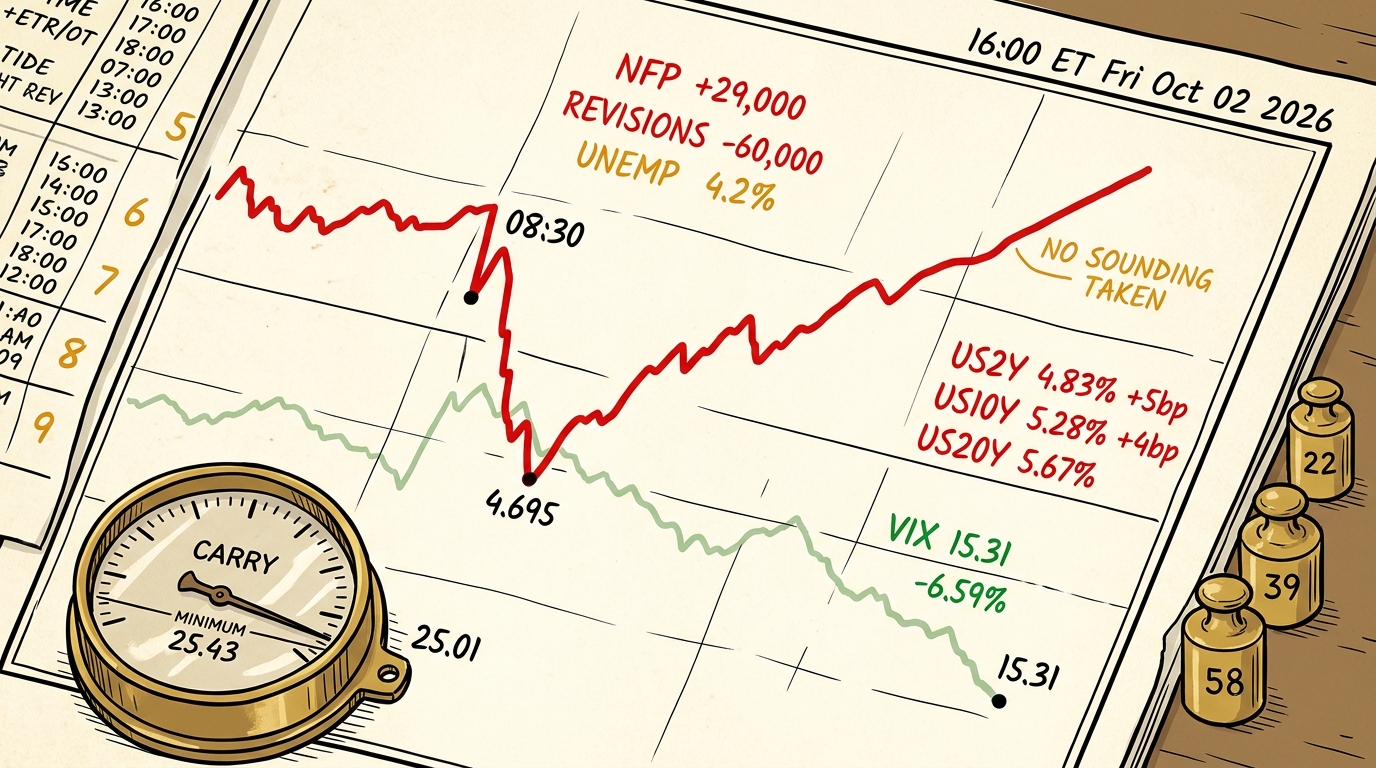
Now look at the release. September delivered 29,000 jobs, unemployment rose to 4.2%, and earnings growth slowed to 3.0% on the year. The statisticians also restated July from plus 21,000 to minus 10,000 and August from 162,000 to 133,000, removing 60,000 jobs from months already reported. The release gave 29,000 and took back 60,000.
The two-year Treasury closed at 4.83%, five basis points higher.
Here is the part that keeps catching us, and it is timing rather than direction. For one five-minute bar the front end behaved exactly as the textbook requires. At 08:30 the two-year and the ten-year both printed their session lows inside that single bar, falling 7.8 and 6.7 basis points. That is a clean release-to-price fingerprint, and the only causal moment of the day.
Then the afternoon took it back. The two-year retraced 196% of the move it had just made, the ten-year 210%. Nothing we can find explains it. No Board governor spoke, and the one Fed president who did gave welcome remarks at a migration workshop and said nothing about rates. Her 50-basis-point remark came the day before, so it cannot be Friday’s cause. An afternoon of repricing with no author.
Most desks would say the textbook expectation is plain enough: a weakening labour market lowers the expected path of policy, so the front end should fall and stay fallen. Friday delivered the first half for 300 seconds and then reversed it. That gap is today’s product.
Two readings fit and we cannot separate them. The first is that the front end has stopped treating labour data as policy-relevant, because the committee hiked in September into a slowing economy and a regional president promised more on Thursday. The second is duller: with three coupons and the minutes arriving this week, Friday afternoon would be supply being made room for.
One measurement might separate them, and it is the oddest thing on the desk. Gold’s aligned carry, the December future against spot on a matched hour, printed 25.01 on Friday, below a floor that had held ten sessions. Carry should widen as rates rise, and rates rose. A front end selling off whilst carry compresses looks like funding, not policy. If it persists through the auctions, the second reading wins.
Phil’s Musing
What I cannot get past is that the bond market got five honest minutes and then argued itself out of them. When a market reverses on news it usually reverses on different news, and there was none. That makes me think Friday afternoon was mechanical rather than interpretive, and mechanical would point at supply. So I treat the 29,000 as a real datapoint the front end declined to trade.
Happy trading,
Phil
Less Brain, More Gain
…and may your trades be smoother than a cashmere codpiece
P.S. – Phils Footnote I want to own a small thing, because it was nearly a large thing. My first read of the revisions had July at minus 10,000 and treated that as the revision itself, which would have put the two-month revision at well under its true 60,000. July’s revision is 31,000, because the month first printed at plus 21,000 and crossing zero is not the same as the distance from zero. Two numbers, one of them the level and one of them the change, and I had them in the wrong slots for about ten minutes. The lesson I keep relearning is that a decomposition has to be made to add up before it is allowed into a sentence, not after.
🗂 Desk Notes – Part 221 | 5 Oct 2026
Raw briefing. Observations, not positions. Everything below is held in lock_part221.json.
Session read (§8.4)
SESSION BRIDGE: prior session (Fri) full reaction +0.5632% on December ES, being a cash leg of +0.6894% and a post-close and weekend tail of -0.1254%; live premarket ES -0.1254% / NQ -0.1014%, VIX 15.31 prior-session official cash close; threshold: none.
Threshold reasoning. The full prior-session reaction of +0.5632% sits inside the normal envelope under §8.4.1, which puts the bridge silent below 1.0%. No carry-over note fires. The volatility leg did not fire either: VIX moved -6.589%, inside the ±8% soft trigger. The commodity leg did not fire: November WTI moved -1.8951%, inside the ±4% soft trigger. Three legs checked, three silent, so the silence is a measured result rather than a default.
Close-to-premarket window. Friday cash close 7,722.72 on the index; December ES settled 7,777.25, an index basis of +54.53 points. The 07:30 UK capture bar, stamped 2026-10-05T06:30:00Z, closed 7,767.50 on 1,342 contracts. The whole weekend therefore cost the December contract 9.75 points.
Premarket capture provenance. Two-read protocol run and clean for a seventh consecutive edition. Open, high, low, close and volume were byte-identical across both reads on all four December contracts, whilst the adjacent still-forming bar moved on all four in the same two responses, which is the control that makes the result evidence rather than assertion. Container clock verified against the bar stamp both before and after, rather than assumed.
Contract roll (§2.5). Not a roll window. The third Friday of September was 18 September and the third Friday of December is 18 December. December is front month for all four equity-index contracts, confirmed from Friday’s own volumes: ES 1,763,424, NQ 573,488, RTY 216,050, YM 84,975. In energy the two products run opposite ways and each was established from Friday’s own volumes independently: WTI front month is NOVEMBER at 327,902 lots against December’s 213,693, a ratio of 1.5345, whilst Brent front month is DECEMBER at 415,371 against January 2027’s 238,491, a ratio of 1.7417. The WTI finding is not carried across to Brent.
Permanent absence, recorded so it is not retried. There is no premarket VIX on this stack. CBOE:VIX at five-minute intervals terminates at the cash close and does not resume, and the tool’s own response states it carries no pre or post-market bars. The bridge therefore carries Friday’s official cash close explicitly labelled as a prior-session figure. A dated CFE:VX contract is a different instrument on a different basis and was not substituted.
The mechanism read (full)
What moved. The September employment report printed at 08:30 ET Friday. Payrolls rose 29,000 against a tier-2 consensus near 79,000. Unemployment rose to 4.2% from 4.1%. Average hourly earnings added 0.1% on the month and 3.0% on the year. Participation 61.8%, average weekly hours unchanged at 34.4. Private payrolls added 46,000, government shed 17,000, manufacturing added 9,000. U-6 fell to 7.6% from 7.7% even as U-3 rose.
The revisions, and the arithmetic is stated because it has to sum. July was restated from plus 21,000 to minus 10,000, a reduction of 31,000. August was restated from 162,000 to 133,000, a reduction of 29,000. 31,000 plus 29,000 is 60,000, which is the combined two-month revision. September’s 29,000 against that gives a net of minus 31,000 across the print and the restatement together. Both components share one date basis, the 2 October release, and the decomposition was recomputed before it was written.
The CMT curve, 1 and 2 October, in basis points of change.
| Tenor | 1 Oct | 2 Oct | Change |
|---|---|---|---|
| 1 Mo | 4.06 | 4.04 | -2 |
| 1.5 Month | 4.10 | 4.09 | -1 |
| 2 Mo | 4.13 | 4.11 | -2 |
| 3 Mo | 4.17 | 4.19 | +2 |
| 4 Mo | 4.26 | 4.26 | 0 |
| 6 Mo | 4.27 | 4.27 | 0 |
| 1 Yr | 4.44 | 4.46 | +2 |
| 2 Yr | 4.78 | 4.83 | +5 |
| 3 Yr | 4.91 | 4.96 | +5 |
| 5 Yr | 5.01 | 5.06 | +5 |
| 7 Yr | 5.12 | 5.17 | +5 |
| 10 Yr | 5.24 | 5.28 | +4 |
| 20 Yr | 5.64 | 5.67 | +3 |
| 30 Yr | 5.61 | 5.63 | +2 |
2s10s 46 to 45. 2s30s 83 to 80. 20s30s -3 to -4. The twenty-year at 5.67% is strictly the highest published yield of all fourteen tenors, by 4bp over the thirty-year, with nothing else above 5.28%.
What it implies, and where the causation stops. Causation is established for one bar and one bar only. On the tier-2 intraday path, TVC:US02Y printed its session low of 4.695 inside the 08:30 ET payrolls bar, falling 7.8bp in that bar, and TVC:US10Y printed its session low of 5.157 in the same bar, falling 6.7bp. Both lows were unique to that bar. That is a clean release-to-price fingerprint. What followed is not attributable. The two-year then retraced 196% of its payrolls move and the ten-year 210%, and there is no publishable catalyst inside the retracement. No Board governor spoke on 2 October. The Dallas Fed president did speak, and her primary text is welcome remarks to a workshop on migration carrying no policy, rate, target-range or payrolls content of any kind. Her explicit guidance of an additional 50 basis points or more was delivered on 1 October, the day before, and cannot be the Friday cause. The afternoon has no headline in it and none is manufactured.
The one artery. A 29,000 payrolls print, read two incompatible ways by two markets inside the same six hours. Equities priced the hiking cycle ending: S&P 500 +0.734% to 7,722.72, Nasdaq Composite +1.1881%, Nasdaq 100 +1.0044%, Dow +0.4917%, Russell 2000 +0.936%, ten of eleven sector proxies higher, VIX -6.589% to 15.31 and its lowest close since 25 September. The front end priced the opposite and won the afternoon. The spine is 29,000.
Breadth, and it is the cleanest reading in this window. NYSE advancers 1,646 against 1,081 decliners, a ratio of 1.522664. New 52-week lows fell to 68 from 180, which is the lowest count since 22 September. New highs rose to 27 from 11. Nasdaq advancers 2,859 against 2,076, a ratio of 1.377168, so both exchanges carried the same sign for the first time in several sessions. Up volume 739,908,273 against down volume 499,750,136 on a total of 1,257,932,420, giving shares of 58.8194% and 39.7279%. The unchanged-volume integrity residual reads 1.4527%, against a tracked series of 0.99%, 2.045%, 1.5037% and 1.6952%, so the Part 218 widening still has not persisted and this does not look like a feed change.
Cross-asset. The dollar index closed 101.923, down 0.11662% actual against a six-leg reconstruction of -0.09304% and a residual of -0.02358 percentage points. Sterling supplied the largest single leg at +0.3373%, with the euro leg almost absent at +0.056%, so this was not the euro event the prior session was. November WTI settled 91.11, down 1.8951%, on a 93.51 high and an 88.06 low; the same-date November-minus-December backwardation narrowed to 1.68 from 2.03. December Brent settled 102.25, down 0.0586%, essentially unchanged, with the December-minus-January 2027 spread at 3.54 from 3.88. Gold spot closed 4,138.45, down 0.931%, December futures 4,162.30, down 0.9519%. Silver December -1.2423%, copper December +0.1682%. Bitcoin marked 84,489.05, down 0.3951%; ether 2,667.80, down 1.3606%.
Overnight Excitement (§8.5)
Did not fire, and the numbers are recorded rather than the absence asserted. The trigger is US futures overnight movement above 1.0%. December ES moved -0.1254%, NQ -0.1014%, YM -0.0855% and RTY -0.0491%, so the largest leg cleared the 1.0% threshold by 0.8746 percentage points and the whole complex sat below the 0.3% floor of the normal band. Dispersion across the four contracts was 0.0763 percentage points, so all four sat inside 0.08 of a point of each other. No dispersion history is held, so no superlative is claimed. No non-US central bank decision, G10 policy speech or high-impact non-USD print landed outside US hours. Foreign indices are colour once the futures trigger fires and the futures did not fire, so no foreign index direction is carried and no level was sought. Quiet night, honestly quiet.
Forward catalyst slate
- Today, Monday 5 October. ISM services at 10:00 ET. Bills: 13-week $95bn and 26-week $82bn. Two small reporters, whose fiscal periods are not established from any company release and are therefore not printed.
- Tuesday 6 October. The 3-Year note, $58bn. Read it against its own trailing run of 2.68 on bid-to-cover, not against the headline size. A 6-week bill, $95bn. Constellation Brands, RPM and Lamb Weston report.
- Wednesday 7 October. The 9-Year 10-Month reopening, $39bn – the API’s own term string, and it is not a “10-year”. The September FOMC minutes at 14:00 ET, covering the 12-0 hike to 3.75% to 4.00%. A 17-week bill with no published size, because
offering_amtis null until announced. Levi Strauss and Applied Digital report. - Thursday 8 October. The 29-Year 10-Month reopening, $22bn, again the API’s term string and not a “30-year”. Bid-to-cover on this sector has risen five auctions running, 2.30, 2.33, 2.44, 2.39, 2.61, and September’s primary-dealer award share of 2.21% was the lowest of that five-auction window, meaning dealers were left with almost nothing. 4-week and 8-week bills, both unannounced and therefore unsized. PepsiCo, Progressive and Helen of Troy report.
- Friday 9 October. Michigan consumer sentiment, the week’s third tier-1 release. Delta reports.
- 🔴 MONDAY 12 OCTOBER IS COLUMBUS DAY. The bond market closes on the SIFMA recommendation and Treasury publishes no daily yield curve rate, so there is no CMT close that session. The lock corroborates it from the inside: the 13-week, 26-week and 6-week bills, which auction on Mondays, are scheduled for Tuesday 13 October. Any window enumerating sessions across that date must skip it.
- Coiled. Six Fed speakers across the week, two of them Board members and four Reserve Bank presidents, the latter visible only on a calendar that mislabels them “FOMC Member”. FOMC is a two-day meeting, 27 to 28 October, not a single day.
- What is NOT this week, confirmed against the Bureau of Labor Statistics own October schedule: no CPI, no PPI, no import or export prices, no retail sales, no FOMC decision. The week’s tier-1 items are ISM services today, the FOMC minutes Wednesday, Michigan sentiment Friday and the three coupons.
- Awards shares are derived, never published by the API. Each share is computed against the sum of indirect, direct and primary-dealer accepted. The API’s own
total_acceptedfield was not used: it includes add-ons and noncompetitive tenders and overstates by a variable 8.63% to 18.55%, enough to invert a well-bid auction into a weak one. - No tail is obtainable on any permitted route. No when-issued level exists here, so no tail will be published for any of the three coupons. The high yield is stated against the same-day CMT mark and the absence is stated plainly.
Divergence flags
- The headline divergence, and it is the edition. Two markets read one release in opposite directions inside six hours, and both moves were large enough to be real. Equities and the curve cannot both be right about October.
- Policy expectation against the curve. The tier-3 fed funds relay repriced toward a hold: a hold at the 28 October decision moved from roughly 71% to 82.8%, with a further 25 basis point hike falling from roughly 29% to 17.2%. So the relay went dovish on Friday whilst the two-year sold off five basis points. And the two relays conflict with each other: a second route, Zacks citing CME, put no change at 77.9% after the print against a 70.3% hike probability as at 29 September. Both are tier 3 and both are held at tier 3 rather than published: no reader-facing output carries either figure. The direction is named throughout, and the bucket orientation was checked by hand against the 3.75% to 4.00% range and is not inverted.
- Gold carry against rates. The aligned December-minus-spot carry printed 25.01, being the December settlement of 4,162.30 against the matched 14:00 ET spot mark of 4,137.29, which is 0.42 below the floor of a band that had held ten sessions at 25.43 to 39.49. The definition was re-verified before the breach was accepted, reproducing 1 October’s 32.10 exactly from the same method, so this is a genuine breach and not the artifact that was mistakenly cleared at Part 217. Carry has now compressed 35.25, 32.10, 25.01 across three sessions whilst the front end rose five basis points, and carry should widen as rates rise, not compress. This is the strongest unexplained reading on the desk.
- The attention gap, and it widened rather than closed. There is not one labour-related symbol across three Stocktwits boards at depth 25, nor on either Zacks attention window. Last edition the jobs conversation at least survived inside the long-bond ETF’s message stream; this morning that stream has moved to the ten-year, the dollar and the Treasury Secretary. The most consequential macro print of the month produced no ticker at all.
- Board-scope divergence set a record on one leg and tied on the other. Eighteen names shifted rank between the equities and all-asset boards, six were absent from the other board’s top 25 entirely, and one held an identical rank across both, which accounts for all twenty-five. Twenty-five symbols sat on one board but outside another’s top 25, the same count as the prior edition. Reading one board as another today would have produced eighteen wrong numbers and six missing names. Against Part 220’s fifteen shifts the rank leg is a record on a two-observation history, and that is stated rather than implied.
- Two flow rows arrived partial and neither is marked. The single largest issuer column renders blank on both cache-busted reads of the bitcoin product and two render blank on ether. Both rows reconcile to their own stated totals without them, which is exactly the shape that preceded a 23 September row publishing at plus $32.4m and completing at plus $346.9m. Both displayed cumulatives moved by precisely the partial row total, so both cumulatives are provisional too.
- The flow truncation model is refuted, not merely delayed. The earliest available row moved to 16 September against a carried prediction of 15 September. The ladder now reads 8, 9, 10, 11, 14, 14, 16: a one-session stall followed by a two-session step, which no per-edition erosion model produces.
- Rank is not attention, in both directions on one morning. X-Energy left all three boards with volume low and falling, which is a genuine fade. Bitcoin and Solana left boards with weekly volume rising 6.82% and 14.58%, which is not. Reported separately for every name.
- Health care was the only sector lower, at 0.012%. On a ten-of-eleven-higher session that is not a rotation signal, and it is flagged here so nobody writes it up as one.
- The sector block is single-route and unreconciled. The cap-weighted index route died on 1 October and the block runs on SPDR sector ETF proxies at tier 2, labelled as proxies. The one route that has ever reconciled the block independently did not carry it this morning. Any cross-edition sector comparison spanning 30 September needs a basis note, because proxies and cap-weighted indices are not directly comparable.
Regime and sensitivity read (§17.3)
Running LOOSE, thirty-second consecutive edition, stated openly rather than presented as neutral. The diagnosis is unchanged and remains specification rather than tuning.
Friday produced three regime-grade observations and the tripwire saw none of them. A labour print that reversed the policy trade and moved the front end the wrong way. A carry measure breaching a ten-session band in the direction rates say it should not. And a breadth reading in which, for the first time in six sessions, the advance-decline ratio and every other participation measure pointed the same way.
Recommendation order, carried from Part 220 with one addition.
- The intraday-path requirement on the turn condition’s attribution limb, promoted at Part 220 and vindicated again this edition: the only honest statement about Friday’s afternoon is that it has no catalyst, and only the path establishes that.
- A two-sided volatility leg. Sixteen editions overdue. VIX fell 6.589% to its lowest close since 25 September on a 29,000 payrolls print, and a one-sided leg built for suppression sees neither the level nor the direction.
- Split the turn condition into two separately-scored legs. Eleven attempts.
- A breadth leg built on the new-high and new-low counts rather than the advance-decline ratio. Friday is the constructive instance after Thursday’s destructive one: the counts moved 180 to 68 and 11 to 27 whilst the ratio moved 1.2647 to 1.5227, so this time they agreed. A leg on the counts would have caught both sessions; the ratio alone caught one.
- NEW: a leg on data-to-price transmission failure. Three editions in four have now produced a release whose causation is establishable for one bar and unattributable thereafter. That is a measurable regime property and nothing in the candidate set looks at it.
- A leg on calendar-driven price formation. Carried unchanged.