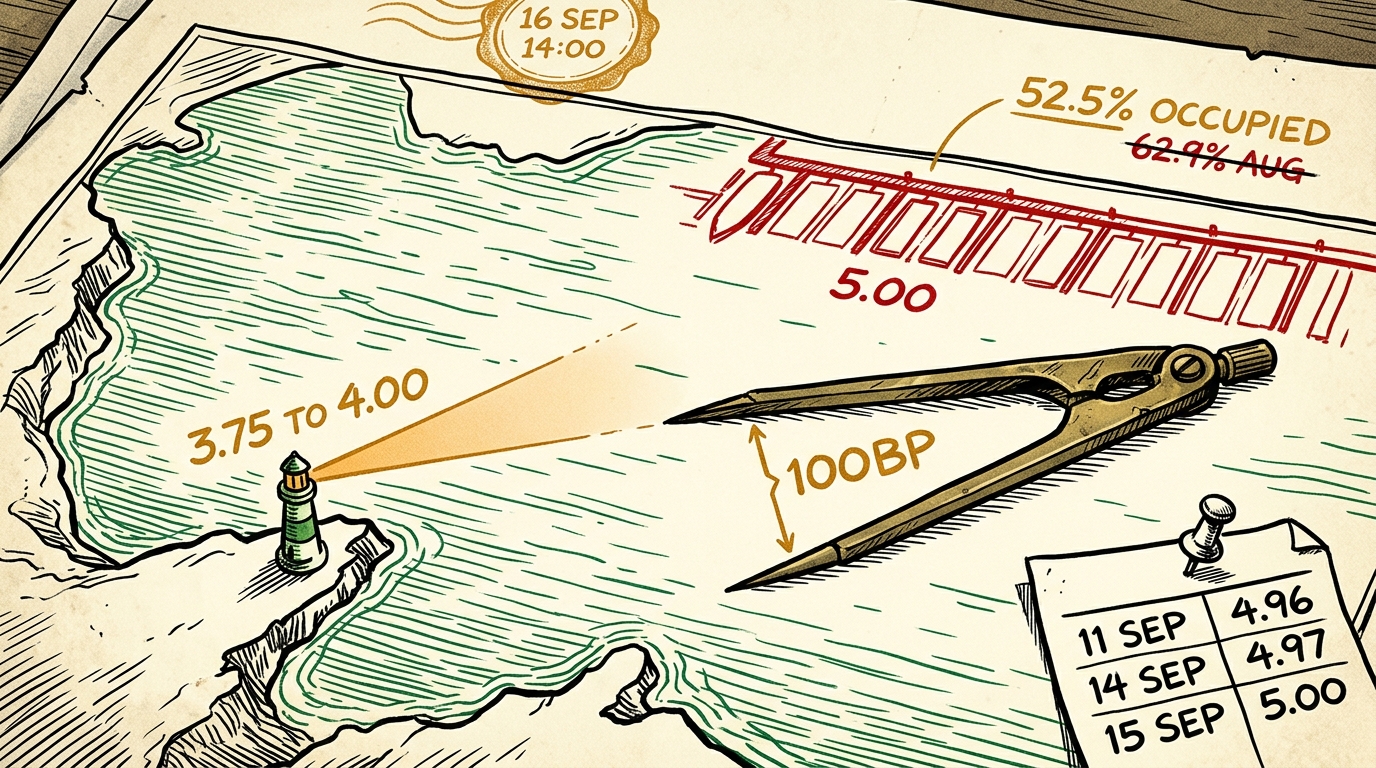
The ten-year closed at 5.00% the day before the Fed moved, and the long-bond buyers were thin
⚓ Weathervane. The wind still comes from the long end. The policy rate has been frozen at 3.50% to 3.75% since July whilst the term premium does the tightening, and the price of long money is now set by deficits, issuance supply and a synchronised global duration bid rather than by the committee. Higher-for-longer has stopped being a Fed decision and become a bond-market fact. The cruise ship is holding this heading, and Tuesday gave the banner’s issuance clause its first direct support in five weeks.
 Ahoy there, Trader! ⚓️
It’s Phil…
When the long end cannot find its buyers, what exactly is a quarter point supposed to fix?
The surface story today is the decision itself. Relayed pricing sits above 90% for a 25bp increase at 14:00 ET, taking the range to 3.75% to 4.00%, the first hike since July 2023.
What happened on Tuesday deserves more of our attention. The Treasury sold $13bn of 20-year bonds at 5.420%, 2.0bp above where they were trading beforehand. Indirect bidders, the group that includes foreign central banks, took 52.5%, the lowest share on record for that bond, down from 62.9% in August. By the close, Treasury’s own series had the ten-year at 5.00%, a level it had not closed at since 2007. The two-year rose only 2bp and the dollar sat near a two-week high.
Put those side by side and the shape is clear enough. The front end is waiting for the committee. The long end is waiting for buyers, and fewer of them came.
The textbook version runs like this. The central bank raises the short rate, a credible hike calms inflation expectations, and the long end settles or even falls as the market trusts the committee to do its job. On that model a hike today should help the ten-year.
The tape does not quite fit. The long end did not rise on inflation fear alone this week; it rose on a question of who holds the paper. A higher policy rate does nothing obvious to bring an absent buyer back to an auction. If anything, it makes the short end more attractive and the long end a harder sell.
History adds a second wrinkle. The Stock Trader’s Almanac tracks 20 hikes since 2008. The S&P 500 fell on 13 of those announcement days and lost 0.68% on average the day after. Weakness around Fed days has usually been bought, but after hikes the average 30 sessions later has stayed negative. Twenty cases is a small crowd. Does that pattern still hold when the bond market set the price before the committee spoke? Neither we nor the sample can say yet.
So the fair answer to our question may be: not much, directly. A quarter point addresses inflation credibility. It does not address demand for duration. The projections this afternoon may tell us whether the committee sees the difference.
Phil’s Musing
My lean is that today’s hike is the right move for the wrong end of the curve. The signal I care about sits in the next long auction, not the dot plot. If foreign demand stays thin whilst the Fed tightens, the long end keeps the steering wheel, and a rate hike becomes a gesture at a problem it cannot reach.
Happy trading,
Phil
Less Brain, More Gain
…and may your trades be smoother than a cashmere codpiece
P.S. – Phils Footnote I went into this week thinking the Fed decision was the event and the auctions were plumbing. Tuesday flipped that for me. I had never paid much attention to the indirect bid column, and it turns out that one column told me more about the price of money than a week of previews. Wall Street often says don’t fight the Fed. Nobody mentions what happens when the buyers quietly stop turning up to lend.