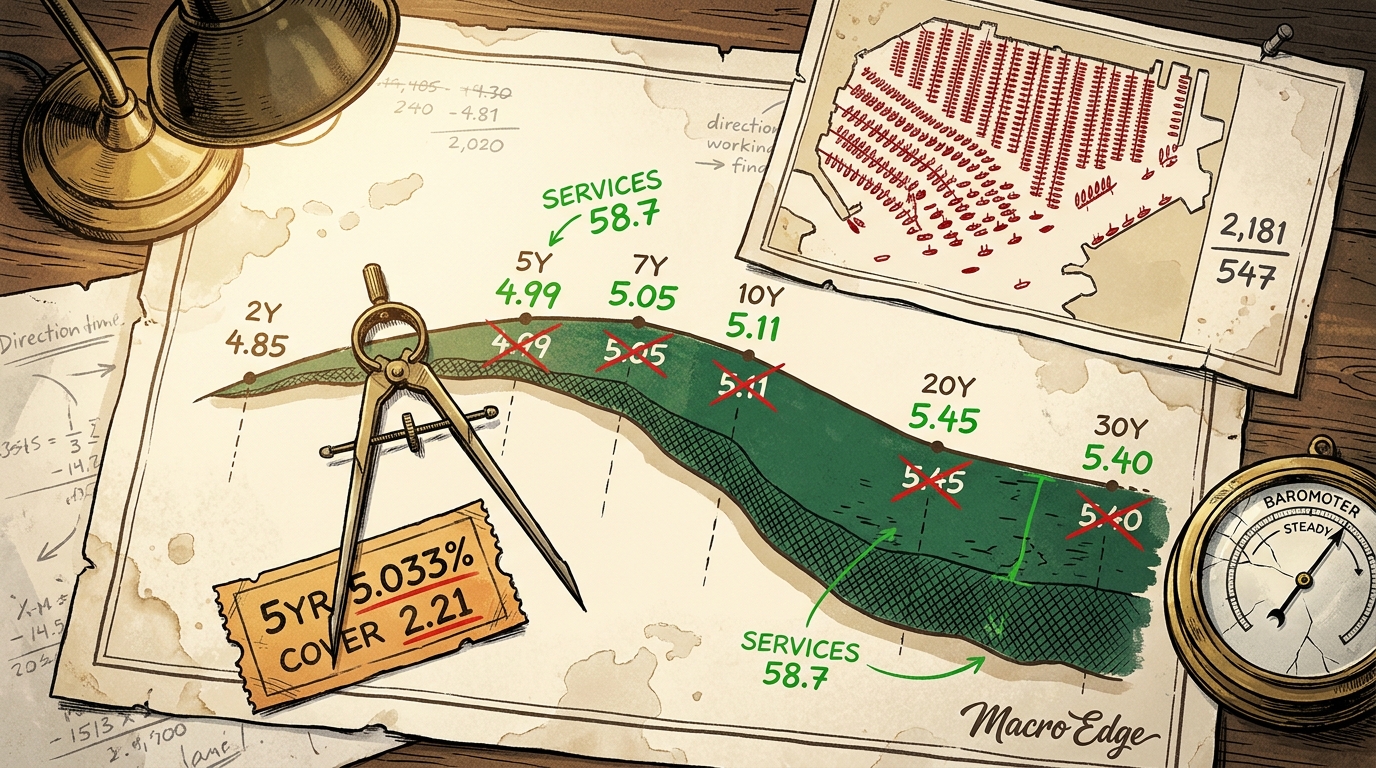
2,181 stocks fell and 547 rose. Only 1 of those facts reached the wrap.
⚓ Weathervane. The wind is coming from the long end. The policy rate has been frozen for most of the year whilst the term premium does the tightening, and the price of long money is set by deficits, issuance supply and a synchronised global duration bid rather than by the committee. Higher-for-longer stopped being a Fed decision and became a bond-market fact. The cruise ship is holding this heading, and we note with some discomfort that Wednesday’s gust came from amidships rather than from astern.
 Ahoy there, Trader! ⚓️
It’s Phil…
If the index says one thing and the average stock says another, which one is describing the economy the Fed is about to keep tightening into?
Wednesday handed us two instruments and they disagreed flatly. The S&P 500 closed down 0.75%, a decline so ordinary it barely earns comment. Underneath it, 2,181 NYSE issues fell and 547 rose, a ratio of 0.251 and the weakest of the thirty-two sessions we hold. New lows went from 37 to 101. One of those descriptions will look silly in hindsight.
The cause is unusually clean. US flash services activity printed 58.7 against 56.5 in August, manufacturing 57.0 against a 53.6 forecast, and the curve lifted at every tenor beyond two years. The shape of the lift is the tell. The 5-year added 16 basis points; the 20-year added 12 and the 30-year 11. Most desks read a bond selloff as a Fed story. Not this one. A market rethinking what the committee does next moves the front end hardest; a market rethinking how strong the economy is moves the belly hardest. The belly led, by some distance.
Now the textbook. It says a growth surprise is good for equities and bad for bonds, and that equities should sort into cyclicals up, rate-sensitives down. Half happened: utilities lost 1.92%, real estate 1.55%, small caps 1.77%, exactly as the discount-rate arithmetic requires. The other half did not. Cyclicals did not celebrate. Energy rose 0.96% and that was crude, not growth. The average stock simply fell.
So we are left with a gap. The textbook says a strong economy is worth paying for; the tape spent Wednesday declining to pay, twice over. Cintas raised both ends of guidance and lost 3.44%. Paychex beat and raised and lost 8.77%. General Mills reported earnings down 67%, promised nothing, and closed higher. That is not rotation between winners and losers. That is a market discounting everything by a bigger number and hunting shelter, which is what you do when the good news is the problem.
Treasury put the question to a vote that afternoon and got an answer nobody enjoyed. The 5-year cleared at 5.033% with a cover of 2.21 against its own trailing run of 2.28 to 2.37, indirects taking the smallest share of the last seven and dealers the largest. Higher yield, worse sponsorship, same auction.
Phil’s Musing
The honest version is that I do not know which instrument to believe, and I have noticed that I want to believe the index because it is the more comfortable number. Breadth like that usually means something and occasionally means nothing, and the only way to find out is whether the next three sessions repair or extend it. The 7-year today will tell us more about that than any equity print will.
Happy trading,
Phil
Less Brain, More Gain
…and may your trades be smoother than a cashmere codpiece
P.S. – Phils Footnote I had assumed for most of this year that the front end had stopped listening. It has been my steadiest assumption since the summer and I have built rather a lot on it. Wednesday the 2-year moved 14 basis points, and not for a Fed governor, who spoke and was largely ignored, but for a questionnaire sent to a panel of purchasing managers who were asked only whether things felt better or worse than last month. I was wrong about what it had stopped listening to. It had not stopped listening. It had changed who it listens to, and I did not notice the switch until it had already happened.
🗂 Desk Notes | 24 Sep 2026
Session read (§8.4)
SESSION BRIDGE: prior session (Wed) full reaction, S&P 500 cash -0.75% to 7,706.03 with the after-hours tail quiet, Nasdaq Composite -1.13%, Russell 2000 -1.77%, NYSE advance/decline 0.251, VIX +6.83% to 15.18; live premarket ES -0.36% / NQ -0.52%, VIX no premarket capture available; threshold: none.
Capture time. 07:20 UK, 02:20 ET, Thursday 24 September. The fixed capture is 07:30 UK; the scanner route was rate-limited, so the figures come from the 5-minute bar available at retrieval and are stamped with its actual time rather than the nominal one. December contracts throughout: ES 7,744.25, NQ 30,605.50, YM 51,771, RTY 2,853.90.
Basis warning. December ES settled 7,772.50 against cash SPX 7,706.03 on 23 September, a basis of +66.47 points. That is 4.5 points wider than the +62 recorded at Part 211. Comparing the ES premarket to the cash close without removing the basis produces a phantom gain of half a percent and reverses the sign of the overnight read. Basis-adjusted, the premarket implies a cash-equivalent 7,677.78, or -0.37%.
Threshold reasoning, all three legs stated. Equity leg: -0.75% on the prior session sits inside the sub-1.0% normal envelope, so no carry-over fires. Volatility leg: VIX +6.83%, short of the ±8% trigger. Commodity leg: November WTI +1.81%, well short of ±4%. No leg trips and no carry-over note is written this edition. Recorded because the session was editorially significant despite tripping nothing, which is a finding about the thresholds rather than about the tape.
Contract roll. Quarterly roll was the third Friday, 18 September, and is four sessions behind us. Equity index front month is December 2026. WTI front month is November 2026, October having expired 22 September; November carried 350,772 lots on 23 September against December’s 206,814, so the liquidity confirms the expiry. No roll warning applies today.
The mechanism read
What moved. A survey did. US flash services activity printed 58.7 for September against 56.5 in August, and flash manufacturing 57.0 against a 53.6 forecast. Both are large upside surprises and both landed five sessions after the committee raised the policy rate to 3.75% to 4.00%.
CMT curve, 23 September, against 22 September:
| Tenor | 23 Sep | 22 Sep | Change |
|---|---|---|---|
| 1-year | 4.49% | n/a | n/a |
| 2-year | 4.85% | 4.71% | +14bp |
| 3-year | 4.97% | n/a | n/a |
| 5-year | 4.99% | 4.83% | +16bp |
| 7-year | 5.05% | n/a | n/a |
| 10-year | 5.11% | 4.96% | +15bp |
| 20-year | 5.45% | 5.33% | +12bp |
| 30-year | 5.40% | 5.29% | +11bp |
Spreads: 2s10s 26bp from 25bp. 2s30s 55bp from 58bp. 20s30s -5bp from -4bp. The 20-year remains strictly the highest published yield on the curve, by 5bp over the 30-year, which is the widest of the eight sessions held.
What it implies. This is a growth and inflation repricing, not a policy repricing, and the distinction is the whole read. The belly moved most, at 16 basis points on the 5-year. The far end moved least, at 11bp to 12bp. No 22 September prior is held for the 3-year or the 7-year, so no change is stated for either. A market repricing the Fed’s reaction function moves the front end. A market repricing the terminal rate and the path moves the belly. That is what happened, and it is the first session in this run in which the driver was unambiguously data rather than communication.
The one artery. Flash services at 58.7 to the belly of the curve, the belly to the discount rate, the discount rate to every rate-sensitive and long-duration equity on the board. Utilities -1.92% on 1.30 times average volume, real estate -1.55% on 1.33 times, financials -0.47% on 1.29 times, small caps -1.77%. Energy at +0.96% was the only green sector and was responding to crude, not to rates.
Why the index did not show it, and the explanation is NOT the one that suggests itself. The obvious reading is that a few megacaps held the index up. The data refuses it: Alphabet -3.80%, Oracle -3.11%, Broadcom -2.62%, Amazon -2.24%, Nvidia -1.47% all fell harder than the index. Meta at +1.02% and Microsoft at +0.52% are worth a few basis points against a 58.61 point decline. The gap is a universe difference, not a weighting rescue. The S&P 500 is 500 large companies; the NYSE advance/decline tally counts every issue on the exchange, most of them small, and small caps lost 1.77%. The index fell less than the Russell 2000 and the Nasdaq Composite because it contains less of what was being sold. NYSE new lows went from 37 to 101. Nasdaq ran 1,158 advancing against 3,790 declining.
Governor Barr, read directly rather than from coverage. Speaking on housing affordability at the Chicago Fed on 23 September, Barr said the committee’s action last week was one he supported, and that in his base case further policy adjustments are likely to be needed to bring inflation to target in a timely fashion. The policy content is a short passage inside a speech that is mostly land-use reform and housing supply, so it should not be over-weighted as a policy speech. It is nonetheless a governor stating that further adjustments are likely in his base case, and the front end moved 14bp the same day, though not for him.
Overnight Excitement (§8.5)
Does not fire. December ES -0.36% and December NQ -0.52% between the 23 September settlement and the 07:30 UK capture, both inside the 0.3% to 0.6% normal band and well short of the 1.0% trigger. Foreign markets are therefore colour and not cause, and no section is carried in AVE or the Snippet.
For the record only: Tokyo reopened on 24 September after a three-session closure for Respect for the Aged Day, a bridge day and the Autumnal Equinox. The closure is demonstrated rather than assumed, by a successful pull on a liquid constituent returning no bars at all for 21, 22 and 23 September and a full 24.15 million share bar for today. Toyota closed 2,977.5, down 1.57% against its 18 September close. Seoul was shut for Chuseok. No non-US cash index level is published: no tier-1 route exists for one and the available figures are all secondary market wraps, which the registry bars as a numeric source.
Forward catalyst slate
- Today, 24 September, 13:00 ET: the $44bn 7-year note auction. Confirmed from Treasury’s own fiscal data. This is the third coupon auction in three sessions and the first to land after the curve repriced 11bp to 16bp. Read it against its own trailing run, not against the headline size.
- Today, 11:30 ET: $90bn 4-week and $85bn 8-week bills.
- Today, after the close: Costco fiscal Q4 and full year, call at 17:00 ET. Consensus $6.55 EPS on $94.85bn revenue. Also today: Darden, and BlackBerry, which is sitting at rank 2 on the retail equities board this morning.
- Today: the Xi state visit reaches its formal session and the state dinner. Treasury announced a two-month extension of the trade truce on 23 September, shorter than either side had trailed. No new tariff rates were set.
- Four Reserve Bank presidents speak today: Williams 04:10 ET, which is an unusually early slot and is calendar-sourced rather than confirmed against the Reserve Bank’s own page, Barkin 08:30 ET on ForexFactory against 08:00 ET on TradingView, Hammack 08:50 ET, Paulson 10:10 ET. Note that Paulson is the Philadelphia Fed president and not a Board governor, whatever the calendar’s “FOMC Member” label implies.
- Friday 25 September: durable goods, revised consumer sentiment, Williams again at 05:15 ET and Hammack at 14:00 ET. BoJ core CPI, forecast 1.5% against 1.6% prior.
- Not this week, commonly misplaced: Accenture reports fiscal Q4 and the full year on 1 October, not this week, and its -0.11% on 23 September is noise rather than a reaction. Micron reports 30 September, not this week, and its recent two-session swing of +5.00% then -2.22% will read as an earnings reaction to anyone who does not check. No coupon auction beyond today is yet announced; the October cycle has not been published.
Divergence flags
- The index and the market underneath it did not reconcile, and the gap is the session. A -0.75% cap-weighted decline against the weakest breadth reading in 32 sessions. Either the index is understating the damage or the average stock is overstating it, and the base rate says this window is already skewed: median A/D 0.811, zero sessions above 2.0, six below 0.5.
- Good news was sold and its absence was bought. Cintas raised both ends of guidance and fell 3.44%. Paychex beat on adjusted EPS, raised two components, cut none, and fell 8.77%. General Mills posted earnings down 67%, reaffirmed, and rose 1.04%. Three data points is not a pattern, but the sign is consistent across all three.
- Energy rallied and the monetisation name still fell. Energy was the only green sector at +0.96% and November crude added 1.81%, yet Marathon Petroleum closed -0.33% on 1.36 times average volume, its third consecutive decline. A sector bid that the tracked name does not participate in is evidence against the monetisation framing, not for it.
- The auction went badly whilst the curve was repricing, and both cannot be coincidence. Cover 2.21 below a 2.28 to 2.37 trailing range, indirects 54.31% below a 59.24% to 74.85% range, dealers 15.77% above a 10.05% to 15.61% range. All three outside their own trailing-six range in the adverse direction, in the same auction, at a yield 64bp above where the same note cleared four weeks ago. Higher yield, worse sponsorship.
- The Brent-to-WTI spread widened from 8.73 to 10.92 dollars in one session and was independently corroborated at 10.82 by a second source this morning. That is a waterborne-versus-landlocked dislocation and it is not explained by the EIA build of 2.969 million barrels, which was itself against a consensus draw.
- Bitcoin traded as a duration asset. Down 2.10% alongside gold spot -1.62%, December silver -2.35% and December copper -1.21% on the day real yields moved. Four asset classes moved together on one driver.
Carry-over note
Not fired. No leg of §8.4.1 tripped and Phil has flagged no catalyst. Recorded rather than omitted, because a session that produced the weakest breadth of the holding window and a genuinely poor coupon auction without tripping any threshold is itself a specification observation, and it is the second such observation in three editions.
Regime and sensitivity read
Sensitivity is running LOOSE, twenty-fifth consecutive edition, and the bias is stated rather than presented as neutral.
The diagnosis hardens again. Wednesday produced three regime-grade observations and the tripwire registered none: a 16 basis point belly move on a survey six sessions after a hike, the weakest advance/decline ratio of the holding window, and a coupon auction whose cover, indirect share and dealer share all fell outside their own trailing-six range in the same direction.
The turn condition failed on a fourth distinct leg, which is now the finding. The condition requires two sessions in which a dated Federal Reserve communication moves the 2-year by 10bp or more whilst the 30-year moves by less than half. Wednesday carried a dated communication from Governor Barr and a 14bp move in the 2-year, satisfying the first leg outright for the first time. It failed on the second: the 30-year moved 11bp, far more than half. Friday failed on movement without communication, Monday on communication without movement, Tuesday on an insufficient move with a satisfied second leg, and Wednesday on a satisfied first leg with a failed second. Four sessions, four different failure modes, is a stronger argument about the condition’s specification than about the tape, and it is now the third consecutive edition making that argument from different evidence.
Recommendation order, carrying one more edition of evidence:
- Two-sided volatility leg. Nine editions overdue. VIX moved 6.83% on the weakest-breadth session of the window and registered nothing, because the leg is one-sided and the threshold is 8%.
- Un-retire the front-end selective-deafness leg. Three consecutive vindications, and Wednesday inverts it usefully: the front end that ignored two hawkish speeches moved 14bp on a purchasing managers’ survey.
- Re-specify the policy-transmission thread. Now challenged in four distinct directions across four consecutive editions.
- Breadth-versus-index leg. The base rate now exists. Thirty-two sessions of NYSE advance/decline are held with a full dated series, median 0.811, zero sessions above 2.0 and six below 0.5. The measurement problem and the base-rate problem are both solved. This is the strongest candidate in the set and it should be specified next.
- Split rates-versus-energy leg. Unchanged, and Wednesday’s sector-versus-name divergence is the first new evidence it has had in some time.