The innocent question with the impossible honest answer
 Ahoy there, Trader! ⚓️
It’s Phil…
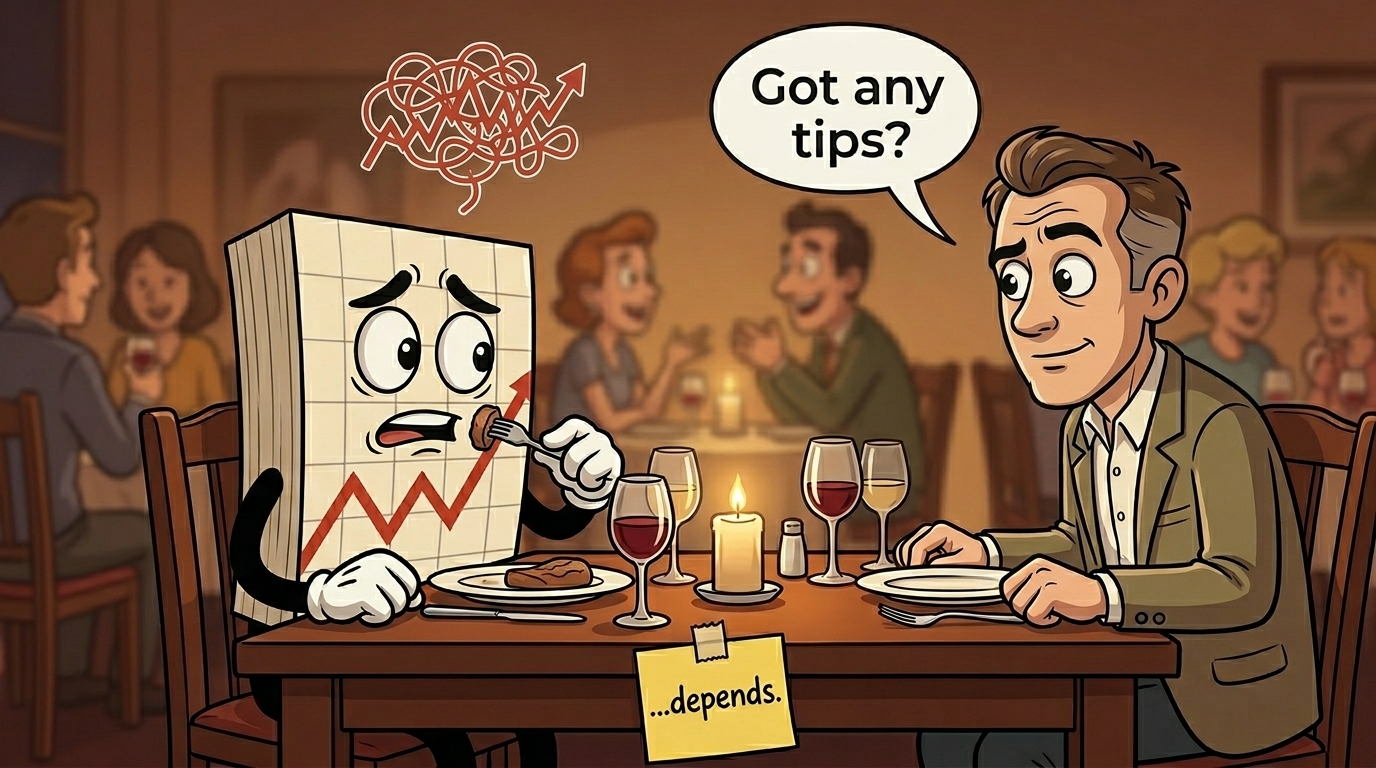
It happens at parties. At dinners. In the back of taxis. The moment I tell someone honestly what I do for a living, the next question is always the same.
“Got any tips?”
Three words. A smile. A raised eyebrow. The expectation that I’m going to hand over a stock ticker or a strategy or a single piece of advice that neatly fits between the starters and the mains.
And for years I tried. I’d offer something polite. Something generic. Something that wouldn’t get me in trouble or bore the table.
But the honest answer to that question is long. It’s complicated. And more importantly, it depends entirely on who’s asking.
The answer changes with age
If you’re 20, the honest answer is one thing. You’ve got 10, 20, 50 years to work with. Mistakes are tuition. Time compounds in your favour. You can afford asymmetric bets because the clock isn’t ticking, it’s winding up.
If you’re 75, the answer is the opposite. Time has flipped from ally to adversary. Volatility isn’t opportunity anymore, it’s risk of ruin. One bad year doesn’t get recovered, it gets lived with.
So the same question asked by two people at the same dinner table requires two completely different answers. Opposite ones, actually.
And that’s just the easy axis.
Get The Complete Premium Popper System – Automation Included
Your entry ticket to consistent SPX income. Inside: the exact setup, rules, and checklists I trade daily – for less than the cost of lunch. Easily actionable.
Get The Premium Popper System – Click Here

The answer also changes with temperament
Here’s the part nobody likes to admit out loud. Not every trading style fits every person. And pretending otherwise is how most people end up losing money doing something that was never going to suit them in the first place.
When I was 20, the world of finance was in love with Warren Buffett. And I looked at what Buffett actually did day to day, the annual reports, the balance sheets, the years of patience waiting for a fat pitch, and I thought: no.
Not because it doesn’t work. Clearly it works. It works spectacularly.
It just wasn’t for me.
I didn’t want to read company reports. I didn’t want to wait years for the payoff. I didn’t want to sift through fundamentals trying to spot an undervalued business the rest of the market had missed. Yes, I was aware even back then that there were tools to sort the fundamentals. I still wasn’t interested.
What I liked was patterns. The geometric shapes price action drew on a chart. The feedback loop of an idea you could test in days instead of decades. The short timeframes where you could actually see if you were right or wrong before you’d forgotten what the idea was.
That preference didn’t make me clever. It made me me. And the job at 20 was to work out which version of the game I was actually suited to play.
Today, 30 years on, my preferred payout cycle is 0 to 3 days. Sometimes out to a week. That’s where my head lives. That’s the rhythm that fits how I think.
Buffett’s still right. He just isn’t right for everyone, and he certainly wasn’t right for me.
The third axis: the unknowns
Age is what you can afford. Temperament is what you can tolerate. But there’s a third axis that nobody mentions, and it quietly decides as much as the other two.
The unknowns.
How the market behaves in the decade you happen to be trading it. The regime. The inflation backdrop. The interest rate environment. The blow-ups nobody saw coming. Whether your career starts in a raging bull or a grinding sideways chop that eats patience for breakfast.
You don’t get to pick these. You get handed them. And the right answer for a trader starting in 2010 was not the same as the right answer for a trader starting in 2000, or 1987, or 1972.
Any honest answer to “got any tips?” has to acknowledge that the game you’re playing is partly a game you didn’t design and can’t change. All you get to control is how you show up inside it.
Sunday morning, mid-90s, Blockbuster Video
Which brings me to the actual story. The one I’d tell at the dinner if the host wasn’t trying to bring out the next course.
It’s a sunny Sunday morning, somewhere in the mid-90s. I’m working a part-time job at Blockbuster Video. Quiet shift. Empty store. And I’ve got a copy of Jack Schwager’s book on the technical analysis of the futures markets with me, which I’ve now read for the third or fourth time.
And sitting there, on that sunny Sunday, in a video shop that no longer exists, I had my first real epiphany about the business I was about to spend the rest of my life in.
Three things hit me at once.
1. This book is the same as all the other books.
The indicators had different names. The charts had different timeframes. But underneath, every book was telling me the same things in slightly different words. The information wasn’t the differentiator. The information was freely available and endlessly recycled.
2. The book doesn’t tell you what to do.
It tells you what exists. Here’s a moving average. Here’s an oscillator. Here’s a head and shoulders. But nowhere in those thousand pages is the actual answer to the only question that matters: out of all this, what do I actually do on Monday morning?
3. Everything is perfect in hindsight.
Every example worked. Every chart showed the pattern playing out beautifully. Which, as any trader who’s ever traded anything will tell you, bears roughly zero resemblance to what it feels like to make the decision in real time with money on the line.
The subtraction
Half the book was of no interest to me at all. Fundamentals, macro, the Buffett end of the pool. Gone. Ignored.
The other half was technical analysis, which, for a thousand-page book, was also way too much. Every indicator ever invented. Every pattern ever named. You can’t put all of it on a chart at once. It would be absurd.
So I asked myself the question that, looking back, was probably the most important question I’ve ever asked myself about this job.
“What do I actually find interesting?”
Not what works. Not what the gurus say. Not what sounds cleverest at a dinner. What do I, personally, find interesting enough to stare at for the next 30 years?
The answer was the geometric shapes. The way price consolidates, builds pressure, and breaks. The visual language of the chart.
So from a thousand-page book, I ended up with 2 or 3 chapters. The bits on price action, breakouts, trend.
That was the subtraction.
And then the real work started
This is the part that gets lost if you tell the story too fast.
Picking the sliver is the easy bit. It takes a Sunday morning and a bit of honesty about what you actually like.
The grind is what comes after.
I then spent the next 30 years on those 2 or 3 chapters. Watching consolidations. Trading breakouts. Learning the difference between the setups that pay and the ones that look identical but don’t. Learning how I respond when I’m wrong, how I respond when I’m right, how I respond when I’m bored, how I respond when I’m tilted.
Those 2 or 3 chapters didn’t simplify my work. They focused it. Which is a different thing. Focusing your work doesn’t make it less work. It just means the work is happening on the part of the field that actually matters to you.
I’m still a breakout trader. Still looking for a consolidation of one sort or another. Still waiting for the pressure to release and the trend to follow. The setup I picked on that sunny Sunday is essentially the setup I traded yesterday, and will trade next week.
The sliver is the job. And the job is the sliver, done for long enough that you know it better than anyone else in the room.
So, what do I tell them at the dinner?
Here’s where I’ve landed, after enough dinners and enough “got any tips?” that I’ve had to work out something honest to say.
The first answer is the throwaway one.
“I smash the keys on my keyboard and the internet sends me money.”
That shuts down 90% of the non-serious tip-chasers right there. They laugh, I laugh, the wine glasses get topped up, the conversation moves on to something easier. Job done.
But every now and again, someone presses. They actually want the real answer. They’re not after a ticker, they’re after a way of thinking about it. And that’s when the honest version comes out.
- I ask them their age.
Not because I’m being rude, but because it’s the first input. A 25-year-old and a 65-year-old asked me the same question last month. They should have left with completely different answers. - I ask them what they like.
Not what they think they should like. What they’d actually be willing to look at for 30 years. If the answer is “I don’t know,” that’s the project. Before any strategy, before any setup, before any trade, the project is finding the version of this game that fits how you actually think. - I tell them the bit they don’t want to hear.
Which is that the answer isn’t out there in a book. The book is the same as the other books. The answer is the subtraction you have to do yourself, and then the decades you spend on what’s left.
That’s not a tip. It’s barely a piece of advice. And nine times out of ten, the person asking wanted a stock ticker.
But it’s the honest version. And I’ve decided, somewhere along the way, that the honest version is the only one worth giving at the dinner.
Even if it means I don’t get invited back.
PopPop
Happy trading,
Phil
Less Brain, More Gain
…and may your trades be smoother than a cashmere codpiece
p.s. There are 3 ways I can help you…
- Option 1: The SPX Income System Book (Just $12)
A complete guide to the system.
Written to be clear, concise, and immediately actionable.
>> Get the Book Here

- Option 2: Full Course + Software Access – 50% off for Regular Readers – Save $998.50
Includes the video walkthroughs, tools for TradeStation & TradingView, and everything I use daily. Plus 7 additional strategies
>> Get DIY Training & Software

- Option 3: Join the Fast Forward Mentorship – 50% off for Regular Readers – Save $3,000
>> Join the Fast Forward Mentorship – trade live, twice a week, with me and the crew. PLUS Monthly on-demand 1-2-1’s
No fluff. Just profits, pulse bars, and patterns that actually work.