Why stacking charts makes you late, not early. And why 1 timeframe is fine.
 Ahoy there, Trader! ⚓️
It’s Phil…
Saw a post on LinkedIn this week that had me reaching for the bullshit alarm.
You know the type. Nice graphic. Three neatly nested boxes. Monthly, weekly, daily. “Price is always in a box,” the author says. “Each timeframe only does 3 things: break out, fail, or stay inside. The edge is in understanding how these boxes align.”
Cue a thousand likes and a chorus of “great insight.”
Down in the comments, somebody chimed in with the line that really made me wince: “Confluence isn’t a bonus filter. It’s the foundation.”
Bollocks it is. Confluence isn’t the foundation of anything except your procrastination habit.
Let me explain.
Get The Complete Premium Popper System – Automation Included
Your entry ticket to consistent SPX income. Inside: the exact setup, rules, and checklists I trade daily – for less than the cost of lunch. Easily actionable.
Get The Premium Popper System – Click Here

What’s right about it, first
Credit where it’s due. Price IS always in a box. Every timeframe does do those three things: break out, fail, or stay inside. That bit’s fine. That bit’s just maths.
The problem isn’t the observation. The problem is the leap from “boxes exist on every timeframe” to “your edge is in waiting for them to align.”
Because here’s the bit nobody in the MTF choir wants to say out loud:
By the time monthly, weekly, and daily all agree, the move’s already happened.
You’re not early. You’re not catching a trend. You’re the exit liquidity for the poor sod who took the trade on one timeframe three weeks ago and is now unloading it into your “confirmed” breakout.
31 years. 1 timeframe. Still here.
I’ve been at this since the ’90s. Real money. Real scars. Real P&L.
I’ve traded every fashion. Trend-following. Mean-reversion. Options. Systematic. Discretionary. The lot. And I have never, not once, needed three timeframes to agree before I pulled the trigger.
Not because MTF analysis “doesn’t work.” Plenty of things work. The question isn’t “does this work?” It’s “do I need it?“
For the way I trade, the answer’s no. One timeframe. Defined setup. Defined risk. Defined exit. Job’s a good’un.
So when I see posts claiming the edge is in stacking timeframes, I reach for the bin. Because what’s actually being sold is complexity dressed as rigour. And complexity, in trading, is usually just avoidance with extra steps.
The confluence trap
Here’s how MTF confluence actually plays out in the real world. Not in the LinkedIn graphic. In your actual P&L.
You pick your three timeframes. Monthly, weekly, daily. Or whatever flavour you’ve been sold this month. And you wait for them to align.
One of two things happens.
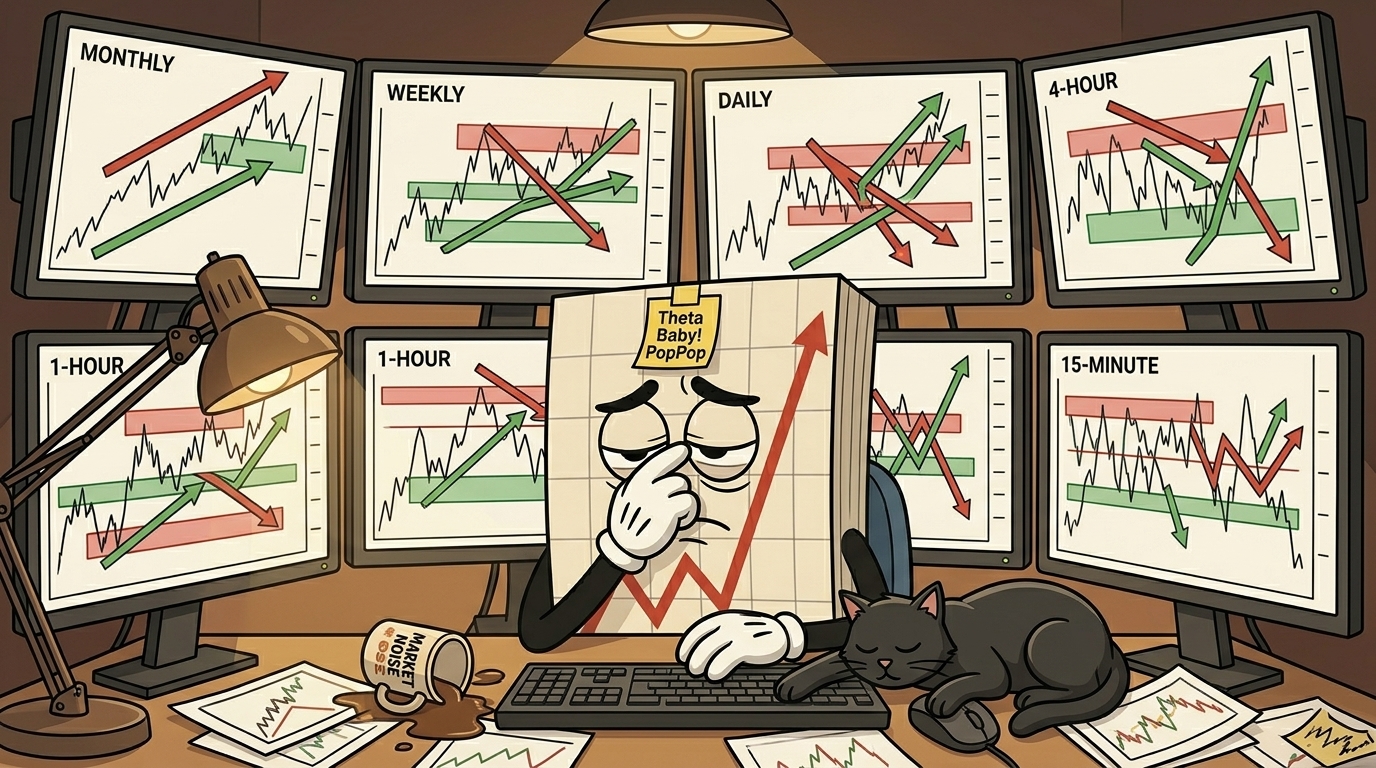
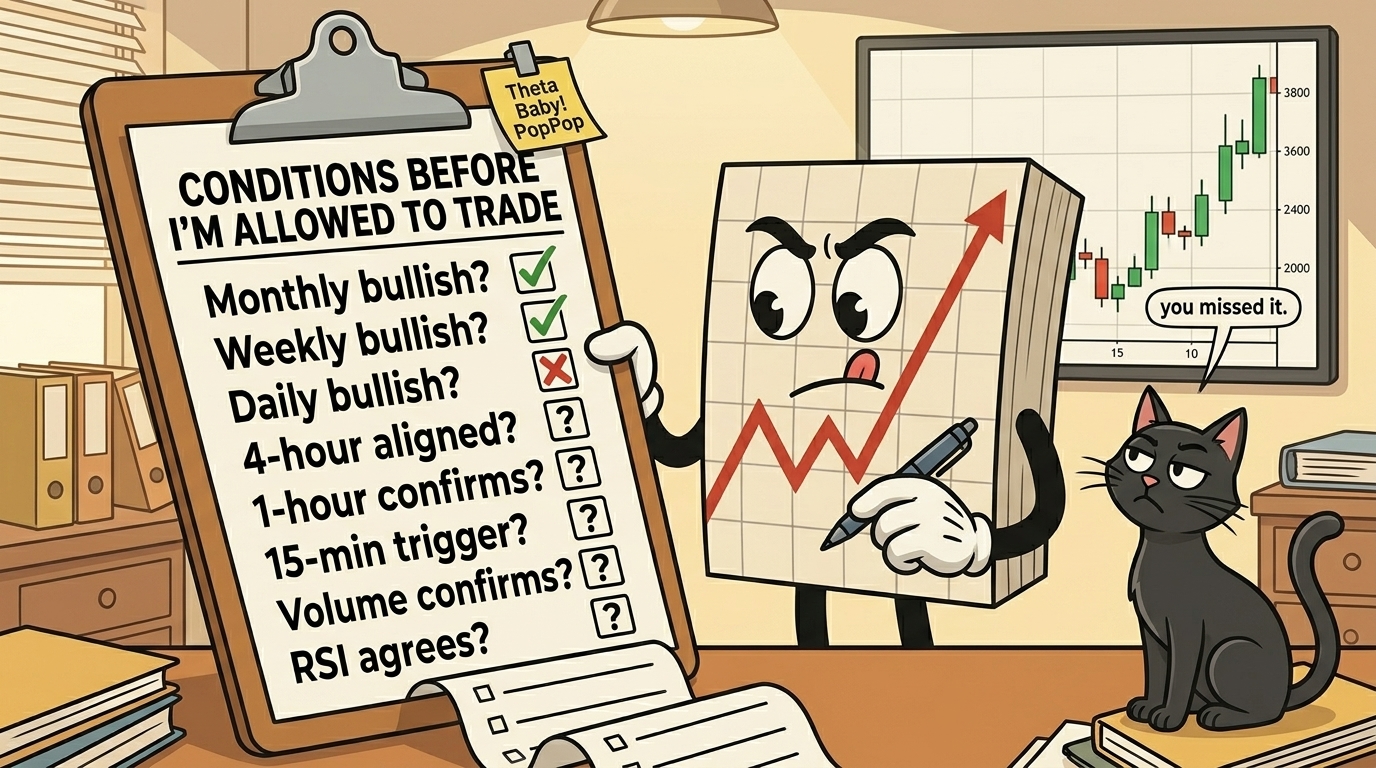
Scenario one. They never quite line up. Monthly says one thing. Weekly disagrees. Daily’s flipping back and forth like a fish on a dock. You sit on your hands. Weeks pass. You tell yourself you’re being “disciplined.” You’re actually just paralysed.
Scenario two. They finally do line up. You pull the trigger. Except the move started three weeks ago on the daily, ten days ago on the weekly, and by the time the monthly finally nods along, the easy money’s been and gone. You enter at the top of the run. Price rolls over. You’re stopped out. You go back to LinkedIn to read about confluence.
Either way, you lose. Either by missing the trade, or by taking it too late.
This is not a bug in MTF trading. It’s the feature.
Higher timeframes are slower. That’s maths, not opinion. If you make your entry contingent on the slowest timeframe agreeing, you are making your entry contingent on being late. By design.
Conflict is the default. Not the exception.
Here’s the other thing the confluence crowd won’t tell you.
Markets are fractal. Every timeframe has its own push and pull, its own little tug-of-war. The monthly might be grinding up while the weekly’s pulling back while the daily’s ranging. That’s not a broken market. That’s what markets look like nine days out of ten.
So when you’re waiting for three timeframes to agree, you’re not waiting for a setup. You’re waiting for the exception. You’re hunting a unicorn.
Then when the unicorn finally shows up, you congratulate yourself on your patience, enter the trade, and get your face caved in because the conditions that produced the alignment have already started unwinding.
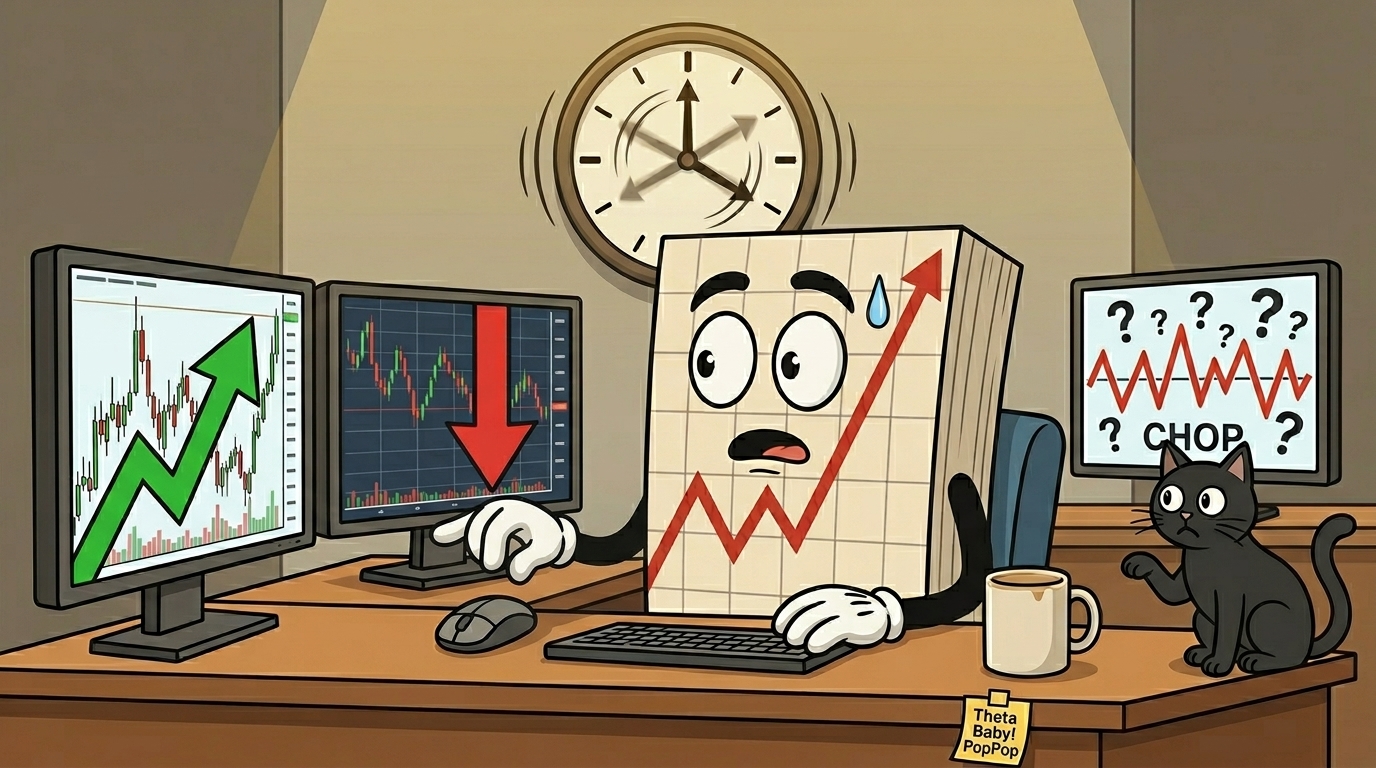
Conflict across timeframes isn’t a problem to be solved. It’s the normal state of the market. If your system requires it to be absent before you’ll trade, your system requires you to not trade.
Three timeframes, three times the noise
People think adding timeframes adds information. It doesn’t. It adds decisions.
Each timeframe has its own breakouts, fails, and stays-inside. Three timeframes means three sets of breakouts to evaluate, three sets of fails to interpret, three sets of ranges to track. That’s not a signal filter. That’s a cognitive tax.
And the tax compounds. Now every setup needs cross-referencing. Is the daily breakout confirmed by the weekly? Does the monthly agree? What about the 4-hour? Oh, and the 1-hour just diverged. Better wait for that. Actually, let’s check the 15 as well, just to be safe.
By the time you’ve checked all of it, the trade’s gone.
One timeframe is simple. You see a setup. You take it or you don’t. You’re not running a parliamentary committee every time you want to open a position.
What higher timeframes are actually for
I’m not saying ignore the higher timeframes entirely. That’d be as stupid as the position I’m arguing against.
Higher timeframes are context. They are not confirmation.
They tell you where the freight trains are parked. They tell you if the bigger flow is broadly bullish or bearish. They give you a sense of where the big money’s paying attention.
But context is something you glance at before the session and file away. It’s not something that sits on your execution chart demanding a tick-box before you’re allowed to trade.
The MTF crowd has confused “being aware of the bigger picture” with “needing three timeframes to agree in real time.”
These are different things. One is common sense. The other is expensive procrastination.
The bookmaker and his card
I’ve said this before and I’ll keep saying it until it sinks in.
A bookie doesn’t wait for every race on the card to agree before he prices the next one. Ascot, Kempton, Lingfield. He doesn’t need the 2:30 at one to confirm the 3:15 at another before he’ll take your money.
He prices each race on its own merits. He knows the odds he’s giving. He knows the edge he’s holding. He takes the bets as they come.
That’s what one-timeframe trading is. You pick the race. You price the setup. You take the trade. You move on.
The multi-timeframe crowd is the mug who won’t back a horse at Ascot until the results come in from Newmarket. By the time he’s got his “confirmation,” the race he wanted to bet on is already over and he’s just staring at the payout slip.
“But Phil, what about swing trading? Wyckoff? Elliott?”
Fair questions. Let me have them.
Swing trading on the daily doesn’t need three timeframes. It needs the daily. That’s your timeframe. You execute on it. You manage on it. You exit on it. The weekly might give you context for how long you expect to hold. Fine. But the trade lives on the daily.
Wyckoff, Elliott, market profile, all the rest. These are frameworks for narrative. They help you tell a story about what the market’s doing. Useful, in the right hands. But the execution still lives on one timeframe. Nobody actually trades Wyckoff by stacking six timeframes and waiting for alignment. You pick your operational chart and you work it.
Using one timeframe doesn’t mean pretending the others don’t exist. It means refusing to make your entries and exits contingent on them. You know they’re there. You know the context. You don’t need them on your screen to pull the trigger.
The real edge is on your timeframe
Here’s what I’ve learned in 31 years, boiled down to a paragraph.
The edge is not in watching more charts. The edge is in knowing what you’re looking for on the chart you’ve chosen. That’s it. That’s the whole game.
Pick your timeframe. Pick your setup. Define your risk. Define your exit. Execute when the setup shows up. Don’t execute when it doesn’t.
You don’t need a second timeframe. You don’t need a third. You don’t need alignment. You don’t need confluence. You need a defined system and the discipline to trade it.
And if you can’t trade profitably on one timeframe, adding two more isn’t going to fix you. It’s going to give you three times as many ways to not pull the trigger.
The uncomfortable truth
MTF confluence appeals because it feels like work. It feels like the kind of thing a professional would do. It looks rigorous. It sounds clever when you talk about it on LinkedIn.
But a lot of what passes for “rigour” in retail trading is just highly-productive avoidance. You’re not analysing. You’re justifying not trading. You’re not finding an edge. You’re finding a reason to wait.
The bookie doesn’t do that. He prices the race, takes the bet, and moves on. That’s the job.
The trader who treats it like the bookie does, who picks the timeframe and works it and stops faffing about with six charts, tends to do fine. The trader who’s still waiting for the monthly to confirm the weekly to confirm the daily is usually the one writing LinkedIn posts about “the edge.”
Stop stacking charts. Pick your battlefield.
The confluence crowd has it backwards. They think adding timeframes adds certainty. It doesn’t. It adds delay, adds noise, and adds excuses.
One timeframe works fine. It’s worked fine for 31 years. It’ll work fine for the next 31.
Pick your timeframe. Learn what you’re looking for on it. Trade the setup when it shows up. Size your risk. Take your exit. Rinse, repeat.
You’re not a stock analyst. You’re not writing a research report. You’re taking a bet on a price move over a specific horizon, and you need one chart to do it.
Everything else is just you trying to convince yourself you’ve done enough homework to deserve the trade.
You don’t need to deserve it. You just need to take it.
PopPop 🏴☠️
Happy trading,
Phil
Less Brain, More Gain
…and may your trades be smoother than a cashmere codpiece
p.s. There are 3 ways I can help you…
- Option 1: The SPX Income System Book (Just $12)
A complete guide to the system.
Written to be clear, concise, and immediately actionable.
>> Get the Book Here

- Option 2: Full Course + Software Access – 50% off for Regular Readers – Save $998.50
Includes the video walkthroughs, tools for TradeStation & TradingView, and everything I use daily. Plus 7 additional strategies
>> Get DIY Training & Software

- Option 3: Join the Fast Forward Mentorship – 50% off for Regular Readers – Save $3,000
>> Join the Fast Forward Mentorship – trade live, twice a week, with me and the crew. PLUS Monthly on-demand 1-2-1’s
No fluff. Just profits, pulse bars, and patterns that actually work.