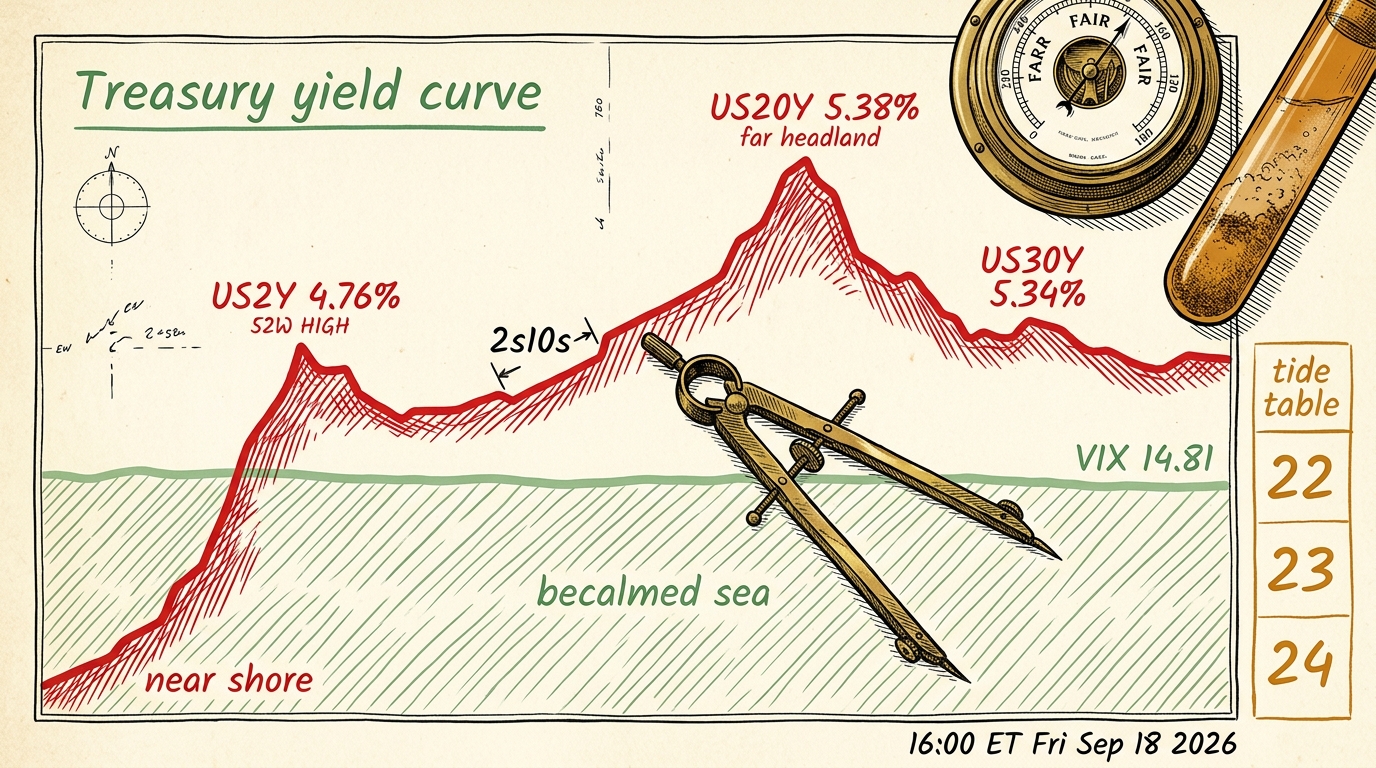
Volatility closed at a nine-session low on the week the front end made a 52-week high
⚓ Weathervane. The wind is coming from the long end. The policy rate has been frozen for most of the year whilst the term premium does the tightening, and the price of long money is set by deficits, issuance supply and a synchronised global duration bid rather than by the committee. Higher-for-longer stopped being a Fed decision and became a bond-market fact. The cruise ship is holding this heading.
 Ahoy there, Trader! ⚓️
It’s Phil…
What is volatility at 14.81 pricing that the front end at 4.76% is not?
The common view of last week is tidy. The Fed raised rates on Wednesday for the first time since 2023, twelve votes to nothing, and markets took it in their stride. Stocks finished higher. Volatility fell. Everyone behaved like adults.
Look at what actually happened on Friday and the tidiness falls apart. The two-year Treasury closed at 4.76%, up nine basis points, a fresh 52-week high. The ten-year returned to 5.01%, a level it last held in 2007. The curve flattened to twenty-five basis points, the tightest of the month. And the S&P 500 moved 12.74 points, which on the quarter’s largest options expiry is close to nothing.
Here is the part that keeps catching us. No Fed official said a word about policy on Friday. The only governor speaking gave two London talks, both on bank supervision. So the front end repriced on its own, two sessions after the meeting, with no fresh instruction. That is a market that has stopped waiting to be told.
Most desks would say the textbook is clear enough: a central bank starting a hiking cycle should lift both the price of money and the price of protection. Tighter policy means wider outcomes, and wider outcomes make protection dearer. Friday delivered exactly half of that. The price of money went up. The price of protection went down, to 14.81, its lowest since 4 September.
Two readings fit, and we cannot separate them yet. The first says the volatility complex is right and the tightening is nearly done, so thirty days of calm is a fair forecast. The second says volatility is measuring the recent past rather than the near future, and the recent past has been unusually still: thirty-six sessions without a one percent down day.
The second reading has an uncomfortable companion. Underneath that stillness, only thirty-one percent of the index sits above its fifty-day average, fewer than one in five above the twenty-day, and new lows outnumber new highs by roughly fifteen to one. Dealers are short gamma. Volatility-control funds carry exposure in the ninety-fifth percentile. A tape priced calm and positioned fragile is not a contradiction, but the two resolve at different speeds.
Chairman Warsh, incidentally, described the hike as having removed a dose of accommodation and said he would be hard-pressed to call financial conditions restrictive. A dose implies a bottle. The bond market appears to have read it that way.
Phil’s Musing
The bit I keep turning over is that nobody had to say anything for the front end to move nine basis points. That is not a market reacting to news, it is a market finishing somebody else’s sentence. When that happens I trust the rates read over the equity read, because the front end has fewer reasons to be polite. So my lean is that 14.81 is a lagging measurement dressed up as a forecast.
Happy trading,
Phil
Less Brain, More Gain
…and may your trades be smoother than a cashmere codpiece
P.S. – Phils Footnote I got the crude number wrong before I got it right this morning, and the reason is worth admitting. The chart I was reading had already rolled to the next contract whilst the settlement I was quoting had not. Four dollars of difference, entirely self-inflicted. Wall Street often says the tape never lies, which is true and also useless, because the tape will happily tell you the truth about a completely different thing than the one you asked about. I have added a contract-month check to the morning list.