Twenty-five years. One rule. One deadline. Today.
 Ahoy there, Trader! ⚓️
It’s Phil…
Tuesday, April 14, 2026
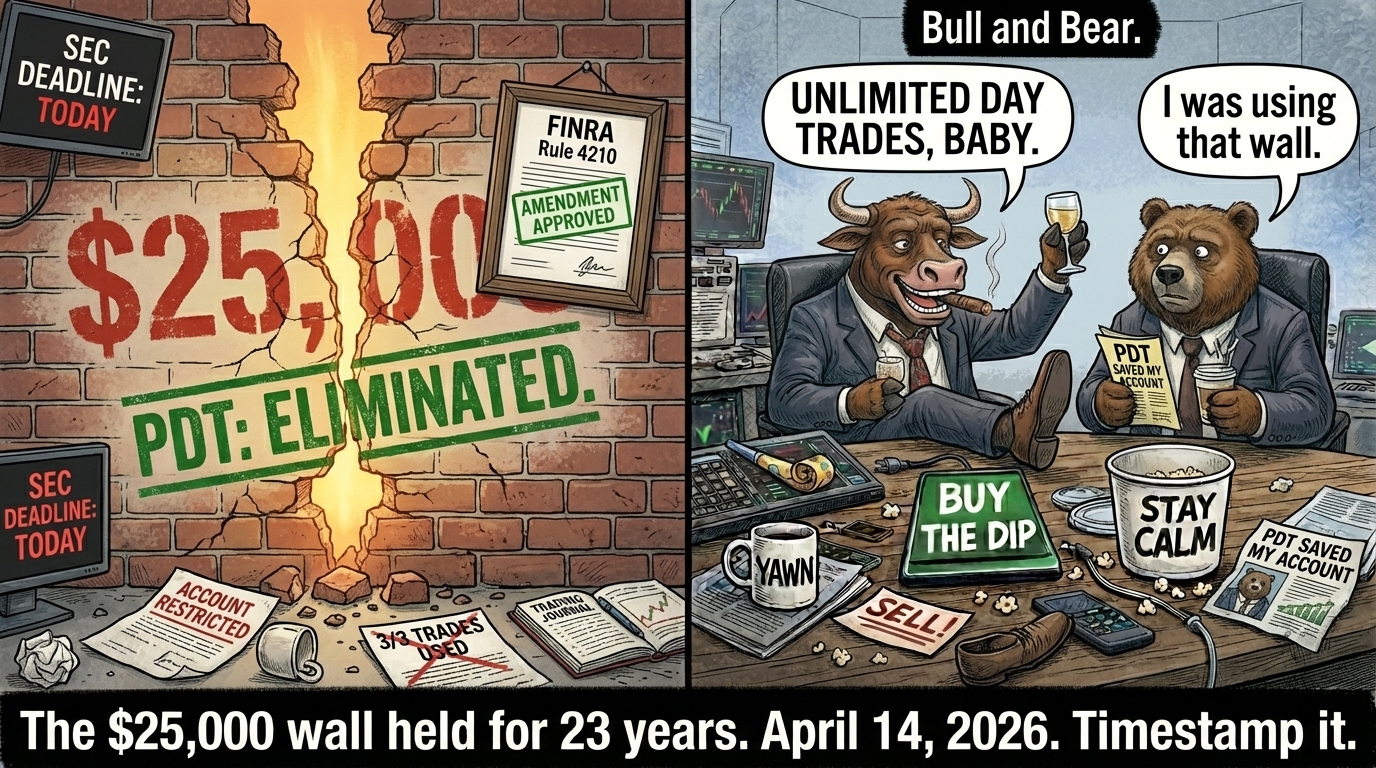
The SEC’s final decision deadline on FINRA’s pattern day trader overhaul lands today. Twenty-five years after regulators built a $25,000 wall around retail day trading, that wall may be rubble by close of business.
Here is everything you need to know.
What the PDT Rule Actually Is
Born in 2001, in the wreckage of the dot-com collapse, the Pattern Day Trader rule had a simple logic: if retail traders are going to blow themselves up in margin accounts, at least make them rich enough to absorb the damage.
Under FINRA Rule 4210, the trigger is precise. Execute four or more day trades (same security, open and close, same session) within any rolling five-business-day window in a margin account, and those trades represent more than 6% of your total trading activity in that period – you are designated a Pattern Day Trader.
Once flagged: maintain $25,000 minimum equity. Always. Fall below it and your broker locks you out of further margin day trades until you top up. No exceptions. No grace period.
The rule affected roughly 1.3 million accounts across the major US brokerages as of January 2025, according to FINRA’s own data – just 2.4% of all margin account holders, but an outsized constraint on the most active retail participants.
The workarounds became an industry of their own: cash accounts (no PDT rule, but T+1 settlement restrictions), offshore brokers (no FINRA protection, significant withdrawal risk), futures markets (CFTC jurisdiction, no PDT), prop firm funded accounts (pay-to-play evaluation), or simply parking $25K in an account you cannot afford to lose.

Get The Complete Premium Popper System – Automation Included
Your entry ticket to consistent SPX income. Inside: the exact setup, rules, and checklists I trade daily – for less than the cost of lunch. Easily actionable.
Get The Premium Popper System – Click Here

The Timeline That Got Us Here
October 2024 – FINRA issues Regulatory Notice 24-13, opening a formal retrospective review of day trading margin requirements. Public comment solicited.
July 24, 2025 – The SEC publishes a petition for rulemaking to change or eliminate the PDT rule entirely. Formal review now on the clock.
September 17-18, 2025 – FINRA’s Board of Governors votes to replace the current PDT framework. First fundamental overhaul of the rule since 2001. The vote approves scrapping the $25,000 minimum and the PDT designation itself, replacing both with a real-time, risk-based intraday margin model.
December 29, 2025 – FINRA formally files the proposed rule change with the SEC. File number: SR-FINRA-2025-017.
January 14, 2026 – Federal Register publishes the filing. Public comment period opens.
February 4, 2026 – Public comment period closes.
April 14, 2026 – Today. The SEC’s extended deadline to approve, disapprove, or initiate further proceedings on the proposal. The SEC has already extended this deadline multiple times. The industry is watching closely.
What Changes Under the New Framework
The proposal does not simply lower the $25,000 threshold. It eliminates the entire PDT structure.
Gone: the pattern day trader designation. Gone: the four-trades-in-five-days trigger. Gone: the day-trading buying power calculation based on prior close-of-day equity. Gone: the $25,000 minimum.
What replaces it is an intraday margin level (IML) system. Under the new framework:
Buying power becomes dynamic. Margin available is calculated in real time based on the actual risk profile of positions held during the session – volatility, concentration, and security type all factor in.
The account minimum drops to $2,000. This matches the standard minimum for any margin account. Brokers retain discretion to set higher internal minimums (Cobra Trading, for instance, has signalled it may hold its own floor above the regulatory minimum).
Leverage structure holds. The 4:1 intraday buying power (Reg-T) that PDT accounts currently access remains in place. The change is not to the leverage ratio but to who can access it.
Unlimited day trades. The current restriction of three round-trip trades per five-day period for non-PDT accounts is eliminated. Traders manage risk through margin requirements rather than trade-count ceilings.
Sweep accounts count. Cash held in bank sweep products or money-market funds can now be included in buying power calculations.
Who Pushed for This and Why
The industry consensus behind this proposal is unusually broad.
Morgan Stanley submitted a comment letter arguing that “the overnight settlement and investor protection concerns that the current rules were designed to mitigate no longer pose the same risks they did over two decades ago,” citing real-time risk monitoring systems and the collapse of self-directed trading commissions as structural changes that made the original rule obsolete.
Charles Schwab described the existing PDT rules as “anachronistic” and “no longer necessary or appropriate.” The firm noted that the line between traditional brokerages and day-trading firms has effectively disappeared – the access that once required a specialist firm is now standard.
Interactive Brokers pushed for firms using real-time margining systems to compute intraday buying power based on live excess margin rather than prior-close data – a framework IBKR already uses internally for its institutional clients.
Robinhood proposed an opt-in framework: investors choose PDT-level access after receiving enhanced disclosures, rather than being designated based on trade counts. The firm argued this aligns with a 2000 Industry Task Force recommendation that investors, properly informed, are best placed to determine how they want to trade.
Retail comment response was overwhelming. Most of the approximately 65 public comments FINRA received in response to its Regulatory Notice called for significant change or outright abolition of the day trading margin requirements.
What It Means for Retail Traders
The immediate effect, if approved today: smaller accounts gain full access to intraday margin day trading that was previously gated behind $25,000.
The subtler effect: buying power is no longer a static number visible at account open. It breathes throughout the session. A trader in a high-volatility name will see tighter intraday margin than one in a large-cap liquid stock. This is more sophisticated risk management – and it demands more sophisticated traders.
The practical implications worth understanding before implementation:
The $2,000 floor is a floor, not a target. Trading with minimum margin in a dynamic IML environment creates a scenario where a single adverse move can trigger an immediate margin call. Brokers will likely build proprietary buffers well above the regulatory minimum.
Intraday margin calls are instant. Unlike the current system where deficits are measured at close-of-day, the new framework monitors in real time. A position that pushes an account into margin deficit triggers an immediate IML-reducing requirement.
Leverage cuts both ways. The 4:1 intraday multiplier available to a small account will amplify gains and losses proportionally. The PDT rule, for all its clumsiness, did prevent inexperienced traders from accessing full margin leverage with minimal capital.
Broker rules will vary. Regulatory minimums define the floor. Individual broker policies define what you actually experience. Expect significant variation across platforms in how aggressively they implement intraday margin monitoring.
The Risk Nobody Is Talking About
Every brokerage announcement, every retail trading forum, and every financial media headline has framed this as unambiguously good news for retail traders. That framing deserves scrutiny.
The PDT rule was a blunt instrument. Raising $25,000 as a barrier to day trading did not distinguish between an experienced trader with a disciplined system and a first-time Robinhood user who watched three YouTube videos and wants to trade NVDA options on margin.
The new framework is more sophisticated but more demanding of the trader to understand it. A fixed $25,000 threshold is simple to track. An intraday margin level that fluctuates with real-time position volatility is not.
The population of retail traders who will enter day-trading margin accounts for the first time after this rule changes is, by definition, the population least equipped to navigate dynamic margin requirements under market stress. The May 2025 volatility spike, the tariff-driven swings of early 2026 – these are the conditions in which dynamic margin systems generate the most punishing outcomes for undercapitalised accounts.
The rule change does not make day trading less risky. It makes it more accessible. Those are not the same thing.
What Happens Today
The SEC faces three options by its April 14 deadline:
Approve the FINRA filing as submitted. Implementation would follow, likely with a broker transition period of weeks to months.
Disapprove the proposal. This would require a formal explanation of why the rule change fails to meet the standards of the Securities Exchange Act.
Institute proceedings for further review. This is the third extension the SEC could take, pushing the timeline into mid-to-late 2026.
Market consensus and industry commentary lean heavily toward approval. The political environment under the current administration favours deregulation. The industry coalition behind the proposal – spanning Morgan Stanley, Schwab, Robinhood, IBKR, Fidelity, and Tastytrade – is formidable. The public comment record supports change. The FINRA filing is technically thorough.
The $25,000 wall has had 25 years. Its replacement is a real-time margin system that demands more of traders, not less. Whether retail participants are ready for that is the question regulators chose not to answer for them.
Meme of the Day
Happy trading,
Phil
Less Brain, More Gain
…and may your trades be smoother than a cashmere codpiece
p.s. There are 3 ways I can help you…
- Option 1: The SPX Income System Book (Just $12)
A complete guide to the system.
Written to be clear, concise, and immediately actionable.
>> Get the Book Here

- Option 2: Full Course + Software Access – 50% off for Regular Readers – Save $998.50
Includes the video walkthroughs, tools for TradeStation & TradingView, and everything I use daily. Plus 7 additional strategies
>> Get DIY Training & Software
- Option 3: Join the Fast Forward Mentorship – 50% off for Regular Readers – Save $3,000
>> Join the Fast Forward Mentorship – trade live, twice a week, with me and the crew. PLUS Monthly on-demand 1-2-1’s
No fluff. Just profits, pulse bars, and patterns that actually work.