The U.S. and Israel Just Launched Joint Strikes on Iran – And Iran Is Firing Back Across the Entire Middle East
 Ahoy there, Trader! ⚓️
It’s Phil…
Well.
I’ve spent weeks banging on about the seasonal crash window.
I’ve been telling anyone who’d listen that we’re sitting in the danger zone for a correction.
And now we’ve got a full-blown shooting war in the Middle East landing right in the middle of it.
The U.S. and Israel launched coordinated strikes across Iran early Saturday morning – not a symbolic slap, not a contained exchange of pleasantries – but what Trump himself called “major combat operations” under the rather Hollywood-sounding Operation Epic Fury.
Explosions in Tehran. Strikes in Isfahan, Qom, Tabriz, Kermanshah. Reports of assassination attempts on senior Iranian leadership including the Supreme Leader’s compound.
And Iran isn’t taking it quietly.
Missiles fired at Israel. Strikes on U.S. military bases across Qatar, UAE, Kuwait, Bahrain, Jordan, and Saudi Arabia. Dubai took a drone hit near a hotel. Qatar scrambled air defences. The UAE reports at least one fatality from intercepted missiles.
This isn’t a headline. This is a regional war unfolding in real time.
And the part that should make every trader sit up and pay attention?
Iran’s Revolutionary Guard Corps has radioed commercial shipping that no vessel is allowed to pass through the Strait of Hormuz.
If that holds, we’re looking at a completely different market on Monday.
Keep scrolling – this is one you need to read through…
When the Seasonal Crash Window Gets Its Catalyst. And 20% of Global Oil Supply Hangs in the Balance.
Keep reading for trade anatomy.
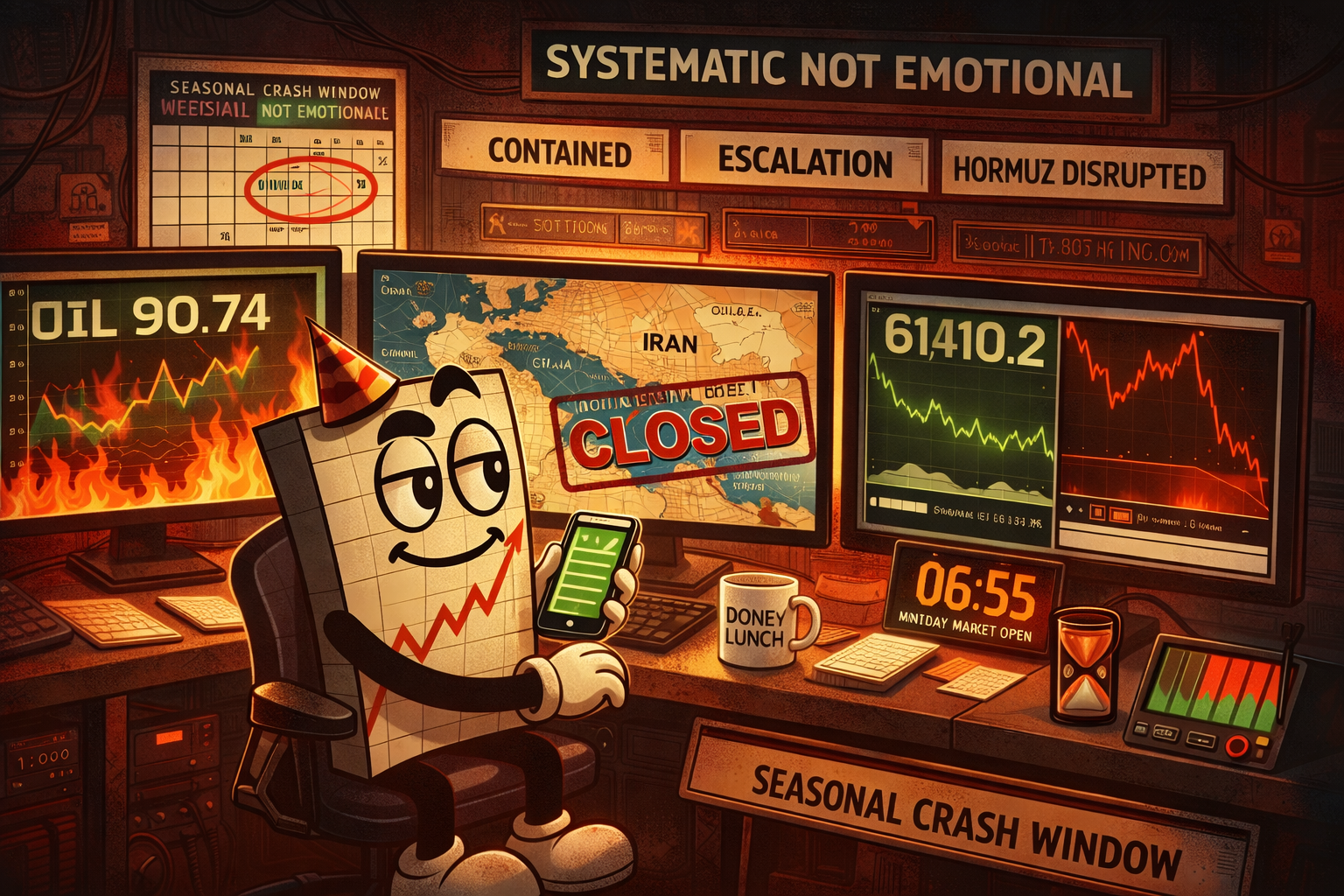
Market Briefing:
The Strait of Hormuz – Why This Changes Everything
Let’s talk about what actually matters to your portfolio.
Forget the politics for a moment. Forget the talking heads. Follow the oil.
The Strait of Hormuz is a narrow waterway between Iran and Oman. At its tightest, the navigable shipping channel spans just two miles in each direction.
Through this corridor flows roughly 20 million barrels of oil per day. That’s approximately 20% of global petroleum liquids consumption and over a quarter of all seaborne oil trade.
[Source: U.S. Energy Information Administration – “Amid regional conflict, the Strait of Hormuz remains critical oil chokepoint”]
Qatar – the world’s third-largest LNG exporter – ships virtually all of its gas through Hormuz. Combined with UAE LNG exports, the Strait carries approximately one-fifth of all globally traded LNG.
And Iran’s IRGC has now radioed merchant ships telling them the Strait is closed.
Whether that holds is the single most important question for markets right now.
The Domino Chain – Oil to Inflation to Yields to Risk Assets
Here’s where the mechanics kick in. And if you’ve been reading my briefings, you know I love mechanics.
JP Morgan and other major investment banks estimate a full Hormuz blockade could push oil beyond $120-130 per barrel – that’s roughly 70% above current levels of around $70.
[Source: Seoul Economic Daily – “Strait of Hormuz Closure Could Spike Oil Prices 70%”]
More extreme estimates from sustained disruption scenarios model prices pushing toward $180-200 per barrel – levels not seen in inflation-adjusted terms since the 1979 Iranian Revolution.
Now connect the dots. This is a mechanical chain reaction, not speculation:
Oil spikes → inflation risk roars back overnight.
Inflation surges → the Fed’s rate cut path gets obliterated. Yields spike.
Yields surge → liquidity tightens across the board.
Liquidity tightens → risk assets get dumped. Hard. Fast. Without mercy.
And what are risk assets? High-multiple tech stocks. Speculative growth names. Small caps. Crypto.
This isn’t emotional guesswork. It’s plumbing. When the liquidity pipes narrow, the first thing that gets flushed is whatever was being held with borrowed money.
What’s Already Happened – Before Markets Even Open
Bitcoin was the canary in the coal mine over the weekend because it’s the only large, liquid asset that trades 24/7.
BTC plunged from around $67,500 to as low as $63,000 – roughly a 6% drop in hours. Over $515 million in crypto liquidations in 24 hours. Nearly $5 billion in institutional selling within 30 minutes across Binance, Bybit, Bitfinex, Kraken, and Coinbase.
[Source: CoinDesk – “Bitcoin drops to $63,000 as U.S. and Israel launch strikes on Iran”]
Ethereum dropped to around $1,835. Altcoins got hammered worse – high-beta meme coins and DeFi tokens shed 8-12%.
Oil-linked perpetual futures on Hyperliquid surged over 5%.
And none of the traditional markets have even opened yet.
Stock futures don’t trade until Sunday evening. Bond markets are closed. Commodity pits are shut.
Monday’s opening bell is where the real repricing begins.
Three Scenarios – And They’re Not Equal
Let’s be systematic about this. There are really only three ways this plays out:
Scenario 1: Contained Shock
Both sides trade strikes, both declare a form of victory, Hormuz stays open (or reopens quickly), and markets digest the shock as a gap-down-and-recover event. Oil adds a temporary risk premium but settles. We’ve seen this playbook before – Iran’s retaliatory strikes in April 2025 followed this pattern.
For traders: Gap down on Monday, elevated VIX, then gradual recovery within the week. Premium selling strategies thrive on that kind of volatility spike and decay. The range reasserts itself.
Scenario 2: Sustained Escalation
The operation drags on – U.S. officials have already said they’re planning for a “multiday operation” and sources told CNN the military is planning for several days of attacks. Iran keeps retaliating across the region. Oil grinds higher. Shipping routes get disrupted. Insurance premiums on tankers rocket. Inflation expectations reprice.
For traders: This is where the market shifts from pricing a “shock” to pricing duration. And duration is where the real damage happens.
Expect widening ranges, failed bounces, and a VIX that stays stubbornly elevated. Mechanical systems that adapt to expanding volatility will outperform anyone trying to catch a falling knife.
Scenario 3: Full Hormuz Disruption
Iran enforces the Strait closure, removes 20 million barrels per day from global supply, and the entire macro picture shifts. Oil gaps toward $120+. Global recession probability jumps above 75% for a sustained closure beyond 30 days.
Central banks are caught between fighting inflation and preventing economic collapse.
For traders: This is a regime change in markets. Not a dip. Not a pullback. A structural repricing of risk across every asset class. Cash becomes king. Defence and energy stocks outperform. Everything else gets sold.
The Seasonal Crash Window – I Told You So (And I Hate Saying That)
I’ve been flagging the seasonal crash window for weeks.
Every major market correction and crash in history has a season. And we’ve been sitting right in the thick of it.
What I couldn’t tell you was the catalyst. Nobody can predict the specific match that lights the fire. But you can absolutely identify when the kindling is dry and stacked high.
The kindling was dry:
Positioning was crowded. Leverage was elevated. Valuations were stretched. The VIX was complacent. And now a regional war has dropped a lit match right into the middle of it.
This is why systematic trading beats prediction every single time.
I didn’t need to predict Iran. I didn’t need to know Trump would launch Operation Epic Fury on a Saturday morning. I needed to know that the market was vulnerable and that my systems would handle whatever catalyst showed up.
Premium sellers profit from volatility expansion. Mechanical setups don’t care about the headline – they care about the price action. And when the VIX spikes, theta decay accelerates and premium gets fat.
What Systematic Traders Do Now
Here’s the thing about chaos.
Everyone else is doom-scrolling, panic-reading, and trying to figure out whether to sell everything at Monday’s open. That’s emotional trading. That’s reactive trading.
That’s not what we do.
We follow the system. We read the range. We wait for the setup.
If you’re running Premium Poppers, Monday’s opening range is likely to be wider than usual. That means fatter premiums and bigger opportunity – but it also means wider strikes and more disciplined position sizing. The system handles this. You don’t need to reinvent anything.
If you’re on Tag ‘n Turn swings, the algorithms will tell you which of the 6 patterns just went active. Bear breakout? Range reversal? The software doesn’t care about geopolitics. It reads price.
If you’re in Lazy Poppers, wait for the opening seesaw to settle. In high-volatility opens, the seesaw takes longer. Patience pays more than panic.
The process doesn’t change because the headline is bigger.
That’s the entire point of having a process.
Rumour Has It…
From the Financial Nuts Newsdesk…
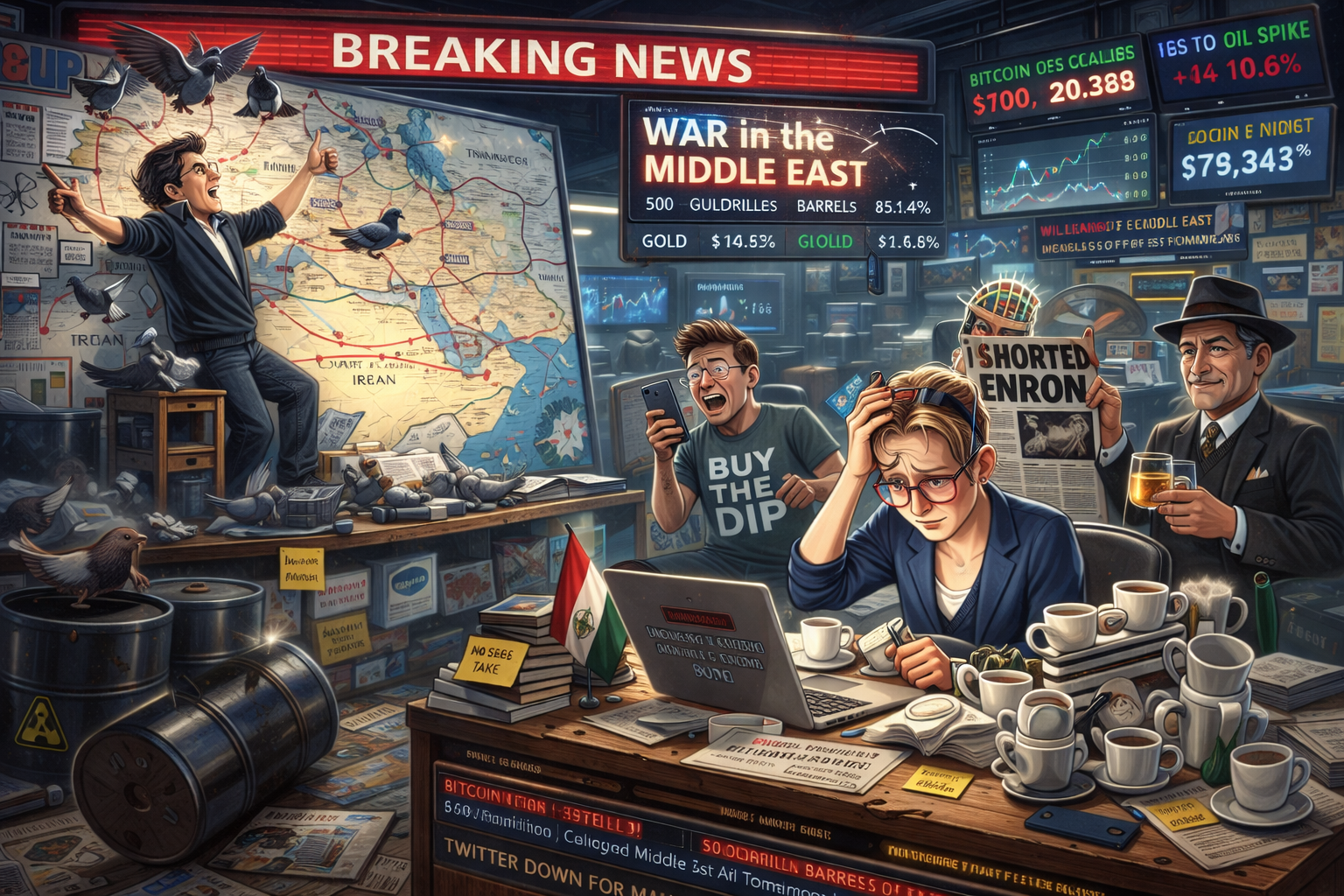
Breaking: Percy was found this morning attempting to redirect his carrier pigeons toward Tehran for “on-the-ground market intelligence.” When questioned about the strategic value of pigeon-based geopolitical analysis, he held up a chart – upside down, naturally – and declared the Strait of Hormuz “looked quite bullish from this angle.”
Hazel, who’d been monitoring oil futures since 3am with a cafetiere the size of a small child, was heard muttering “I tweeted about this two weeks ago and nobody bloody listened.” She then added another shot of espresso and began drafting a risk report that, knowing Hazel, will turn out to be frighteningly accurate by Wednesday.
Wallie stormed in demanding to know why anyone was surprised. “I shorted Enron. I’ve seen real chaos. This is just Tuesday with missiles.” He then spent 40 minutes explaining how paper trading tickets would survive an EMP blast, unlike “that crypto nonsense.”
Kash arrived late wearing a “BUY THE DIP” t-shirt that was already factually incorrect by several thousand dollars. He announced Bitcoin was “just shaking out weak hands” before checking his portfolio, going very quiet, and excusing himself to the toilets.
Mac breezed in with a whisky at 8am, adjusted his fedora, and said: “Darlings, wars end. Cocktail hours don’t. The smart money is in gin futures.”
Cache-AI-Bot processed the entire Financial Nuts debate in 0.003 seconds and concluded: “Beep-Beep. Probability of rational decision-making in this newsroom: 4.2%. Probability of Percy’s pigeons reaching Tehran: 0.0%.
Probability of Hazel being right: 87.6%. Beep.”
Expert Insights:
“Risk is what’s left over when you think you’ve thought of everything.” – Carl Richards
The traders who get hurt in events like this aren’t the ones who were wrong about direction. They’re the ones who had no plan for the unexpected.
Systematic trading isn’t about predicting the future. It’s about building a framework that handles any future. The same mechanical rules that work on a quiet Tuesday work on the Monday after a war breaks out.
The range is the range. The setup is the setup. The process is the process.
Whether the catalyst is an earnings miss, a tariff announcement, or a full-scale military operation in the Middle East – the only thing that changes is the size of the move, not the method for trading it.
Losing money doesn’t make it a losing trade. Abandoning your system because you’re scared? That’s the losing trade.
Fun Fact:
[Source: U.S. Energy Information Administration – “Amid regional conflict, the Strait of Hormuz remains critical oil chokepoint”]
The Bottom Line
This could end quickly. Scenario 1 is still on the table and historically, the most common outcome for Middle East escalations.
But this time the containment thesis is harder to make. Missiles in Dubai, Kuwait, and Bahrain isn’t a bilateral exchange. It’s a regional war touching some of the most economically sensitive territory on the planet.
Be prepared for multiple scenarios, not just the one you’re hoping for.
If you’ve got a system – follow it.
If you don’t – that’s exactly the problem this kind of event exposes.
Monday’s open will separate the systematic from the emotional. The prepared from the panicked.
I know which side I’ll be on.
Done by lunch. As always.
Happy trading,
Phil
Less Brain, More Gain
…and may your trades be smoother than a cashmere codpiece
p.s. There are 3 ways I can help you…
- Option 1: The SPX Income System Book (Just $12)
A complete guide to the system.
Written to be clear, concise, and immediately actionable.
>> Get the Book Here

- Option 2: Full Course + Software Access – 50% off for Regular Readers – Save $998.50
Includes the video walkthroughs, tools for TradeStation & TradingView, and everything I use daily. Plus 7 additional strategies
>> Get DIY Training & Software
- Option 3: Join the Fast Forward Mentorship – 50% off for Regular Readers – Save $3,000
>> Join the Fast Forward Mentorship – trade live, twice a week, with me and the crew. PLUS Monthly on-demand 1-2-1’s
No fluff. Just profits, pulse bars, and patterns that actually work.